Merchant Quarter of Ur (Area AH)
Ur, Iraq · Established c. 2000 BCE
This site requires authorization to access.
To request access, contact
william.goetzmann@yale.edu
The merchant quarter of Ur, designated Area AH by Sir Leonard Woolley during his joint British Museum and University of Pennsylvania expedition (1922–1934), remains the largest contiguous expanse of Old Babylonian domestic architecture ever excavated. Woolley labeled the zone “Abraham’s Housing”—abbreviated AH—because its best-preserved floors dated to the early second millennium BCE, the era traditionally associated with the biblical patriarch. As Woolley and Max Mallowan documented in *Ur Excavations, Volume VII: The Old Babylonian Period* (British Museum Publications, 1976), the quarter encompassed roughly 10,000 square yards and contained more than fifty houses connected by narrow, winding streets to which Woolley assigned characteristically English names: Church Lane, Paternoster Row, Old Street, Store Street, and Broad Street. The most celebrated structure is No. 1 Old Street, identified as the residence of the copper merchant Ea-nasir on the basis of approximately thirty-two cuneiform tablets recovered from within its walls. The house, measuring roughly 110 square meters—substantially larger than the neighborhood average of about 70 square meters—was approached through a narrow alley leading to a lobby and central courtyard. Like all major dwellings in Area AH, it was constructed from sun-dried mudbrick walls on foundations of kiln-fired brick laid as a damp course to resist moisture, with interior surfaces finished in thick mud plaster, sometimes whitewashed. Woolley noted a peculiarity: in addition to a regularly constructed domestic chapel in Room 6, the guest room (Room 5) possessed its own altar and family tomb beneath the floor, suggesting it served as a second shrine. The house was originally larger, with chambers on all four sides of the court, but Ea-nasir had walled off rooms on the southeast side and sold them to the owner of No. VII Church Lane, who appears to have been enlarging his premises at the expense of two neighbors. Roofs throughout the quarter consisted of mud layered over reed matting supported by wooden rafters, sloped inward to drain rainwater toward the central courtyard. In 2015, Elizabeth Stone and Paul Zimansky of Stony Brook University returned to Area AH, opening four new trenches to test Woolley’s records, as reported in “Archaeology Returns to Ur: A New Dialog with Old Houses” (*Near Eastern Archaeology*, vol. 79, no. 4, 2016). They discovered that considerably more Isin-Larsa period material survived beneath Woolley’s documented floors than his reports had suggested, and that six feet of post-excavation fill had accumulated since the 1930s. Today the site of Tell el-Muqayyar lies in the desert of Dhi Qar province, Iraq, and was inscribed as a UNESCO World Heritage Site in 2016 as part of The Ahwar of Southern Iraq. The exposed mudbrick foundations of the merchant quarter continue to face erosion and require ongoing conservation.
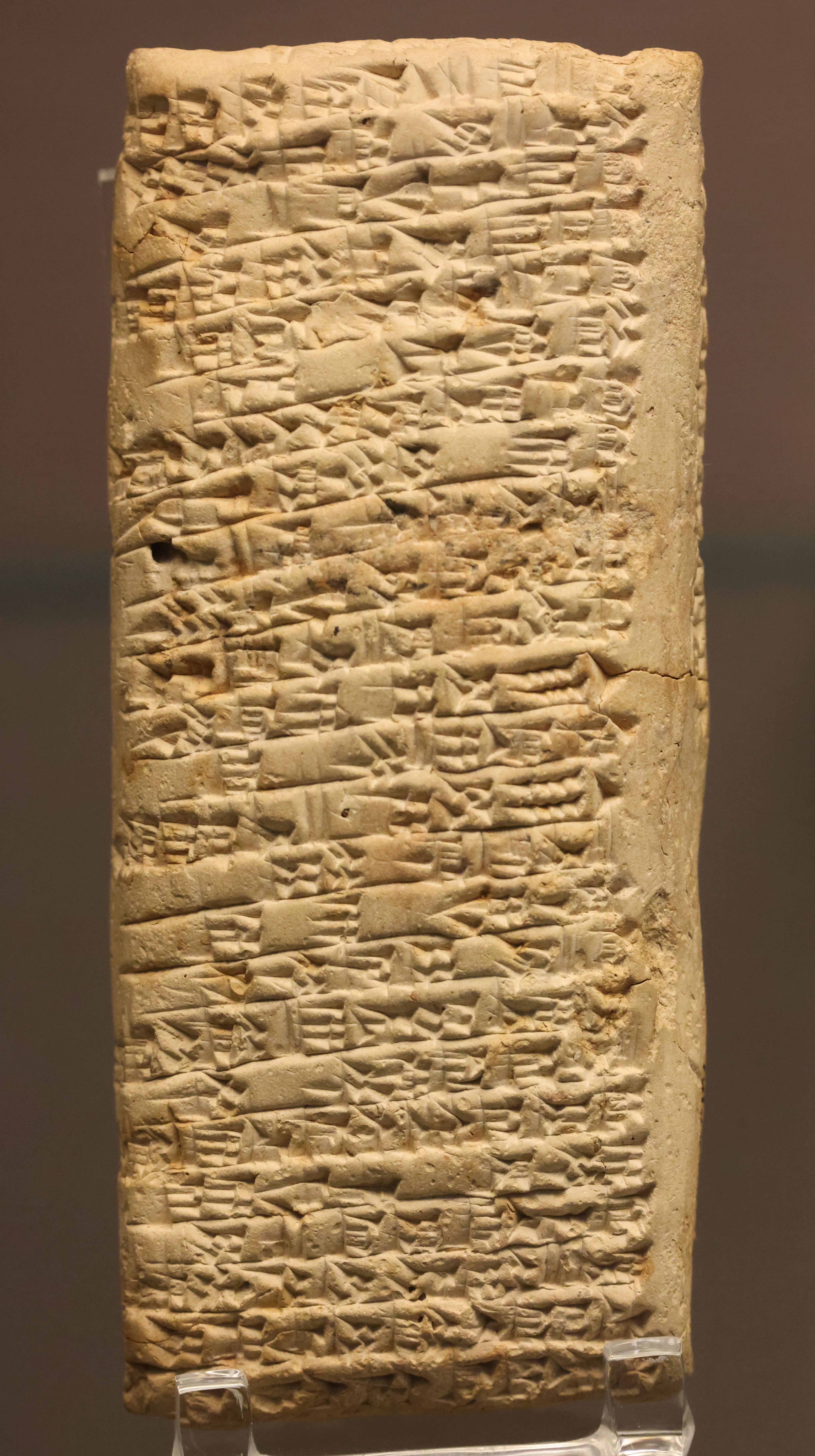
The material culture recovered from Ur’s merchant quarter reflects the intersection of commercial life and domestic ritual in an Old Babylonian urban setting. Among the most significant artifacts are the cuneiform tablets themselves, which constitute a distinctive form of documentary art: each clay tablet was inscribed in Akkadian cuneiform using a reed stylus, and the archive from No. 1 Old Street—published by H.H. Figulla and W.J. Martin in *Ur Excavations Texts, Volume V: Letters and Documents of the Old-Babylonian Period* (British Museum, 1953)—preserves the handwriting, formulae, and personal seals of Ur’s merchant community. The most celebrated single object is the complaint tablet to Ea-nasir (UET V 81, British Museum no. 1953,0411.71), a rectangular clay tablet measuring 11.6 centimeters in height, 5 centimeters in width, and 2.6 centimeters in thickness, in which a dissatisfied customer named Nanni protests the delivery of substandard copper ingots. A. Leo Oppenheim published the standard English translation in *Letters from Mesopotamia: Official, Business, and Private Letters on Clay Tablets from Two Millennia* (University of Chicago Press, 1967), rendering Nanni’s rebuke: “You said to me: I will give Gimil-Sin fine quality copper ingots. You left then but you did not do what you promised me.” Recognized by Guinness World Records as the oldest known written customer complaint, the tablet has since 2015 become a widely circulated internet meme, a phenomenon analyzed in “The Legend of Ea-Nasir: How a Babylonian Businessman Became an Internet Meme” (*Journal of Contemporary Archaeology*, 2024). Cylinder seals were essential instruments of commercial authentication throughout the quarter. The 2015 Stone and Zimansky excavations recovered a cylinder seal (Lot 366) from Trench 1 within Area AH, and from No. 1 Baker’s Square they identified two residents—Gimil-Ningizzida and his wife Ningal-lamazi—through their personal cylinder seals found in situ. Balance pan weights recovered from Trench 2 on Niche Lane further corroborated the mercantile character of the neighborhood. Artifacts from Woolley’s campaigns are divided principally between the British Museum in London and the University of Pennsylvania Museum of Archaeology and Anthropology in Philadelphia, with a portion repatriated to the Iraq Museum in Baghdad. The Ur-Online digital resource, a joint project of the British Museum and the Penn Museum supported by the Leon Levy Foundation, has digitized and indexed the excavation records, photographs, and artifacts, enabling researchers worldwide to consult the material from Area AH.
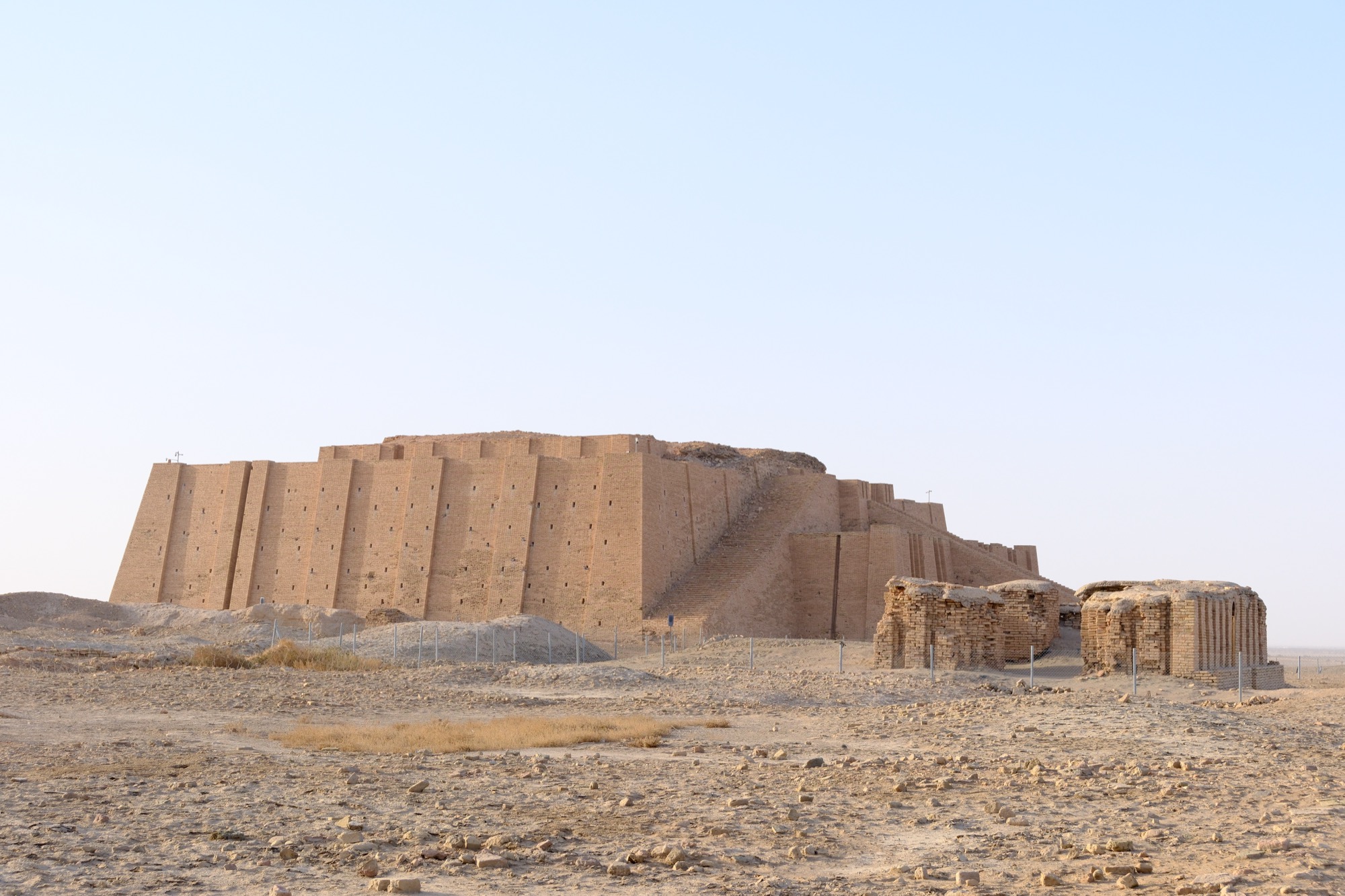
In antiquity, Ur stood near the mouth of the Euphrates River on the shore of the Persian Gulf, whose waters extended considerably further inland than they do today—millennia of riverine sedimentation have pushed the coastline roughly 200 kilometers to the southeast, leaving the ruins of Tell el-Muqayyar stranded in arid desert. As Harriet Crawford observed in *Ur: The City of the Moon God* (Bloomsbury, 2015), this geographic position at the head of the Gulf gave the city control over one of the ancient world’s most important maritime trade routes, channeling metals, timber, precious stones, and exotic goods from the Indian Ocean littoral into the Mesopotamian heartland. The city was enclosed by an oval wall roughly eight meters high, with harbors on its northern and western flanks connected to the Euphrates by canals that allowed seagoing vessels direct access both to the Gulf and to inland cities such as Uruk. The sacred precinct, or temenos, dominated the northwestern sector of the city. Within its great enclosure wall stood the Ziggurat of Nanna—the moon god Sin—a massive stepped tower approximately 30 meters tall on a base of 65 by 45 meters, originally constructed by Ur-Nammu (c. 2112–2095 BCE) and demonstrating a sophisticated use of architectural entasis in its curved, tapering walls. Surrounding the ziggurat were the Giparu temple, the Ehursag royal palace, administrative buildings, and storage magazines that together formed the institutional core of the city. Area AH, the merchant quarter excavated by Woolley, lay in the southeastern portion of the city, separated from the temenos by residential neighborhoods. As Marc Van De Mieroop analyzed in *Society and Enterprise in Old Babylonian Ur* (Dietrich Reimer Verlag, 1992), private archives recovered from houses across the city’s different quarters reveal that merchants, scribes, priests, and laborers lived in close proximity, with rich and poor dwellings side by side rather than segregated into distinct economic zones. Ur’s maritime trade network extended to three principal regions documented in cuneiform sources: Dilmun (centered on modern Bahrain), which served as the primary entrepot for copper and transit trade; Magan (the coast of Oman), a source of copper and diorite stone; and Meluhha (widely identified with the Indus Valley civilization), from which carnelian, lapis lazuli, ivory, and exotic timbers were imported. A number of Indus Valley–style seals found at Ur attest to these long-distance connections. The discovery of an ancient Sumerian harbor at Abu Tbeirah, a satellite settlement approximately fifteen kilometers from Ur, has further illuminated the canal and waterway infrastructure that supported maritime commerce.
The merchant quarter of Ur documents a critical period in Mesopotamian economic history: the transition from the centralized bureaucratic state of the Third Dynasty of Ur (Ur III, c. 2112–2004 BCE) to the more commercially dynamic Isin-Larsa period (c. 2004–1763 BCE) that followed its collapse. During the Ur III period, as Steven Garfinkle demonstrated in *Entrepreneurs and Enterprise in Early Mesopotamia* (CUSAS 22, 2012), individual merchants such as SI.A-a, Turam-ili, and Ur-Nuska maintained significant entrepreneurial activity in money-lending and exchange even within the framework of a powerful institutional economy. The Ur III state fell around 2004 BCE when the last king, Ibbi-Sin, proved unable to resist the combined pressures of Amorite incursions and an Elamite invasion from the east. In the Isin-Larsa period that followed, Ur came under the control of the dynasty of Larsa, and it was during the reign of Rim-Sin I of Larsa (c. 1822–1763 BCE) that the merchant community documented in Area AH flourished. The copper trader Ea-nasir, an *alik Tilmun*—a designation meaning “one who goes to Dilmun”—was active between at least the 11th and 19th regnal years of Rim-Sin I. As W.F. Leemans established in *Foreign Trade in the Old Babylonian Period as Revealed by Texts from Southern Mesopotamia* (E.J. Brill, 1960), Ea-nasir was a prominent wholesale merchant who purchased copper in Dilmun and shipped it by waterway to Ur for resale. Twenty-six of the approximately thirty-two tablets found in his house relate to his copper business, including multiple complaint letters from dissatisfied customers—a pattern that, as Garfinkle has observed, suggests these written protests functioned as negotiating tools in an ongoing commercial relationship rather than as exceptional expressions of grievance. Ea-nasir operated within a company structure involving upwards of fifty investors at a time, who pooled capital in silver, sesame oil, and other commodities to finance overseas purchasing ventures—the Akkadian term *ummianum* describes these investor partnerships, representing an early form of joint-stock arrangement. Ur’s prominence as a trading center declined in the centuries after Hammurabi of Babylon conquered Larsa in 1763 BCE. As Crawford noted in *Ur: The City of the Moon God*, the progressive retreat of the Persian Gulf shoreline—driven by silt deposits from the Tigris and Euphrates—gradually deprived the city of its maritime advantage, while Gulf trade with the Indus Valley had already collapsed after approximately 1900 BCE with the decline of the Harappan civilization. Woolley’s twelve seasons of excavation (1922–1934) brought Ur to international prominence and yielded one of the largest cuneiform archives ever recovered from a single site, fundamentally shaping modern understanding of ancient Mesopotamian commerce and daily life.
The principal commodity traded through Ur’s merchant quarter was copper, imported from the island entrepot of Dilmun (modern Bahrain) and ultimately sourced from the mines of Magan (Oman). As W.F. Leemans documented in *Foreign Trade in the Old Babylonian Period* (1960), Ea-nasir and his fellow *alik Tilmun* merchants undertook the roughly 960-kilometer voyage down the Persian Gulf to Dilmun, where they purchased copper ingots for resale in Ur. The tablets from No. 1 Old Street reveal the mechanics of this trade in remarkable detail: individual merchants banded together to finance overseas purchasing expeditions, each contributing capital in the form of silver, sesame oil, textiles, or barley. The copper was then transported by waterway back to Ur, where it was resold to palace agents and private traders for use in bronze production—an alloy critical for weaponry and tools during King Rim-Sin I’s military campaigns. The complaint tablet from Nanni (UET V 81) documents the commercial disputes that arose over copper grading: Nanni protests that Ea-nasir delivered ingots of inferior quality rather than the “fine quality” copper he had been promised, and that his messenger Sit-Sin was treated contemptuously when he attempted to select acceptable pieces from the stockpile. Silver functioned as the primary medium of exchange, weighed in shekels of approximately 8.3 grams, with the mina (60 shekels, roughly 500 grams) and the talent (60 minas) serving as larger denominations. Barley served as a secondary standard of value, with a customary exchange rate of one gur of barley to one shekel of silver. As A. Leo Oppenheim discussed in *Ancient Mesopotamia: Portrait of a Dead Civilization* (University of Chicago Press, 1964; revised 1977), these commodity moneys circulated alongside sophisticated credit instruments: loan documents from Ur specify interest rates fixed by convention at 20 percent per annum for silver and 33⅓ percent for barley, and merchants routinely extended trade credit, recorded debts on clay tablets, and used written orders that functioned as transferable claims on goods or silver. William Goetzmann demonstrated in *Money Changes Everything: How Finance Made Civilization Possible* (Princeton University Press, 2016) that a tablet from 1796 BCE in Ur records a five-year loan at 3.78 percent annual interest—evidence of a market capable of pricing risk over extended time horizons. Beyond copper, the cuneiform record attests to trade in textiles, wool, barley, dates, sesame oil, precious stones, and exotic timbers. The *ummianum* partnership structure—in which multiple investors pooled resources, shared risks, and divided proceeds—represents one of the earliest documented forms of commercial joint venture, anticipating by millennia the partnership arrangements of medieval Italian and Hanseatic merchants.