Tel Aviv Stock Exchange
Tel Aviv, Israel · Established 1953
This site requires authorization to access.
To request access, contact
william.goetzmann@yale.edu
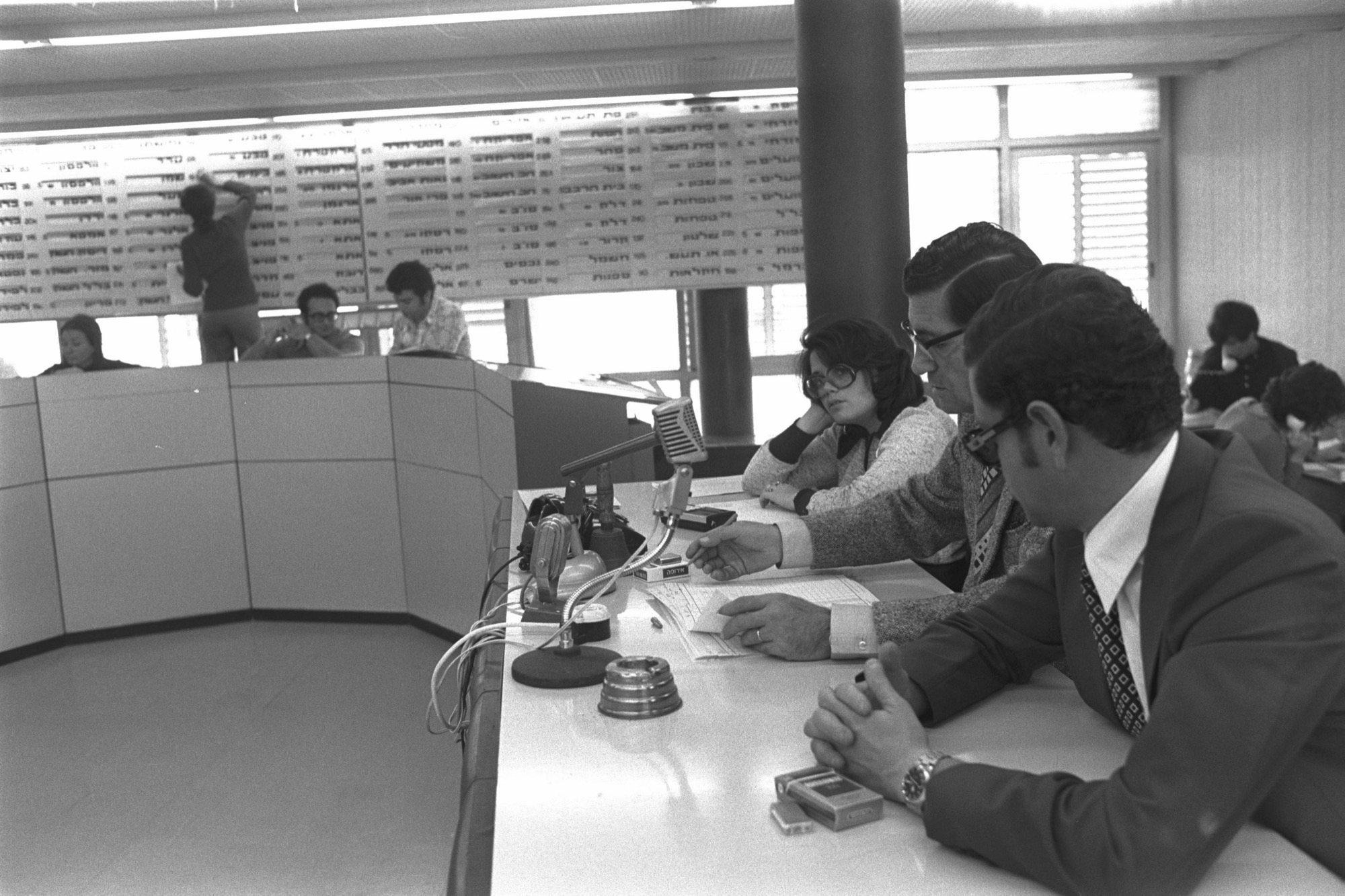
The Tel Aviv Stock Exchange has occupied several successive premises reflecting the evolution of Israel’s capital markets from informal beginnings to institutional modernity. Securities trading in Mandatory Palestine commenced in 1935 in the offices of banker Mordechai Pinchas Hasson at the Anglo-Palestine Bank (later Bank Leumi), where the “Exchange Bureau for Securities” (Lishkat Sacher Arvot) operated for just one hour daily in a single room. When the exchange was formally incorporated in September 1953, trading continued in similarly modest quarters. In 1960 the TASE moved to its own premises in the “Passage” at 113 Allenby Street, a pedestrian commercial arcade in Tel Aviv’s central business district. In February 1983 the exchange relocated to a purpose-built facility at 54 Ahad Ha’am Street, a Brutalist-inflected office block that served as its home for three decades and became an iconic address in the city’s financial geography. On 24 July 2014, TASE inaugurated its current headquarters on the corner of Montefiore Street and Ahuzat Bayit Street, designed by the prominent Israeli architect Eri Goshen. The fourteen-story structure, rising sixty meters and encompassing 22,600 square meters of floor space, stands adjacent to the landmark Shalom Meir Tower (1965)—Israel’s first skyscraper, designed by Yitzhak Pearlstein, Gideon Ziv, and Meir Levy—and near the cluster of bank towers that define the financial district. As described in The Plan architecture review, the building is characterized by a double-skin facade combining a glazed curtain wall with an external system of printed glass louvers that filter solar radiation while admitting natural light and preserving occupants’ visual connection to the Mediterranean landscape. The first six stories incorporate a blast-resistant envelope using innovative energy-absorption frames, a concession to Israel’s security environment that does not compromise the transparent, corporate-modernist aesthetic. The Alum Eshet engineering firm, which fabricated the facade system, has documented how the stepping surfaces between the inner and outer skins create maintenance walkways integrated into the building’s visual rhythm. Haaretz architecture critic Esther Zandberg noted that the new TASE building, with its “appropriate design and location,” ranks among the best commercial structures erected in Israel in recent years.
The decorative program of the Tel Aviv Stock Exchange’s successive buildings has been restrained, consistent with the functionalist and International Style traditions that have dominated Israeli commercial architecture since the Mandate era. The earlier premises on Ahad Ha’am Street presented a severe Brutalist facade with minimal ornamentation. The current headquarters, however, introduced Israel’s first “digital gallery” within a financial institution: as reported by Israel21c, the TASE displays thirty works of video art on a monumental media wall in its lobby and public areas, rotating the installations hourly during trading days for the benefit of visitors and market participants. This initiative reflects a broader trend in Israeli cultural policy of integrating contemporary art into commercial and civic spaces. The surrounding financial district features public sculpture and architectural art characteristic of Tel Aviv’s modernist urbanism. Nearby Rothschild Boulevard, the city’s principal promenade through the “White City,” is punctuated with sculptures and site-specific installations that address themes of civic identity, commerce, and Mediterranean life. The First International Bank Tower, designed by Pei Cobb Freed & Partners and located opposite the exchange, contributes a glass-clad profile to the skyline while enriching its immediate surroundings with a landscaped public plaza. While the TASE buildings themselves lack the elaborate decorative programs found in older European bourses, the digital art initiative and the district’s sculptural landscape connect the exchange to Israel’s vibrant tradition of public art, catalogued comprehensively by the Israel Public Art project.
Tel Aviv was founded on 11 April 1909 when sixty-six Jewish families gathered on sand dunes north of the ancient port of Jaffa to allocate building lots for a new neighborhood they named Ahuzat Bayit (“House Estate”), later renamed Tel Aviv. The city’s rapid growth was shaped decisively by the 1925 master plan of the Scottish planner Sir Patrick Geddes, who envisioned a garden city of wide boulevards, residential “home-blocks” with interior courtyards, and east-west streets channeling Mediterranean breezes into the urban fabric—principles analyzed by Volker Welter in “The Machine in the Garden City: Patrick Geddes’ Plan for Tel Aviv” (Planning Perspectives, 1995). The waves of immigration from Central Europe in the 1930s brought architects trained in the Bauhaus and related modernist schools—among them Arieh Sharon, Dov Karmi, and Ze’ev Rechter—who collectively erected some 4,000 buildings in the International Style, adapting European functionalism to Mediterranean conditions with recessed balconies, pilotis, horizontal ribbon windows, and white-rendered facades. In 2003, UNESCO inscribed this ensemble as the “White City of Tel Aviv” World Heritage Site, recognizing it as “an outstanding example of new town planning and architecture in the early 20th century, adapted to the cultural and climatic conditions of the place.” The TASE’s current headquarters sits at the nexus of this heritage. Rothschild Boulevard, the city’s grandest tree-lined promenade and the epicenter of the White City, runs parallel to the exchange’s block. Independence Hall—the former residence of Mayor Meir Dizengoff where David Ben-Gurion declared the establishment of the State of Israel on 14 May 1948—stands on the boulevard barely 300 meters from the exchange. The financial district clusters around the Shalom Meir Tower and extends south toward Neve Tzedek, the oldest Jewish neighborhood outside Jaffa’s walls (founded 1887). The ancient port of Jaffa—an old Canaanite city mentioned in Egyptian records of the fifteenth century BCE, used by Kings David and Solomon for landing Lebanese timber, and a hub of the Ottoman citrus trade—lies just three kilometers to the south. This spatial continuity between Jaffa’s millennia-old trading heritage and Tel Aviv’s modern financial sector embodies the layered commercial geography that the city’s planners and historians, including Maoz Azaryahu in “Tel Aviv: Mythography of a City” (Syracuse University Press, 2007), have traced from antiquity to the present.
Securities trading in the territory of British Mandate Palestine began informally in the early 1930s and was institutionalized in 1935 with the establishment of the Exchange Bureau for Securities at the Anglo-Palestine Bank in Tel Aviv, under the direction of the banker Mordechai Pinchas Hasson. As Nachum Gross documented in “The Economic Policy of the Mandatory Government in Palestine” (Research in Economic History, 1984), and as Jacob Metzer elaborated in “The Divided Economy of Mandatory Palestine” (Cambridge University Press, 1998), the Jewish community in Palestine developed a surprisingly sophisticated financial infrastructure during the interwar period, including cooperative credit institutions, the Anglo-Palestine Bank’s investment subsidiary, and rudimentary securities markets. After the establishment of the State of Israel in 1948, informal trading continued until the Tel Aviv Stock Exchange was formally incorporated on 16 September 1953 as a private company owned by banks and brokerage firms. In 1968, the Knesset passed the Securities Law, establishing the Israel Securities Authority (ISA) as the exchange’s regulatory supervisor. The most traumatic episode in the TASE’s history was the bank stock crisis of October 1983. For several years Israel’s major commercial banks—Bank Leumi, Bank Hapoalim, Israel Discount Bank, Mizrahi Bank, and the General Bank (Clali)—had systematically purchased their own shares to support prices, creating an illusion of riskless appreciation and fueling a 300 percent rise in real terms. On 6 October 1983, dubbed “Black Thursday,” the banks announced they could no longer absorb selling pressure without government assistance, and the TASE was closed for eighteen days while a rescue plan was devised. As Asher Blass and Richard Grossman demonstrated in “Assessing Damages: The 1983 Israeli Bank Shares Crisis” (Contemporary Economic Policy, 2001), the government nationalized the banks at a cost of approximately $6.9 billion—roughly a quarter of Israel’s GDP—and shareholders lost some 35 percent of their investments. The Bejsky Commission, appointed in January 1985 under Justice Moshe Bejski, concluded in its April 1986 report that the banks had engaged in systematic price manipulation and that regulators had acted “negligently and irresponsibly.” Bank executives were convicted of criminal charges. The crisis’s long shadow shaped subsequent reform. As Assaf Razin analyzed in “Israel and the World Economy: The Power of Globalization” (MIT Press, 2018), the 1985 Economic Stabilization Plan—which halted hyperinflation—and the gradual reprivatization of the banks through the 1990s laid the groundwork for capital market liberalization. The decisive structural reform came with the Bachar Commission (2004–2005), headed by Ministry of Finance Director General Joseph Bachar, whose recommendations—enacted into law in 2005—required the three largest banks to divest their provident fund, mutual fund, and asset management operations, fundamentally separating banking from capital markets. A Bank for International Settlements report (BIS Papers No. 28) documented how the Bachar reforms stimulated nonbank credit supply, doubled the volume of corporate bond issuance, and enhanced market competition. In 2017 the Knesset passed legislation enabling TASE’s demutualization, transforming it from a members’ cooperative into a for-profit company, and on 1 August 2019 the exchange listed its own shares on its own platform—a symbolic milestone in Israel’s capital market maturation.
The Tel Aviv Stock Exchange lists equities, government and corporate bonds, Treasury bills (Makam), exchange-traded funds, and derivatives. The flagship equity benchmark is the TA-35 Index, launched on 2 January 1992 as the “MAOF Index” with a base value of 100, later renamed the TA-25, and expanded to thirty-five constituents in February 2017. The index tracks the largest companies on the exchange by market capitalization, with a heavy weighting toward technology, banking, real estate, and energy. In early 2026, TASE introduced the TA-Technology 35 Index, exclusively comprising the thirty-five largest technology companies—including dual-listed firms such as Elbit Systems—with a combined market capitalization exceeding NIS 424 billion, in a structure analogous to the NASDAQ-100. The government bond market constitutes a major segment of TASE activity. As documented by the Ministry of Finance’s Government Debt Management Unit, Israel issues fixed-rate bonds across a curve spanning 3, 5, 10, 20, and 30 years, along with CPI-indexed bonds (Galil series) and short-term Makam bills (maturities of six to nine months) issued by the Bank of Israel. As of 2021, 204 series of government bonds were listed, with total bond market capitalization reaching approximately $196 billion. The corporate bond market expanded dramatically after the Bachar reforms, as institutional investors—newly independent provident and mutual funds—diversified into nonbank credit instruments. Israel’s distinctive position as the “Startup Nation,” a term popularized by Dan Senor and Saul Singer in their 2009 book of that title, is reflected in the TASE’s evolving listings profile. The 2000 dual-listing amendment (Amendment No. 21 to the Securities Law) enabled companies listed on NASDAQ, the NYSE, or the London Stock Exchange to list simultaneously on TASE with minimal additional regulatory burden. As of 2025, approximately 85 Israeli companies traded on US exchanges, with an aggregated market capitalization exceeding 75 percent of Israeli GDP. The dual-listing framework channels global capital into Israel’s technology, cybersecurity, pharmaceutical, and cleantech sectors while giving Israeli retail investors domestic access to the country’s most successful firms. Israel’s venture capital ecosystem—among the most active per capita globally—feeds a pipeline of IPOs that increasingly choose TASE or dual-listing pathways, reinforcing the exchange’s role as the financial infrastructure of one of the world’s most innovation-intensive economies.
Images will be added as the project develops. Photographs by Larry Ng and from research sources.