Tehran Stock Exchange
Tehran, Iran · Established 1967
This site requires authorization to access.
To request access, contact
william.goetzmann@yale.edu
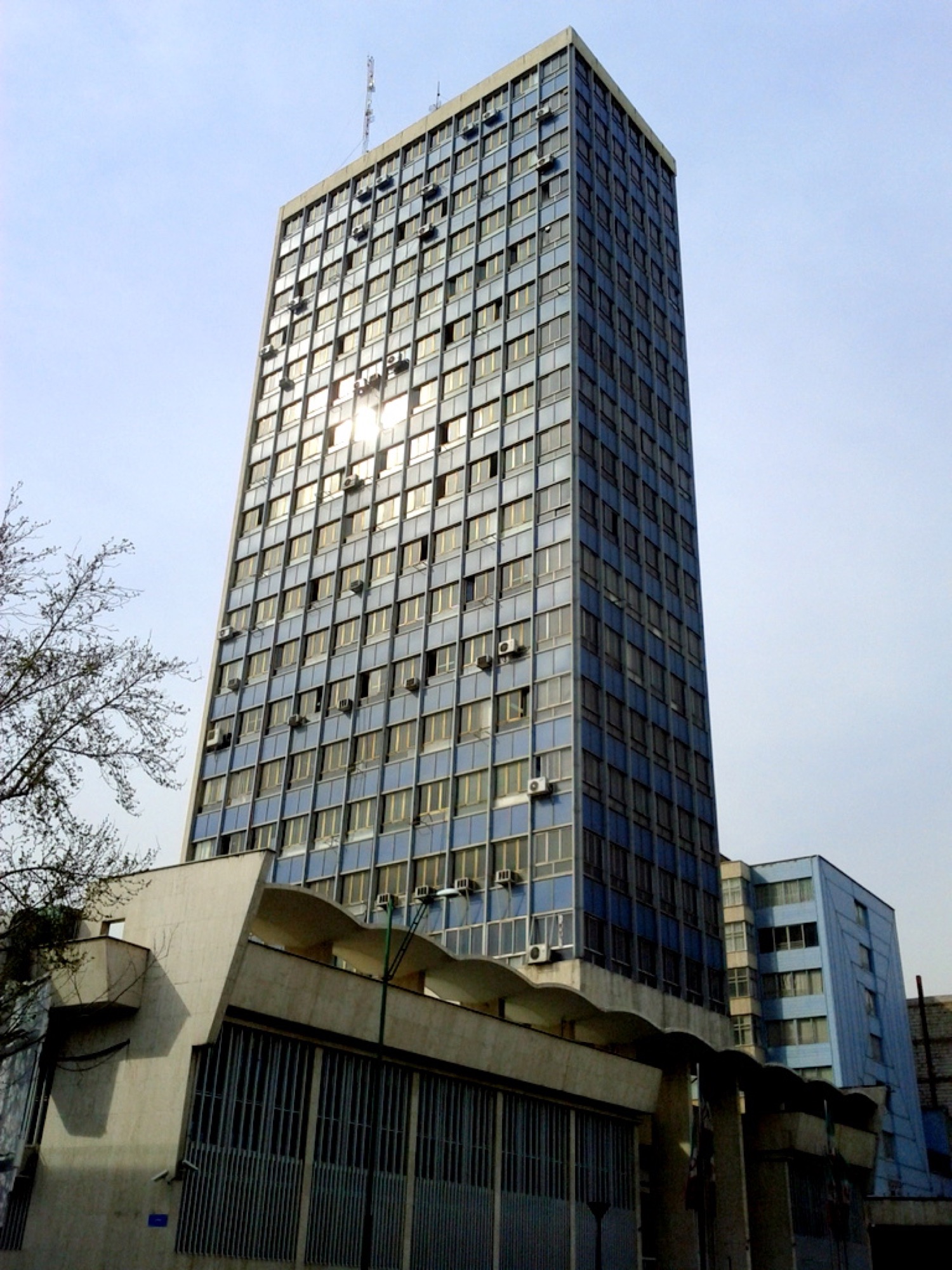
The Tehran Stock Exchange has been housed in two principal structures over its six-decade history. The original headquarters, designed by the prominent Iranian modernist architect Abdol-Aziz Farmanfarmaian and completed in the early 1960s, stood on Hafez Avenue (Khiaban-e Hafez) in downtown Tehran’s District 11. Farmanfarmaian, a scion of the Qajar dynasty who trained at the École des Beaux-Arts in Paris, created an elegant modernist building whose geometric clarity and restrained ornamentation reflected the Pahlavi state’s ambitions to project Iran as a modernizing nation. The building’s main trading hall—known colloquially as the Talar-e Shisheh, or Glass Hall, for its expansive glazed walls that flooded the trading floor with natural light—became the iconic space of Iranian securities trading for half a century. As the exchange grew from a handful of listed companies to hundreds, and as electronic trading gradually replaced open-outcry methods, the Hafez Avenue building proved increasingly inadequate. In 2012, the TSE’s Physical Development Research Center organized a major international architectural competition for a new headquarters, inviting twenty-nine firms from around the world. The first prize was awarded to Chilean architect Alejandro Aravena (later the 2016 Pritzker Prize laureate) in collaboration with the Iranian firm VAV Studio. As David Basulto reported in ArchDaily (2012), Aravena’s design was praised for its conceptual clarity, seismic resilience, and sensitivity to Tehran’s mountainous landscape. Other notable entries included proposals by Hans Hollein & Partner and by LAVA Architects, whose scheme envisioned the exchange as an “urban rock” with ovoid openings inspired by Iran’s wind-carved sandstone gorges and cave dwellings. In late 2019, the TSE relocated to its new premises in the Sa’adatabad district of northwestern Tehran, leaving behind the historic Hafez Avenue site that had witnessed the entire arc of Iran’s modern capital-market development.
The decorative programs of the Tehran Stock Exchange’s buildings reflect the broader tension in modern Iranian institutional architecture between international modernism and indigenous artistic traditions. Farmanfarmaian’s original 1960s headquarters on Hafez Avenue employed the restrained palette characteristic of his oeuvre—clean lines, exposed concrete, and large glass surfaces—though it incorporated subtle references to Persian geometric patterning in its fenestration and spatial organization. The Glass Hall’s luminous interior, framed by its signature glazed walls, served as both functional workspace and symbolic statement about transparency in financial markets. The 2012 design competition explicitly called upon entrants to engage with Iran’s rich artistic heritage. LAVA Architects’ proposal drew upon muqarnas—the honeycomb vaulting technique that has been a hallmark of Persian and Islamic architecture since the Seljuk period—reimagining these traditional forms as “modern muqarnas” in the interior of the exchange hall, combined with an interactive data dome and high-technology display screens. Their façade design referenced the tessellation and light-prism effects characteristic of traditional Persian architecture, creating what the architects described as a media wall broadcasting real-time market data through an “intelligent skin.” These proposals illustrate how contemporary Iranian institutional design increasingly seeks to integrate elements of both pre-Islamic and Islamic artistic traditions—geometric tilework, calligraphic ornament, and light-modulating screens—into buildings that serve thoroughly modern financial functions.
Tehran sprawls across a sloping plain at the foot of the Alborz mountain range, whose snow-capped peaks, including Mount Damavand at 5,610 meters, form a dramatic northern backdrop to the capital. As Asef Bayat documented in “Tehran: Paradox City” (New Left Review, 2010), the city grew from a walled settlement of roughly 19 square kilometers and 230,000 inhabitants in 1900 to a sprawling metropolis of over 13 million people—about one-sixth of Iran’s total population. When Agha Mohammad Khan of the Qajar dynasty chose Tehran as his capital in 1786, it was a minor town overshadowed by the grandeur of Isfahan, the former Safavid capital. The city’s subsequent transformation into Iran’s political and economic center was driven by successive waves of modernization under the Qajar and Pahlavi dynasties. At the heart of old Tehran lies the Grand Bazaar (Bazar-e Bozorg), a vast covered market extending over three square kilometers with more than ten kilometers of corridors, making it one of the largest bazaars in the world. During the reign of Naser al-Din Shah Qajar (1848–1896), the bazaar underwent major expansion and became a primary hub for trade connecting merchants across Iran and beyond. The bazaaris—the merchant class of the bazaar—have historically wielded enormous economic and political influence, controlling significant portions of non-oil foreign trade and providing crucial financial backing to both the Constitutional Revolution of 1905–1911 and the Islamic Revolution of 1979. The relationship between this ancient bazaar economy, with its informal credit networks (hawala) and risk-sharing partnerships, and the modern securities exchange located just a few kilometers north is one of the most distinctive features of Tehran’s financial landscape. The TSE’s relocation from Hafez Avenue—near the old commercial center—to Sa’adatabad in the affluent northwest reflects the broader northward drift of Tehran’s economic gravity over the past half-century.
Iran’s commercial heritage stretches back millennia. The Achaemenid Empire (550–330 BCE) established the Royal Road connecting Sardis to Susa, a sophisticated infrastructure for long-distance trade that later fed into the Silk Road networks traversing the Iranian plateau. Persian bazaars evolved over centuries into complex institutions combining wholesale distribution, credit provision, and risk-sharing partnerships—functions that, as scholars such as Arang Keshavarzian argued in “Bazaar and State in Iran” (Cambridge University Press, 2007), constituted an indigenous form of financial intermediation. The modern capital market emerged from Shah Mohammad Reza Pahlavi’s White Revolution, the sweeping modernization program launched in 1963. In 1966, an initial study by Bank Melli—building on a 1936 proposal developed with Belgian advisors that had been shelved due to World War II—led to the ratification of the Stock Exchange Act in 1967 and the formal opening of the Tehran Stock Exchange on February 4, 1967. Initially, only government bonds and a handful of corporate shares traded on the floor. Iran’s economic boom of the 1970s, fueled by rising oil revenues, drove rapid expansion: by 1978, the TSE listed 105 companies with a combined market capitalization of approximately $12 billion. The Islamic Revolution of February 1979 convulsed the exchange. The Revolutionary Council nationalized banks, insurance companies, and major industries, seizing assets of fifty-one prominent industrialists and their families. As Djavad Salehi-Isfahani has documented in numerous studies of Iran’s post-revolutionary economy, the new regime’s interpretation of Islamic principles—particularly the prohibition of riba (interest)—necessitated a fundamental restructuring of the financial system. Article 44 of the new constitution reserved banking, heavy industry, and large-scale mining for exclusive state ownership. The eight-year Iran–Iraq War (1980–1988) further devastated the economy, and the TSE remained effectively moribund throughout the 1980s. Revival came under President Akbar Hashemi Rafsanjani’s First Five-Year Economic Development Plan (1989–1994), which embraced cautious privatization and reopened the exchange. As the IMF documented in its Country Report No. 11/242 (2011), the capital market gained increasing importance through the 1990s and 2000s. The landmark Securities Market Act of 2005 demutualized the TSE, established the Securities and Exchange Organization (SEO) as an independent regulator, and created the Central Securities Depository of Iran. In 2006, Supreme Leader Ayatollah Khamenei issued a reinterpretation of Article 44 permitting the privatization of up to 80 percent of state assets—a watershed moment that, as documented in studies from the Iran Data Portal at Syracuse University, opened the floodgates for listing state enterprises on the TSE, though critics noted that many “privatized” firms were transferred to entities affiliated with the Islamic Revolutionary Guard Corps (IRGC) and quasi-governmental bonyads (foundations). The dramatic stock market bubble of early 2020, when the TEDPIX index surged over 400 percent in nominal terms before crashing sharply from August onward, exposed the fragility of a market where the government had actively encouraged millions of first-time retail investors to enter as a hedge against hyperinflation and currency depreciation. As analysts at the Middle East Institute and the Foundation for Defense of Democracies documented, the crash obliterated the savings of countless small investors and deepened public disillusionment with the state’s management of the economy.
The Tehran Stock Exchange lists over 700 companies across a broad range of sectors that mirror the structure of Iran’s resource-rich, state-dominated economy. Petrochemical firms constitute the largest sector by market capitalization, reflecting Iran’s position as one of the world’s leading producers of hydrocarbons. Mining and metals companies—particularly in steel, copper, and aluminum—form the second major cluster, followed by banking and insurance institutions (the seven largest private banks are among the most actively traded securities), and the automotive sector, dominated by the major state-linked manufacturers Iran Khodro and SAIPA. Telecommunications, agriculture, cement, and pharmaceuticals round out the sectoral composition. Because Iran’s entire financial system must comply with Islamic law, all instruments traded on the TSE are structured to avoid riba. Conventional bonds do not exist; instead, the market trades participation certificates (musharakah sukuk), ijarah sukuk (lease-based certificates), and murabahah contracts. The first musharakah sukuk was issued by Tehran Municipality in 1994 to finance the Navab urban development project, while the first ijarah sukuk appeared in 2011 for Mahan Air. The Securities and Exchange Organization maintains a dedicated Sharia committee to evaluate the compliance of new financial instruments. A distinctive feature of the Iranian market is the Justice Shares (Sahaam-e Edalat) program, launched under President Mahmoud Ahmadinejad in the mid-2000s as a vehicle for distributing shares in state-owned enterprises to roughly 49 million low-income citizens. As the Diligencia Group documented in its analysis of Iranian “cooperativization,” each recipient received approximately $550 in shares to be repaid over twenty years from dividends—though the program has been widely criticized for enriching connected insiders rather than genuinely broadening share ownership. International sanctions—particularly those imposed by the United States and the European Union targeting Iran’s petroleum, petrochemical, banking, and manufacturing sectors—have profoundly shaped the TSE’s character. As the Federal Reserve Board documented in its International Finance Discussion Paper No. 1281, sanctioned firms have reduced leverage and increased cash holdings in response to heightened risk perceptions, while the market as a whole has become largely isolated from global capital flows, creating a self-contained financial ecosystem driven primarily by domestic liquidity, inflation hedging, and government policy.
Images will be added as the project develops. Photographs by Larry Ng and from research sources.