Tabriz Grand Bazaar
Tabriz, Iran · Established 13th century
This site requires authorization to access.
To request access, contact
william.goetzmann@yale.edu
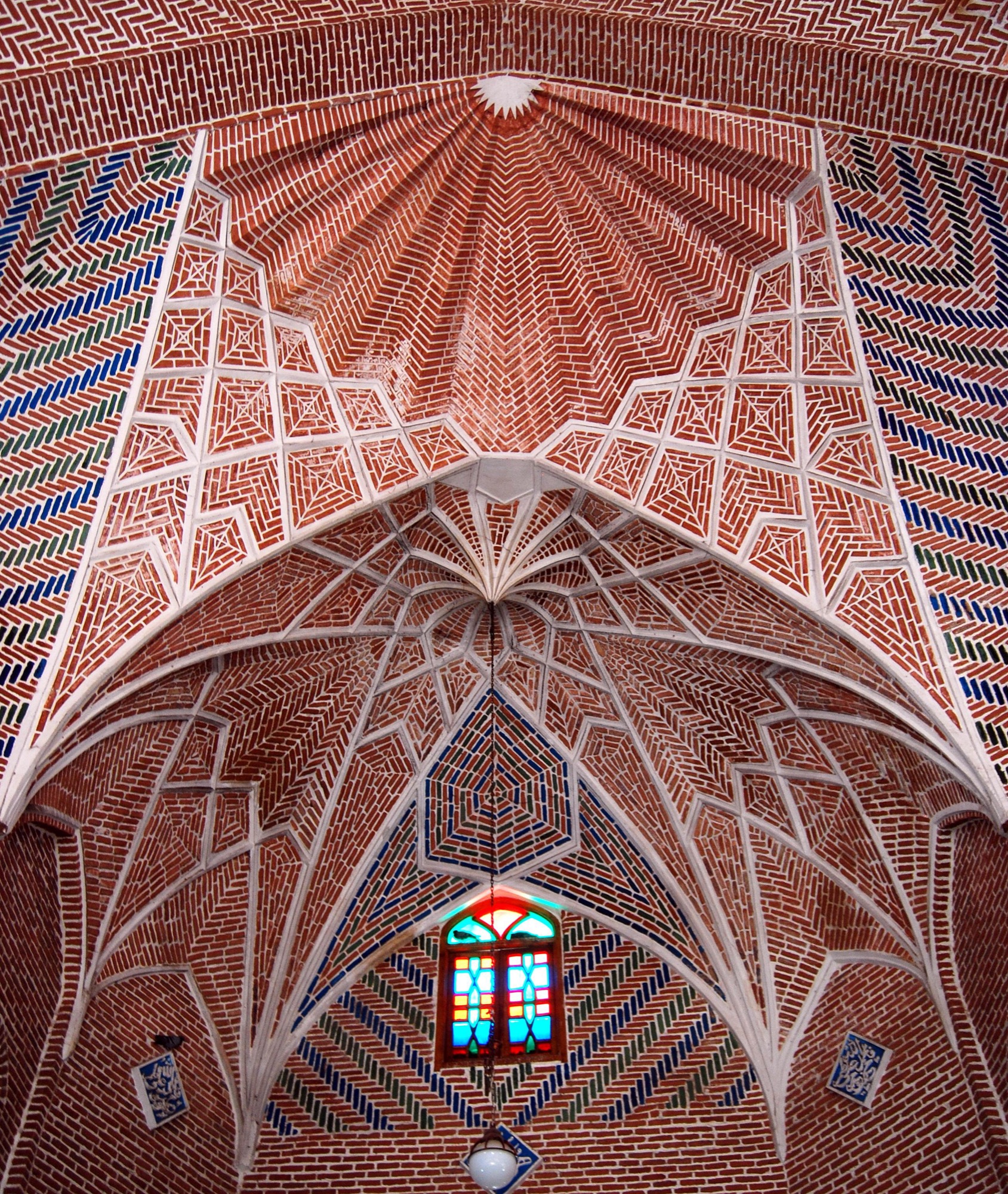
The Tabriz Grand Bazaar is one of the largest and most architecturally complex covered market structures in the world, occupying a core area of approximately 29 hectares with over 5.5 kilometres of interconnected brick-vaulted commercial streets. The complex comprises some 5,500 shops, 35 sarays (caravanserais), 25 timchehs (domed trading halls), 30 mosques, 20 rastehs (market corridors), 11 connecting corridors, and 5 bathhouses, forming a dense, self-contained commercial city within the urban fabric of Tabriz. The corridors are typically four to five metres wide with vaulted ceilings rising five to six metres, a relatively compact profile suited to the severe continental climate of Iranian Azerbaijan, where winter temperatures routinely fall below freezing. The bazaar's origins are attested from at least the tenth century, though its most significant expansion occurred during the Ilkhanid period (1256-1335), when Tabriz served as the Mongol capital of Persia. The geographer Hamdallah Mustawfi described the bazaar in his Nuzhat al-Qulub (c. 1340), documenting its commercial vitality under the late Ilkhanids. Catastrophic earthquakes in 1721 (estimated magnitude 7.3, killing over 80,000) and 1780 (magnitude 7.3, killing an estimated 50,000 or more) devastated the city and necessitated extensive reconstruction, as documented by Berberian in 'Historical monuments and earthquakes in Tabriz' (2014). Much of the surviving fabric dates from the Qajar period (1789-1925), when the bazaar was rebuilt with the characteristic thick brick walls and pointed vaults that define its present character. The most celebrated architectural element is the Timcheh-ye Amir, an octagonal domed hall at the entrance to the Amir Bazaar, dating to the Qajar era. Its brick dome, the largest in the complex, rises above two levels of shops and features muqarnas arches and elaborate decorative brickwork. The Timcheh-ye Mozaffariyeh, founded in 1887 by Haji Jafar Qazvini and named in honour of crown prince Mozaffar al-Din Mirza, houses 26 shops on two floors beneath a dome reaching nine metres in height, and serves as the centre of the carpet trade. The Kolahduzan dome, spanning the old fabric bazaar, exemplifies the karbandi ribbed vault technique; its rehabilitation was led from 1981 by Reza Memaran Bename Tabrizi, one of the last traditional master builders, as analysed by Nazari in 'The practical geometry of Persian ribbed vaults: A study of the rehabilitation of the Kolahduzan Dome in the Tabriz historic bazaar' (2021). The Amir caravanserai, the largest in the complex, features a rectangular courtyard spanning 3,350 square metres with shops arranged symmetrically on two levels. The bazaar was officially protected in 1975, inscribed as a UNESCO World Heritage Site in 2010, and received the Aga Khan Award for Architecture in 2013 for its comprehensive rehabilitation programme, in which the bazaar community eventually provided up to 90 percent of restoration funding.
The decorative program of the Tabriz bazaar is defined by its sophisticated brickwork, which serves simultaneously as structure and ornament. The timchehs display the highest concentration of decorative artistry: the Amir Timcheh features muqarnas corbelling, interlocking geometric patterns in relief brickwork, and pointed arch profiles that exemplify the mature Persian-Islamic decorative vocabulary. The Mozaffariyeh Timcheh, with its lofty dome and clerestory lighting, achieves a particularly refined balance of structural engineering and ornamental effect. The karbandi ribbed vault technique, used prominently in the Kolahduzan dome, produces a distinctive pattern of intersecting ribs that creates both structural integrity and an intricate geometric display visible from below. Throughout the corridors, brick pilasters, pointed arches, and rhythmic vault bays create a visual cadence that unifies the sprawling complex. The tilework found in the bazaar's mosques and madrasas echoes the celebrated ceramic traditions of Tabriz, notably the polychrome tile mosaic that made the nearby Blue Mosque (Masjid-i Muzaffariyya, 1465) one of the masterpieces of Timurid-era decoration. The French artist Eugene Flandin, who traveled through Tabriz in 1840-1841 with the architect Pascal Coste as part of a scientific embassy, produced detailed lithographic views of the city's commercial quarters and architectural landmarks, published in their Voyage en Perse pendant les annees 1840 et 1841 (Paris, 1851), constituting the most important visual documentation of the pre-modern bazaar. Their 200 images, comprising 130 paintings by Flandin and 70 architectural plans by Coste, remain, as the Encyclopaedia Iranica entry on 'Flandin and Coste' notes, indispensable for the study of Qajar-era Persian architecture. European cartographic depictions of the bazaar district appear in sources such as the 1883 detail map of Tabriz in L'Asie Anterieure by Perron.
Tabriz occupies a position of extraordinary strategic significance at the convergence of major overland trade routes linking Anatolia, the Caucasus, Central Asia, and the Persian Gulf. Situated in the valley of the Aji Chay river in Iranian Azerbaijan at an elevation of approximately 1,350 metres, the city commands the principal east-west corridor through northwestern Iran. Marco Polo, passing through around 1275, described Tabriz (which he called Tauris) as 'a great city' where 'merchants come from many regions,' noting that 'Latin merchants, especially Genoese, go there to buy the goods that come from foreign lands,' including silk, gold fabrics, and precious stones (The Travels of Marco Polo, Book I, Chapter 11). As Johannes Preiser-Kapeller documented in 'Civitas Thauris: The significance of Tabriz in the spatial frameworks of Christian merchants and ecclesiastics in the 13th and 14th century' (2013), Genoese merchants were established in Tabriz from 1280 and Venetians from 1263, with both communities flourishing under Ilkhanid commercial privileges. The bazaar's central axis runs east-west through the city centre, with the Arg-e Alishah (the massive Ilkhanid citadel-mosque built 1318-1339 by vizier Taj al-Din Alishah) standing approximately 500 metres to the south, its surviving brick walls rising to monumental height with an iwan originally 30.5 metres wide and over 45 metres tall, as recorded by Archnet. The Blue Mosque (1465), built by Jahan Shah of the Qara Qoyunlu, lies nearby, its surviving iwan a testament to the catastrophic 1780 earthquake that levelled much of the city. To the northeast, the Rab-e Rashidi, the extraordinary scholarly quarter endowed by Rashid al-Din Hamadani around 1300, once contained a university, hospital, paper factory, library, caravanserai, and some 30,000 houses, its endowment deed now inscribed on UNESCO's Memory of the World Register. The city's location on the North Tabriz Fault makes it one of the most earthquake-prone urban centres in the world, a geological reality that has repeatedly shaped the bazaar's architectural history. Under the Qajar dynasty, Tabriz's proximity to the Ottoman and Russian borders made it Iran's principal gateway to European commerce, with the Tabriz-Trabzon trade route, established in the 1830s, channelling British manufactured goods and Persian raw materials through the bazaar, as Willem Floor documented in 'The Foreign Trade of Tabriz: 1800-1900' (Iranian Studies, 2024).
The history of the Tabriz bazaar as a financial marketplace reaches its most dramatic moment with the chao paper money experiment of 1294, the first attempt to introduce Chinese-style paper currency outside East Asia. As documented by Rashid al-Din Hamadani in his Jami al-Tawarikh (Compendium of Chronicles, c. 1307), the Ilkhan Gaykhatu, facing a treasury emptied by extravagant spending and a devastating cattle plague, turned to his vizier Sad al-Din Zanjani, who proposed adopting the Chinese paper money system. The Chinese ambassador Bolad Aqa, who had arrived at the Ilkhanid court in the 1280s as representative of Kublai Khan and who served as a crucial intermediary between Chinese and Persian cultures, as Thomas T. Allsen detailed in Culture and Conquest in Mongol Eurasia (Cambridge, 2001), explained the mechanics of the Yuan dynasty jiaochao system. Notes were printed bearing Chinese characters alongside Arabic text and the Islamic shahada (profession of faith), imitating the Yuan model so closely that they retained Chinese inscriptions. First circulation began on 12 September 1294 in Tabriz. As Karl Jahn documented in 'Paper currency in Iran: A contribution to the cultural and economic history of Iran in the Mongol Period' (Journal of Asian History 4, 1970, pp. 101-135), the experiment was an immediate catastrophe. The bazaar erupted in riots within days as merchants refused to accept the notes. Markets closed, commerce ground to a halt, and merchants fled the city. Rashid al-Din recorded that the chao brought 'the ruin of Basra,' so far-reaching were the economic disruptions. The experiment lasted barely two months before Gaykhatu was forced to withdraw the paper currency entirely. The episode stands as one of the most consequential monetary policy failures in pre-modern history and illuminates the sophistication of the bazaar's merchant community, whose collective refusal defeated a sovereign decree. The Ilkhanid successor Ghazan Khan (r. 1295-1304), advised by Rashid al-Din as chief minister, pursued radically different monetary reforms: standardising coinage, unifying weights and measures throughout the Ilkhanate based on Tabriz standards (1301-1302), and constructing caravanserais to facilitate long-distance trade, as analysed by Judith Kolbas in 'The Gold Reform of Ghazan Khan.' Under Ghazan and his successor Oljeitu, Tabriz became what the Encyclopaedia Iranica describes as an 'international entrepot,' with the bazaar functioning as the commercial heart of a Mongol empire that stretched from Anatolia to Afghanistan. Rashid al-Din himself endowed the Rab-e Rashidi quarter with an investment of nearly 50,000 dinars, creating a scholarly and commercial complex of unprecedented scale. After the Ilkhanid collapse in the 1330s, Tabriz passed through Jalairid, Timurid, Qara Qoyunlu, and Aq Qoyunlu hands before Shah Ismail captured the city in 1501 and proclaimed it the first Safavid capital, minting coins and declaring Twelver Shia Islam the state religion. Ottoman-Safavid rivalry made Tabriz a contested frontier city; it was under Ottoman occupation from 1585 to 1603 before Abbas the Great recovered it. Under the Qajars, the bazaar regained prominence as Iran's principal commercial gateway. On the eve of the Constitutional Revolution (1906-1911), 15 percent of Iran's exports and 25 percent of its imports passed through Tabriz, and the city's merchants played a decisive role in the constitutional movement, culminating in the siege of Tabriz in 1908-1909.
The Tabriz bazaar functioned as one of the great entrepots of medieval Eurasian commerce, its specialised market sections reflecting the extraordinary diversity of goods that flowed through the city. The Amir Bazaar, devoted to gold and jewellery, was famously described by the Moroccan traveller Ibn Battuta (visiting c. 1327): 'I traversed the bazaar of the jewellers, and my eyes were dazzled by the varieties of precious stones which I beheld.' This section, centred on the Amir Timcheh, has continuously housed goldsmiths and dealers in precious stones from the Ilkhanid period to the present. Silk was the premier commodity of the long-distance trade. Marco Polo noted that Tabriz's merchants produced 'silk fabrics and brocades' and dealt in goods from India, Baghdad, and Hormuz, including perfume, spices, coral, amber, rice, gold, and silver. Under the Safavids, Tabriz became a focal point of the silk trade contested between the Ottoman and Safavid empires, as documented in 'Caravans of Silk and Imperial Armies: Ottoman-Safavid Rivalry over the Silk Hub of Tabriz' (Association for Iranian Studies). The Mozaffariyeh Timcheh, constructed in 1887, became and remains the centre of the Persian carpet trade, where dealers and collectors from around the world acquire handwoven Tabriz carpets, renowned for their fine knotting and elaborate medallion designs. The bazaar's commercial specialisation extended across some 40 distinct occupation types organised by rasteh: the Bashmakhchi Bazaar for shoes, the Rahli Bazaar for produce, separate sections for copperware, leather, spices, textiles, and dried fruits. Money-changing operations, essential to a trading city that handled Ottoman, Safavid, Russian, and European currencies, were concentrated in the sarrafkhaneh sections. Under Ghazan Khan's reforms, the Ilkhanid monetary system was reorganised around a silver unit called the tuman, valued at 10,000 dinars or 60,000 dirhams, with Tabriz weights and measures adopted as the empire-wide standard. In the nineteenth century, as Floor documented in 'The Foreign Trade of Tabriz: 1800-1900,' the bazaar handled the transit of British manufactured goods (especially Manchester textiles, which dominated imports by mid-century), raw Gilani silk (the principal export until the silk disease of the 1860s), and a growing volume of Persian carpets. Caucasian Armenian merchants dominated the foreign trade, with European firms maintaining branches in the city. By the early twentieth century, Tabriz's commercial reach, while diminished by the opening of the Suez Canal and Russian transit restrictions, still made it Iran's most important mercantile centre.
Images will be added as the project develops. Photographs by Larry Ng and from research sources.