Samarkand Sogdian Trading Quarter (Afrasiab)
Samarkand, Uzbekistan · Established c. 500 BCE
This site requires authorization to access.
To request access, contact
william.goetzmann@yale.edu
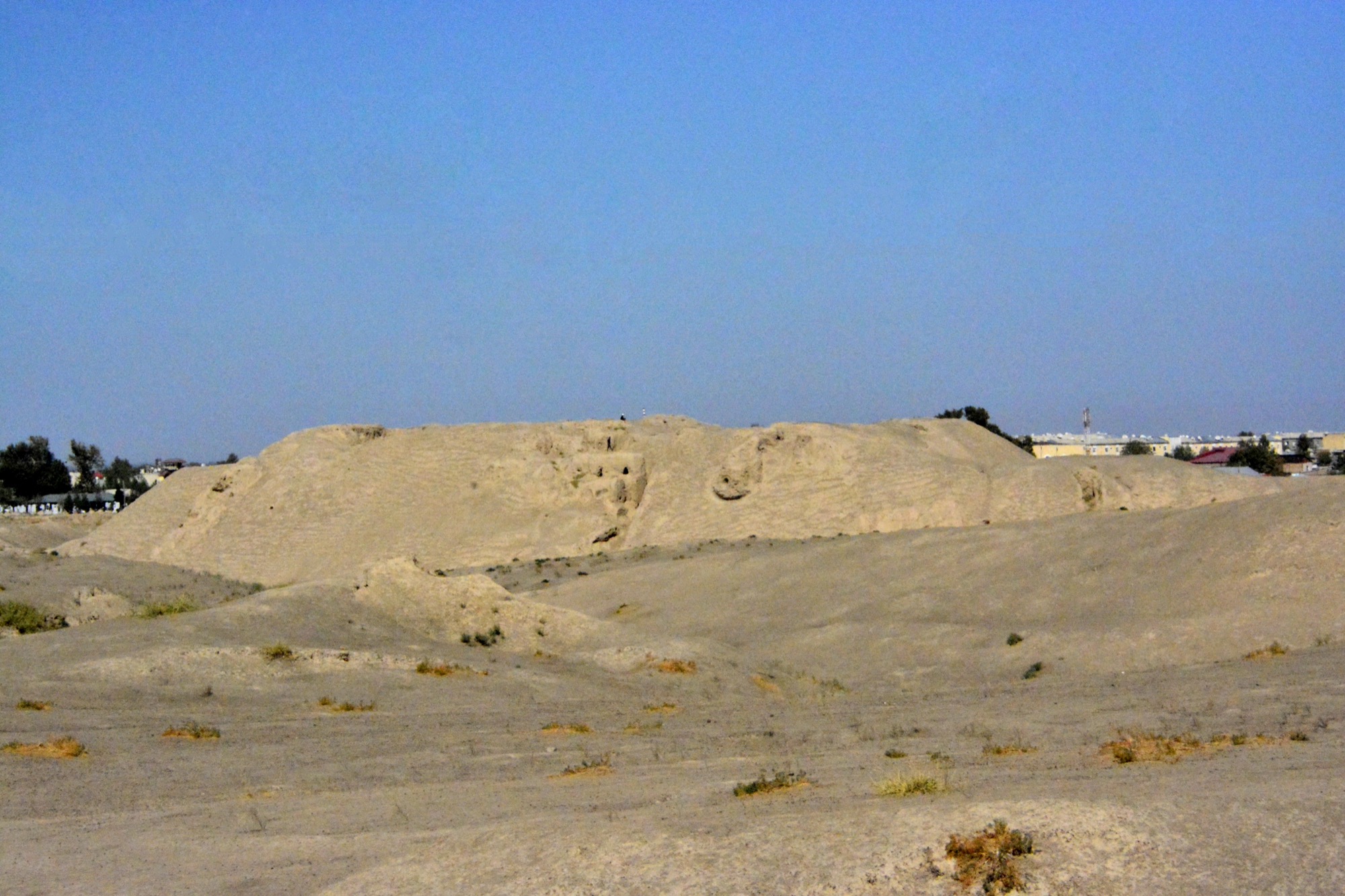
The ancient city of Afrasiab—the pre-Mongol settlement that preceded modern Samarkand—occupies approximately 220 hectares of terraced hillside along the southern edge of the Zeravshan River valley, with archaeological strata reaching eight to twelve meters in depth. First systematic excavations were undertaken in the late nineteenth century by Nikolay Veselovsky, who conducted campaigns at the site following the Russian conquest of Central Asia. In the 1920s, the archaeologist Mikhail Evgenievich Masson expanded work at Afrasiab considerably, cataloging artifacts and placing them in the Samarkand museum. Continuous archaeological investigation has proceeded since 1946, led by successive Uzbek and international teams, including the Franco-Uzbek Archaeological Mission in Sogdiana (MAFOUZ-Sogdiane) directed by Frantz Grenet since 1989, as noted in his bibliographic essay “The Pre-Islamic Civilization of the Sogdians (Seventh Century BCE to Eighth Century CE)” published in the *Silk Road Foundation Newsletter* (2002). The walled city comprised a fortified citadel at its northwestern corner and an inner urban core divided into residential quarters, or *guzars*, linked by cobbled streets. As Étienne de la Vaissière documented in *Sogdian Traders: A History* (Brill, 2005), Sogdian cities like Samarkand were organized around the commercial infrastructure necessary for long-distance trade: bazaars extended along the southern suburbs, while caravanserais provided lodging and warehouse space for merchants arriving from across Central Asia. Workshops for metalworking, textile production, and ceramics occupied dedicated artisan quarters. Notably, archaeological work has revealed an advanced lead-piped water supply system and evidence of Chinese-style paper production at the site. In 1965, a transformative discovery occurred when road construction through the mound exposed the remains of a seventh-century palatial residence decorated with monumental frescoes—the so-called “Hall of Ambassadors.” The Afrasiab Museum of Samarkand, designed by architect Bagdasar Arzumanyan and opened in 1970 adjacent to the archaeological site, was purpose-built to house these murals along with more than 22,000 objects recovered from the excavations, including coins, ossuaries, ceramics, terracotta figurines, glassware, and weaponry. The site preserves layers of continuous occupation from approximately 500 BCE, when the Achaemenids incorporated Sogdiana into their empire, through the catastrophic Mongol destruction of 1220 CE, when Genghis Khan’s armies demolished the city’s walls, destroyed its aqueduct, and killed or enslaved much of the population.
The Afrasiab murals, discovered in 1965, constitute the most significant surviving example of pre-Islamic Sogdian monumental painting. Dating to the mid-seventh century CE—likely between 648 and 660 CE during the reign of the Samarkand ruler Varkhuman—the paintings adorned the four walls of a reception hall (designated Site XXIII:1) and measured approximately 3.4 meters high by 11.52 meters wide. As Frantz Grenet argued in “What Was the Afrasiab Painting About?” published in *Royal Nawrūz in Samarkand* (edited by Matteo Compareti and Étienne de la Vaissière, Rome, 2006), the western wall depicts a long procession of foreign delegations—envoys from China, Chaghaniyan, Chach (Tashkent), Tibet, and the Korean kingdom of Goguryeo—converging toward a now-lost central composition, while the southern wall shows Varkhuman himself on horseback in a procession of richly dressed courtiers, his wives, and sacrificial animals including a riderless horse and geese, probably representing the celebration of Nawruz, the Iranian New Year. The northern wall portrays riders hunting wild cats and a pleasure boat carrying Chinese ladies, and the heavily deteriorated eastern wall contains figures in Indian garb. These scenes capture a remarkably cosmopolitan world of diplomatic and commercial exchange. Boris Marshak, the leading authority on Sogdian painting who led excavations at the sister site of Panjikent from 1954 until his death in 2006, proposed that the central figure on the main wall might represent the goddess Nana rather than Varkhuman, drawing on Panjikent parallels where deities consistently appear at the top of primary walls, as he discussed in *Legends, Tales, and Fables in the Art of Sogdiana* (Bibliotheca Persica Press, 2002). Matteo Compareti, in *Samarkand the Center of the World: Proposals for the Identification of the Afrasyab Paintings* (2016), offered an alternative reading connecting the scenes to Nawruz festivities and astronomical motifs. The Panjikent murals, excavated by Aleksandr Belenitsky and later Marshak in the Zeravshan valley of present-day Tajikistan, provide essential comparative material: over forty illustrative wall paintings from merchant houses and temples depict scenes from Aesop’s Fables, the Panchatantra, and the Rustam cycle, revealing how Sogdian traders absorbed and transmitted artistic and literary traditions across cultural boundaries. The Afrasiab murals are now housed in the Afrasiab Museum of Samarkand, while important Sogdian art collections are also held at the State Hermitage Museum in Saint Petersburg, which preserves extensive material from Panjikent. Together, these paintings demonstrate that Sogdian artistic traditions were intimately connected to the mercantile culture that sustained them—the cosmopolitan imagery of foreign visitors bearing trade goods reflects the commercial networks documented in the written record.
Samarkand—known as Marakanda to the Greeks and as one of the principal cities of Sogdiana—occupied a position of extraordinary strategic advantage at the intersection of the major overland trade routes connecting China, India, Persia, and the Mediterranean world. Situated in the fertile Zeravshan River valley in what is now northeastern Uzbekistan, the city commanded access to abundant water, productive agricultural land, and the mountain passes linking Central Asia to its neighbors. As the UNESCO Silk Roads Programme has documented, Samarkand stood at the crossroads where the northern Silk Road route from China, passing through Kashgar and over the Tian Shan or Pamir Mountains, converged with routes running south toward India through the passes of northern Pakistan—where Sogdian rock inscriptions testify to merchant activity—and westward through Merv toward Persia and ultimately the Mediterranean. The city was the capital of a broader Sogdian cultural zone that included Bukhara to the west and Panjikent to the east, each functioning as an independent city-state within what Frantz Grenet characterized as a “patchwork of oasis towns and rich agricultural land” in his survey of Sogdian civilization published through the Collège de France. As Étienne de la Vaissière demonstrated in *Sogdian Traders* (Brill, 2005), these Sogdian city-states, though politically fragmented into small principalities each with its own ruler, were bound together by shared language, commercial networks, and cultural traditions that gave them outsized influence across the Asian landmass. Alexander the Great conquered Marakanda in 329 BCE, and the city endured a prolonged Sogdian revolt led by Spitamenes that required two years to suppress—the most determined resistance Alexander encountered in his campaigns. Hellenistic influence persisted under the Seleucids and Greco-Bactrians before the region passed through Kushan, Hephthalite, and Turkic rule. The Arab general Qutayba ibn Muslim captured Samarkand in 712 CE, initiating the gradual Islamization of Sogdiana. The catastrophic Mongol siege of 1220 CE destroyed the ancient city of Afrasiab entirely; when Tamerlane made Samarkand his imperial capital in the fourteenth century, he built the new Timurid city to the south of the ruined Afrasiab mound, establishing the monumental architectural ensemble—the Registan, the Bibi-Khanym Mosque, the Shah-i-Zinda necropolis—that defines Samarkand’s visual identity today, while the ancient commercial quarter of Afrasiab remained an uninhabited archaeological tell.
The Sogdian merchant networks centered on Samarkand dominated overland trade across Central Asia from approximately the fourth through the eighth centuries CE, constituting what Étienne de la Vaissière, in *Sogdian Traders: A History* (Brill, 2005), called the most important commercial intermediaries in the pre-modern Asian world. The earliest direct evidence of this mercantile activity comes from the Sogdian Ancient Letters, a cache of five nearly complete letters and numerous fragments discovered in 1907 by Sir Aurel Stein in an abandoned Chinese watchtower west of Dunhuang, near the Jade Gate frontier post. As Nicholas Sims-Williams demonstrated in his authoritative translation and commentary—first published in collaboration with the International Dunhuang Project and subsequently revised in “Towards a New Edition of the Sogdian Ancient Letters: Ancient Letter 1” in *Les Sogdiens en Chine* (edited by Étienne de la Vaissière and Éric Trombert, École française d’Extrême-Orient, 2005)—the letters date to approximately 312–313 CE and document Sogdian merchants operating from communities in Dunhuang, Guzang (Wuwei), and Jincheng (Lanzhou) while maintaining correspondence with partners in Samarkand. The letters appear to be the contents of a mailbag lost or confiscated in transit, providing an unmediated snapshot of commercial life along the Silk Road. Sogdian commercial organization rested on what scholars have identified as the *naf*—self-governing civic communities of merchants and traditional aristocracy that managed trade relations and adjudicated disputes within the diaspora. As the Smithsonian’s Freer and Sackler Galleries’ exhibition *The Sogdians* documented, these merchant communities established settlements extending from the interior of China to the edges of the Byzantine Empire, functioning as logistical hubs and cultural outposts. The Sogdians generated trust and enforced contracts through social leverage: third parties served as witnesses and guarantors who maintained their own commercial relationships with the contracting parties, creating interlocking networks of mutual obligation, as analyzed in the *Journal of Institutional Economics* (Cambridge University Press). The major political transitions that shaped Samarkand’s history profoundly affected its commercial role. Alexander the Great’s conquest of Marakanda in 329 BCE and the subsequent revolt led by Spitamenes disrupted but ultimately integrated the region into the Hellenistic trading world. The Arab conquest under Qutayba ibn Muslim in 712 CE transformed the cultural and religious landscape of Sogdiana, though Sogdian merchants continued to operate under the Abbasid Caliphate. The catastrophic Mongol destruction of 1220 CE—when Genghis Khan’s forces demolished Samarkand’s walls, destroyed its water infrastructure, and killed an estimated 100,000 people while deporting 30,000 skilled artisans—effectively ended the ancient city of Afrasiab and the Sogdian mercantile tradition that had sustained it for over a millennium.
The Sogdian Ancient Letters, translated by Nicholas Sims-Williams of the School of Oriental and African Studies, provide the most detailed early evidence of the commodities and financial practices that sustained the Sogdian trading networks. Letter 2, written by the merchant Nanai-vandak to his “noble lord” Varzakk in Samarkand, contains instructions regarding substantial sums left on deposit and references to “1,000 staters or 2,000 staters” of silver available for withdrawal, along with directions to add “interest to the capital.” Letter 5, from a merchant named Fri-khwataw to the chief merchant Aspandhat, records debts of “twenty staters of silver” and inventories including “a half stater of silver” at Guzang, along with instructions for dispatching “2,500 measures of pepper” and “4 bundles of white” (probably white lead powder used in cosmetics and medicine). Across the corpus, the letters mention gold, silver, musk (sourced from Tibet), pepper, camphor, silk, linen, unprocessed cloth, and wheat—commodities with high value relative to their weight, ideally suited for transport over the vast distances of the Silk Road. As Étienne de la Vaissière documented in *Sogdian Traders* (Brill, 2005), the Sogdian language itself shaped the commercial vocabulary of Central Asia: the Old Turkic word for “debt” (*borč*) derives from Sogdian *pwrc*, and the Uighur word for “coin” (*styr*) comes from Sogdian *styr*—linguistic evidence of the Sogdians’ foundational role in establishing financial institutions across the region. The stater of silver served as the standard unit of account in Sogdian commercial correspondence, enabling merchants to track deposits, calculate interest, and settle debts across a network spanning some 2,000 miles from Samarkand to the Chinese interior. Sogdian functioned as the lingua franca of the Silk Road from at least the fourth century CE through the period of the Arab conquests, as documented in scholarly analysis of Sogdian inscriptions, commercial documents, and religious texts found across Central Asia, China, and the Turkic steppe. The merchants operated through networks of diaspora communities, with agents stationed in the principal cities along the trade routes managing deposits, extending credit, and coordinating the movement of goods. Their particular method of generating trust involved social leverage—using third parties as contract witnesses and guarantors who maintained their own commercial relationships with the contracting parties—a mechanism that, as analyzed in the *Journal of Institutional Economics*, represented a private institutional solution to the problems of long-distance trade centuries before comparable arrangements emerged in medieval Europe.


