Muscat Securities Market (MSM)
Muscat, Oman · Established 1988
This site requires authorization to access.
To request access, contact
william.goetzmann@yale.edu
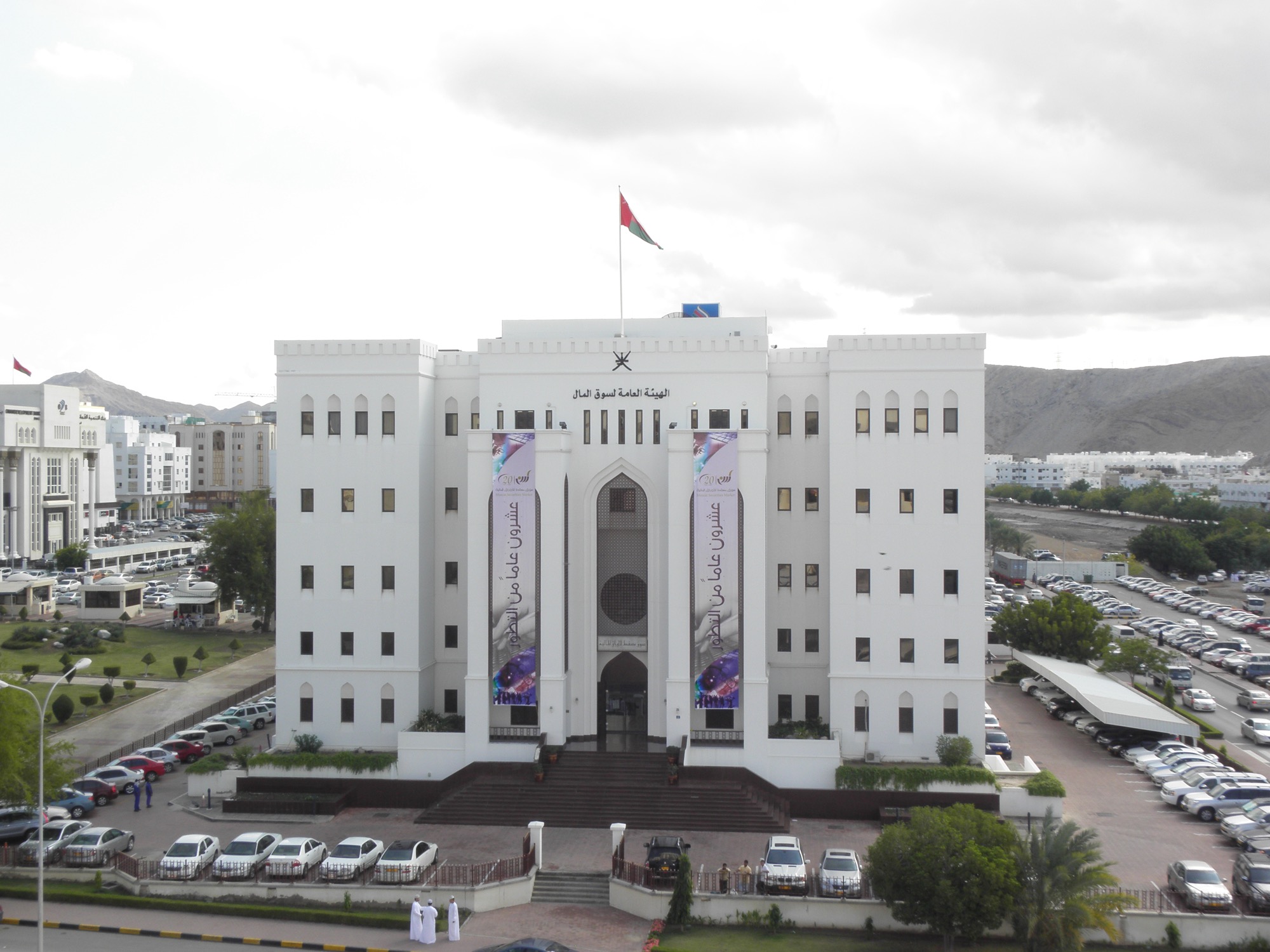
The Muscat Securities Market (now Muscat Stock Exchange, or MSX) is headquartered in the Ruwi district of Muscat, Oman’s primary commercial and financial quarter. The exchange’s building sits within the Ruwi Central Business District, a corridor of mid-rise office towers and institutional headquarters that emerged in the decades following Sultan Qaboos’s modernization campaign after 1970. Consistent with the Sultanate’s distinctive architectural regulations—which Sultan Qaboos personally championed to limit building heights to roughly forty metres and mandate white or earth-toned facades with Islamic design vocabulary—the MSX headquarters presents a civic-modern structure employing pointed arches, shaded colonnades, and geometric lattice screens reminiscent of traditional mashrabiya work. As the architectural critic Jonathan Glancey noted in a survey of Gulf urbanism, Muscat’s building codes have produced a cityscape that “blends seamlessly with the natural terrain,” avoiding the glass-and-steel verticality of neighboring Dubai or Doha (Glancey, “The Shape of Cities,” 2014). The exchange building reflects these principles: it is low-rise and horizontally proportioned, with recessed windows that mitigate solar gain in Oman’s harsh desert climate. The Ruwi district itself occupies a valley between mountain ridges, extending from the old Muttrah port area inland toward newer suburbs. The Central Bank of Oman (established 1974) and the National Bank of Oman (1973) both maintain their headquarters in Ruwi, anchoring the financial cluster in which the exchange operates. A prominent local landmark is the Ruwi Clock Tower, a fifty-metre civic monument constructed in 1991, whose mosaic panels depict scenes from Omani history. The MSX building stands within this institutional environment, its architectural language echoing the broader Omani commitment to blending modernist functionality with Islamic ornamental traditions.
The decorative program of the Muscat Securities Market building follows the characteristically restrained aesthetic that Sultan Qaboos’s building regulations imposed across Muscat’s civic architecture. Royal Orders specify that building design should combine “Omani, Arab, Islamic and contemporary style and character,” and the exchange’s interior spaces reflect this directive through geometric tile work, arabesque plaster reliefs, and carved wooden panels inspired by traditional Omani craftsmanship. These elements echo the broader tradition of Omani decorative arts, which, as John Willard Peterson describes in Oman’s Diverse Society: Northern Oman (2004), draws on centuries of Indian Ocean cross-cultural exchange, blending Swahili, Persian, and Indian motifs into a distinctive coastal Arabian vocabulary. Compared with the lavish ornamentation of the Sultan Qaboos Grand Mosque or the Royal Opera House Muscat, the exchange’s decorative scheme is relatively modest—appropriate to a commercial institution rather than a ceremonial one. The building employs the light-colored stone, recessed arched windows, and geometric screen panels that characterize Muscat’s government and financial buildings, materials and forms that serve both aesthetic and practical purposes in the extreme heat of the Gulf climate. Like many Omani civic buildings of its era, the MSX headquarters subordinates individual artistic expression to the collective architectural identity that the Sultanate’s planners have cultivated since the 1970s.
Muscat occupies one of the most strategically significant positions on the Arabian Peninsula, straddling the Gulf of Oman at the entrance to the Persian Gulf. The historic core of the city—the old walled port of Muscat and the adjacent commercial quarter of Muttrah—sits within a series of narrow bays enclosed by the craggy foothills of the Al Hajar Mountains, a geography that has shaped the city’s role as a maritime entrepot for millennia. As K. N. Chaudhuri argues in Trade and Civilisation in the Indian Ocean: An Economic History from the Rise of Islam to 1750 (Cambridge University Press, 1985), the ports of the Omani coast functioned as critical nodes in the long-distance trading networks connecting the South China Sea to the eastern Mediterranean, with Muscat serving as a principal way-station for monsoon-driven sailing routes between India, East Africa, and the Persian Gulf. The commercial heart of modern Muscat lies just inland from the historic Muttrah waterfront, where the Muttrah Souk—one of the oldest continuously operating markets in the Arabian Peninsula—still trades in frankincense, textiles, and silver jewelry. The souk’s labyrinthine covered alleys, locally known as Souq al-Dhalam (“the dark souk”) for the shade cast by its tightly packed stalls, represent the pre-modern commercial tradition from which Oman’s modern financial infrastructure descends. The Ruwi district, located roughly three kilometers southeast of the Muttrah port, emerged as the Sultanate’s Central Business District during the oil-fueled development boom after 1970, when rapid urbanization transformed what had been a small fishing settlement into a dense corridor of banks, corporate offices, and government agencies. Unlike the dramatic vertical skylines of Abu Dhabi or Dubai, Muscat’s urban landscape remains distinctly horizontal, a consequence of Sultan Qaboos’s deliberate policy of limiting building heights and mandating traditional architectural vocabularies. The result, as Calvin Allen and W. Lynn Rigsbee describe in Oman under Qaboos: From Coup to Constitution, 1970–1996 (Frank Cass, 2000), is a capital city that projects an image of measured modernity—technologically capable but aesthetically rooted in Omani cultural identity. The MSX’s location in Ruwi places it at the intersection of this old and new Muscat: within walking distance of the ancient Muttrah trading quarter, yet firmly embedded in the institutional infrastructure of the modern Gulf state.
Oman’s commercial heritage extends deep into antiquity. During the Bronze Age, the Oman peninsula was known to Mesopotamian civilizations as Magan, a legendary source of copper that fueled the metallurgical industries of Sumer and Akkad. As Claudio Giardino documents in Magan—The Land of Copper: Prehistoric Metallurgy of Oman (Archaeopress, 2019), copper mines around the northern Omani settlement of Sohar produced an estimated twenty thousand tons of metal annually for export, establishing the region as a critical supplier within the earliest international trading networks. The Dhofar region of southern Oman, meanwhile, was the ancient world’s principal source of frankincense, the aromatic resin that commanded enormous prices in Egyptian, Greek, and Roman markets. UNESCO’s designation of the Land of Frankincense World Heritage Site—encompassing the archaeological ports of Sumhuram and Al-Balid and the frankincense groves of Wadi Dawkah—testifies to the enduring significance of this trade. Oman’s maritime trading tradition flourished through the medieval Islamic period, when the port of Sohar was celebrated by Arab geographers as one of the great emporias of the Indian Ocean. The Omani seafaring tradition produced figures such as the fifteenth-century navigator Ahmad ibn Majid, whose navigational treatises guided monsoon sailing across the Indian Ocean. By the early modern period, as Patricia Risso details in Oman and Muscat: An Early Modern History (Croom Helm, 1986), the Omani maritime empire extended from the East African coast—where the Sultanate of Zanzibar became an Omani possession—to the western coast of India, creating a vast commercial network trading in dates, dried fish, pearls, and enslaved persons. The modern Muscat Securities Market was established on June 21, 1988, by Royal Decree 53/88, a product of Sultan Qaboos’s broader campaign to build institutional infrastructure for the Sultanate’s economy. Trading commenced in May 1989 using an open outcry system. For its first decade, the MSM served both regulatory and exchange functions. This dual mandate was restructured in 1998 by Royal Decrees 80/98 and 82/98, which separated the exchange from its regulator by creating the Capital Market Authority (CMA) as an independent supervisory body. As Sarah Phillips and Jennifer Hunt argue in “Without Sultan Qaboos, We Would Be Yemen” (Journal of International Development, 2017), Oman’s developmental trajectory represented a “positive outlier” among post-colonial resource states, and the measured institution-building of which the MSM was part reflected Qaboos’s preference for gradual reform over the speculative exuberance of some Gulf neighbors. In 2021, Royal Decree 5/2021 converted the MSM into a closed joint-stock company under the name Muscat Stock Exchange (MSX), owned by the Oman Investment Authority. The restructuring introduced the Euronext-developed Optiq electronic trading platform, replacing the earlier Universal Trading Platform. Marc Valeri, in Oman: Politics and Society in the Qaboos State (Hurst, 2009), characterizes Oman’s approach to economic modernization as deliberately more cautious than that of its Gulf Cooperation Council peers—a pattern visible in the exchange’s measured pace of reform, its relatively modest market capitalization, and its alignment with the Oman Vision 2040 strategy, which emphasizes economic diversification, privatization of state-owned enterprises, and deepening of capital markets as alternatives to oil dependency.
The Muscat Stock Exchange lists approximately 111 companies across three principal sectors tracked by the MSM 30 Index, a capitalization-weighted benchmark of the exchange’s thirty most liquid securities: Banking and Investment, Industry and Services, and Insurance. Market capitalization reached approximately 31.3 billion Omani rials (roughly 81 billion US dollars) as of late 2025, representing substantial growth from the exchange’s early years. The banking sector, led by institutions such as Bank Muscat, the National Bank of Oman, and Bank Dhofar, constitutes the largest share of market value. Energy companies, reflecting Oman’s continued dependence on hydrocarbon revenues, are increasingly prominent: the 2024 initial public offering of OQ Exploration and Production (OQEP), a subsidiary of the state energy company OQ, was the largest IPO in Omani history, raising approximately 2.5 billion US dollars and signaling the government’s commitment to privatization under Vision 2040. Beyond equities, the MSX has developed dedicated segments for bonds and Islamic sukuk, the latter reflecting Oman’s growing Islamic finance sector, which is projected to reach 45 billion US dollars by 2026. Sukuk accounted for approximately sixty percent of all US dollar-denominated debt issuance from Oman in 2025. The exchange also operates a Parallel Market for smaller companies and a Third Market for distressed securities; in 2025, the Financial Services Authority introduced a Promising Companies Market segment designed to channel capital to small and medium enterprises. The commodities that historically defined Omani commerce—frankincense from the Dhofar groves, copper from the mines of the northern interior, dates from the palm oases of the Batinah coast, and pearls from the Gulf waters—are not traded on the modern exchange, but their legacy persists in the economic structure of the listed companies, many of which operate in sectors descended from Oman’s traditional resource base. The IMF’s 2024 Article IV Consultation with Oman noted the exchange’s potential for upgrade to emerging market status, recommending continued efforts to deepen capital markets, invigorate money markets, and expand the role of nonbank financial institutions as part of the Sultanate’s diversification strategy.
Images will be added as the project develops. Photographs by Larry Ng and from research sources.