Bahrain Bourse
Manama, Bahrain · Established 1987
This site requires authorization to access.
To request access, contact
william.goetzmann@yale.edu
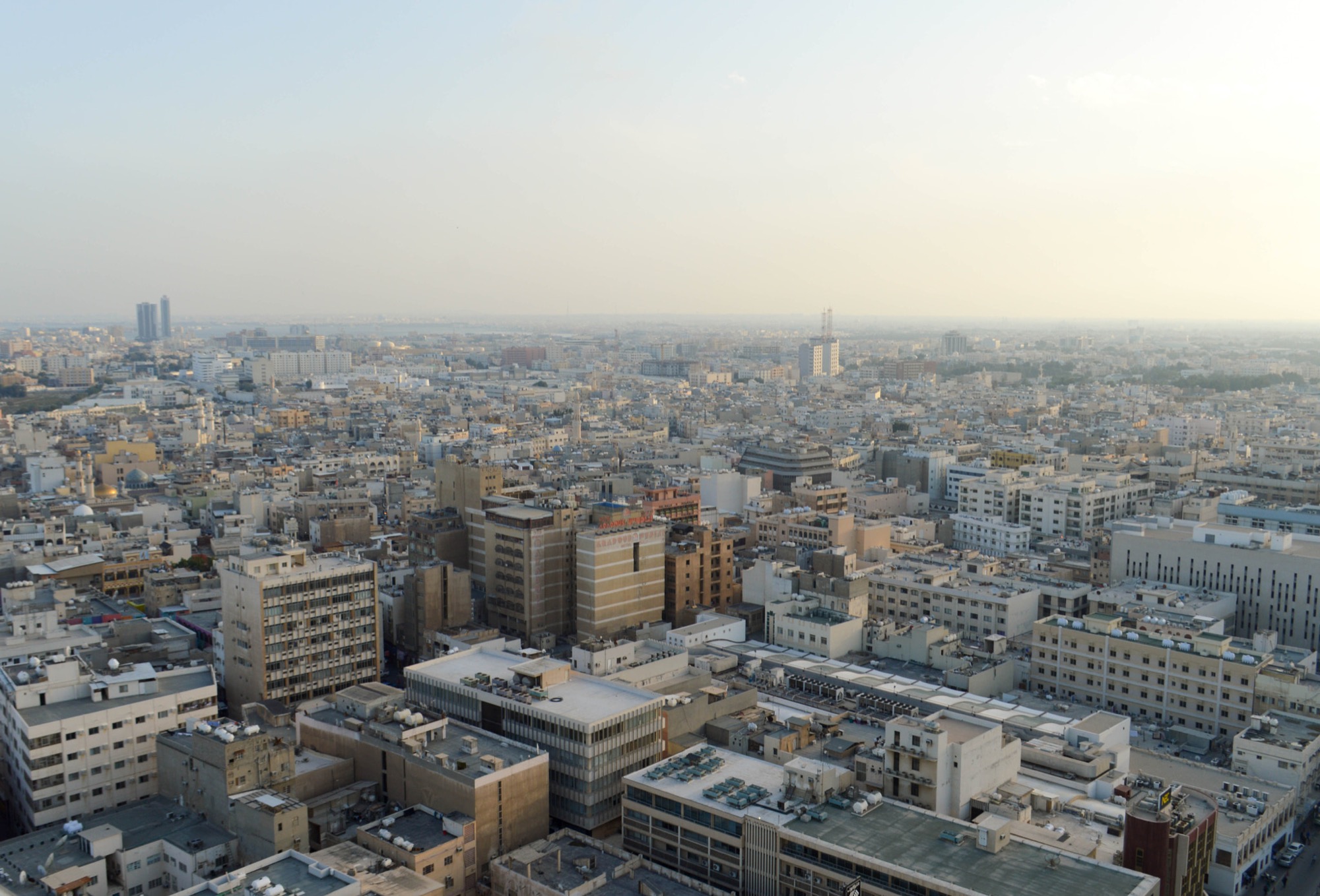
The Bahrain Bourse occupies the fourth floor of the Harbour Mall within the Bahrain Financial Harbour (BFH), a $1.5 billion waterfront commercial development on the northern shoreline of Manama facing the Arabian Gulf. The BFH complex, designed by Ahmed Abubaker Janahi Architects, is anchored by the twin Harbour Towers—East and West—each rising fifty-three stories to 260 meters, their curving glass-curtain facades evoking the billowing sails of the dhows that once dominated Gulf waters. The towers, officially opened in May 2007, rank among Bahrain’s tallest completed structures and are connected at the second level to the Harbour Mall, a six-story mixed-use podium of approximately 22,000 square meters that houses the exchange alongside investment firms and retail establishments. As Nelida Fuccaro documented in Histories of City and State in the Persian Gulf: Manama since 1800 (Cambridge University Press, 2009), Manama’s waterfront has long been the gravitational center of commercial life, from the pearl-merchant warehouses of Muharraq to the modern financial towers that now line King Faisal Highway. Before its relocation to the Financial Harbour, the Bahrain Stock Exchange operated from more modest government-affiliated premises in Manama’s diplomatic area. The move to BFH signaled Bahrain’s ambition to compete with Dubai and Doha as a regional financial hub, embedding the exchange within a master-planned district spanning 380,000 square meters that includes high-rise office towers, a marina, luxury residential units, and the Bahrain International Insurance Centre. The broader Manama skyline also features the Bahrain World Trade Center (designed by Atkins and completed in 2008), the first skyscraper in the world to integrate wind turbines, underscoring the island’s architectural commitment to modernity and sustainability as analyzed in the Council on Tall Buildings and Urban Habitat’s study Harnessing Energy in Tall Buildings (2008).
The decorative program of the Bahrain Financial Harbour complex reflects a dialogue between contemporary Gulf modernism and traditional Islamic design vocabulary. The twin towers’ sail-inspired profiles serve as monumental symbolic references to Bahrain’s maritime heritage—the pearling dhow as architectural motif—while the interior public spaces of the Harbour Mall incorporate geometric patterning and calligraphic elements characteristic of Islamic ornamental traditions. As Oleg Grabar discussed in The Mediation of Ornament (Princeton University Press, 1992), Islamic geometric art functions not merely as decoration but as a symbolic representation of cosmic order and divine unity, principles that inform the patterned screens and lattice-work found in many Gulf financial buildings. Bahrain’s broader artistic heritage related to trade is preserved most visibly in the UNESCO World Heritage Site known as the Pearling Path in Muharraq, inscribed in 2012 as “Pearling, Testimony of an Island Economy.” The site encompasses merchant residences, stores, and warehouses whose architectural ornament—carved coral-stone facades, wind towers, and ornate wooden doors—reflects the wealth generated by the pearl trade. While the Bourse itself favors the sleek minimalism of international financial architecture, the broader context of Bahrain’s commercial spaces offers a rich visual record of how trade shaped decorative culture, a theme explored in Robert Carter’s Sea of Pearls: Seven Thousand Years of the Industry That Shaped the Gulf (Arabian Publishing, 2012).
Manama sits on the northeastern tip of Bahrain Island, an archipelago of thirty-three islands in the Persian Gulf connected to Saudi Arabia’s Eastern Province by the King Fahd Causeway, a twenty-five-kilometer bridge inaugurated in 1986 that carries upward of seventy thousand vehicles daily and has fundamentally shaped Bahrain’s role as a commercial gateway. Fuccaro’s Histories of City and State in the Persian Gulf (2009) traces how Manama evolved from a modest pearling and trading port into a cosmopolitan capital whose financial district now rivals those of its wealthier Gulf neighbors. The city’s geographic advantages are considerable: its central location within the Gulf Cooperation Council (GCC) zone places it within a two-hour flight of every other GCC capital, while the causeway link provides Saudi investors with direct overland access to Bahrain’s more liberal commercial and regulatory environment. The Bahrain Financial Harbour district, situated along King Faisal Highway on reclaimed seafront land, represents the most concentrated expression of Manama’s financial ambitions. The development joins an urban corridor that includes the Bahrain World Trade Center, the Central Bank of Bahrain headquarters, and the offices of major international banks that established offshore units beginning in the mid-1970s. As Youssef Cassis and colleagues argued in The Rise of International Financial Centres after the Breakdown of Bretton Woods (2018), Bahrain’s ascent was catalyzed by a confluence of factors: the quadrupling of oil prices in 1973–1974, which flooded the Gulf with petrodollar surpluses requiring professional financial intermediation; and the outbreak of the Lebanese Civil War in 1975, which displaced Beirut’s expatriate banking community. Bahrain captured much of this migrating talent and capital, growing from a handful of local banks to hosting over thirty offshore banking units within a single decade—a transformation that permanently reshaped the island’s urban fabric and economic identity.
Bahrain’s commercial pedigree extends deep into antiquity. The island archipelago is widely identified with Dilmun, the Bronze Age civilization that served as a transshipment hub between Mesopotamia and the Indus Valley from the late fourth millennium BCE, trading timber, lapis lazuli, copper, ivory, and pearls, as documented in Sumerian cuneiform economic texts analyzed by scholars including Robert Carter in “The History and Prehistory of Pearling in the Persian Gulf” (Journal of the Economic and Social History of the Orient, 2005). Pearling remained the backbone of Bahrain’s economy for millennia; by the early twentieth century, Bahrain handled an estimated 97 percent of the Gulf’s pearl turnover, its merchant houses in Muharraq attracting buyers from Paris, London, and Bombay. The industry collapsed in the 1930s with the advent of Mikimoto’s Japanese cultured pearls and the discovery of oil at Jebel Dukhan in 1932, which inaugurated a new economic era. Modern financial infrastructure arrived incrementally. The Bahrain Monetary Agency, established in 1973, began issuing offshore banking licenses that same year, and by the late 1970s Bahrain had become what the IMF classified as a “major offshore banking center” alongside Hong Kong, Singapore, and the Cayman Islands, as analyzed by Fenton in “Bahrain’s Offshore Banking Center” (IMF Finance & Development, 1980). The formal securities market followed with Legislative Decree No. 4 of 1987, which established the Bahrain Stock Exchange (BSE); trading commenced on 17 June 1989 with twenty-nine listed companies. Supervision initially fell under an independent board chaired by the Central Bank governor, and in 2002 regulatory authority was transferred to the Central Bank of Bahrain under the comprehensive CBB and Financial Institutions Law. In 2010, the BSE was restructured as a shareholding company and renamed the Bahrain Bourse (BHB), reflecting modernization reforms aligned with Bahrain’s Economic Vision 2030, which positions financial services—contributing approximately seventeen percent of GDP—as the primary engine of post-oil diversification, as examined by Rodney Wilson in Economic Development in the Middle East (Routledge, 3rd edition, 2020). Bahrain simultaneously became a global standard-setter in Islamic finance. The Bahrain Islamic Bank, established in 1979, was among the earliest Islamic commercial banks in the Gulf. In 2001, the Central Bank of Bahrain issued the first US-dollar-denominated sovereign sukuk—an ijara instrument worth $100 million—catalyzing the international sukuk market. Bahrain hosts four key Islamic finance infrastructure institutions: the Accounting and Auditing Organization for Islamic Financial Institutions (AAOIFI), the Islamic International Rating Agency, the International Islamic Financial Market, and the General Council for Islamic Banks and Financial Institutions. The Oxford Business Group’s annual country reports have consistently described Bahrain as the leading regulatory jurisdiction for shari’a-compliant finance in the Gulf.
The Bahrain Bourse lists approximately thirty-nine equities across sectors including commercial banking, investment, insurance, services, industrial, hotel and tourism, and real estate, with a total market capitalization exceeding $20 billion as of 2024. The financial sector dominates trading volume, accounting for roughly eighty-five percent of transactions. Major listed companies include Ahli United Bank, the National Bank of Bahrain, Al Baraka Banking Group (a leading Islamic banking conglomerate that raised over $630 million in its 2006 IPO), and Aluminium Bahrain (Alba), one of the world’s largest aluminum smelters and a cornerstone of the kingdom’s industrial diversification strategy. Beyond equities, the Bourse trades government bonds, treasury bills, and—critically—sukuk (Islamic bonds), reflecting Bahrain’s pioneering role in Islamic capital markets. Between 2001 and 2014, Bahrain issued ninety-four international sukuk instruments valued at approximately $6.8 billion, as documented in Fitch Ratings’ assessments of the Bahraini Islamic finance industry. The BHB also introduced a Shari’a-compliant stock index to guide Islamic institutional investors. In 2021, the Bourse collaborated with the Abu Dhabi Securities Exchange to launch Tabadul, the Gulf region’s first digital cross-listing hub, allowing traders to access participating bourses through local authorized brokers—an initiative aimed at deepening GCC capital-market integration. A 2024 memorandum of understanding between the Central Bank of Bahrain and Saudi Arabia’s Capital Market Authority further formalized bilateral dual-listing cooperation. Historically, the commodities that flowed through Bahrain’s ports were far more varied. As an entrepot of Dilmun, the island traded pearls, copper from Magan (modern Oman), carnelian beads, shell inlays, and lapis lazuli destined for Mesopotamian markets. In the modern era, Bahrain’s trade profile shifted to petroleum products following the 1932 oil discovery, then progressively toward aluminum, financial services, and refined petroleum exports, as traced in the World Bank’s periodic economic assessments of the Kingdom of Bahrain.
Images will be added as the project develops. Photographs by Larry Ng and from research sources.