Souk al-Manakh
Kuwait City, Kuwait · Established 1978
This site requires authorization to access.
To request access, contact
william.goetzmann@yale.edu
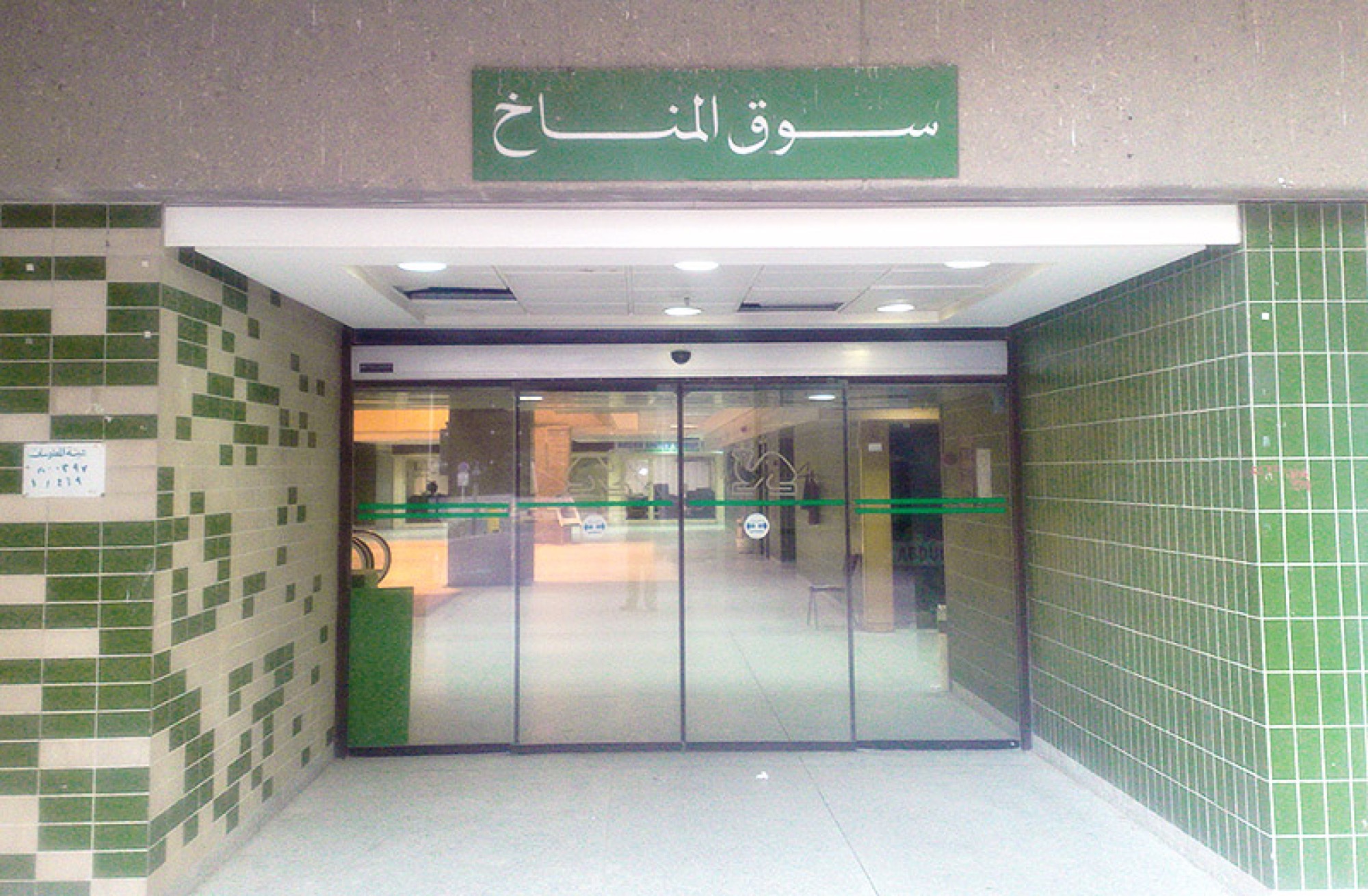
The Souk al-Manakh occupied a multi-story brutalist concrete building designed by The Architects Collaborative (TAC), the Cambridge, Massachusetts firm founded by Walter Gropius, and constructed between 1973 and 1975 in the Jibla district at the heart of Kuwait City. The name “Manakh” derives from the Arabic “nakha,” referring to a camel in a sitting posture, because the site had historically served as a resting place for camel caravans arriving in Kuwait’s old commercial quarter. As documented in the Aga Khan Visual Archive at MIT, the building’s lower levels housed commercial retail space arranged around a central covered court, with an entrance and exit ramp forming a solid core; three stories of air-conditioned parking occupied the middle floors; and the top level featured office space cantilevered outward behind an external gallery of arched openings in sandblasted concrete. The structure was part of a wave of modernist souq complexes commissioned during Kuwait’s oil-boom years, when foreign architectural firms including TAC, Skidmore Owings & Merrill, and Candilis-Josic-Woods reshaped the cityscape, as analyzed in Roberto Fabbri, Sarina Wakil, and Kevin Mitchell’s study “Modern Architecture Kuwait, 1949–1989” (2016). By 1978, this parking garage had been informally converted into an over-the-counter trading floor. The air-conditioned interior filled with men in traditional white dishdashas, telephones in hand, conducting trades at a frantic pace. Ben R. Craig, in his Federal Reserve Bank of Cleveland Economic Commentary “The Souk al-Manakh Crash” (2019), described the surreal contrast: an unregulated exchange housed in a converted parking structure that, at its peak, ranked as the third-largest stock market in the world by capitalization, behind only the United States and Japan. The physical setting—utilitarian concrete floors, fluorescent lighting, no formal trading posts or electronic boards—stood in stark incongruity with the billions of dollars changing hands through handwritten post-dated checks passed between traders on the garage floor.
The Souk al-Manakh, being a repurposed parking garage, possessed no formal decorative program or artistic commissions of the kind associated with purpose-built exchanges. Its aesthetic was that of raw brutalist concrete: sandblasted arches, functional ramps, and exposed structural elements typical of 1970s Gulf modernism. The building’s visual interest lay not in ornament but in the striking incongruity between its utilitarian shell and its extraordinary financial function—a juxtaposition frequently noted in journalistic and scholarly accounts. The most significant cultural representation of the Souk al-Manakh is the theatrical play “Fursan al-Manakh” (Knights of the Stock Exchange), written and performed by the celebrated Kuwaiti actor Abdulhussain Abdulredha in 1983, just months after the crash. Abdulredha, often called “the fourth tower of Kuwait,” used satirical comedy to dramatize the mania, the reckless speculation, and the devastating aftermath that rippled through Kuwaiti families and society. The play was controversial within Kuwait and the wider Gulf, as it laid bare the social dynamics—greed, hubris, the breakdown of traditional merchant ethics—behind the crisis. NPR’s “The Indicator from Planet Money” revisited the story in a 2019 episode titled “The Bubble That Broke Kuwait.” The visual culture of the crisis itself centers on the post-dated check: handwritten instruments, often for staggering sums, that served simultaneously as purchase receipts, credit instruments, and transferable securities. These paper artifacts, totaling an estimated $94 billion by the time of the collapse, constitute an extraordinary archive of speculative excess—financial documents whose face values exceeded the GDP of most nations.
The Souk al-Manakh stood in the Jibla district of Kuwait City, opposite the Old Souk (Souq al-Mubarakiya), at the historic commercial heart of the capital. This location placed it within walking distance of the official Kuwait Stock Exchange (the Boursa), which had been formally established in 1977 in a separate facility. The proximity was significant: the two markets operated in parallel yet under radically different regulatory regimes, with the official Boursa subject to strict listing requirements and the Souk al-Manakh entirely unregulated. As Craig noted in his Cleveland Fed study, the Kuwaiti government introduced rules intended to prevent interaction between the two markets—banks were forbidden from trading on the Souk or lending for Souk purchases—but these barriers proved porous in practice. Kuwait City itself, a compact metropolis on the southern shore of Kuwait Bay at the northwestern corner of the Persian Gulf, was by the late 1970s awash in petrodollar wealth from the world’s largest proven oil reserves per capita. The Iran-Iraq War, which began in September 1980, paradoxically boosted oil revenues in the short term while also driving capital flight from Iran into Kuwaiti financial markets. Ragaei El Mallakh, in “Kuwait: Trade and Investment” (Routledge, 1979), documented how the small nation’s financial sector had grown disproportionately large relative to its geographic size and population of roughly 1.4 million, creating a hothouse environment for speculation. The 1977 crash on the official Boursa, in which the market fell approximately 16 percent, had prompted a government bailout of roughly $550 million and the suspension of new company incorporations from 1977 to 1979. Mohammed A. Al-Yahya, in “Kuwait: Fall and Rebirth” (Kegan Paul International, 1993), argued that the government’s response to the 1977 crisis—shielding investors from losses while tightening official-market regulations—inadvertently drove the most aggressive speculators into the unregulated Souk al-Manakh, sowing the seeds of the far larger catastrophe to come.
The Souk al-Manakh emerged informally around 1978, when Kuwaiti businessmen, constrained by the strict regulations imposed on the official Boursa after the 1977 crash, began incorporating companies in neighboring Gulf states—particularly Bahrain and the United Arab Emirates—and trading their shares in the parking garage. By 1979, the market had established itself as a recognizable venue for over-the-counter dealing in these offshore Gulf company shares. Fida Darwiche, in “The Gulf Stock Exchange Crash: The Rise and Fall of the Souq Al-Manakh” (Croom Helm, 1986), traced how the market grew at a phenomenal rate throughout 1981 and early 1982, fueled by manic speculation in which inexperienced investors gambled huge sums on shares of shell companies with minimal assets and virtually no earnings. The speculative mechanism that powered the bubble was the post-dated check. Under Kuwaiti commercial law, a check was theoretically payable upon presentation regardless of its written date, but in practice the post-dated check functioned as a forward contract: a buyer would acquire shares by writing a check dated three, six, or twelve months in the future, paying a premium of 35 to 400 percent above the stock’s current value—effectively an annualized interest rate exceeding 100 percent. These checks could be endorsed to third parties, used as collateral for further purchases, or discounted for cash, creating what Craig described as a self-reinforcing cycle of leverage with no clearinghouse, no margin requirements, and no institutional oversight. Stock prices surged 20 to 50 percent per month; the Gulf Company for Industrial Development rose fifteenfold; Gulf Medical, a failed real estate project converted to a hospital, saw its IPO oversubscribed 2,600 times and its shares rise 800 percent. By mid-1982, the combined capitalization of Kuwait’s official and unofficial markets exceeded that of the London Stock Exchange, ranking third globally. The collapse began in August 1982. A female dealer presented a post-dated check written by Jassim al-Mutawa—a young Passport Office employee who had become one of the most prolific speculators in a group known as “The Cavaliers”—and the check bounced. Al-Mutawa had accumulated an estimated $14 billion in stock positions financed entirely by post-dated checks, making him perhaps the largest individual debtor in history. On August 23, the Kuwaiti government announced it would not support the market. Trading ceased instantly: as one participant recalled, “There were simply no bids.” When the Ministry of Finance ordered all outstanding checks surrendered in September 1982, investigators discovered approximately 29,000 post-dated checks with a total face value of $94 billion—equivalent to $90,000 for every Kuwaiti citizen, and roughly four times the country’s GDP. Some 6,000 investors were implicated; eight major dealers (“The Cavaliers”) accounted for $55 billion of the obligations. The aftermath was devastating. All Kuwaiti banks except the National Bank of Kuwait became technically insolvent, sustained only by Central Bank support. The government established a $1.7 billion fund to compensate small investors and, in April 1983, created the Corporation for the Settlement of Company Forward Share Transactions to untangle the web of claims. As A. A. Elimam, M. Girgis, and S. Kotob documented in their landmark paper “A Solution to Post Crash Debt Entanglements in Kuwait’s al-Manakh Stock Market” (Interfaces, 1997), the Corporation employed linear programming models to identify insolvent traders and apportion payments—a mathematical approach that provided the basis for court decisions and avoided an estimated $10 billion in litigation costs. By September 1985, creditors received initial payments, but as late as 1989 over 25 percent of obligations remained unresolved. The Souk al-Manakh was permanently closed and replaced by a new, tightly regulated Kuwait Stock Exchange. The IMF’s Occasional Paper “Kuwait: From Reconstruction to Accumulation for Future Generations” (1997) noted that Kuwait’s financial system had yet to fully recover from the 1982 crisis even fifteen years later, and the crash, coupled with declining oil revenues from the Iran-Iraq War, helped push the entire Gulf region into recession.
The Souk al-Manakh traded shares in approximately 45 Kuwaiti-founded companies and 38 foreign firms, nearly all incorporated outside Kuwait in Gulf jurisdictions—principally Bahrain and the United Arab Emirates—that imposed minimal regulatory requirements. These were overwhelmingly closed-end investment companies and holding companies, many of which Darwiche characterized as “paper entities with minimal assets and virtually no earnings.” Few published annual reports; some had no operations at all. The most actively traded names included the Gulf Company for Industrial Development, Gulf Medical Projects, and various so-called “Funds of Funds”—investment trusts that held shares in other speculative trusts, creating recursive layers of leverage. As the bubble expanded, promoters launched “Funds of Funds of Funds,” trading at premiums far exceeding the underlying asset values. The principal financial instrument was the post-dated check, which functioned simultaneously as a purchase receipt, a credit instrument, and a negotiable security. A buyer would write a check dated months into the future for a price well above the current share value; the seller, now holding a forward claim, could endorse the check to a third party at a discount, use it as collateral, or present it to another dealer in exchange for additional shares. Craig described this mechanism as creating “a form of credit collateralized by the future delivery of a stock”—in effect, an unregulated forward contract with no clearinghouse to monitor exposures or enforce margin calls. The system generated enormous implicit leverage: a single trader could build a portfolio of billions of dollars backed entirely by a chain of post-dated paper promises. The absence of any netting or settlement infrastructure meant that when al-Mutawa’s check bounced, the cascade of defaults propagated through the entire network almost instantaneously, as each check’s validity depended on the solvency of every subsequent endorser in the chain.
Images will be added as the project develops. Photographs by Larry Ng and from research sources.