Kızlarağası Han (Kemeraltı Bazaar)
İzmir (Smyrna), Turkey · Established 1744
This site requires authorization to access.
To request access, contact
william.goetzmann@yale.edu
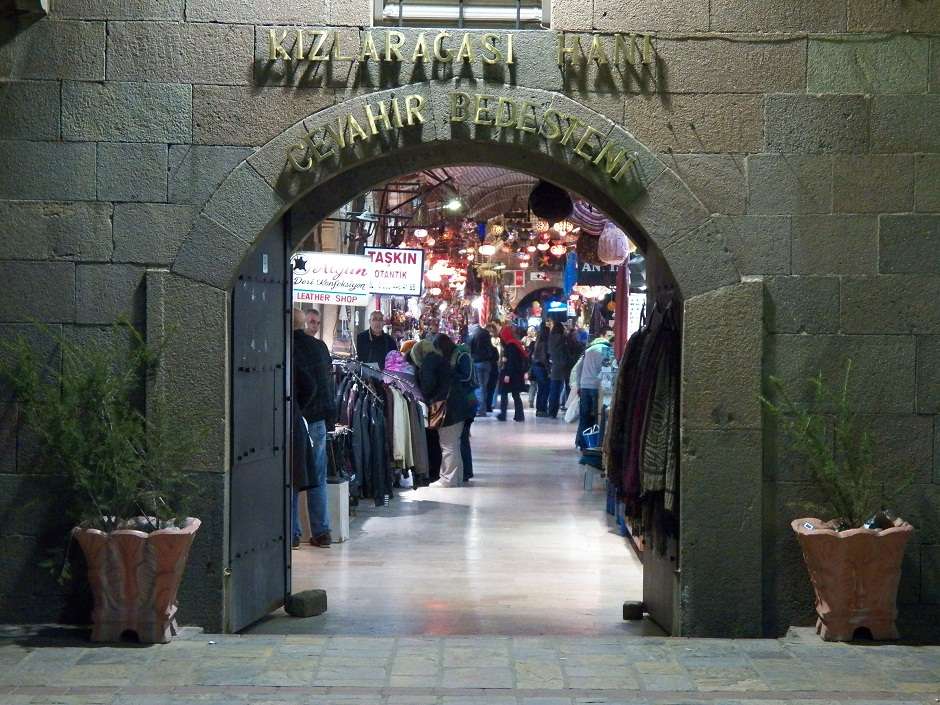
The Kızlarağası Han is the best-preserved of the great commercial inns (hans) of Ottoman Smyrna, raised in 1744 for Hacı Beşir Ağa, the powerful Kızlarağası or Chief Harem Eunuch (Darüssaâde Ağası) who served under Sultans Ahmed III and Mahmud I and from whom the building takes its name (Turkish Ministry of Culture and Tourism, İzmir Directorate; Kültür Portalı, "Kızlarağası Hanı"). Like the long-distance caravanserais of the Anatolian interior, it is a two-storey block organised around a large rectangular courtyard of roughly 500 square metres and pierced by four gates. The ground floor, opening onto the court through an arcade, held shops, storerooms and stabling for the camels of arriving caravans, while the upper floor carried the merchants' lodging cells, reached from a continuous gallery that runs around the courtyard (Vikipedi, "Kızlarağası Hanı"). Incorporated into the fabric is a two-storey bedesten, the secure, lockable covered market reserved for the most valuable goods, an arrangement that contemporaries compared to the İç Bedesten at the heart of Istanbul's Grand Bazaar. Between 1988 and 1993 the han was comprehensively restored — almost entirely rebuilt from the foundations apart from the northern wing — and reopened in the mid-1990s as a craft and antiques market, today the single most visited monument of the Kemeraltı bazaar (Vikipedi, "Kızlarağası Hanı"; Kültür Portalı).
As a working caravanserai rather than a princely foundation, the Kızlarağası Han carries little figurative decoration; its visual character derives instead from the rhythm of its arcaded courtyard, the rough-cut stone and brick of its piers, and the play of light across the two-tiered gallery. The principal ornamental accents are the carved stone portals of its four gates and the dedicatory inscription recording its patron, together with the courtyard fountain (şadırvan) that originally provided water for ablution and refreshment at the centre of the court (Vikipedi, "Kızlarağası Hanı"). A separate Kızlarağası Hanı fountain (çeşme) set into the structure is itself a registered item of cultural inventory in İzmir (Kültür Envanteri, "Kızlarağası Hanı Çeşmesi"). The adjoining Hisar Mosque, the largest in İzmir and built in the late sixteenth century, supplies the han's monumental neighbour and, with the surrounding maze of arched lanes that give Kemeraltı its name ("under the arches"), frames the inn within one of the most richly textured Ottoman commercial townscapes to survive on the Aegean coast.
The han stands in the Konak district at the heart of Kemeraltı, the sprawling Ottoman bazaar that curves along the line of the old inner harbour of Smyrna, following the arc of a bay that was progressively filled in from the seventeenth century onward. Kemeraltı grew up in the second half of the seventeenth century as a refuge and trading ground for merchants and travellers and expanded as French, English, Dutch and Venetian traders, followed by Greeks from the mainland and the islands, settled around it; the result was one of the largest and oldest continuously functioning open-air markets in the world, threaded with mosques, churches and synagogues that mirror the city's plural population (alaturka.info, "Historical Kemeraltı Bazaar of İzmir"; Daily Sabah, "Kemeraltı: İzmir's Grand Bazaar"). The Kızlarağası Han sits beside the Hisar Mosque near the ancient agora of Smyrna, within the zone that Turkey placed on the UNESCO World Heritage Tentative List in 2020 as "The Historical Port City of İzmir" (UNESCO World Heritage Centre, Tentative List ref. 6471).
İzmir rose in the seventeenth and eighteenth centuries to become the busiest export port of the Ottoman Aegean, the funnel through which the produce of western Anatolia reached the markets of Europe, and the hans of Kemeraltı were the working machinery of that trade. The Kızlarağası Han, founded in 1744 by a wealthy court eunuch as a charitable and income-generating endowment (vakıf), exemplifies the type: caravans arriving from the interior were unloaded, their goods stored and bonded in the bedesten, their drivers and the resident merchants lodged above, and bargains struck in the courtyard shops below (Kültür Portalı; Vikipedi). For nearly two centuries it functioned as a lodging-and-exchange house in this fashion. By the twentieth century, with the displacement of caravan traffic and the catastrophic fire of 1922 that destroyed much of Ottoman Smyrna, the surviving hans fell into disrepair; the Kızlarağası Han was rescued by a major restoration campaign of 1988–1993 and now operates as a heritage marketplace, the centrepiece of efforts to secure UNESCO World Heritage status for the historic port city (UNESCO World Heritage Centre, ref. 6471; Daily Sabah).
The han stood at the centre of an export economy built on the agricultural wealth of the İzmir hinterland. Through Smyrna and its bazaar passed the dried figs and sultana raisins of the Aydın valley, the cotton of western Anatolia, together with olive oil, tobacco, opium, valonia, dyestuffs and the carpets and silks brought in by caravan from the interior — commodities that Greek, Armenian, Jewish and Levantine (Frankish) merchant houses gathered, bonded and shipped on to Marseille, Livorno, Amsterdam and London (alaturka.info; Daily Sabah). Within the han itself, alongside lodging and storage, the courtyard and bedesten shops handled the buying and selling, sampling and warehousing of these goods, making the Kızlarağası Han one of the principal exchange-points of the most cosmopolitan commercial city of the Ottoman Aegean.
Images will be added as the project develops. Photographs by Larry Ng and from research sources.