İzmir Commodity Exchange (İzmir Ticaret Borsası), Borsa Sarayı
İzmir (Smyrna), Turkey · Established 1891
This site requires authorization to access.
To request access, contact
william.goetzmann@yale.edu
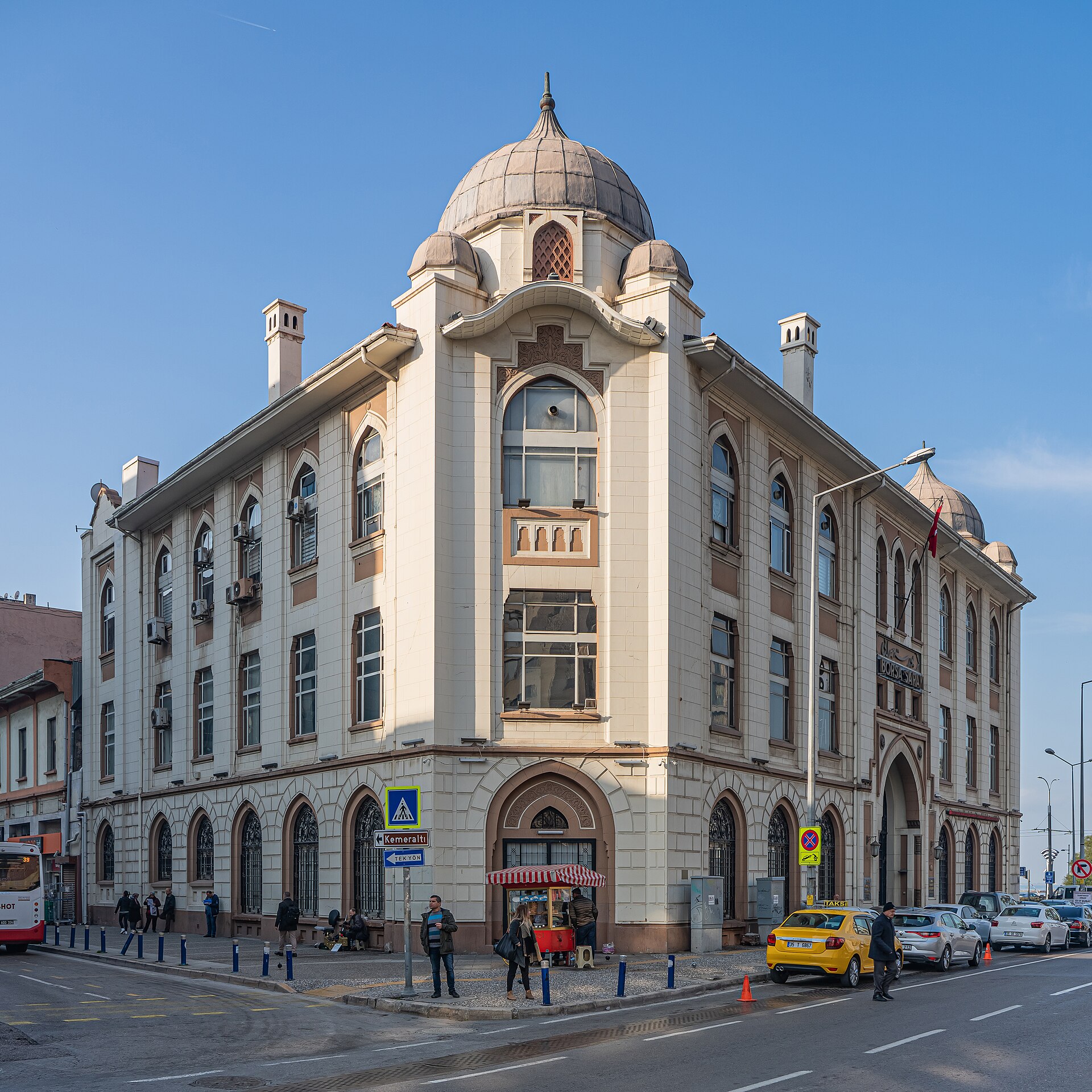
The Borsa Sarayı, or Exchange Palace, that houses the İzmir Commodity Exchange was designed by the İzmir architects Tahsin Sermet and Hüseyin Mazlum, its foundation stone laid on 25 November 1926, its construction completed on 11 June 1928, and the building opened to the public on 23 July 1928 (İzmir Ticaret Borsası, 'Tarihçe'; Turkish Wikipedia, 'İzmir Borsa Sarayı'). It is a leading monument of the First National Architecture movement (Birinci Ulusal Mimarlık Akımı) of the early Republican period, the eclectic idiom that, as Cenk Berkant and Erdem Bayazıt note in their study of Sermet's career, combined Western neoclassical massing with Seljuk-Ottoman and Turkish decorative elements ('Tahsin Sermet Bey (1889-1969)', Bitig Edebiyat Fakültesi Dergisi, 2024). The masonry structure rises three storeys above a basement; its roof is crowned by one large central dome flanked by two smaller domes, while the principal entrance opens onto a marble hall served by a triple staircase. Pointed and round-headed arches and shallow floral low-reliefs, drawn from Ottoman and Seljuk precedent, articulate the facades, lending a self-consciously national character to what was conceived as a palace of commerce. The original 1891 exchange had occupied a more modest, Art Nouveau-inflected building, and the move to the purpose-built Borsa Sarayı on the Second Cordon marked the institution's arrival as a permanent civic presence.
The artistic program of the Borsa Sarayı is restrained, befitting a working commercial institution rather than a temple or palace of state. Its principal decorative interest lies in the architecture itself -- the floral low-relief carving and the rhythm of pointed arches that translate Ottoman-Seljuk ornament into a Republican register, as documented in the building's restitution studies (PAKBEN Mimarlık, 'Borsa Sarayı Rölöve ve Restitüsyon Projesi'). The chief sculptural element is a marble bust of Mustafa Kemal Atatürk by the Istanbul sculptor Azizzade Mustafa, installed at the entrance, a fitting emblem for a building completed in the founding decade of the Turkish Republic (Turkish Wikipedia, 'İzmir Borsa Sarayı'). Beyond this the interior is finished plainly in marble; there is no major fresco, mural, or allegorical commerce-cycle of the kind found in northern European exchanges, and honesty requires noting that the building's significance is institutional and architectural rather than artistic.
The Exchange Palace stands at the foot of Gazi Bulvarı (Gazi Boulevard) in the Konak district, near the waterfront of İzmir's great bay, with Cumhuriyet Bulvarı to the west and Şehit Fethi Bey Caddesi to the east. Its position on the Second Cordon places it at the commercial heart of the city, only steps from Konak Square, the harbour quays along which Smyrna's export trade flowed, and the rebuilt grid of streets laid out after the catastrophic fire of September 1922 that destroyed much of the old Levantine city. The boulevard siting was deliberate: the new exchange was meant to anchor the modern, planned İzmir that rose from the ashes of Ottoman Smyrna, a monumental terminus on one of the city's principal axes. Nearly a century later the building remains in active use, occupied by the institutions of İzmir's commercial life and standing as one of the most recognisable early-Republican landmarks of the Aegean port.
The İzmir Commodity Exchange was founded in 1891, the first commodity exchange in Turkey, growing out of the practical problems that the swelling trade of nineteenth-century Smyrna had created -- uneven prices, poor information on supply and demand, and monetary uncertainty (İzmir Commodity Exchange, English Wikipedia). After preliminary legal frameworks adopted in 1886, two informal exchanges briefly competed before the government intervened in June 1892 and officially recognised the exchange of the merchant Nişli Hacı Ali Efendi as the city's sole legal market; it was formally inaugurated with a ceremony on 13 June 1892 and received its charter in 1895 (İzmir Ticaret Borsası, 'Tarihçe'). Hemmed in by lack of space, the exchange relocated several times before, under the presidency of Filibelizade Ferit Bey, it began construction of its own Borsa Sarayı in 1926, opening the new building in 1928 before more than a thousand guests. The institution thus bridged the late Ottoman and Republican eras, surviving the upheavals of war and the 1922 fire to remain a continuously functioning regulator of İzmir's agricultural trade.
The exchange organised the agricultural commerce of Smyrna, which in the nineteenth century had become the chief export port of the Ottoman Empire and the great commercial entrepôt of the Levant, channelling the produce of its fertile western Anatolian hinterland to European markets. Its characteristic commodities were figs, raisins (sultanas), cotton, tobacco, and olive oil -- the staples that made Smyrna's name abroad. As Elizabeth Williams's study 'Fruits of Empire' (Environment and History, 2019) shows, from the 1870s figs and raisins together drove the opening of previously unexploited districts of western Anatolia to commercial agriculture, their export running to thousands of tons annually as railways, commercial networks, and packing and shipment operations developed. A list from 1897 records the exchange trading an extraordinary range of goods -- barley, wheat, flour and semolina, maize, chickpeas, beans, sesame, poppy seed, olive oil, cotton and cotton seed, and opium among them -- buyers and sellers gathering on its floor to negotiate prices that set the terms for the whole Aegean trade.
Images will be added as the project develops. Photographs by Larry Ng and from research sources.