Grand Bazaar (Kapalıçarşı) and the Cevahir Bedesten
Istanbul, Turkey · Established 1455/56
This site requires authorization to access.
To request access, contact
william.goetzmann@yale.edu
The kernel of the Grand Bazaar is the Cevahir Bedesten -- the 'Bedesten of Gems,' also called the Inner or Old Bedesten -- erected on the orders of Sultan Mehmed II between the winters of 1455/56 and 1460/61, within a few years of the Ottoman conquest of Constantinople. As described in the Wikipedia synthesis of Çelik Gülersoy's 'Story of the Grand Bazaar' (1980) and Wolfgang Müller-Wiener's 'Bildlexikon zur Topographie Istanbuls' (1977), it is a rectangular masonry hall, roughly 45.3 by 29.5 metres internally, in which two rows of four heavy stone piers are linked by wide arches to carry fifteen brick domes set on blind drums, the central dome rising about 14.89 metres. Forty-four vaulted cellars (mahzen) are sunk into the thick inner and outer walls, and iron gates closed the four entrances at night. The structure is built of rubble masonry tied with brick arches and juniper beams, a deliberately fireproof and theft-resistant construction whose solidity, as the Discover Islamic Art / Museum With No Frontiers database notes, 'denotes a desire for permanence.' A second, larger hall, the Sandal Bedesten, with twelve piers under twenty domes, was added in the sixteenth century for the silk and textile trade. The two bedestens originally stood apart amid open lanes; after repeated fires the intervening streets were progressively roofed with masonry vaults, so that by the early seventeenth century the bazaar had coalesced into a single covered labyrinth of more than sixty streets and some four thousand shops spread across roughly 30,700 square metres, interlaced with fourteen hans, mosques and fountains.
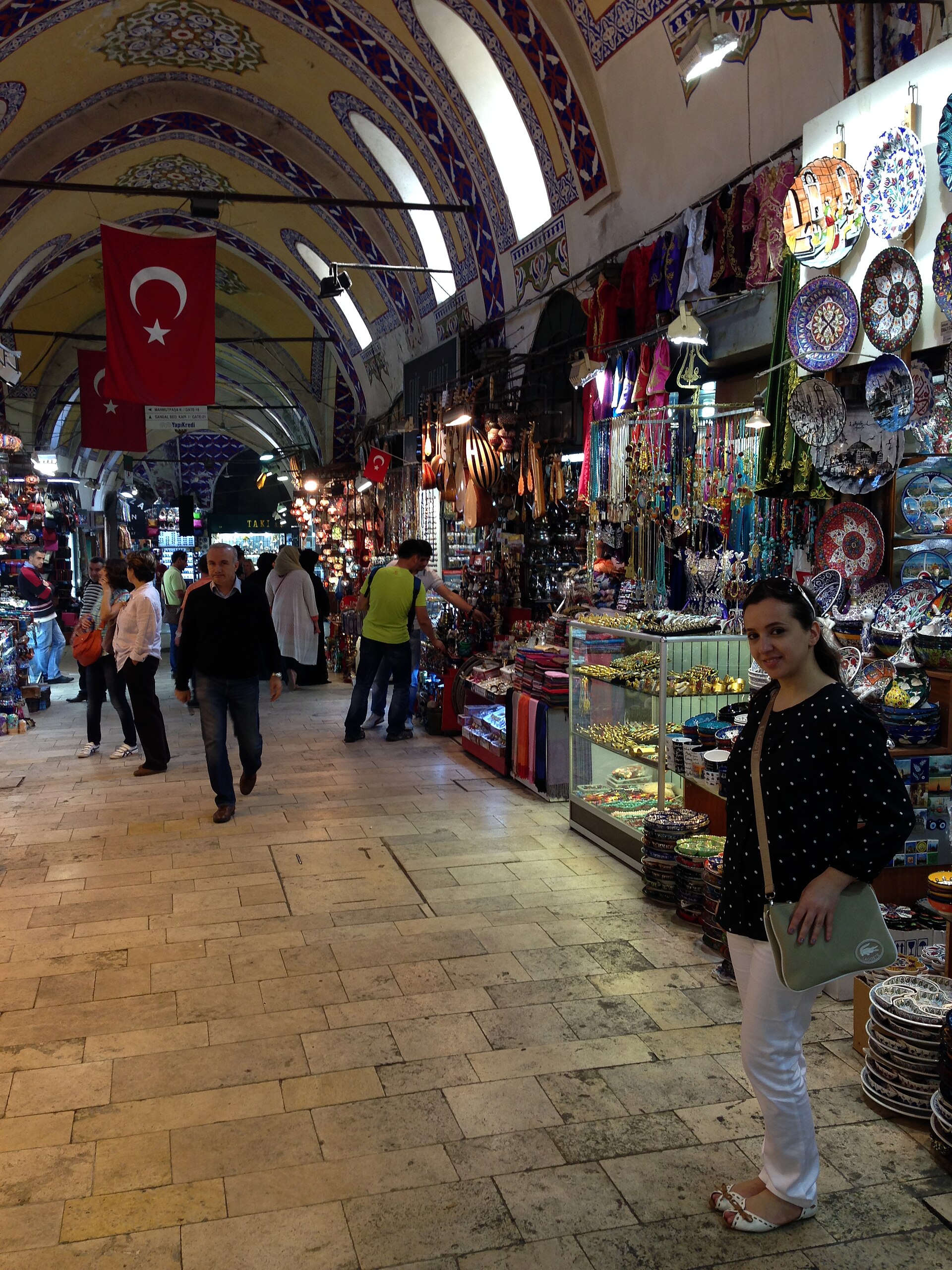
The Grand Bazaar is a work of commercial rather than monumental art, and its decorative ambitions are correspondingly modest: the visual character of the Cevahir Bedesten lies above all in the rhythm of its bare stone piers, pointed arches and the repeating canopy of fifteen domes, an austere Ottoman geometry of vaulting rather than of figural or applied ornament. The painted and gilded arabesque decoration that today brightens many of the bazaar's vaults and lunettes is largely the product of nineteenth- and twentieth-century repaintings carried out during successive restorations -- particularly those following the 1894 earthquake (completed 1898) and the campaign concluded in 1959 -- rather than original fifteenth-century work, and it should be read as a layered accretion. The bazaar's true artistic interest is the merchandise it has always displayed: the worked gold, jewels, enamels, carpets, ceramics and embroidered silks for which the Cevahir Bedesten and the surrounding goldsmiths' streets remain famous, making the building less a gallery than a permanent exhibition of the decorative arts of the eastern Mediterranean.
The bazaar occupies the spine of Istanbul's historic peninsula, on the slope between Beyazıt Square and Nuruosmaniye on the third hill of the old city, a short walk from the mosque of Mehmed II's successors and the imperial palace of Topkapı. Its foundation was a deliberate act of urban economic policy: as Halil İnalcık argues in his account of Istanbul as 'an Islamic City' and in 'An Economic and Social History of the Ottoman Empire, 1300-1914' (ed. İnalcık and Quataert, Cambridge, 1994), Mehmed II planted the bedesten at the centre of the conquered city to anchor its commercial revival, with the rents of its shops endowed as waqf to support his great mosque complex. Around this nucleus grew the dense quarter of specialised covered streets -- each historically devoted to a single trade, from the goldsmiths and gem-dealers of the Kuyumcular to sellers of arms, books, shoes, furs and spices -- knitting the bedesten into the wider network of hans (commercial inns) and the nearby Mısır Çarşısı (Egyptian/Spice Bazaar) by the Golden Horn. The Grand Bazaar must be distinguished from Istanbul's modern financial district: the bourse-style securities trading of the later nineteenth century developed across the water in Galata, while the bazaar remained the historic heart of the city's commodity, bullion and luxury commerce.
The Cevahir Bedesten was begun in 1455/56 and the surrounding market grew around it through the sixteenth and seventeenth centuries, reaching its present extent by the early 1600s; a 1638 account records some 3,000 shops, and an 1890 survey counted roughly 4,400 active shops across 30.7 hectares. The bazaar's history is punctuated by catastrophe and rebuilding: major fires swept through it repeatedly -- among them blazes recorded in the sixteenth century, the great city fire of 1660, and the fire of 1701, after which the Ottoman authorities increasingly mandated stone-and-brick construction in place of timber to limit conflagration. A strong earthquake struck Istanbul in 1894, and repairs under Minister Mahmud Celaleddin Pasha continued until 1898; a comprehensive restoration was completed in 1959, with further conservation campaigns since. As both Gülersoy and İnalcık emphasise, the bedesten functioned as far more than a shop hall: under the supervision of the merchants' guilds and night-watchmen, its locked, windowless cellars served as the city's most trusted strongroom, where merchants and even the state deposited bullion, jewels, title-deeds and cash, so that the bedesten became, in İnalcık's phrase, the centre of economic life in the Islamic city.
From its foundation the Cevahir Bedesten was reserved for the empire's most valuable goods -- jewels, worked gold and silver, precious stones, fine fabrics and antiques -- while the later Sandal Bedesten concentrated the trade in silk and other textiles, taking its name from a Bursa-woven cloth. Beyond retail exchange, the bedesten performed quasi-banking functions central to the Ottoman economy: its guarded cellars acted as safe-deposit vaults in which valuables and documents were held in trust, and the surrounding bazaar housed the sarrafs (money-changers and bankers), often Armenian, Greek and Jewish, who changed and discounted the many coinages circulating in the empire, advanced credit, and effectively set bullion and currency rates. The bazaar thus gathered Turkish, Greek, Armenian, Jewish, Persian and Levantine merchants in a single regulated marketplace where commodities, precious metals and money instruments all changed hands. That mixture of luxury retail, secure deposit and currency exchange -- documented in İnalcık and Quataert's 'Economic and Social History of the Ottoman Empire' -- made the Grand Bazaar the effective central exchange of the Ottoman world for centuries, a role it retained until specialised banking and securities institutions emerged in Galata in the nineteenth century.
Images will be added as the project develops. Photographs by Larry Ng and from research sources.