Galata Financial District
Istanbul, Turkey · Established 1261
This site requires authorization to access.
To request access, contact
william.goetzmann@yale.edu
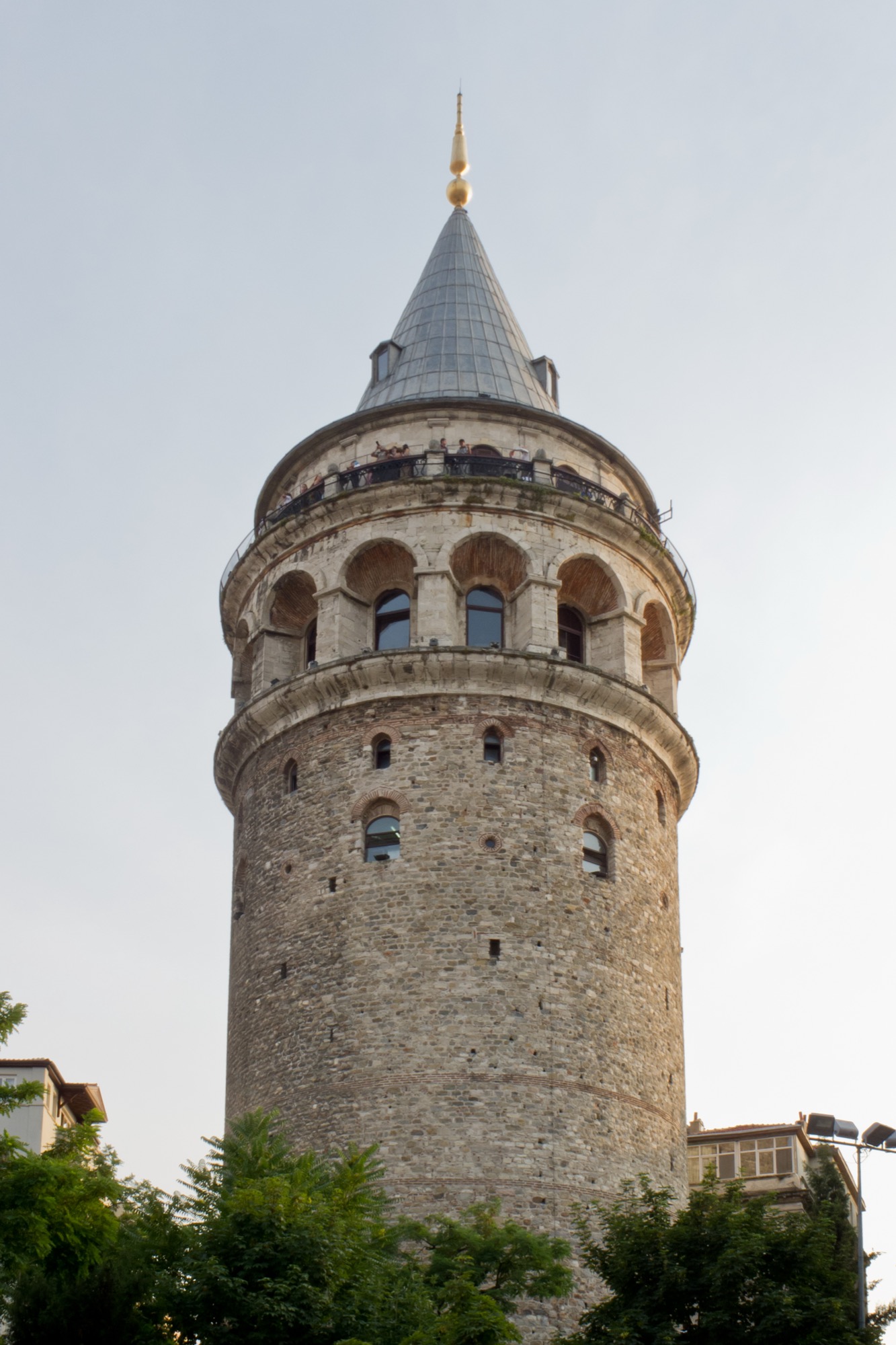
The built environment of the Galata financial district accumulated over seven centuries, beginning with the Genoese colonial infrastructure authorized by the Treaty of Nymphaeum in 1261. The earliest administrative structure was the Palazzo del Comune—the Palace of the Podestà—built in 1314 by Lord Montano De Marini, then podestà of Galata, who restored the settlement and rebuilt the communal palace, marketplace, loggia, hospital, and weigh house. As architectural historians at the Istanbul City Walls Project (Koç University) have documented, the palazzo was modeled after the thirteenth-century wing of the Palazzo San Giorgio in Genoa, establishing an architectural link between the colony and its metropolitan seat of power. A fire in 1315 damaged the structure, but De Marini repaired it in 1316. The defining landmark of the district—the Galata Tower, known to the Genoese as Christea Turris (Tower of Christ)—was erected in 1348 at the highest point of the Genoese fortification walls, functioning as the donjon of the colony’s defensive system. The tower rises sixty-seven meters, its Romanesque cylindrical shaft capped with a conical spire; the walls measure approximately 3.75 meters thick at the base, tapering upward for structural stability. The Genoese walls themselves expanded through successive diplomatic agreements—in 1304, 1349, 1352, 1387, 1397, and circa 1400—eventually enclosing a compact triangular area of approximately thirty-seven hectares with walls up to two meters thick and a fifteen-meter moat. Within the walls, commercial hans served as both warehouses and lodgings for merchants. After the Ottoman conquest of 1453, when Mehmed II granted the people of Galata a privilege preserving their property rights and customs in exchange for submission, the district’s commercial buildings evolved under Ottoman administration. The nineteenth century brought European-style bank headquarters to Bankalar Caddesi (Voyvoda Caddesi), most notably the Ottoman Bank building designed by the Levantine architect Alexandre Vallaury and completed in 1892, its street-facing façade rendered in a neo-Renaissance vocabulary of Corinthian columns and sculpted pediments. Following the establishment of the Turkish Republic, the stock exchange relocated to the 4th Vakıf Han in Sirkeci, designed by Mimar Kemaleddin Bey in 1911 and constructed between 1916 and 1926 in the First National Architecture style (Birinci Ulusal Mimarlık Akımı), its façade combining pointed arches, İznik-inspired tile panels, and Ottoman Revivalist stone carving.
The decorative legacy of the Galata financial district spans from medieval Genoese heraldic carving to late Ottoman architectural ornament. The Genoese fortification walls bore numerous carved stone slabs displaying the coats of arms of the Republic of Genoa, the ruling podestà, and prominent colonial families. As documented in the epigraphic surveys published by the Byzantine Legacy Project, the earliest recorded slab—now lost—commemorated the establishment of the Genoese quarters in 1304. At the non-extant İç Azap Gate, the arms of the Palaiologos dynasty flanked by two arms of Genoa acknowledged Byzantine suzerainty; by the mid-fourteenth century, as the colony asserted greater autonomy, Palaiologos insignia disappeared from new commissions. A slab dated April 1, 1452, recovered from the semicircular lower wall before the Galata Tower, bears papal insignia alongside the arms of Genoa flanked by those of the Fregoso and Lomellini families, commemorating Pope Nicholas V during the podestàship of Angelo Giovanni Lomellini under Doge Pietro de Campofregoso. Three such Genoese slabs are currently displayed within the Galata Tower, and two mural slabs remain in situ on surviving wall fragments—the only examples still in their original positions. The Genoese coinage circulating in the colony likewise carried heraldic imagery: the arms of Genoa (a red cross on a white field) appeared on grossi and minuti minted for Mediterranean trade. In the nineteenth century, the decorative vocabulary shifted to European historicism. Vallaury’s Ottoman Bank headquarters on Bankalar Caddesi presented a dual decorative program: the northern street façade deployed neo-classical columns, rusticated stonework, and sculpted pediments, while the southern façade overlooking the Golden Horn employed what Fabian Steininger, writing for Global Urban History (2016), describes as “neo-Ottoman or neo-Islamic” pointed arches and ornamental eaves. The SALT Galata cultural center, now housed in the Vallaury building, preserves Ottoman Bank Museum holdings including banknotes bearing the sultan’s tuğra, share certificates with illuminated calligraphic borders, corporate seals, and bond documents—a material archive of Ottoman financial visual culture. The 4th Vakıf Han contributed Kemaleddin Bey’s Ottoman Revivalist decorative program: İznik-inspired tile panels in turquoise and cobalt, pointed-arch window surrounds, carved muqarnas corbels, and symmetrical turrets reflecting his synthesis of classical Ottoman and Germanic structural traditions.
Galata occupies the northern shore of the Golden Horn, directly across the inlet from the historic peninsula of Constantinople (Sultanahmet). This geographic position—separated from yet intimately connected to the Byzantine and later Ottoman capital—defined the district’s function as a semi-autonomous commercial gateway for nearly eight centuries. When the Treaty of Nymphaeum (1261) granted Genoa trading privileges in return for naval assistance to Emperor Michael VIII Palaiologos, the Genoese received a long, narrow strip of coastline west of the existing Fort of Galata, measuring roughly one kilometer in length. Philip Mansel, in Constantinople: City of the World’s Desire, 1453–1924 (John Murray, 1995), describes how Galata had “become the Shanghai of the Levant: a semi-independent colony taking control of regional commerce from the dying Byzantine Empire.” The walled Genoese quarter expanded through successive treaties—eastward in 1352, northwestward in 1387, westward into the Spiga district in 1397, and east into Lagirio around 1400—eventually forming a compact triangular enclosure of approximately thirty-seven hectares with a circumference of about 2.5 kilometers. The street plan within the walls followed the steep topography rising from the waterfront to the Galata Tower at the summit, with narrow commercial lanes radiating downward to the maritime gates and harbor quays. After the Ottoman conquest in 1453, Sultan Mehmed II appointed a subaşı (voivode) and a qadi, placing Galata under direct Ottoman administration while preserving the commercial infrastructure. Over centuries, the district’s identity shifted from Genoese trading colony to cosmopolitan Ottoman financial quarter. By the late nineteenth century, Bankalar Caddesi (Banks Street)—the former Voyvoda Caddesi—had become what Edhem Eldem documented in Bankalar Caddesi: Voyvoda Street from Ottoman Times to Today (2000) as the empire’s financial center, concentrating the headquarters of the Ottoman Bank, the Banque de Salonique, the Crédit Lyonnais, and numerous insurance companies within walking distance of the Karaköy Tünel railway (opened 1875), the second-oldest underground railway in the world after London’s Metropolitan line.
The financial history of Galata begins with the Treaty of Nymphaeum, signed in March 1261 between the Genoese Republic and the exiled Byzantine Emperor Michael VIII Palaiologos. In exchange for naval support in recapturing Constantinople from the Latin Empire, the Genoese received sweeping commercial privileges: exemption from customs duties, the right to establish trading quarters, and the authority to collect customs revenues at Galata. Halil İnalcık, in his foundational essay “Ottoman Galata, 1453–1553” and in An Economic and Social History of the Ottoman Empire (Cambridge University Press, 1994), demonstrated that by the fourteenth century, Genoese Galata collected far more customs revenue from Bosphorus shipping than Constantinople itself—an estimated eighty-seven percent of all tolls, leaving the Byzantine treasury with only 30,000 hyperpyra annually. Governed by a podestà appointed from Genoa, the colony functioned as a self-governing commune with its own palazzo, loggia, courts, and market. Kate Fleet, in European and Islamic Trade in the Early Ottoman State: The Merchants of Genoa and Turkey (Cambridge University Press, 1999), showed how Genoese merchants in Galata forged commercial partnerships with early Ottoman Turkish traders, contributing to Ottoman economic development and territorial expansion. After the fall of Constantinople in 1453, Mehmed II issued a privilege on June 1 granting the people of Galata protection as Ottoman subjects in return for submission and payment of the poll tax. Under Ottoman rule, the district’s financial functions intensified. The sarraf (money-changer) tradition, organized as the Esnaf-ı sarrafan guild, evolved from coin assaying into sophisticated credit intermediation. Şevket Pamuk, in A Monetary History of the Ottoman Empire (Cambridge University Press, 2000), traces how the Galata bankers—predominantly Armenian, Greek, and Jewish financiers such as the Camondo, Zarifi, Mavrokordato, and Köçeoğlu families—progressed from money-changing to financing the Ottoman state through tax-farming guarantees and treasury loans. The first Ottoman foreign loan, contracted in 1854 to finance the Crimean War, was mediated in part through the Galata bankers’ connections to Paris and London. In 1866, the government established the Dersaadet Tahvilat Borsası (Bond Exchange of the Sublime Porte) in Galata, modeled on the French bourse system. Speculative excess led to crisis when the 1873 Vienna Stock Exchange crash spread to Istanbul, and by 1874 the empire had defaulted on half its external debt, leading to the creation of the Ottoman Public Debt Administration (Düyün-u Umumiye) in 1881 under European creditor supervision.
The commodities and financial instruments traded through Galata evolved from medieval Genoese long-distance merchandise to modern Ottoman securities and foreign exchange. In the thirteenth and fourteenth centuries, Galata served as the western terminus of the Genoese Black Sea trading network linking Caffa (Crimea), Tana (mouth of the Don), Soldaia, and Cembalo, as documented in the UNESCO tentative listing of “Trading Posts and Fortifications on Genoese Trade Routes from the Mediterranean to the Black Sea.” The principal commodities flowing through this network included grain (with Caffa alone exporting 31,344 minas in 1384 according to colonial records), alum from the Phocaean mines—a mordant essential to the European textile industry—silk, cotton, and spices transshipped from Levantine and Central Asian caravan routes. Hannah Barker, in That Most Precious Merchandise: The Mediterranean Trade in Black Sea Slaves, 1260–1500 (University of Pennsylvania Press, 2019), documents the substantial traffic in enslaved Tatar, Circassian, and steppe peoples transshipped through Genoese Black Sea colonies to markets in Egypt, Italy, and the wider Mediterranean, with Galata functioning as a key node in this network. Bills of exchange (poliçe) facilitated long-distance payments between Genoese counting houses, and maritime insurance contracts underwrote the risks of Black Sea voyages. Under Ottoman rule, the sarraf guild in Galata handled foreign-exchange transactions, converting the diverse coinages—akce, para, kuruş, and European currencies including French francs, British pounds, and Austrian thalers—that circulated in the cosmopolitan port. As the Galata bankers grew in sophistication during the eighteenth and nineteenth centuries, they extended credit to Ottoman tax-farmers through polices and letters of credit, effectively operating a proto-banking system. The 1866 establishment of the Dersaadet Tahvilat Borsası formalized the secondary market in Ottoman government bonds, including the esham (tax-revenue annuities) and esham-ı cedid, foreign-denominated bonds issued from 1854 onward to finance the Crimean War and subsequent deficits. Gold coins and bullion were traded alongside paper instruments. By the early twentieth century, railway company shares, bank equities, and public-works concession securities also circulated on the Galata exchange.
Images will be added as the project develops. Photographs by Larry Ng and from research sources.