Isfahan Moneychangers' Bazaar (Qaysariyya)
Isfahan, Iran · Established 1052
This site requires authorization to access.
To request access, contact
william.goetzmann@yale.edu
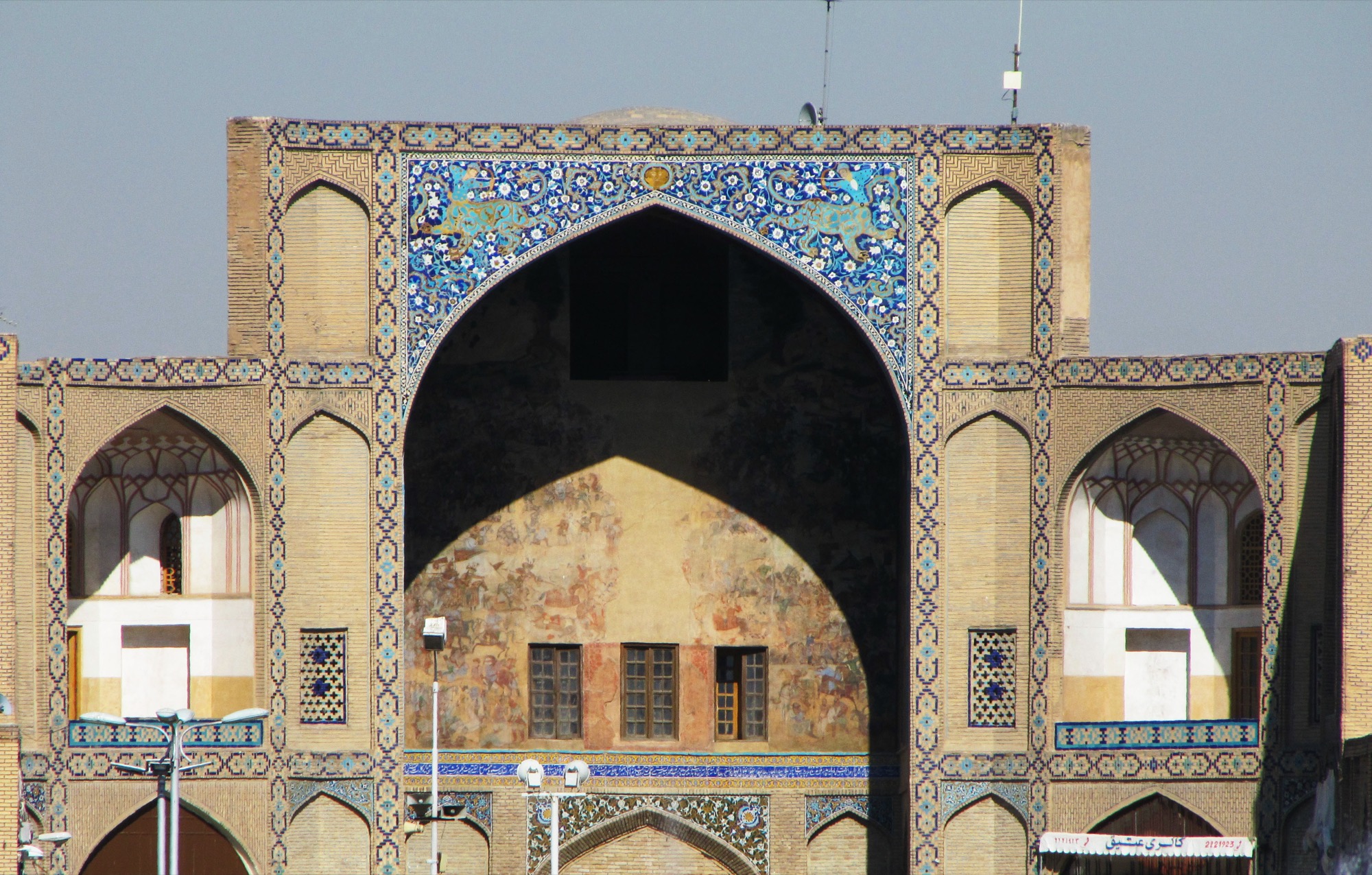
The Isfahan Moneychangers' Bazaar occupies a two-kilometer covered corridor of vaulted brick construction running roughly north-south from the Seljuk-era Kohneh Square (Meidan-e Kohneh) to the Safavid-era Naqsh-e Jahan Square, making it one of the longest roofed market structures in the world. The earliest attestation of a dedicated moneychangers' quarter in Isfahan comes from the Persian traveler Nasir Khosrow, whose Safar-nama (Book of Travels, composed ca. 1088 CE from notes of his 1046-1052 journey) records his arrival in Isfahan on 8 Safar 444 AH (June 9, 1052 CE), where he observed a bazaar section containing two hundred moneychangers' stalls, a figure suggesting an already mature financial infrastructure under Seljuk rule. The present physical fabric dates overwhelmingly from the early seventeenth century, when Shah Abbas I (r. 1588-1629) undertook the wholesale reconstruction of Isfahan as his imperial capital beginning in 1598. As Willem Floor details in his Encyclopaedia Iranica article "Isfahan xii. Bazaar: Plan and Function," the first stone of the new bazaar was laid in 1603, with construction proceeding in phases as the grand Meidan-e Naqsh-e Jahan took shape to the south. The chief architect of the urban transformation was Shaykh Bahai (Baha' ad-Din al-'Amili, 1547-1621), who conceived the bazaar corridor as the commercial spine linking the old Seljuk urban core to the new Safavid palace precinct. The monumental Qaysariyya Gate (Sardar-i Qaysariyyah), completed between 1617 and 1619, marks the southern terminus of the bazaar where it opens onto the north side of Naqsh-e Jahan Square through a towering iwan-style portal of brick masonry with muqarnas vaulting. The gate originally rose three stories: the ground floor served as the commercial threshold, the second story housed a balcony for court musicians, and the uppermost level functioned as a naqqareh khaneh (drum house) from which ceremonial trumpets and kettledrums sounded at dawn and dusk to mark the opening and closing of trade. The third story was destroyed during the Qajar period. Immediately north of the portal, the main bazaar street passes through a domed chahar-suq (four-way intersection), a characteristic Persian bazaar element where vaulted corridors cross beneath a raised dome pierced with oculi that admit shafts of natural light. At this chahar-suq, the royal caravanserai (Saray-i Shah) opens to the west and the royal mint (zarrabkhana) to the east. The Qaysariyya section proper, as distinct from the broader Grand Bazaar, constituted the imperial bazaar maintained at crown expense, housing wholesale silk merchants, goldsmiths, silversmiths, jewelers, and the state mint, as well as a public bath and a hospital. Farshid Emami, in Isfahan: Architecture and Urban Experience in Early Modern Iran (Pennsylvania State University Press, 2024), reconstructs the bazaar as a sensory environment where the interplay of light filtering through dome oculi, the acoustic reverberation of vaulted corridors, and the spatial rhythm of alternating chahar-suqs and covered passages created what he calls a distinctly early modern urban experience. The bazaar suffered catastrophic damage during the Afghan siege and occupation of Isfahan (1722-1729), when Mahmud Hotak's forces sacked the city and set fire to the commercial quarter. Subsequent Afsharid and Qajar-era restorations rebuilt much of the fabric, though the overall plan and many Safavid-period structural elements survived. The site was registered as Iranian national heritage property number 103 on January 6, 1932, and is encompassed within the UNESCO World Heritage inscription of Meidan Emam (Naqsh-e Jahan Square), designated in 1979.
The decorative program of the Qaysariyya Gate constitutes one of the most significant ensembles of Safavid architectural art in Isfahan. The portal's upper spandrels bear a celebrated pair of polychrome tile panels depicting the zodiacal sign of Sagittarius as a mounted centaur-archer drawing his bow at a dragon's tail, rendered in the haft rang (seven-color) glazed tile technique employing turquoise, cobalt blue, yellow, green, red, black, and white pigments separated by cuerda seca outlines. As Sara Sadat Ghaffari-Oskooei and Mohammad Hasan Aghajani Esfahani have demonstrated in their study "The Symbol of Sagittarius on the Tile Spandrels of Qaysariya Gate of Isfahan," the composition encodes astronomical information drawn from Persian and Islamic star catalogues: eight gold dots on the archer's costume mark the eight brightest stars of the Sagittarius constellation, while seventeen brown dots represent Libra and twenty-seven colored dots indicate Leo, linking the commercial gateway to cosmic and royal symbolism rooted in Achaemenid and Sasanian traditions of celestial kingship. A companion lion figure embodies Leo and reinforces associations with royal authority. Above the tile panels, the interior surfaces of the iwan vault retain fading fresco paintings widely attributed to Reza Abbasi (ca. 1565-1635), the foremost court painter of Shah Abbas I and namesake of the Isfahan school of painting. These murals depict scenes from Shah Abbas's military campaigns against the Uzbeks, interspersed with hunting episodes and banquet scenes featuring European envoys, the figurative compositions blending narrative vigor with the elongated, sinuous figure style characteristic of Reza Abbasi's manner. Additional wall paintings at the gate entrance show Europeans feasting, reflecting the cosmopolitan cultural exchanges that Safavid Isfahan sustained with Venetian, Dutch, and English trading communities. The broader bazaar interior displays more restrained decoration: geometric brick patterns in the vaulted ceilings, carved plaster medallions at the apices of chahar-suq domes, and calligraphic inscriptions in nastaaliq script, including a couplet attributed to the thirteenth-century poet Saadi Shirazi meditating on transience and remembrance. European artists produced invaluable visual records of the bazaar complex: Jean Chardin's Voyages de monsieur le chevalier Chardin en Perse (Amsterdam, 1711) contains engravings drawn by Guillaume-Joseph Grelot depicting the Maidan and its surrounding arcades, with more than a quarter of the plates devoted to Isfahan and Persepolis. Cornelis de Bruijn, who reached Isfahan on December 13, 1703 and remained nearly a year, produced detailed drawings later published as 320 engravings in his Reizen over Moskovie, door Persie en Indie (Amsterdam, 1711). In 1840, the French architect Pascal Coste and painter Eugene Flandin documented Isfahan's monuments with measured drawings and watercolors, published as Voyage en Perse (Paris, 1843-1854), providing the most precise pre-photographic record of the bazaar's architectural fabric, some 200 images now held in the Bibliotheque de Marseille.
The Isfahan Moneychangers' Bazaar functions as the commercial vertebral column of one of the most ambitious urban compositions in the Islamic world. Shah Abbas I's decision to relocate his capital from Qazvin to Isfahan in 1598 set in motion a comprehensive urban redesign that Shaykh Bahai conceived around two axial elements: the Chaharbagh Avenue, a tree-lined promenade flanked by the residences of foreign dignitaries and aristocratic mansions, and the Meidan-e Naqsh-e Jahan ("Exemplar of the World"), an immense public square measuring 160 by 560 meters (89,600 square meters), making it one of the largest urban open spaces anywhere in the early modern world. The Qaysariyya Gate anchors the northern edge of this square, directly opposite the Royal Mosque (Masjid-i Shah, begun 1611 by architect Ali Akbar Isfahani) on the south. To the west rises the Ali Qapu Palace, the elevated reviewing stand from which the Shah observed polo matches, military parades, and public executions on the maydan below. To the east stands the Sheikh Lotfollah Mosque (completed 1619), the private royal oratory. The bazaar corridor thus served as the commercial artery linking this grand ceremonial ensemble to the older Seljuk city clustered around the Kohneh Square and the Masjid-i Jami (Friday Mosque), whose celebrated brick dome erected by the vizier Nizam al-Mulk circa 1086–1087 anchored the pre-Safavid urban core. As the UNESCO World Heritage inscription of Meidan Emam (1979) recognizes, the square and its surrounding structures, including the Qaysariyya portico, together constitute an outstanding example of Iranian and Islamic urban design, uniting religious, commercial, political, and recreational functions within a single integrated composition. The two-kilometer bazaar corridor diverted commercial traffic from the old city toward the new Safavid precinct, drawing merchants, artisans, and moneylenders into a grander, more legible urban framework under direct royal oversight. Shah Abbas's Isfahan also commanded a pivotal position on continental trade routes: the city sat at the intersection of the east-west Silk Road corridor connecting Tabriz and the Ottoman frontier with Khorasan and Central Asia, and the north-south route linking the Caspian silk-producing regions of Gilan and Mazandaran with the Persian Gulf port of Bandar Abbas. The Zayandeh River, spanned by a series of monumental bridges including the Si-o-se-pol (Bridge of Thirty-Three Arches, completed 1602) and the Khaju Bridge (completed 1650), provided the city's water supply and supported the extensive gardens that European travelers unanimously praised. Across the Zayandeh River to the south, Shah Abbas established the Armenian quarter of New Julfa in 1606, settling over 150,000 Armenians forcibly relocated from the frontier town of Julfa in Azerbaijan and granting them a monopoly on the raw silk export trade, thereby embedding a powerful merchant diaspora within the capital's commercial geography.
The history of organized money-changing in Isfahan extends at least a millennium, reflecting the city's sustained importance as a commercial crossroads of the Iranian plateau. Under the Great Seljuk sultans Alp Arslan (r. 1063-1072) and Malik Shah I (r. 1072-1092), Isfahan served as the empire's primary capital, and the bazaar quarter that grew around the Kohneh Square and the Friday Mosque became a hub of interregional trade. Nasir Khosrow's eyewitness account of June 1052 documents a specialized bazaar section with two hundred moneychangers' stalls, implying a substantial volume of currency exchange operations serving merchants traveling the Seljuk realm. The term qaysariyya itself derives from the Arabic rendering of "Caesar" (Qaysar) and historically designated a covered, state-controlled luxury market, often adjacent to royal mints, throughout the medieval Islamic world, from Fatimid Cairo to Ayyubid Aleppo. When Shah Abbas I reconstructed Isfahan, the Qaysariyya section became the institutional heart of Safavid finance. The royal mint (zarrabkhana), situated in the eastern wing off the main chahar-suq, struck the silver abbasi coin that Shah Abbas introduced as the principal unit of account, along with gold ashrafis and copper fulus. As Rudi Matthee, Willem Floor, and Patrick Clawson demonstrate in The Monetary History of Iran: From the Safavids to the Qajars (I.B. Tauris, 2013), Safavid coins bore no face values and passed by weight, with the silver abbasi initially struck at approximately 7.7 grams of fine silver, though the currency was repeatedly debased after monetary crises in 1687-1688, 1717, and 1721. The moneychangers (sarrafs) who occupied the bazaar stalls performed essential functions: assaying coin purity, exchanging foreign currencies, providing bills of exchange (suftaja), and extending credit. A significant portion of Isfahan's sarrafs were Indian merchants, known as Baniyans or Multanis, whose community grew to an estimated 10,000-15,000 members by the mid-seventeenth century. As Rudi Matthee documents in "Between Venice and Surat: The Trade in Gold in Late Safavid Iran" (Modern Asian Studies, 2000), Indian merchants converted European gold ducats and Venetian sequins into silver mahmudis, profiting from the spread between purchase and sale rates while channeling gold eastward to Mughal India through overland and maritime routes. Stephen Dale's Indian Merchants and Eurasian Trade, 1600-1750 (Cambridge University Press, 2002) demonstrates that these Indian sarrafs also extended loans at interest rates typically ranging from eight to ten percent annually, reinvesting profits in further lending operations across both urban and rural markets. The Armenian merchants of New Julfa, whose global trade networks Sebouh Aslanian analyzes in From the Indian Ocean to the Mediterranean (University of California Press, 2011), dominated the silk export trade and maintained correspondent relationships with Armenian merchant houses in Venice, Amsterdam, Cadiz, and Surat, creating one of the most extensive commercial diasporas of the early modern period. Jean Chardin, the French jeweler who resided in Isfahan during 1673-1677 and whose Voyages (1711) constitute the most detailed European account of Safavid Persia, observed that Christians and Indian gentiles carried on the main foreign trade, while Persians traded domestically, and the Armenians managed the whole European trade. The catastrophic Afghan siege of 1722, culminating in the capitulation of Shah Sultan Husayn on October 23 after eight months of famine that devastated the population, brought destruction to the bazaar when Mahmud Hotak's forces sacked the commercial quarter and killed thousands of inhabitants including some 3,000 ulema and notables. The bazaar was gradually rebuilt under Nader Shah Afshar (r. 1736-1747) and the Qajar dynasty, though Isfahan never recovered its former status as the imperial capital. Rudolph Matthee's Persia in Crisis: Safavid Decline and the Fall of Isfahan (I.B. Tauris, 2012) traces the structural economic weaknesses, including currency debasement and the breakdown of the silk trade monopoly, that preceded the Afghan invasion. The Qaysariyya bazaar continues to function today as an active commercial market, its vaulted corridors housing metalworkers, textile merchants, and craftsmen amid the architectural fabric of the Safavid period.
The Isfahan Moneychangers' Bazaar served as the nerve center of Safavid Iran's monetary system and a critical node in early modern Eurasian trade networks. The primary function of the sarrafs in the Qaysariyya section was currency exchange and assaying: foreign merchants arriving with European gold ducats, Venetian sequins, Ottoman coins, or Mughal rupees required conversion into the local silver abbasi, the standard Safavid coin introduced by Shah Abbas I and struck at the zarrabkhana adjacent to the bazaar. As Matthee, Floor, and Clawson establish in The Monetary History of Iran (I.B. Tauris, 2013), the silver and gold coins of Safavid Persia bore no face values and passed by weight, making the assaying skills of the sarrafs indispensable for determining genuine metal content and detecting counterfeits or debased issues. The silver abbasi, initially minted at approximately 7.7 grams, circulated alongside the gold ashrafi, the copper pul, and various foreign coins, with the relationships between these denominations left to market forces rather than fixed by the state. Indian Baniyan merchants dominated the money-changing trade, converting gold into silver and profiting from the differential between the gold-silver ratio in Iran (approximately 1:10 in the early seventeenth century) and that prevailing in India and Europe. Matthee's "Between Venice and Surat" (Modern Asian Studies, 2000) traces how gold flowed into Iran primarily as Venetian ducats through Ottoman intermediaries and flowed out eastward to Mughal India, where gold commanded a premium, making Isfahan's sarraf stalls a pivot point in transcontinental bullion flows. Beyond currency exchange, the sarrafs extended credit through bills of exchange (suftaja or havala), enabling merchants to transfer funds between distant cities without physically transporting coin, an essential mechanism for long-distance trade. The Qaysariyya also housed the wholesale silk trade, the single most important commodity in Safavid Iran's economy. Rudolph Matthee's The Politics of Trade in Safavid Iran: Silk for Silver, 1600-1730 (Cambridge University Press, 1999) demonstrates that Shah Abbas established a royal silk monopoly, funneling the raw silk production of the Caspian provinces of Gilan and Mazandaran through Isfahan for export, principally through Armenian merchants of New Julfa who held the export concession. Silk was traded for European silver, sustaining the currency in circulation. Adjacent bazaar sections traded textiles (including the celebrated Isfahan brocades and velvets), carpets, spices imported from India, precious stones, metalwork, and ceramics. The caravanserais (sarays) and smaller enclosed market halls (timchas) branching off the main bazaar corridor accommodated wholesale dealers in specific commodity categories, while the open stalls along the maydan arcades served retail customers. Jean Chardin observed that the bazaar's commercial organization reflected a hierarchy of prestige, with gold and precious metals concentrated near the Qaysariyya portal and more mundane goods in the northern sections. The East India Companies, both Dutch (VOC) and English (EIC), maintained factors in Isfahan who purchased silk and other commodities, their transactions passing through the sarraf network for currency conversion and credit settlement.
Images will be added as the project develops. Photographs by Larry Ng and from research sources.