Commercial Agora of Ephesus
Ephesus, Turkey · Established 3rd century BC
This site requires authorization to access.
To request access, contact
william.goetzmann@yale.edu
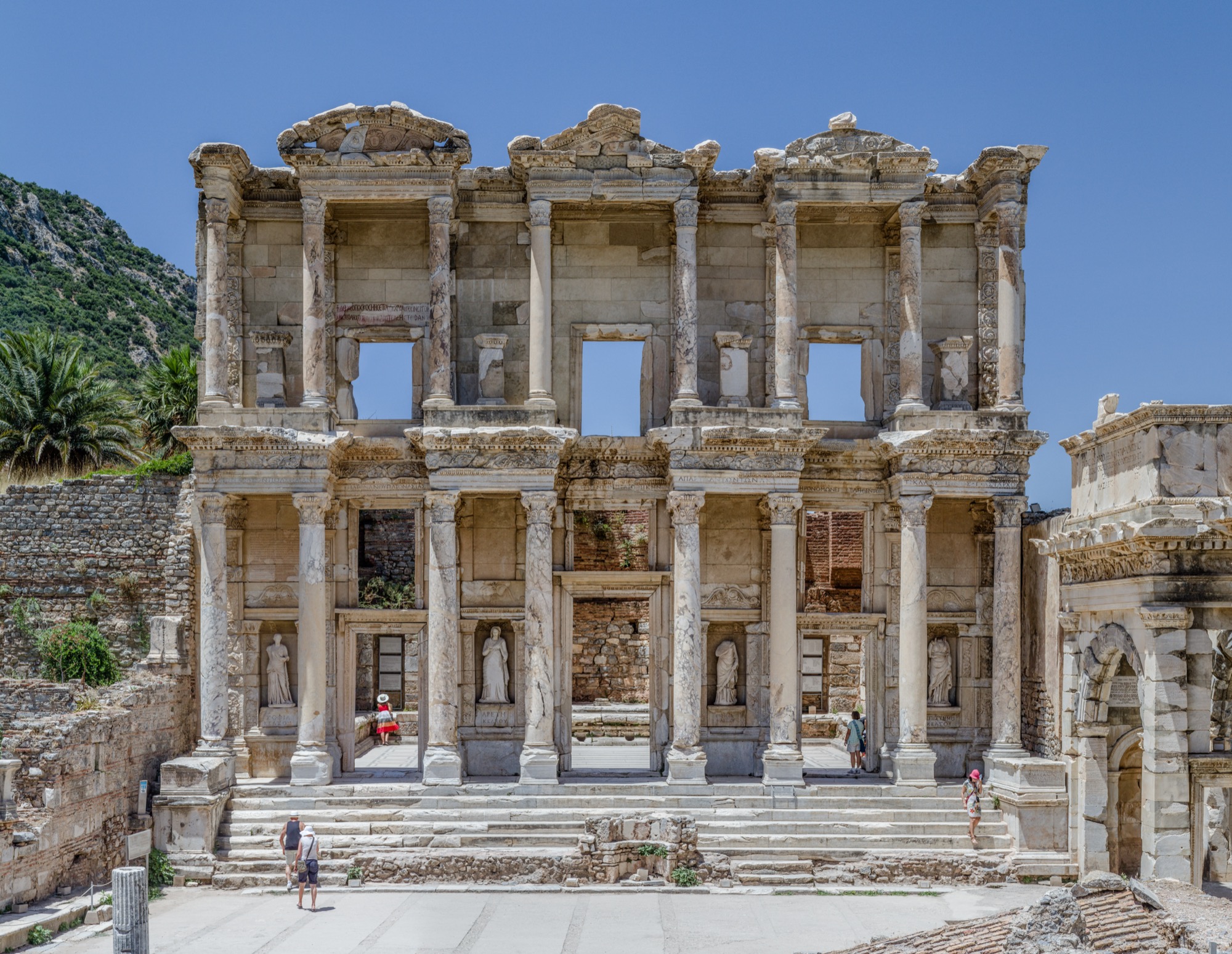
The Commercial Agora of Ephesus — known in antiquity as the Tetragonos Agora, or "Square Market," a name confirmed by inscriptions found on the site — is one of the best-preserved Hellenistic-Roman marketplace complexes in the Mediterranean world. Peter Scherrer and Elisabeth Trinkl's definitive excavation report, Die Tetragonos Agora in Ephesos (Forschungen in Ephesos XIII/2, 2006), documents a vast rectangular open square measuring approximately 111 by 111 meters, surrounded on all four sides by double-aisled colonnaded stoas 11.20 meters wide. Behind these porticoes lay approximately one hundred rooms that served as commercial shops, workshops, warehouses, and meeting halls for guild associations. Some shops featured intermediate mezzanine floors used as storerooms or offices, reflecting the intensity of commercial activity. The agora was laid out in the third century BCE atop a much earlier settlement. Austrian Archaeological Institute (OAI) excavations beginning in 1904 and resumed systematically from 1976 onward revealed five successive building phases beneath the marketplace, with evidence of an archaic settlement and necropolis dating to the eighth century BCE lying six meters below the Roman ground level. In its Hellenistic phase, the western gate displayed Ionic order columns, and a warehouse from the third century BCE was uncovered in the southwestern corner. During the Augustan period (late first century BCE), the agora was substantially enlarged, the stoas raised to two stories — indicated by staircase remains found at several points — and the monumental southeastern Gate of Mazaeus and Mithridates was erected in 4-3 BCE. Under Nero (54-68 CE), a 150-meter-long double Doric basilica was added to the northern side. The Emperor Caracalla (r. 211-217 CE) financed extensive restorations, and further restructuring occurred in the late fourth and sixth centuries CE. At the center of the agora stood a horologion — a combined solar and water clock structure measuring roughly ten by six meters — that regulated market hours and commercial timekeeping, an arrangement paralleling the famous Tower of the Winds (Horologion of Andronikos Kyrrhestes) in the Roman Agora of Athens. The Commercial Agora must be distinguished from the State Agora (Upper Agora) on the higher ground to the east, which served civic and administrative rather than commercial functions. As Sabine Ladstatter, current director of the OAI excavations since 2009, documented in Ephesos from Late Antiquity until the Late Middle Ages (SoSchrOAI 58, 2019), the commercial square continued to function in modified form into the Byzantine period, undergoing a final restructuring in the sixth century CE before the progressive silting of the harbor rendered it obsolete.
The artistic program of the Commercial Agora was intimately tied to its commercial identity. The colonnaded porticoes surrounding the square displayed hundreds of honorific statues — depicting orators, philosophers, athletes, and civic officials — whose inscribed bases provide what Helmut Engelmann, Dieter Knibbe, and Reinhold Merkelbach catalogued in Die Inschriften von Ephesos (IvE, multiple volumes, 1979-1984) as a rich documentary record of the city's social and mercantile elite. Among these were dedications by and to market officials (agoranomoi) whose oversight of fair trading was commemorated in stone. The most significant artistic monument is the Gate of Mazaeus and Mithridates (4-3 BCE), the monumental southeastern entrance to the agora erected by two freedmen — Mazaeus, manumitted by Augustus himself, and Mithridates, freed by Marcus Agrippa. Their trilingual inscriptions (Latin on the side arches, Greek on the central arch) dedicated the gate to Augustus, his wife Livia, his daughter Julia, and his son-in-law Agrippa. The gate's three arched openings, with the central arch receding 1.5 meters, bore elaborate floral carvings on the facade, while the interior vaults were lined with contrasting black and white marble. As the sole large-scale Augustan structure in Ephesus to survive the devastating earthquake of 23 CE, it testifies both to the quality of its construction and to the extraordinary social mobility that Roman commercial wealth could produce — two former slaves commissioning one of the city's grandest public monuments. A graffito of the goddess Hecate, protectress of crossroads and thresholds, was carved inside one of the arches, marking the liminal passage between the open agora and the street. Commercial inscriptions carved on the agora walls recorded market regulations, price controls, and official declarations that were publicly displayed to inform merchants and shopkeepers. One notable inscription, documented in the IvE corpus, honors an agoranomos named Eutyches, son of Menecrates, for preventing a rise in the price of bread — a vivid reminder that market regulation was commemorated as civic virtue. The legislation and official declarations about the marketplace were hung on the gate structures, informing shop owners of current rules. While the carved stone weights and measures standards common in other Greek agoras have not survived intact at Ephesus, the epigraphic record confirms that standardized commercial oversight was thoroughly institutionalized in this marketplace.
The Commercial Agora occupied a strategically pivotal position in the urban topography of Ephesus, situated at the nexus of the city's harbor, its principal processional streets, and its most prestigious public buildings. To the north, the Arcadiane (Harbor Street) — a colonnaded boulevard 530 meters long and 21 meters wide, named after Emperor Arcadius (r. 395-408 CE) though dating in origin to the Hellenistic period — connected the agora directly to the harbor. This was one of only three illuminated streets in the Roman Empire (alongside streets in Rome and Antioch), lined with fifty streetlamps and flanked by shops behind its colonnades. It served as the ceremonial entrance for emperors, visiting dignitaries, and merchant caravans arriving by sea. Immediately to the southeast, the Gate of Mazaeus and Mithridates opened onto the Marble Street at a point directly adjacent to the Library of Celsus (completed c. 117 CE), the monumental funerary library erected by Gaius Julius Aquila in honor of his father, the Roman senator Tiberius Julius Celsus Polemaeanus. The physical adjacency of library and marketplace was no accident: as Guy MacLean Rogers argued in The Sacred Identity of Ephesos (1991), public benefaction, intellectual culture, and commercial wealth were intertwined in the civic life of Roman Ephesus. To the northwest lay the Great Theatre, a structure seating an estimated 25,000 spectators carved into the slope of Mount Panayir — the very theater where, according to Acts 19, the silversmith Demetrius incited a riot against the apostle Paul, a scene that vividly illustrates the commercial anxieties of Ephesian craftsmen. Ephesus owed its commercial supremacy to its position on the Anatolian coast at the mouth of the Cayster River (Kucuk Menderes), which gave it access both to the Aegean maritime routes and to the overland trade roads penetrating the interior of Asia Minor. At its height under the early Roman Empire, it served as the de facto capital of the province of Asia and one of the largest ports in the Mediterranean world. However, as Helmut Bruckner and colleagues documented in "Demise of a Harbor: A Geochemical Chronicle from Ephesus" (Journal of Archaeological Science, 2014), the progressive alluvial silting of the harbor by the Cayster River — a process accelerated by the westward migration of the river mouth — gradually strangled the city's commercial lifeline. Despite repeated Roman dredging campaigns, the harbor became increasingly shallow. By the seventh century CE, it was effectively unusable, and the once-great commercial agora stood landlocked, kilometers from the retreating coastline.
Ephesus was among the largest and wealthiest cities of the Roman Empire, with modern estimates placing its population at 200,000 to 250,000 inhabitants at its peak in the first and second centuries CE — making it, as the second-century orator Aelius Aristides declared, "the common chancellery of Asia and her recourse in need." Guy MacLean Rogers, in The Sacred Identity of Ephesos: Foundation Myths of a Roman City (Routledge, 1991), analyzed how civic identity, religious authority, and commercial prosperity were deeply entangled in Ephesian public life, with the city's foundation myths and cult of Artemis serving as instruments of political cohesion. The Commercial Agora evolved through several distinct institutional phases. Founded in the third century BCE during the Hellenistic re-foundation of the city by Lysimachus (one of Alexander's successors, who relocated the population from the old settlement near the Artemision to the new site between Mounts Pion and Coressus), the agora initially served as a relatively modest trading square. Under Augustus and his successors, it was transformed into a grand imperial marketplace with two-story colonnades, monumental gates, and a sophisticated administrative apparatus. Inscriptions from the site, published in the IvE corpus by Engelmann, Knibbe, and Merkelbach, document the office of the agoranomos — the market superintendent responsible for certifying weights and measures, setting prices for essential commodities, policing fraud, and ensuring an adequate grain supply. The 85 BCE financial crisis in Ephesus, during which local authorities granted bankers a ten-year reprieve to repay depositors, provides early evidence of the depth and fragility of the city's financial institutions. A landmark discovery was the Customs Law of the Province of Asia (lex portorii Asiae), a Greek inscription of more than 155 lines found at Ephesus in 1976, containing regulations issued by the Roman government over nearly two centuries to control customs duties on imports and exports throughout the province. The definitive scholarly edition by Michel Cottier, Michael Crawford, and colleagues, The Customs Law of Asia (Oxford University Press, 2008), revealed that the law was originally codified under the consuls of 17 BCE and periodically revised, documenting customs rates, registration procedures, penalties for evasion, and exemptions — a bureaucratic apparatus of remarkable sophistication governing the trade that flowed through the agora. The nearby Artemision — the Temple of Artemis, one of the Seven Wonders of the Ancient World — functioned not merely as a religious sanctuary but as a major financial institution. As Dio Chrysostom (c. 40-115 CE) reported, money belonging to private citizens was deposited in the temple, and even foreign states and kings entrusted their treasures there, relying on the sanctuary's sacred inviolability for security. Stefan Karwiese, who directed the Austrian excavations and published Die Munzpragung von Ephesos I: Die Anfange (1995), documented the electrum coin hoards found in the Artemision's foundation deposits — evidence placing Ephesus at the very origins of coinage itself. The temple priests functioned as de facto bankers, accepting deposits, issuing loans, and managing what amounted to one of the ancient world's earliest banking operations.
The Commercial Agora of Ephesus was a transshipment hub of the first order, where goods from three continents converged. Tamas Bezeczky's comprehensive study, The Amphorae of Roman Ephesus (Forschungen in Ephesos XV/1, 2013), analyzed 621 amphorae — most recovered from the Tetragonos Agora itself — identifying seventy distinct amphora types spanning the Late Hellenistic through Late Roman periods. This ceramic evidence documents the importation of wine from Italy, the Aegean islands, and the Black Sea region; olive oil from the Cayster Valley, North Africa, and the Iberian Peninsula; and garum (fermented fish sauce) from production centers across the Mediterranean. Ephesian amphora production in the Cayster Valley, established during the Hellenistic period and continuing into Late Roman times, attests to a significant local agricultural export industry alongside the entrepot trade. Grain was a critical commodity, as indicated by the inscriptions honoring agoranomoi who intervened to stabilize bread prices. The agora's approximately one hundred shop-rooms, organized behind the four colonnaded stoas, housed specialized merchants dealing in textiles, spices transshipped from eastern caravan routes (including silks arriving via overland routes from China), metalwork, ceramics, and luxury goods. Ephesus maintained the second-largest slave market in the Roman Empire after Rome itself, with major sources of enslaved persons drawn from Lydia, Caria, Phrygia, Galatia, and Cappadocia — the Anatolian hinterland that Ephesus's harbor connected to Mediterranean maritime networks. Banking and money-changing were fundamental agora functions. The trapezitai (Greek bankers, literally "table-men" after the tables at which they conducted business) operated in the stoas, providing currency exchange services essential in a cosmopolitan port where coins from dozens of minting authorities circulated simultaneously. The Customs Law of Asia, inscribed at Ephesus and analyzed by Cottier, Crawford, et al. (2008), documents the bureaucratic framework governing the taxation of this trade — customs rates, registration requirements, and enforcement mechanisms for the goods passing through the harbor and into the agora. The long-distance trade routes converging on Ephesus connected Rome and the western Mediterranean to the grain-producing regions of Egypt, the spice routes of Arabia and India, and the silk roads of Central Asia, making the Tetragonos Agora one of the principal commercial nodes of the ancient world economy.
Images will be added as the project develops. Photographs by Larry Ng and from research sources.