Qatar Stock Exchange (QSE)
Doha, Qatar · Established 1995
This site requires authorization to access.
To request access, contact
william.goetzmann@yale.edu
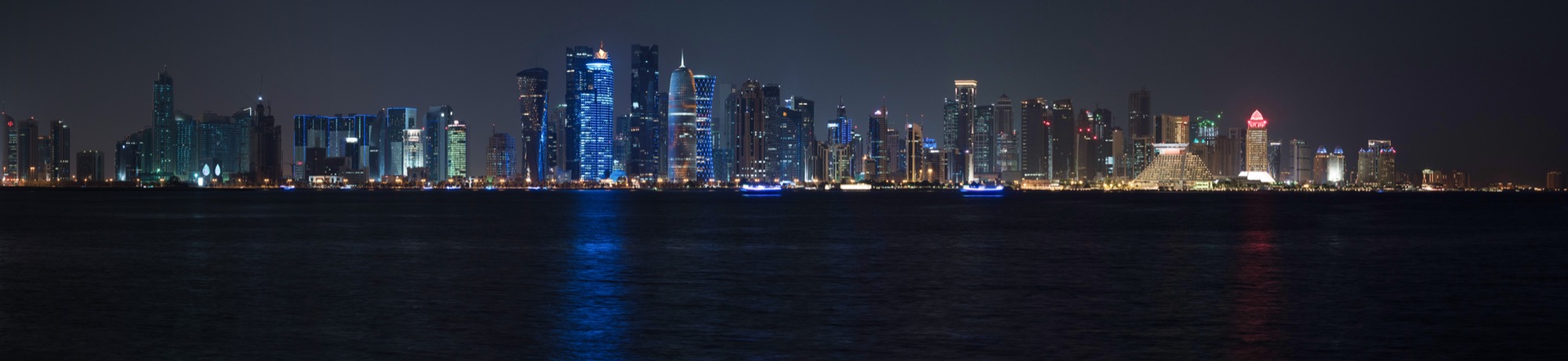
The Qatar Stock Exchange is headquartered in Al Dana Tower, a distinctive twenty-story commercial structure located in Doha’s West Bay business district. Completed in 2004 during the first wave of Qatar’s skyscraper construction boom, the tower takes its name from the Arabic word for pearl (“dana”), an homage to the nation’s pre-oil maritime heritage. Its most striking architectural feature is a spherical conference room, shaped to evoke a Gulf pearl, suspended between the building’s two wings at the uppermost floor and anchored at only two points—a feat of structural engineering that has made the tower a landmark of the West Bay skyline. The exterior façades combine Tala Silver cladding, Mountain Gray Basalt, and Botticino marble with golden-tinted glass, producing a Haussmann-inspired aesthetic adapted to the Gulf climate. The broader West Bay district in which the exchange sits has been the subject of extensive urban-design scholarship. Furlan and Faggion, in their study “The Urban Regeneration of West-Bay, Business District of Doha” (Journal of Urban Management, 2015), document how the area was master-planned in the 1980s as a transit-oriented central business district, with building orientation and massing designed to shade pedestrian routes and channel prevailing sea breezes. The exchange’s situation in this zone places it among flagship financial and governmental towers that define Doha’s contemporary skyline, including the Tornado Tower, the Palm Tower, and the Doha Tower designed by Jean Nouvel. Nearby, the Msheireb Downtown Doha regeneration project—the world’s first sustainable downtown redevelopment, master-planned by Allies and Morrison with contributions from HOK and Gensler—offers an alternative architectural vision that fuses traditional Qatari building proportions with LEED-certified sustainability, as chronicled in the project’s entry in ArchDaily (2023).
The decorative program of the exchange’s immediate environs reflects Qatar’s ambitious national investment in public art, administered since 2011 by Qatar Museums under the leadership of Sheikha Al-Mayassa bint Hamad Al Thani. While the Al Dana Tower itself follows a restrained corporate aesthetic, the West Bay financial district hosts significant sculptural commissions that frame the experience of visitors to the exchange. Most notably, Richard Serra’s monumental Cor-ten steel sculpture “7” (2011), an eighty-foot vertical column installed on the Doha waterfront near I. M. Pei’s Museum of Islamic Art, draws its title from the spiritual significance of the number seven in Islamic tradition. Serra later received a second Qatar Museums commission for “East-West/West-East” (2014), four steel plates rising forty-eight to fifty-five feet in the Brouq Nature Reserve desert, which Artforum described as bridging industrial minimalism and the Arabian landscape. Traditional Islamic geometric patterns and Arabic calligraphy also appear in the district’s public spaces, including a stainless steel calligraphy sculpture exceeding six meters in height that renders a poem by Sheikh Jassim bin Mohamed Al Thani. The nearby Museum of Islamic Art, opened in 2008 in a I. M. Pei–designed building on a purpose-built island, houses decorative arts—ceramics, metalwork, textiles, and calligraphic manuscripts—that contextualize the visual traditions informing Qatar’s contemporary architectural ornament, as surveyed in Sheila Canby’s scholarship on Islamic art collections in the Gulf region.
Doha’s transformation from a modest pearling settlement on the western coast of the Qatar peninsula into one of the world’s wealthiest capital cities constitutes one of the most dramatic episodes of urban metamorphosis in modern history. As Allen J. Fromherz documents in Qatar: A Modern History (Georgetown University Press, 2012), the town was little more than a cluster of barasti huts and coral-stone warehouses when the Al Thani family consolidated authority over the peninsula in the late nineteenth century. The pearling industry, which had sustained Gulf coastal communities for centuries, collapsed in the 1930s under the twin pressures of the Great Depression and Japanese cultured-pearl competition. Oil was discovered at Dukhan in 1940, though World War II delayed exports until 1949, after which hydrocarbon revenues began reshaping the settlement. The exploitation of the offshore North Field—the world’s largest natural gas reservoir, shared with Iran’s South Pars field—from the 1990s onward produced a second and far greater economic windfall. As documented in IMF Country Report No. 25/47 (2025) and the Columbia University Center on Global Energy Policy’s analysis of Qatar’s LNG expansion (2024), gas revenues surged past $130 billion annually, funding both the Qatar Investment Authority (established 2005, now managing over $500 billion in assets) and the physical remaking of Doha. The West Bay district, where the exchange is located, was master-planned as a central business district on reclaimed land along the Corniche. Furlan and Sipe, in “The Spatial Development Potentials of Business Districts in Doha: The Case of the West Bay” (Sustainability, 2017), analyze how this district’s forest of glass-and-steel towers became the emblem of Qatar’s ambition to position itself as a global financial hub, complementing the Qatar Financial Centre established in 2005 under Law No. 7 with its English common-law jurisdiction and 100 percent foreign-ownership provisions. The Qatar National Vision 2030, adopted in 2008, formalized the state’s commitment to economic diversification beyond hydrocarbons, emphasizing financial services, education, tourism, and a knowledge-based economy. The Third National Development Strategy (2024–2030) further targets average annual non-hydrocarbon growth of four percent, with the financial sector designated as a key driver of that transition.
The formal organization of securities trading in Qatar dates to 1995, when the Doha Securities Market (DSM) was established by law, with floor trading commencing in May 1997 with seventeen listed companies. As Jill Crystal details in Oil and Politics in the Gulf: Rulers and Merchants in Kuwait and Qatar (Cambridge University Press, 1990), the pre-oil political economy of the peninsula was dominated by pearling merchants whose influence waned as hydrocarbon revenues shifted power decisively toward the ruling Al Thani family—a dynamic that shaped the state-directed character of Qatari capital markets from their inception. The DSM adopted its first automated trading system, Horizon, in 2001, and transitioned to full electronic trading by March 2002, reflecting the broader Gulf trend toward technological modernization of financial infrastructure. A pivotal transformation came in June 2009, when Qatar Holding—the strategic investment arm of the Qatar Investment Authority (QIA)—signed an agreement with NYSE Euronext to restructure the bourse. Under the partnership, QIA retained an eighty-percent stake while NYSE Euronext acquired a twenty-percent interest for approximately $200 million, and the exchange was renamed the Qatar Exchange. NYSE Euronext replaced the existing trading engine with its Universal Trading Platform (UTP), the same system powering the New York Stock Exchange and Euronext markets in Europe, a transition completed in 2010 as documented in Euronext’s official press release of that year. Qatar Holding acquired NYSE Euronext’s remaining stake in 2013—the year Intercontinental Exchange absorbed NYSE Euronext—restoring full domestic ownership; the bourse trades today as the Qatar Stock Exchange (QSE). Regulatory architecture developed in parallel. The Qatar Financial Markets Authority (QFMA), established under Law No. 33 of 2005, serves as the independent regulator overseeing securities issuance, trading, and corporate governance. In June 2013, MSCI announced Qatar’s upgrade from Frontier Market to Emerging Market status, effective May 2014—a milestone that the Oxford Business Group’s Qatar 2015 report identifies as a catalyst for institutional capital inflows. Market capitalization grew from 18.8 billion Qatari rials in 2000 to over QR 676 billion (approximately $185 billion) by 2014, and by 2024 stood at approximately $170 billion across some fifty-five listed companies.
The Qatar Stock Exchange lists approximately fifty-five companies organized across seven sector indices: banking and financial services, industrials, insurance, real estate, consumer goods and services, telecommunications, and transportation. The market is dominated by a handful of large-capitalization firms that reflect the structure of the Qatari economy. Qatar National Bank (QNB), the largest financial institution in the Middle East and Africa by assets and serving some twenty million customers across thirty-one countries, commands a market capitalization exceeding $40 billion and anchors the banking sector. Industries Qatar (IQ), a conglomerate encompassing petrochemical, fertilizer, and steel operations controlled by QatarEnergy (formerly Qatar Petroleum), represents the industrial sector with a valuation above $22 billion. Qatar Islamic Bank, one of the oldest Islamic financial institutions in the Gulf, rounds out the top three. Islamic finance instruments occupy a prominent position on the exchange, reflecting Qatar’s role as a major center for Sharia-compliant banking and capital markets. As documented in Global Finance Magazine’s coverage of Qatar’s debt capital markets (2024) and the Saturna Capital GCC Sukuk Primer (3rd edition), the government regularly issues sovereign sukuk alongside conventional bonds—in February 2025 raising $3 billion through a dual-tranche issuance that achieved the lowest yield of any bond or sukuk issuer in the Emerging EMEA region. The Al Rayan Qatar ETF tracks the QE Al Rayan Islamic Index, providing a Sharia-compliant passive investment vehicle. The exchange also operates the Qatar Equities Venture Market (QEVM), launched as a joint initiative with Qatar Development Bank to facilitate listings by small and medium enterprises with relaxed capital and profitability requirements—the first such junior market in the Middle East and North Africa region. The QSE employs a T+2 settlement cycle administered by the Qatar Central Securities Depository, with plans to introduce a derivatives exchange and central clearing counterparty to broaden the range of tradeable instruments.
Images will be added as the project develops. Photographs by Larry Ng and from research sources.