Casablanca Stock Exchange (Bourse de Casablanca)
Casablanca, Morocco · Established 1929
This site requires authorization to access.
To request access, contact
william.goetzmann@yale.edu
The Casablanca Stock Exchange, or Bourse des Valeurs de Casablanca, has occupied several premises reflecting the city’s architectural evolution from colonial showcase to modern African financial hub. Founded on 7 November 1929 as the Office de Compensation des Valeurs Mobilières, the exchange initially operated from commercial premises within Casablanca’s Art Deco financial quarter—a district that Jean-Louis Cohen and Monique Eleb, in their landmark study Casablanca: Colonial Myths and Architectural Ventures (Monacelli Press, 2002), described as an “amalgam of Mediterranean culture” and a laboratory of modernist urbanism. By the 1930s Casablanca boasted over four thousand Art Deco buildings, constituting one of the world’s largest such ensembles, as noted in the UNESCO tentative list nomination file (2013) for “Casablanca, Ville du XXe Siècle.” The exchange’s original quarters sat within this milieu along the Boulevard du 4e Zouaves (now Boulevard Mohammed V), where commercial banks occupied elegant buildings designed by architects including Edmond Gourdain. The current Bourse de Casablanca operates from headquarters on the Avenue des Forces Armées Royales, near the modern central business district. Most recently, the creation of the Casablanca Finance City in the Anfa district has established a new architectural landmark—the 122-meter CFC Tower designed by Morphosis Architects (completed 2019), whose brise-soleil façade draws on traditional Moroccan geometric latticework, as discussed in Architectural Record (2020).
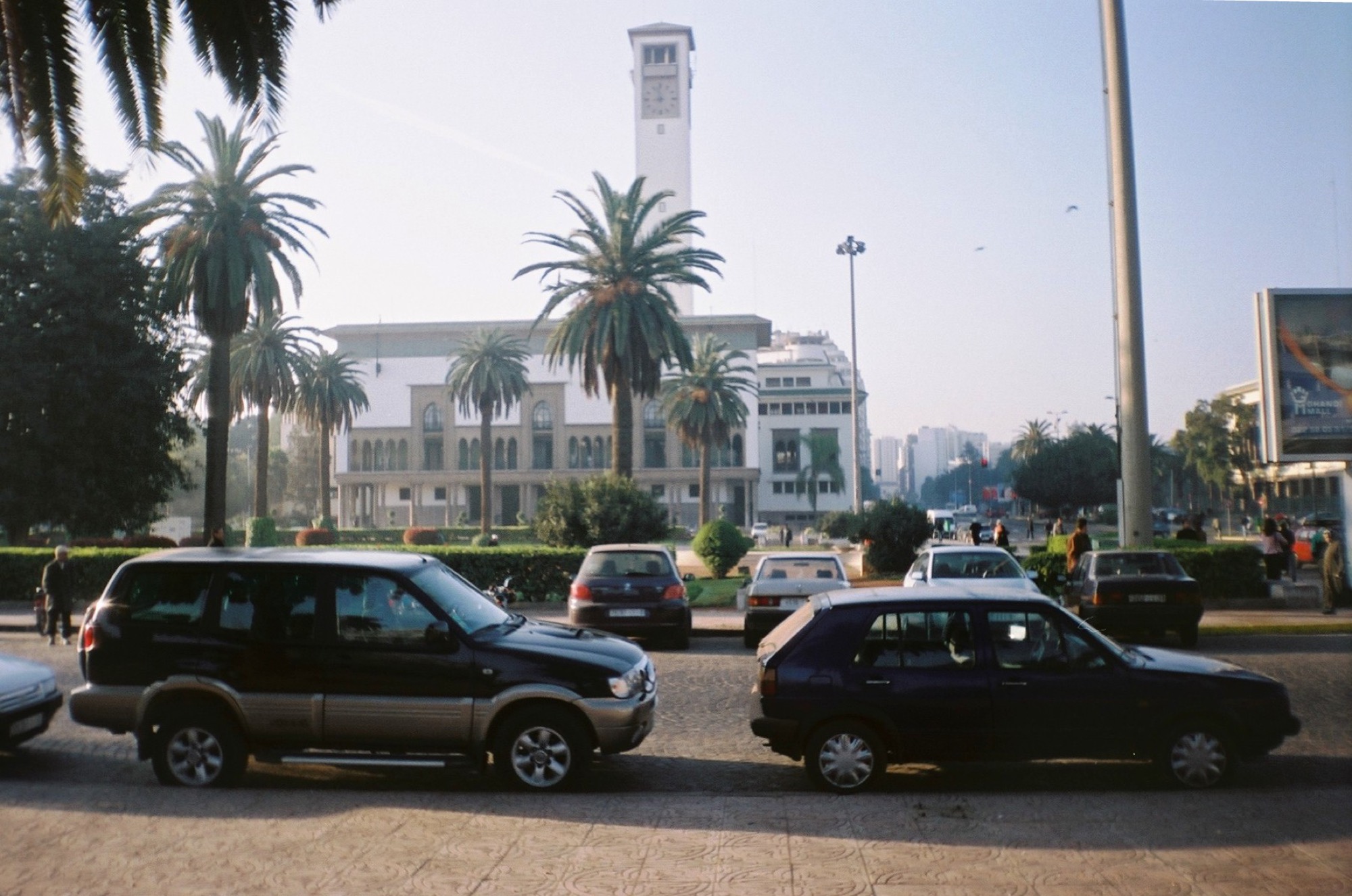
The decorative program of Casablanca’s financial quarter embodies a distinctive fusion that scholars have termed “Art Déco Mauresque”—a hybrid idiom blending Parisian geometric modernism with traditional Moroccan ornamental vocabularies. As Cohen and Eleb documented extensively in Casablanca: Colonial Myths and Architectural Ventures (2002), architects like Marius Boyer and Edmond Brion adapted Art Deco’s streamlined geometry to incorporate carved stucco with arabesques and muqarnas motifs, zellige tilework in polychrome cut-tile mosaics arranged in radiating star patterns, and wrought-iron grillework for balconies, window screens, and entrance gates. The commercial buildings along Boulevard Mohammed V display ornate iron balustrades with geometric and vegetal patterns. The civic structures on Place Mohammed V—particularly the Palais de Justice designed by Joseph Marrast (1925) with its monumental Persian-inspired iwan archway, and the Wilaya building attributed to Boyer (1927–1936) with its distinctive clock tower—integrated cedarwood carved ceilings and zellige mosaic floors that blended French symmetry with Moroccan craftsmanship. Gwendolyn Wright, in The Politics of Design in French Colonial Urbanism (University of Chicago Press, 1991), argued that this decorative synthesis served a political function: the “association” policy encouraged visual references to indigenous craft traditions as a means of legitimizing colonial modernity. The newer CFC Tower continues this dialogue, its perforated aluminum façade explicitly referencing traditional moucharabieh wooden lattice screens, translating centuries of Moroccan decorative geometry into contemporary parametric design.
The Bourse de Casablanca is embedded within a distinctive colonial urban fabric shaped by the vision of Resident General Hubert Lyautey and his chief urbanist Henri Prost. Following the establishment of the French Protectorate in 1912, Lyautey commissioned Prost to design a comprehensive city plan—making Casablanca, as Gwendolyn Wright observed in The Politics of Design in French Colonial Urbanism (1991), “a laboratory for the principles of avant-garde urbanism.” Prost’s 1914 radio-centric plan created a Ville Nouvelle radiating eastward from the port, deliberately separated from the old medina by a cordon sanitaire of open space. Boulevard Mohammed V became the commercial spine connecting the Casa-Voyageurs railway station to the Place de France (now Place des Nations Unies), with banking houses and trading firms lining its Art Deco frontages. Place Mohammed V served as the civic heart, ringed by the Prefecture (1930), the Palais de Justice (1925), and the central post office (1918). The stock exchange occupied premises within this financial district, adjacent to the port that handled Morocco’s phosphate exports—the economic engine driving the city’s growth. As Cohen and Eleb (2002) demonstrated, this spatial arrangement enacted a “dual city” logic: modern European commerce in the Ville Nouvelle, traditional markets in the medina. The recent development of the Casablanca Finance City district in Anfa represents a twenty-first-century extension of this pattern, repositioning Casablanca as a gateway between European and sub-Saharan African capital markets.
The Bourse des Valeurs de Casablanca was established on 7 November 1929 as the Office de Compensation des Valeurs Mobilières, created by the principal banks operating under the French Protectorate to facilitate the clearing of securities transactions in a colony whose economy was being rapidly transformed by phosphate extraction and port-driven trade. Andrea Calamanti, in “The Stock Exchange and the Securities Market in Morocco” (Savings and Development, Vol. 4, No. 4, 1980), traced how the institution evolved from a simple clearing office to a proper quotation market when it was reorganized in 1948 as the Office de Cotation des Valeurs Mobilières. The colonial-era financial architecture was dominated by the Banque d’État du Maroc, established in 1907 following the Algeciras Conference as a quasi-central bank under multinational oversight. Following independence in 1956, the exchange underwent further reorganization in 1967. King Hassan II’s Moroccanization dahir of March 1973 profoundly reshaped the financial landscape, requiring majority Moroccan ownership across key economic sectors. The landmark reforms of 1993–1996 transformed the exchange into a privately managed institution, established the regulatory authority (now AMMC), introduced electronic trading, and created the legal framework for modern capital markets. These reforms coincided with an ambitious privatization program that generated over 107 billion MAD in state divestiture revenue. The creation of Casablanca Finance City in 2010, consistently ranked as Africa’s leading financial center by the Global Financial Centres Index, has positioned the Bourse as a continental hub bridging European, North African, and sub-Saharan markets.
The Casablanca Stock Exchange has evolved from a colonial-era clearing house for a narrow range of French-controlled banking and mining securities into a diversified modern market listing approximately 78 companies across multiple sectors. The exchange’s identity has long been shaped by Morocco’s phosphate wealth: the OCP Group (Office Chérifien des Phosphates, founded 1920), which controls the world’s largest phosphate reserves, is a dominant presence. The banking sector constitutes the market’s largest capitalization bloc, anchored by Attijariwafa Bank—formed in 2004 from the merger of Wafabank and the Banque Commerciale du Maroc—which commands roughly 35 percent of total trading volume. Bank of Africa (formerly BMCE, established 1959) provides the other major banking pillar, with pan-African operations spanning 18 countries. The principal benchmark is the MASI (Moroccan All Shares Index), a free-float capitalization-weighted index with a base value of 1,000 set on 31 December 1991. Key sectors include telecommunications (Maroc Telecom), real estate, cement, and mining. The 1993 reforms introduced government bond trading and the alternative market for small and medium enterprises. More recent innovations include sukuk (Islamic bonds), green bonds, real estate investment trusts, and a derivatives market under development with an integrated central counterparty. As the World Bank noted in its 2024 assessment, Morocco’s capital market reforms have broadened financing channels, positioning the Casablanca exchange as the third-largest in Africa by market capitalization.
Images will be added as the project develops. Photographs by Larry Ng and from research sources.