Toqi Sarrofon (Dome of the Money-Changers)
Bukhara, Uzbekistan · Established 1534
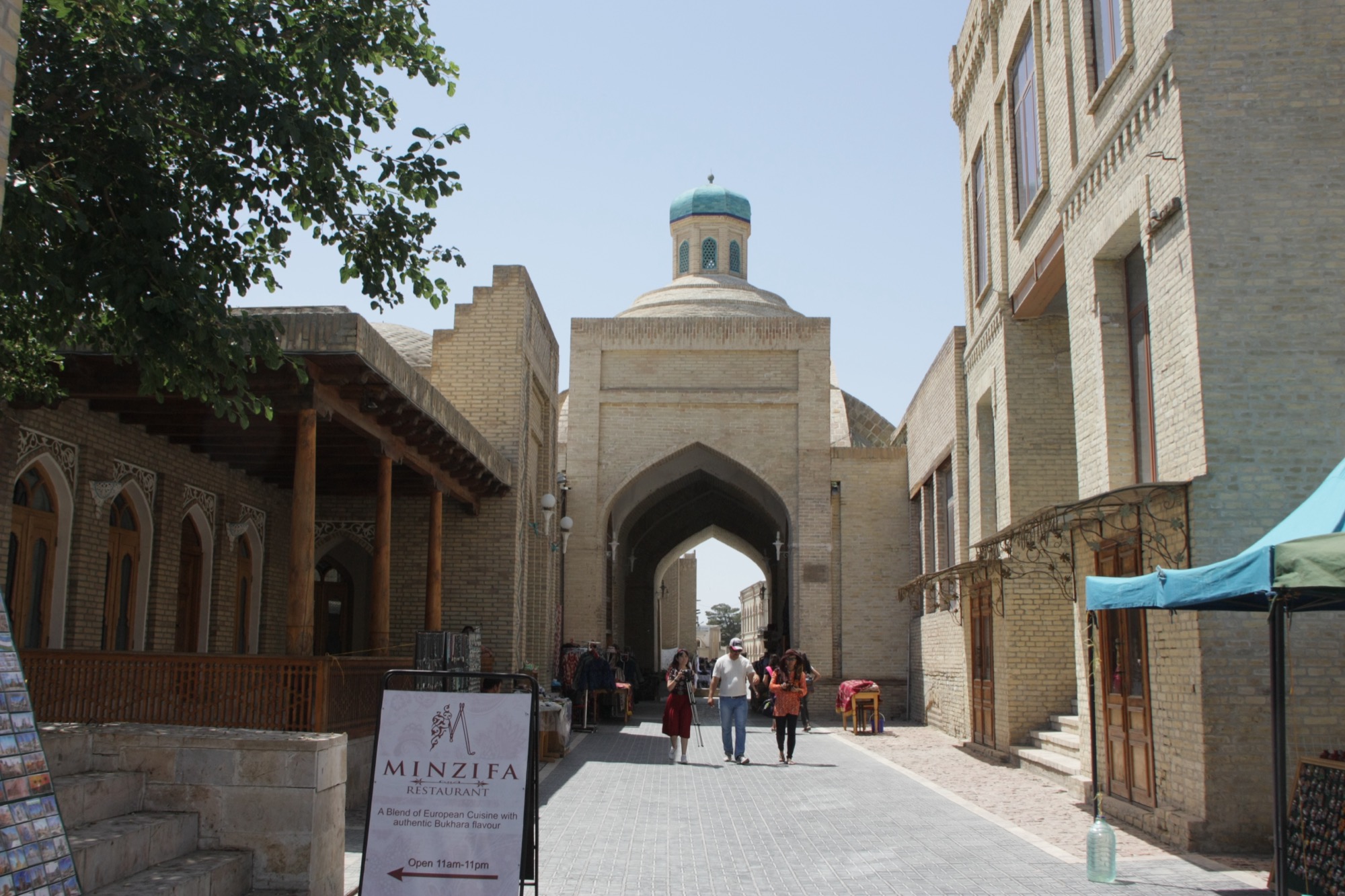
This site requires authorization to access.
To request access, contact
william.goetzmann@yale.edu
The Toqi Sarrofon was erected in 1534-1535 by order of the Shaybanid ruler Ubaydullah Khan (r. 1534-1539), the same patron who commissioned Bukhara's celebrated Mir-i-Arab Madrasa. The architect is not recorded by name, but the building belongs to a tradition of Bukharan master builders whose techniques G. A. Pugachenkova documented in Bukhoro Tim va Toqlar (Tashkent, 1969), the foundational study of the city's trading domes. The structure rises at the intersection of two streets, one leading toward the Registan and the other into the medieval suburbs, covering the ancient Shohrud canal that channeled water from the Zarafshan River through the city center. Its plan is octagonal, measuring approximately 25 by 24 meters, with the massive central dome resting on four great arches -- the so-called charzamin (four-foundation) technique common to Bukharan commercial architecture, prized for its structural stability and natural air circulation. The inner dome spans 12 meters in diameter; the outer dome rises to 16.55 meters, creating a double-shell construction in the Timurid tradition that Springer's study of Discontinuous Double-shell Domes through Islamic Eras in the Middle East and Central Asia (2009) traced back to 11th-century Persian prototypes. Small subsidiary domes and vaulted galleries radiate from the central space, sheltering rows of individual shops and workshops. The building contained three distinct programs: the money-changers' stalls beneath the great dome, a mosque oriented toward Mecca, and the Sarrafon bathhouse (hammam). During the 1980s, Soviet-era restorers undertook conservation work, rebuilding the inscriptions on the mosque walls and stabilizing the brickwork. The building is included in the national register of immovable property of the material and cultural heritage of Uzbekistan and forms part of the Historic Centre of Bukhara, inscribed on the UNESCO World Heritage List in 1993.
The Toqi Sarrofon is distinguished as the most richly ornamented of Bukhara's four trading domes, its decorative program reflecting the refined brickwork and calligraphic traditions of Shaybanid-era Transoxiana. The primary medium is baked brick, laid in intricate geometric patterns that articulate the arches and pendentives of the dome -- an ornamental technique that Pugachenkova's Bukhoro Tim va Toqlar (1969) identified as characteristic of 16th-century Bukharan commercial architecture. The entrance and exit portals bear mosaic tilework, fragments of which survive on the canopies above the doorways, their polychrome palette of cobalt blue, turquoise, and white recalling the contemporaneous tile programs of the Mir-i-Arab Madrasa. Above the door of the interior mosque, an inscription records the building's completion in 1534-1535 during the reign of Ubaydullah Bahodir Khan, executed by Muhammad Darvish Qo'noq, a master calligrapher of Bukhara, in a formal naskh script. The mosque's bookcase niche is decorated with verse 103 of Surat al-Nisa rendered in a complex thuluth script in blue, with the sacred text highlighted in gold leaf -- a fine example of Shaybanid-period devotional epigraphy. The earliest visual documentation dates to late 19th and early 20th-century Russian colonial-era photographs, following the establishment of the Russian protectorate over the Emirate of Bukhara in 1868.
The Toqi Sarrofon occupies a pivotal position in Bukhara's medieval commercial topography, sitting astride the ancient Shohrud canal at the intersection of two of the city's principal bazaar streets. One axis runs northward toward the Poi Kalon ensemble -- the monumental complex of the Kalon Mosque, Kalon Minaret, and Mir-i-Arab Madrasa -- while the other leads southwest toward the Registan, the ceremonial square before the Ark citadel. UNESCO's inscription of the Historic Centre of Bukhara in 1993 recognized this urban fabric as the most complete surviving example of a medieval city in Central Asia. The four trading domes form a linear commercial spine running roughly from the Lyabi-Hauz complex (built 1620) southward to the Poi Kalon, with the Toqi Sarrofon nearest to the Lyabi-Hauz pool and the Toqi Zargaron (goldsmiths' dome, built 1569-1570) farthest north. Between them stand the Toqi Telpak Furushon (hatmakers' dome, 1570-1571) and the Tim Abdullah Khan (silk bazaar, 1577), all built under the patronage of Abdullah Khan II. At their peak, these domes were connected by continuous covered passages and arcades, forming an unbroken commercial corridor. Bukhara's status as a Silk Road nexus, which UNESCO's Silk Roads Programme describes as nourished by merchants arriving from Persia, India, China, and Russia, made this commercial quarter a place where multiple civilizations converged. The city contained more than 60 caravanserais at its zenith, 360 mosques, and 80 madrasas.
The construction of the Toqi Sarrofon in 1534-1535 coincided with a pivotal moment in Bukharan history. Ubaydullah Khan, the fourth Shaybanid ruler of Bukhara (r. 1534-1539), was not merely a conqueror but a cultured patron -- a skilled calligrapher, musician, and prolific poet in Turkic, Persian, and Arabic under the pen name Ubaydiy. His military campaigns against Safavid Persia generated the wealth that funded both the Toqi Sarrofon and the Mir-i-Arab Madrasa, the latter financed by the sale of three thousand Persian captives. The sarraf (money-changer) profession that the dome housed was one of the most essential functions in the Islamic commercial world. As the Encyclopedia of Islam entry on sarraf notes, Muslims were largely restricted from working as money-changers, coin-testers, and collectors of customs dues. In Bukhara, these roles were frequently filled by Jewish, Hindu, and Armenian merchants who served as financial intermediaries across cultural and religious boundaries. Hindu merchants from Shikarpur (in modern Sindh) were particularly active as bankers in Bukhara by the 18th and 19th centuries, as Claude Markovits documented in The Global World of Indian Merchants, 1750-1947: Traders of Sind from Bukhara to Panama (Cambridge University Press, 2000). The Russian conquest came in 1868, when Emir Muzaffar signed a treaty making the Emirate a Russian protectorate. The treaty granted duty-free trading privileges to Russian merchants, opened navigation on the Amu Darya, and integrated Bukhara into the Russian monetary sphere, gradually eroding the autonomy of the traditional sarraf system. The emirate was finally abolished in 1920 when the Red Army stormed Bukhara.
The Toqi Sarrofon served as one of the oldest currency exchanges in the Orient, a place where the sarrafs converted the diverse coinages carried by merchants arriving from across the Eurasian landmass. The primary currency of the Bukharan Khanate was the silver tanga (tenga), standardized by Timur's monetary reform of 1392-1394 at approximately one misqal (4.8 grams), as E. A. Davidovich documented in Istoriia Monetnogo Dela Srednei Azii (History of Monetary Affairs in Central Asia). Ubaydullah Khan's own monetary reforms of 1525-1528 unified the weight standard and introduced khanate-wide overstamps to regularize the diverse coinages then circulating. The gold tilla served as the high-value unit, with one tilla worth 21 to 28 silver tangas depending on the period; the copper pul circulated for small transactions. Against these local denominations, the sarrafs evaluated and exchanged Persian silver shahis and abbasis from the Safavid realm, Mughal rupees from India, Russian kopeks and later rubles, Afghan coins, and Chinese silver and copper pieces brought along the eastern Silk Road routes. The sarraf's essential tools were the small hand-held balance scale (mizan) and the touchstone (mihakk), used to test the fineness of coins. Beyond simple spot exchange, the sarrafs participated in a broader ecosystem of credit instruments. The suftaja -- a written order directing payment at a distant location -- functioned as a precursor to the bill of exchange, enabling merchants to transfer funds without carrying coin across dangerous caravan routes, as Benjamin Geva analyzed in The Medieval Hawale: The Legal Nature of the Suftaj and Other Islamic Payment Instruments (Osgoode Hall Law School, 2019).
Images will be added as the project develops. Photographs by Larry Ng and from research sources.