Khan Mirjan (Khan al-Mirjan / Khan Murjan)
Baghdad, Iraq · Established 1359 (Jalayirid)
This site requires authorization to access.
To request access, contact
william.goetzmann@yale.edu
Khan Mirjan was built between roughly 1356 and 1359 by Amin al-Din Mirjan, the Jalayirid governor (wali) of Baghdad under Shaykh Hasan Buzurg, founder of the Jalayirid dynasty, as a waqf endowment attached to his nearby Mirjaniyya madrasa and mosque (Archnet, "Khan al-Mirjan Restoration," site record 237). What distinguishes the building from the typical caravanserai is that its inner court is not open to the sky but fully roofed: a two-storey rectangular hall is spanned by eight transverse pointed brick arches set at roughly two-metre intervals, with a wider central bay of about three metres, the vaulting stepping upward between the doubled arches and culminating in a dome on squinches, the whole rising some thirteen metres (R. Parapetti, "The Lost Mirjaniya Madrasa of Baghdad," Monumenta Orientalia, 2017). Executed entirely in fired brick in the Mesopotamian tradition, with perforated windows admitting light into the covered hall, this roofing-and-lighting solution is generally described as unique in medieval Islamic architecture. The German expedition of Friedrich Sarre and Ernst Herzfeld recorded and photographed the structure in their 'Archaeologische Reise im Euphrat- und Tigris-Gebiet' (Berlin, 1911-1920), which remains the foundational survey of the monument.
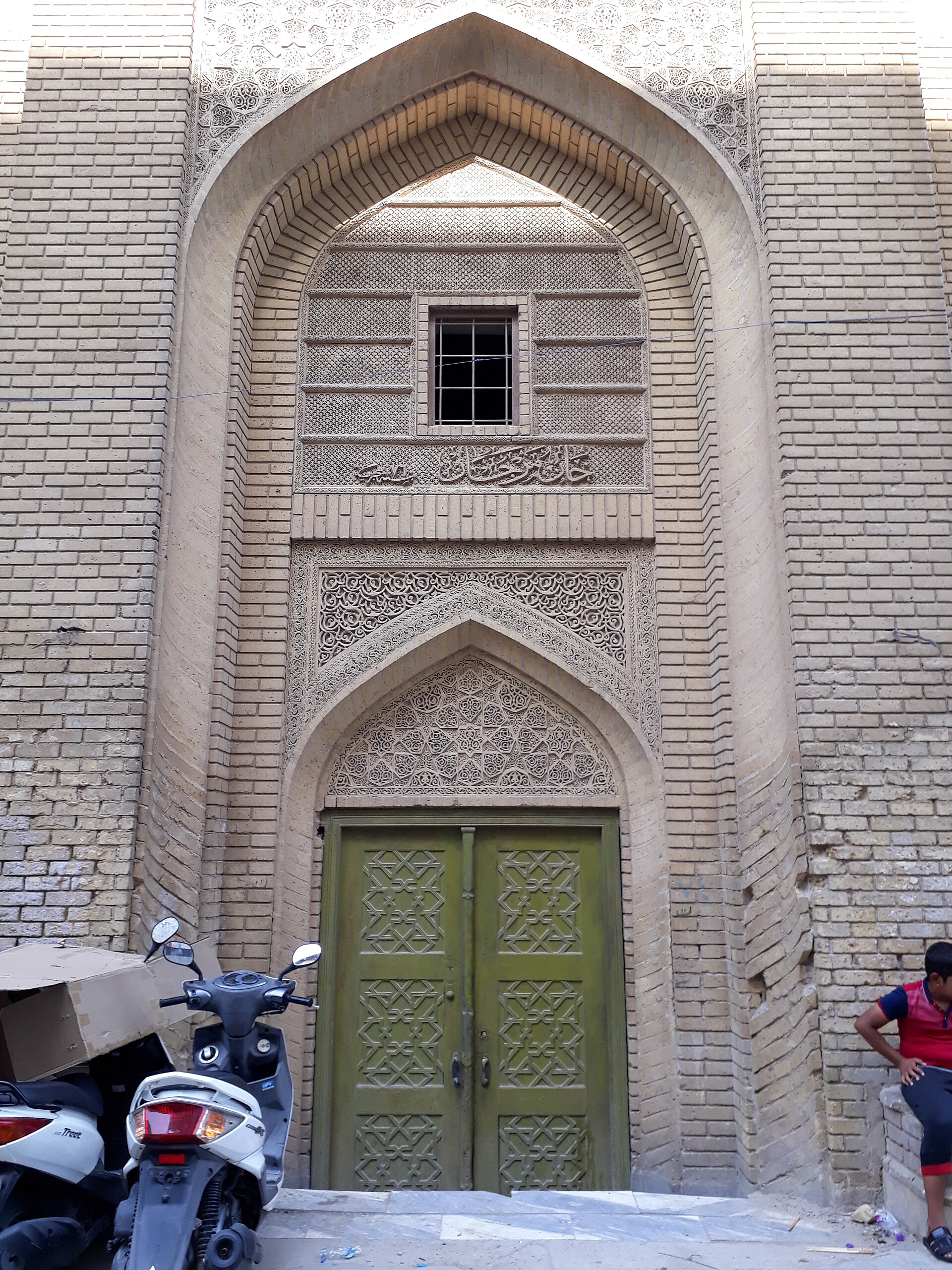
As a working commercial inn rather than a palace or shrine, Khan Mirjan carries comparatively modest decoration, and its artistic interest lies chiefly in the brickwork itself. The street facade is dominated by a tall pointed-arched pishtaq portal framed in crenellated brick, with panels of carved geometric strapwork, an inscriptional band in Arabic, and finely cut moulded brick ornament around the recessed doorway, as seen in surviving photographs of the entrance. The richer figural and floral carving associated with Mirjan's patronage survived next door at the Mirjaniyya madrasa, whose iwan displayed a pointed barrel vault with floral motifs and carved inscriptions before much of it was demolished during the 1945 widening of Al-Rashid Street (Mirjan Mosque article, Wikipedia; Parapetti 2017). Within the khan, the visual drama is architectural rather than ornamental, produced by the rhythm of the great transverse arches and the play of light from the perforated upper windows across the bare brick vaults.
Khan Mirjan stands in the Rusafa district on the east bank of the Tigris, embedded in the historic covered bazaar of Baghdad at the end of Suq al-Thulatha, in the quarter long known as the drapers' market or Suq al-Bazzazin (Archnet, site record 237). Its position deep within the souk reflects its function as a wholesale lodging and exchange for caravans arriving in the commercial heart of the medieval city, a short distance from the Mirjaniyya madrasa and mosque that Mirjan endowed in the same years. The dense fabric around it has been repeatedly altered: the 1945 enlargement of Al-Rashid Street cut through the madrasa, and twentieth-century street and infrastructure works left the khan partly below the modern grade. It remains one of the very few intact pre-Ottoman monuments surviving in Baghdad's old commercial core.
Founded under the Jalayirids, who governed Iraq from Baghdad in the wake of the Ilkhanid collapse, the khan operated for centuries as an urban caravanserai, with shops on the ground floor and lodging rooms above, exactly as stipulated in Mirjan's waqfiya (Parapetti 2017). It survived Tigris flooding and the upheavals that destroyed much of medieval Baghdad. In 1937 the building was repurposed as the Museum of Arab Antiquities, opened under the Director of Antiquities Sati al-Husri as a statement of Arab nationalist heritage. By the mid-1980s, under Saddam Hussein, it had been restored and converted into a heritage restaurant evoking an 'authentic' old-Baghdadi atmosphere, with performances of the Iraqi maqam. After long neglect it became the subject of a rehabilitation effort led by Liwan for Culture and Development together with the State Board of Antiquities and Heritage, reported in 2024 as a long-delayed restoration of one of the city's oldest surviving structures (Iraqi News, 2024; Archnet).
According to its endowment deed the khan functioned as both marketplace and inn, the ground-floor shops and upper rooms serving merchants who arrived with caravans from Persia, the Levant and the wider trans-Asian routes that converged on Baghdad (Archnet, site record 237; Wikipedia, 'Khan Mirjan'). Here traders unloaded and stored textiles, foodstuffs and other long-distance merchandise, lodged with their pack animals, and conducted wholesale dealing within the protected, roofed hall. Sited in the cloth and drapers' bazaar, the building anchored the commercial exchange of a city that, even after the Mongol sack of 1258, remained a significant entrepot linking the Gulf and Indian Ocean trade with Anatolia, Syria and the Mediterranean. In this sense Khan Mirjan represents the pre-modern, caravan-based form of the marketplace, organised around hospitality, storage and face-to-face bargaining rather than around standing securities or formal quotation.
Images will be added as the project develops. Photographs by Larry Ng and from research sources.