House of Egibi
Babylon, Iraq · Established c. 606 BCE
This site requires authorization to access.
To request access, contact
william.goetzmann@yale.edu
The Egibi archive was not recovered through systematic excavation. Local inhabitants discovered the tablets in the ruins of Babylon during the 1870s and 1880s and sold them on the antiquities market, as Cornelia Wunsch and Strahil Panayotov documented in “New Light on George Smith’s Purchase of the Egibi Archive in 1876” (2014). The Assyriologist George Smith, on his final expedition for the British Museum in 1876, purchased approximately 3,400 tablets from the Baghdad dealer Michael Marini—objects reportedly found “somewhere in the area of Babylon” but without precise provenance. Because the archive entered the market through uncontrolled digging rather than stratigraphic excavation, no physical structure can be identified as the Egibi family’s actual place of business. Nevertheless, the archaeological record from Babylon’s residential quarters provides essential context. Robert Koldewey, during his eighteen years of excavation (1899–1917), uncovered the Merkes quarter—the city’s best-documented residential district—where Oscar Reuther led systematic work from 1905 to 1912. As Koldewey described in *The Excavations at Babylon* (1914), Merkes houses followed a characteristic Neo-Babylonian plan: rooms arranged around a central courtyard, with a broad reception hall (līwān) on the south side for shade, constructed of mudbrick (libittu) walls faced with baked brick (agurru) in wealthier dwellings. The most substantial houses contained storerooms, kitchens, and upper floors reached by staircases. Prominent commercial families like the Egibis would have operated from such courtyard compounds, where cuneiform tablets were stored in jars and baskets in dedicated archive rooms. The physical form of the Egibi tablets themselves—small clay rectangles typically 5 to 7 centimeters long and 4 to 5 centimeters wide—confirms they were produced within domestic settings rather than palatial or temple scriptoria.
The primary artistic legacy of the Egibi archive lies in the cuneiform tablets themselves—small clay documents inscribed with Akkadian script using a triangular-tipped reed stylus. Many tablets bear cylinder seal impressions rolled across the clay before it dried, authenticating the identity of contracting parties. As Dominique Collon demonstrated in *First Impressions: Cylinder Seals in the Ancient Near East* (1987), Neo-Babylonian cylinder seals typically depicted worship scenes—a standing figure before divine symbols such as the spade of Marduk or the stylus of Nabu—rendered in a distinctive drilled style. The seal impressions on Egibi documents thus preserve miniature examples of late Babylonian glyptic art. Today, Egibi tablets are dispersed across major museum collections worldwide. The British Museum holds the largest group, acquired through George Smith’s 1876 purchase and subsequent acquisitions. The Metropolitan Museum of Art in New York acquired Egibi tablets in 1879 from the London dealer Joseph Mordecai Shemtob, including receipts, promissory notes, slave sale contracts, and partnership documents—several bearing seal impressions. The Vorderasiatisches Museum in Berlin, which houses one of the world’s largest cuneiform collections with more than 30,000 inscribed objects, holds tablets from the broader corpus of Neo-Babylonian commercial archives. The Yale Babylonian Collection, with some 40,000 items including approximately 4,000 cylinder and stamp seals, preserves related Neo-Babylonian economic texts central to the study of Mesopotamian financial history, as described in William Goetzmann’s *Money Changes Everything: How Finance Made Civilization Possible* (2016). The aesthetic character of these documents—the precise wedge marks, the formulaic but elegant Akkadian legal prose, the rolled seal images—represents a form of commercial art that served simultaneously as legal instrument and cultural artifact.

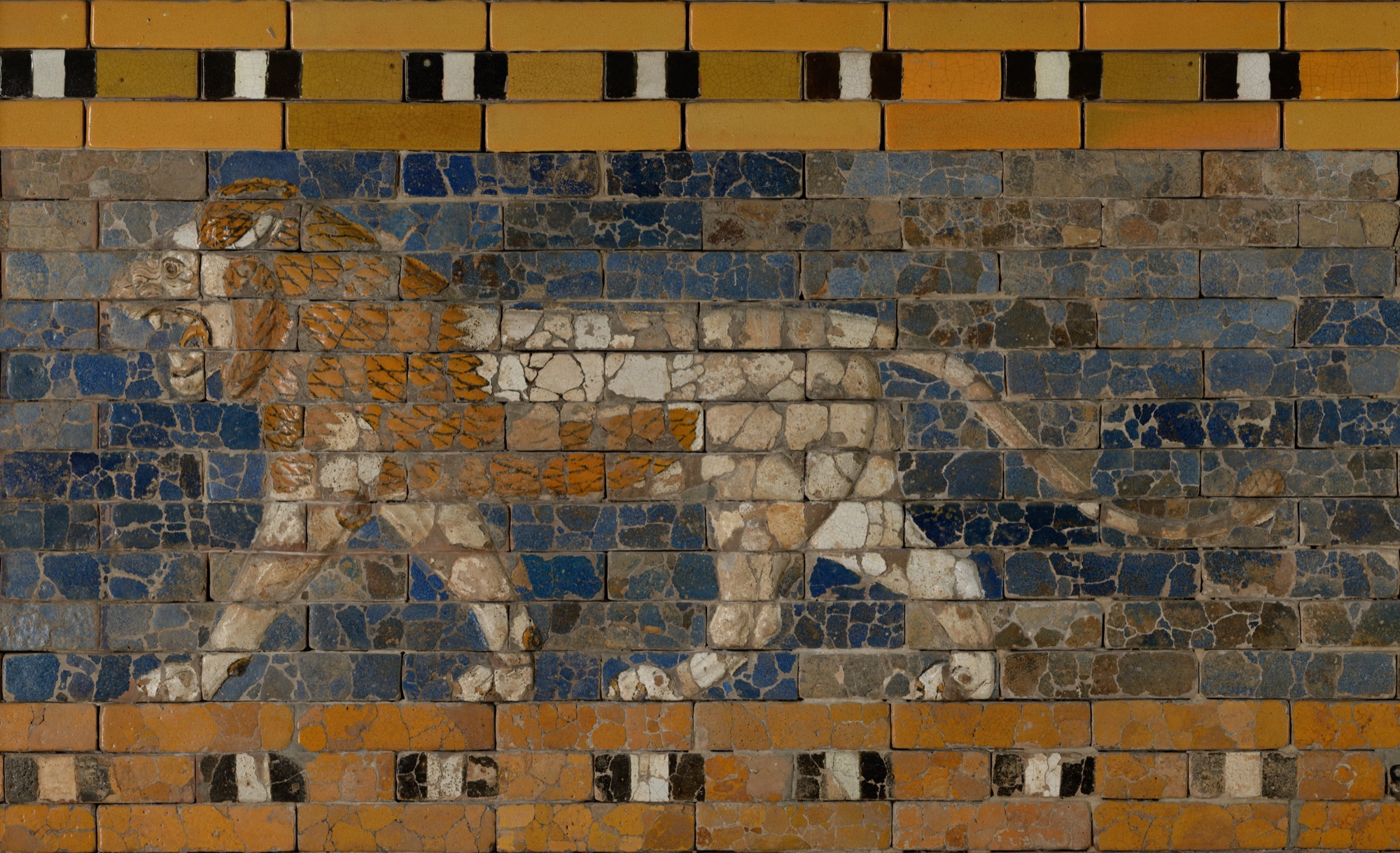
Babylon, situated on both banks of the Euphrates in the alluvial plain of southern Mesopotamia, was the largest and most cosmopolitan city in the ancient Near East during the sixth century BCE. Under Nebuchadnezzar II (r. 605–562 BCE), the city underwent a monumental building campaign that transformed it into an imperial capital of unrivaled scale. As Andrew George detailed in *Babylon: Topography, Texts and History* (1992), the city was enclosed by a double circuit of fortification walls—the inner Imgur-Enlil and outer Nimitti-Enlil—stretching some eighteen kilometers and pierced by eight named gates. The Processional Way (Aībur-šābu), paved with limestone and adorned with glazed-brick relief panels of striding lions, led from the Ishtar Gate southward through the city toward the sacred precinct. The Ishtar Gate itself, reconstructed in the Vorderasiatisches Museum in Berlin, displayed rows of bulls and mushhushshu dragons in molded glazed brick. At the heart of the city stood the Esagila, the temple of the supreme god Marduk, and immediately north of it the Etemenanki ziggurat—the biblical Tower of Babel. As Michael Jursa demonstrated in *Aspects of the Economic History of Babylonia in the First Millennium BC* (2010), temples like the Esagila were major economic actors: they owned vast agricultural estates, employed thousands of workers, and generated revenue through the prebendary system in which families purchased rights to perform temple services in exchange for shares of offerings. The Egibi family operated within this urban economy, their business linking the agricultural hinterland along the canal networks to Babylon’s institutional consumers. The residential quarters where wealthy families maintained their courtyard houses—such as the Merkes district excavated by Koldewey—lay interspersed among temples, workshops, and commercial streets. Babylon’s position on the Euphrates and its network of navigable canals made it a natural hub for the commodity trade, credit operations, and tax-farming activities that defined the Egibi enterprise.
The Egibi archive spans approximately five generations of a single Babylonian family, covering the period from about 606 to 484 BCE—a turbulent era encompassing the Neo-Babylonian Empire and the early Achaemenid Persian conquest. As Cornelia Wunsch documented in her chapter “The Egibi Family” in *The Babylonian World* (Routledge, 2007), the archive of some 1,700 tablets (rising to nearly 2,000 with fragments and duplicates) constitutes the largest private archive surviving from this period. The earliest generation documented, Šulaya, built wealth through wholesale commodity trading, particularly in barley and dates. His grandson Nabû-ahhē-iddin expanded the family’s position dramatically, serving as a royal judge for twelve years under Nabonidus (r. 556–539 BCE) and acquiring approximately 32.4 hectares of agricultural land through connections with the royal court, including transactions linked to King Neriglissar. The family’s fortunes were further consolidated when Nabû-ahhē-iddin’s son Itti-Marduk-balāṭu married Nuptāya, daughter of Iddin-Marduk of the Nūr-Sîn family, bringing a substantial dowry of 24 minas of silver and absorbing portions of the Nūr-Sîn archive into the Egibi holdings. The Persian conquest of Babylon by Cyrus the Great in 539 BCE did not disrupt the family’s operations; rather, the Egibis adapted to the new regime by cultivating ties with Persian officials. As Kathleen Abraham demonstrated in *Business and Politics under the Persian Empire: The Financial Dealings of Marduk-nāṣir-apli of the House of Egibi (521–487 B.C.E.)* (2004), the fifth-generation leader Marduk-nāṣir-apli (nicknamed Širku) inherited the business after his father’s death in 522 BCE and operated it until approximately 487 BCE, becoming deeply enmeshed with Babylonian temple institutions and Persian administrative structures. By the time of the inheritance division in 508 BCE, the family controlled sixteen houses in Babylon and Borsippa and more than one hundred slaves, along with extensive agricultural land. The archive falls silent around 484 BCE, a date that coincides with the suppression of Babylonian revolts under Xerxes I—raising the question, still debated among scholars, of whether the Egibi enterprise was disrupted by Persian reprisals. The physical archive itself was discovered by local diggers in the 1870s and dispersed through the antiquities trade. George Smith purchased approximately 3,400 tablets from the dealer Michael Marini in Baghdad in 1876 and shipped them to the British Museum, though Smith himself died of dysentery in Aleppo before returning to London. Subsequent sales distributed tablets to museums in New York, Berlin, and elsewhere. More than 600 tablets have been published by Wunsch (1993, 2000), and 144 by Abraham (2004), while the NaBuCCo database at the Austrian Academy of Sciences continues to catalog the corpus.
The Egibi archive documents a remarkably diversified portfolio of financial and commercial operations. As Cornelia Wunsch detailed in *Das Egibi-Archiv* (2000), the family’s core activities included lending silver at interest, real estate investment, agricultural management, tax farming, slave trading, and partnership-based ventures. Loans were denominated in silver, weighed according to the standard shekel (šiqlu) of approximately 8.33 grams, with the conventional interest rate of 20 percent per annum—a rate of one shekel per mina per month that, as Michael Jursa noted in *Aspects of the Economic History of Babylonia in the First Millennium BC* (2010), remained stable across Mesopotamia for over a thousand years. Promissory notes (u’iltu) recorded debts in standardized legal formulae, and the archive contains examples of debt transfers, surety bonds, and receipts documenting complex chains of obligation. The Egibis operated harrānu partnerships—a structure in which a senior partner provided capital and a junior partner managed operations, with profits divided equally after recovering the initial investment. As Wunsch observed in *The Babylonian World* (2007), this arrangement bore functional resemblance to the later Islamic muḍāraba and the Italian commenda. The family also engaged extensively in tax farming, advancing silver to officials responsible for canal maintenance fees and other fiscal obligations, then collecting the revenue. Rather than pure rent-seeking, their model involved organizing the transport and urban marketing of agricultural commodities—particularly barley and dates—received as in-kind tax payments from cultivators, effectively linking rural producers to urban and institutional consumers. Real estate transactions figured prominently: the family accumulated urban properties in Babylon and Borsippa and agricultural estates along the canal systems, employing sharecropping arrangements with tenant farmers. One notable financial innovation documented in the archive involved antichretic credit: the Egibis borrowed funds against a house purchase, then leased the property to their creditor at a rate equivalent to the standard 20 percent annual interest, thereby securing effectively interest-free financing while preserving liquid capital for operations—an arrangement that, as Wunsch showed, persisted across four successive reigns and the dynastic transition from Babylonian to Persian rule. The family’s slave holdings exceeded one hundred individuals, some of whom operated semi-independently as business agents, paying their masters a mandattu fee for the privilege of conducting their own commercial activities. William Goetzmann, in *Money Changes Everything* (2016), situated the Egibi operations within the broader history of financial innovation, emphasizing how the cuneiform record from Babylon demonstrates that sophisticated credit instruments, partnership structures, and secondary markets in debt obligations were already well established in the first millennium BCE.