Aleppo Souks (Al-Madina Souq)
Aleppo, Syria · Established c. 13th century CE
This site requires authorization to access.
To request access, contact
william.goetzmann@yale.edu
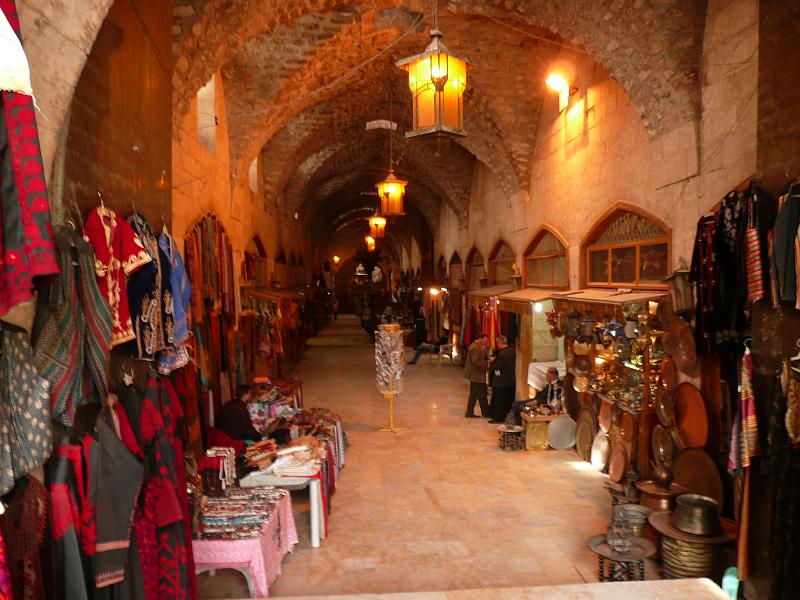
The Al-Madina Souq of Aleppo constitutes the largest covered historical market in the world, its vaulted stone passageways extending approximately thirteen kilometers through the heart of the old city. Jean Sauvaget, in his foundational study Alep: Essai sur le développement d’une grande ville syrienne (1941), traced the souk’s linear plan to the colonnaded avenues of the Hellenistic and Roman city, arguing that the medieval commercial streets represented an organic transformation of classical urban forms. The souk complex as it stood before the Syrian civil war was largely a product of Mamluk and Ottoman construction campaigns spanning the thirteenth through eighteenth centuries. Under the Ayyubids and Mamluks, open market streets were first enclosed with stone vaulting, and permanent stone-built shops replaced earlier timber stalls. Heghnar Watenpaugh, in The Image of an Ottoman City: Imperial Architecture and Urban Experience in Aleppo in the 16th and 17th Centuries (Brill, 2004), demonstrated that Ottoman governors invested heavily in commercial infrastructure, radically reorienting the city’s center while retaining Mamluk architectural models for the design of the great khans. The khan, or caravanserai, was the fundamental unit of wholesale and long-distance trade within the souk complex. Khan al-Wazir, commissioned by the Ottoman governor Qara Muhammad Pasha between 1678 and 1682, is among the largest, organized around a grand central courtyard with merchant storage on the ground floor and lodging chambers above. Khan al-Sabun, dating to the early sixteenth century, served as the center of Aleppo’s celebrated soap industry. Other major khans included Khan al-Shouneh for grain storage and Khan al-Nahhasin for copperwork. Luxury goods were traded in enclosed qaysariyyas, secure market halls with iron-studded doors that could be locked at night. Jean-Claude David, in his study of the souks and khans published in the Revue du monde musulman et de la Méditerranée (1994), documented how these structures formed an integrated commercial ecosystem, with khans, qaysariyyas, and open-air souks each serving distinct functions within the trading network. The Syrian civil war inflicted catastrophic damage on the souk complex beginning in September 2012, when fighting reached the Old City. Fire destroyed approximately one thousand shops along the central market arteries. Francesco Bandarin, in his chapter “The Destruction of Aleppo” in Cultural Heritage and Mass Atrocities (Getty Publications, 2022), assessed that as much as sixty percent of the Old City suffered severe damage, with thirty percent completely destroyed, concentrating around the Great Mosque, the souk, and the citadel. Restoration began in 2018 under the Aga Khan Trust for Culture, whose pilot project on the Souk al-Saqatiyya section—a 150-meter stretch encompassing 52 shops—was completed in July 2019 and received the ICCROM-Sharjah prize for best practice in conservation of Islamic heritage in 2020. The broader rehabilitation program aims to restore eight key sections along the souk’s east-west axis from the Citadel to the Bab Antakiyya.
The decorative vocabulary of the Aleppo souks drew on both Mamluk and Ottoman artistic traditions. Ablaq masonry—the technique of alternating courses of light limestone and dark basalt—was a signature feature of Mamluk architecture in northern Syria, as documented in Terry Allen’s study of Ayyubid and Mamluk architectural ornament in Aleppo and Damascus. This bichrome stonework adorned the facades of khans, mosque portals, and the monumental entrance bays of the souk complex, creating rhythmic patterns of contrast that defined the visual character of the commercial quarter. Muqarnas—the honeycomb vaulting of Islamic architecture—decorated portal niches and transitional zones between walls and domes, reaching particular refinement in the entrance to Khan al-Wazir and the madrasas interspersed along the souk. Carved stone inscriptions in elegant thuluth script identified patrons, recorded endowment deeds, and invoked divine blessing upon commercial activities. The most celebrated artistic survival from Ottoman-era Aleppo is the Aleppo Room (Halep Zimmer), now displayed in the Museum of Islamic Art at the Pergamon Museum in Berlin. Julia Gonnella, who served as head curator at the Pergamon’s Islamic Art collection and directed the Syrian-German excavations of the Citadel of Aleppo (1996–2011), has studied these panels extensively. The painted wooden wall panels, carved by a Persian artist in 1603, originally furnished the reception hall (qa’a) of a Christian merchant’s house. They combine Ottoman floral and geometric compositions with Christian iconographic scenes—the Virgin Mary, Christ and his disciples, and Old Testament narratives—rendered alongside courtly imagery drawn from Persian book illustration, constituting the oldest known painted interior from an Ottoman-period Syrian dwelling. The panels were acquired from the Wakil family in 1912 and donated to the Pergamon Museum. European travelers produced notable artistic depictions of the souks. Alexander Russell, the Scottish physician who spent fourteen years at the English factory, provided detailed descriptions of Aleppo’s commercial quarter in The Natural History of Aleppo (1756), a work later expanded by his half-brother Patrick Russell in 1794. Inlaid woodwork (known as ’ajami) decorated the interiors of the wealthier khans and the reception rooms of merchant houses that bordered the souk, employing elaborate geometric marquetry of walnut, citrus wood, bone, and mother-of-pearl.
Aleppo’s commercial preeminence derived from its position at the convergence of trade routes linking Mesopotamia and the Persian Gulf to the Mediterranean, and Anatolia to Egypt and the Arabian Peninsula. Ross Burns, in Aleppo: A History (Routledge, 2017), traced how the city’s location on a limestone plateau between the Euphrates and the sea made it a natural entrepot for overland trade across millennia. The souk complex occupied the low ground between two commanding landmarks: the great Citadel, perched on its partly artificial mound to the east, and the Umayyad Great Mosque of Aleppo to the north. The principal artery of the souk ran along an approximate east-west axis from the base of the Citadel to the Bab Antakiyya (the Antioch Gate), following a route that Sauvaget identified with the ancient Hellenistic decumanus. The Great Mosque, founded in the Umayyad period and rebuilt by the Zangids in the twelfth century, anchored the northern edge of the souk and served as the spiritual counterpart to the commercial activity that surrounded it; its celebrated square minaret, dating to 1090, was tragically destroyed in April 2013 during the civil war. The UNESCO inscription of the Ancient City of Aleppo as a World Heritage Site in 1986 recognized the exceptional coherence of this urban fabric—the interlocking system of souks, khans, mosques, madrasas, hammams, and residential quarters that formed one of the most complete surviving examples of a medieval Islamic commercial city. The inscription noted that Aleppo had been “located at the crossroads of several trade routes from the 2nd millennium B.C.” and represented “an outstanding example of architecture illustrating a significant stage in human history.” The city’s population, which had reached over two million before the war, made it Syria’s largest city and its commercial capital. Watenpaugh demonstrated how Ottoman-era development created a new commercial center within the intramural city, with monumental khans and religious-commercial complexes (külliye) reshaping the urban landscape around the souk axis, while the residential quarters—organized by confessional community—radiated outward from this mercantile core.
Aleppo ranks among the oldest continuously inhabited cities in the world. The site appears in cuneiform texts from the third millennium BCE: the Ebla tablets (c. 2400 BCE) reference the city as Ha-lam, and it later became the capital of the powerful Amorite kingdom of Yamhad (c. 1800–1600 BCE), one of the dominant states of the Middle Bronze Age. Burns documented how the recently excavated temple of the storm-god Hadad atop the Citadel mound confirmed ritual use of the site from at least the third millennium BCE (Aleppo: A History, 2017). The city passed through Hittite, Assyrian, Persian, Seleucid, Roman, and Byzantine hands before the Arab conquest in 637 CE. Under the Ayyubid dynasty (twelfth–thirteenth centuries), Aleppo experienced a major commercial expansion, and the construction of permanent stone-vaulted souk streets began in earnest. The Mamluk period (1260–1516) brought further development, with the construction of numerous khans, qaysariyyas, and hammams that filled the commercial quarter. Ottoman rule from 1516 transformed Aleppo into one of the empire’s most important provincial capitals. By the mid-sixteenth century, as Watenpaugh argued, Aleppo had displaced Damascus as the principal market for goods arriving from the east. European commercial powers established consulates: Venice opened its Aleppo consulate in 1548, France in 1562, and England in 1583. The English Levant Company, chartered in 1581, made Aleppo its principal Middle Eastern headquarters, maintaining a “factory”—a resident trading establishment—that operated until the late eighteenth century. As Ferreri documented in “Life in the Khans: The Venetians in Early Ottoman Aleppo” (Muqarnas, vol. 34, 2017), Venetian merchants lived and traded within the khan network, using these versatile structures for commerce, lodging, socializing, worship, and diplomacy. Alexander Russell’s Natural History of Aleppo (1756), written during his fourteen years as physician to the English factory, remains the most detailed eighteenth-century European account of the city’s commercial life and social organization. The nineteenth century brought gradual economic decline as new maritime trade routes bypassed the traditional overland caravan system, though the souks remained vibrant local and regional markets. During the Syrian civil war, the Battle of Aleppo (2012–2016) devastated the Old City. UNESCO placed the Ancient City on its List of World Heritage in Danger in 2013. A joint UNESCO-UNITAR satellite survey in 2018 provided the first comprehensive damage assessment, documenting the scale of destruction to the souk, the Great Mosque, and the historic khans. The Aga Khan Trust for Culture has led the principal restoration effort, working in partnership with UNESCO and Syrian heritage authorities.
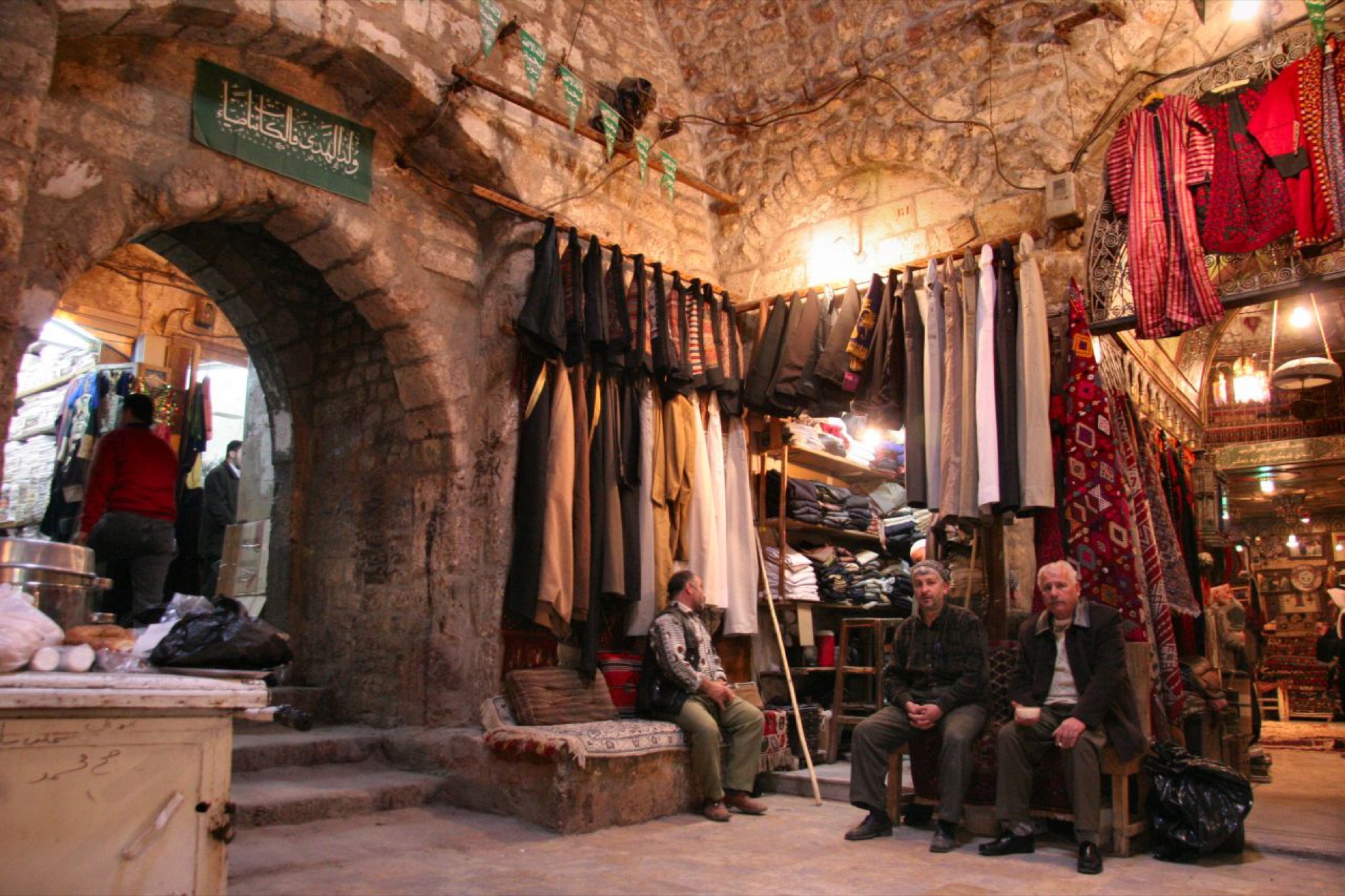
The Al-Madina Souq was organized by commodity, with each section named for its principal trade—a system of spatial specialization documented in detail by Jean-Claude David (Revue du monde musulman et de la Méditerranée, 1994). Souq al-Attarin dealt in spices and perfumes; Souq al-Sabun in the city’s famous soap; Souq al-Nahhasin in copperware; Souq al-Hiraj in textiles; and Souq al-Zarb in goldwork and precious metals. Aleppo soap, manufactured from olive oil and laurel berry oil (zeit ghar), represented one of the city’s most distinctive products, with a tradition of production centered in Khan al-Sabun dating to at least the sixteenth century. The laurel oil content, typically ranging from two to twenty percent, determined the grade and price of each bar. Silk was the most valuable commodity in the long-distance trade. Caravans arriving from Persia via Baghdad and Basra brought raw silk destined for European markets, while the Venetian consul in Aleppo reported in 1602 that silk and spices were traded on what he termed the piazetta—an informal exchange within the souk complex. The Levant Company’s factors exported raw silk, cotton wool and yarn, spices including black pepper and nutmeg, indigo, galls, and woven fabrics. The khan system served as both warehouse and wholesale market: merchants arriving by caravan stored goods on the ground floor of the khan, negotiated sales in the courtyard, and lodged in upper-story chambers. Credit and currency exchange operations were integral to the souk’s functioning. Moneychangers (sarrafin) maintained stalls within the commercial quarter, facilitating transactions between the diverse currencies circulating in a cosmopolitan trading center that linked Ottoman, Venetian, French, English, and Persian commercial networks. Bills of exchange (suftaja) and letters of credit enabled long-distance transactions without the physical transfer of coin, a financial technology with deep roots in Islamic commercial law. Watenpaugh noted that the Ottoman investment in commercial infrastructure reflected the enormous revenues generated by this trade, with customs duties and market taxes constituting a major source of provincial income. The qaysariyya system provided secure, lockable halls for the highest-value goods—silk, precious metals, jewelry—separating wholesale luxury trade from the open-air retail souks that served the general population.