Abu Dhabi Securities Exchange (ADX)
Abu Dhabi, UAE · Established 2000
This site requires authorization to access.
To request access, contact
william.goetzmann@yale.edu
The Abu Dhabi Securities Exchange occupies a landmark position within the Abu Dhabi Global Market Square complex on Al Maryah Island, a 114-hectare mixed-use development that serves as the emirate’s designated Central Business District. Designed by the Chicago-based firm Goettsch Partners and completed in 2012, the complex comprises four office towers—two rising thirty-one stories and two reaching thirty-seven stories—framing a central exchange headquarters building. The exchange structure itself is a striking glass-enclosed pavilion raised twenty-seven meters above a forty-nine-meter-diameter reflective water feature on four massive granite piers that house stairs, mechanical risers, and service elements. Its roof spans roughly the area of a football pitch, and the interior accommodates four levels of trading and administrative facilities. The architectural historian Philip Jodidio, in his survey Architecture in the Emirates (2007), documented the broader trajectory of Gulf modernism within which such buildings emerged, while the trade journal ArchDaily profiled the Sowwah Square project (the complex’s original name) as a defining example of environmentally responsive commercial design in the Arabian Gulf region. Before its relocation to Al Maryah Island, the Abu Dhabi Securities Market (as the exchange was originally known) operated from offices near the Al Ghaith Tower on Hamdan Bin Mohammed Street, in the older commercial core of Abu Dhabi’s main island. The move to the purpose-built ADGM Square represented a deliberate institutional upgrading, part of Abu Dhabi’s 2030 urban framework plan to shift its financial center of gravity to a new island precinct. The complex was the first integrated development in Abu Dhabi to be pre-certified LEED-CS Gold, incorporating a mechanically ventilated double-skin façade system with active solar shades that track the sun angle—a critical design feature given daytime temperatures that regularly exceed forty degrees Celsius. Calculations by the project engineers estimated that the double-skin system generates savings of 7,200 kilowatt-hours of electricity per day across all four towers, as noted in the firm’s technical documentation and by the Integrated Environmental Solutions project profile for ADGM Square.
The decorative program of the Abu Dhabi Global Market Square complex is restrained and modernist in character, reflecting the prevailing aesthetic of Gulf financial districts that favor sleek glass-and-granite surfaces over ornamental elaboration. The four granite piers supporting the exchange headquarters provide the most visually distinctive architectural element—massive, monolithic forms that evoke both structural solidity and the geological substrate of the region’s petroleum wealth. The landscaped plaza connecting the four towers and the exchange building incorporates a forty-nine-meter-diameter water feature beneath the raised pavilion, creating a contemplative interplay of light, reflection, and shade that recalls traditional Islamic courtyard design translated into a contemporary idiom. The broader Al Maryah Island district has become a venue for Abu Dhabi’s expanding public art ambitions. The Department of Culture and Tourism—Abu Dhabi launched the Public Art Abu Dhabi initiative, and in 2023 inaugurated the Manar Abu Dhabi biennial, installing more than fifty site-specific works across the city, including light sculptures and immersive installations along the waterfront. While these programs have concentrated on the Corniche and Saadiyat Island cultural district rather than the financial precinct itself, the presence of institutions such as the Louvre Abu Dhabi on neighboring Saadiyat Island—designed by Jean Nouvel and opened in 2017—has shaped an urban culture in which architecture and public art increasingly interpenetrate the commercial landscape. Within the ADGM Square complex, the retail podium and waterfront promenade feature curated design elements, though the exchange headquarters itself maintains the functional austerity typical of global trading venues.
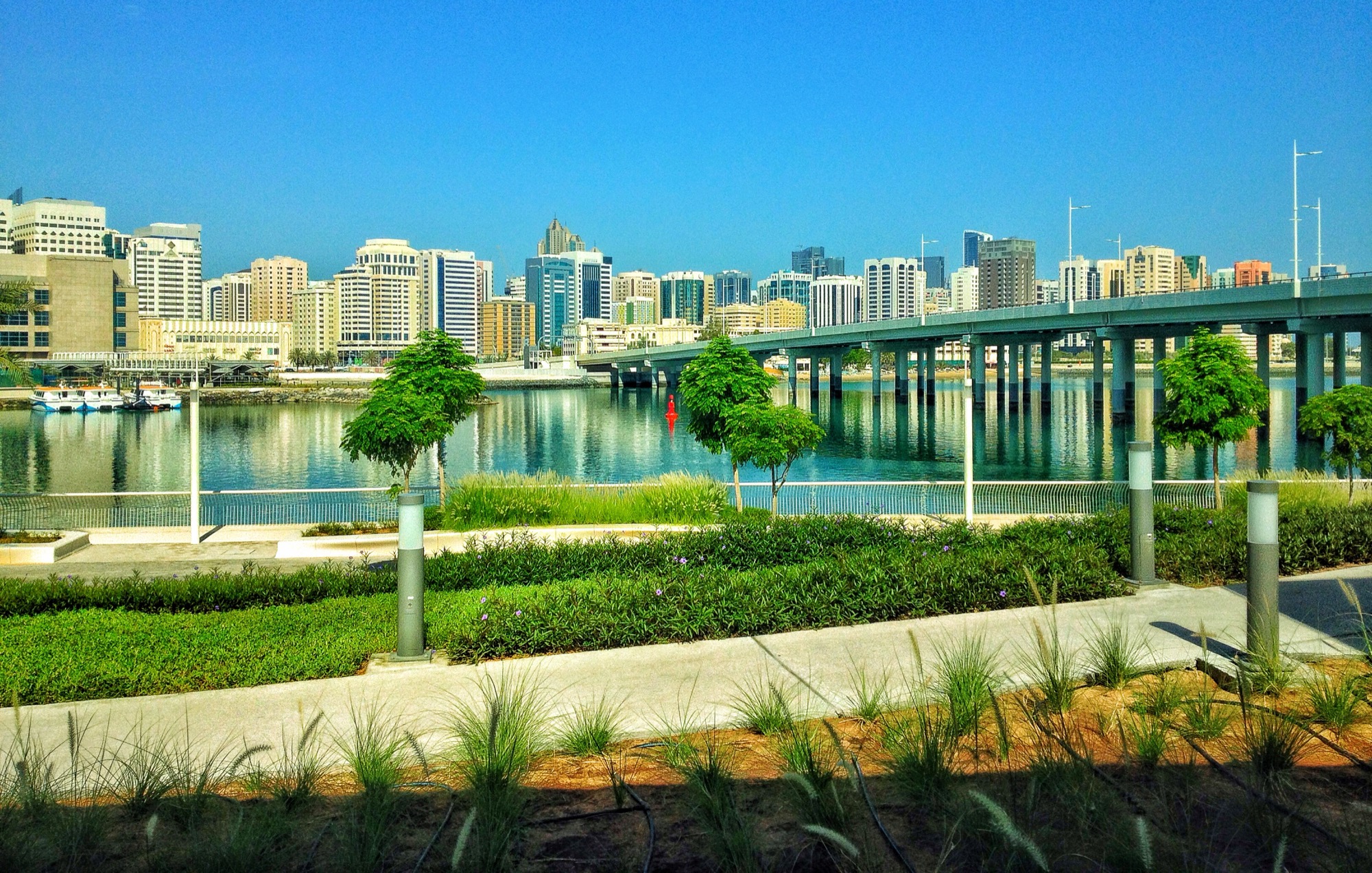
Abu Dhabi’s transformation from a modest fishing and pearling settlement on a low-lying island in the Persian Gulf to the capital of one of the world’s wealthiest states constitutes one of the most dramatic urban metamorphoses of the twentieth century. Frauke Heard-Bey, in her foundational study From Trucial States to United Arab Emirates: A Society in Transition (1982, revised 2005), documented how the coastal village of a few thousand inhabitants surrounded by sabkha salt flats and date groves became, within a single generation, a sprawling modern metropolis. The eight-kilometer Corniche waterfront, developed from the 1960s onward with extensive land reclamation, evolved from a simple sandy promenade and dhow anchorage into a boulevard flanked by glass towers, parks, and hotels—a physical index of the oil-driven transformation. Christopher Davidson, in Abu Dhabi: Oil and Beyond (2009), analyzed how the emirate’s ruling Al Nahyan family channeled petroleum revenues into urban infrastructure while pursuing a long-term diversification strategy codified in the Abu Dhabi Economic Vision 2030. Al Maryah Island—formerly Sowwah Island, an uninhabited sandbar and sabkha separated from the main island by a narrow channel—was designated in 2007 by the Abu Dhabi Urban Planning Council as the site for the new Central Financial District. The island was renamed in 2012 in reference to a village in the Liwa Oasis associated with the Arabian oryx. With the establishment of the Abu Dhabi Global Market as a financial free zone by federal decree in 2013, becoming operational in 2015, Al Maryah Island has emerged as an international finance hub governed by its own legal framework based on English common law—a jurisdictional innovation designed to attract global capital. The island complements rather than competes directly with the Dubai International Financial Centre in the neighboring emirate: whereas DIFC has cultivated a role as a regional hub for asset management and fintech, ADGM has positioned itself around capital markets, derivatives, and commodities. In December 2025, Mubadala Investment Company and Aldar Properties announced a landmark AED 60 billion expansion of the financial district, effectively doubling Al Maryah Island’s Grade A office capacity.
The pre-oil economy of Abu Dhabi rested on three pillars: pearl diving, fishing, and date cultivation in the Liwa Oasis hinterland. As Heard-Bey documented and as Matthew Hopper explored in Slaves of One Master: Globalization and Slavery in Arabia in the Age of Empire (2015), the pearling industry integrated the Trucial States into global luxury commodity networks stretching from Bombay to Paris, with Abu Dhabi’s waters among the richest diving grounds in the Gulf. The advent of Japanese cultured pearls in the 1920s and 1930s devastated this trade, plunging the sheikhdom into decades of poverty. The discovery of oil at the offshore Umm Shaif field in 1958 by Abu Dhabi Marine Areas Ltd (ADMA), followed by the first crude export from Jebel Dhanna in 1962, initiated the transformation. Under Sheikh Zayed bin Sultan Al Nahyan, who became ruler in 1966, petroleum revenues financed rapid modernization and underwrote the formation of the United Arab Emirates in 1971. The formal securities market arrived relatively late. The Emirates Securities and Commodities Authority (SCA) was established on January 29, 2000, by federal decree, and the Abu Dhabi Securities Market (ADSM) was founded on November 15 of that same year under Local Law No. 3 of 2000, which granted it autonomous legal status. Trading initially involved a small number of listed companies. The market was renamed the Abu Dhabi Securities Exchange (ADX) in 2008 to signal its maturation as a modern exchange platform. The period 2004–2006 saw a speculative bubble across Gulf securities markets, driven by retail investors leveraging bank-financed margin accounts and fueled by rising oil prices; the subsequent correction wiped roughly sixty percent off market values on exchanges across the region, as analyzed by the IMF in its working paper Impact of the Global Financial Crisis on the Gulf Cooperation Council Countries and Challenges Ahead (2010). The Abu Dhabi Investment Authority (ADIA), established in 1976 and managing assets estimated near one trillion dollars, represents the deep pool of sovereign capital that shapes the emirate’s financial ecosystem, though ADIA invests predominantly in international rather than domestic markets. Domestically, the network of government-related entities—Mubadala Investment Company, ADQ (formerly Abu Dhabi Development Holding Company, established 2018), and International Holding Company (IHC)—exerts enormous influence on ADX-listed companies and the broader market. In March 2020, the exchange itself was converted from a public entity to a public joint-stock company (PJSC), a corporatization intended to enhance governance and facilitate strategic partnerships. The establishment of ADGM as a financial free zone, with its own Financial Services Regulatory Authority (FSRA) operating under English common law, added a parallel regulatory layer alongside the SCA, creating a dual framework that scholars of Gulf financial regulation continue to analyze.
The Abu Dhabi Securities Exchange lists over ninety companies and funds organized across multiple sectors, with a total market capitalization exceeding three trillion dirhams (approximately $820 billion) as of late 2025. The exchange’s composition reflects Abu Dhabi’s petroleum-dominated economy: the energy sector is anchored by subsidiaries of the Abu Dhabi National Oil Company (ADNOC), which has pursued a strategy of partial privatization through ADX listings. ADNOC Distribution’s 2017 IPO—the first on the ADX in six years and the largest in a decade at the time—raised approximately $851 million and signaled the state oil giant’s commitment to capital-market engagement. ADNOC Gas followed in 2023 in what became Abu Dhabi’s largest-ever market debut and the largest IPO globally that year, attracting massive international investor interest. The banking sector constitutes another dominant pillar. First Abu Dhabi Bank (FAB), created through the 2017 merger of the National Bank of Abu Dhabi and First Gulf Bank, stands as the UAE’s largest bank by assets ($183 billion at formation) and one of the ADX’s most heavily traded securities. The telecommunications giant Etisalat (rebranded as e& in 2022) has been listed since the exchange’s early years and remains a benchmark constituent. International Holding Company (IHC), a conglomerate controlled by interests associated with Abu Dhabi’s ruling family, became the most valuable holding company in the Middle East with a market capitalization exceeding AED 876 billion. Real estate firms such as Aldar Properties also figure prominently among ADX constituents. Beyond equities, the ADX has progressively broadened its instrument offerings. The exchange launched its derivatives market in November 2021 with single-stock futures contracts on major constituents, leveraging Nasdaq technology for the trading platform. Exchange-traded funds have been available since the One Share Dow Jones UAE 25 ETF debuted in 2010. The exchange also supports government and corporate bond listings, including green bonds and sukuk—Islamic fixed-income instruments that comply with Sharia principles prohibiting interest—reflecting the broader regional push toward sustainable finance. The FTSE ADX Index Series, developed in partnership with LSEG (London Stock Exchange Group), provides international investors with benchmarked access to the Abu Dhabi market, while the exchange’s 2023 integration with the ICE Global Network enables direct market access for global institutional participants.
Images will be added as the project develops. Photographs by Larry Ng and from research sources.