Zurich Stock Exchange (SIX Swiss Exchange)
Zurich, Switzerland · Established 1873
This site requires authorization to access.
To request access, contact
william.goetzmann@yale.edu
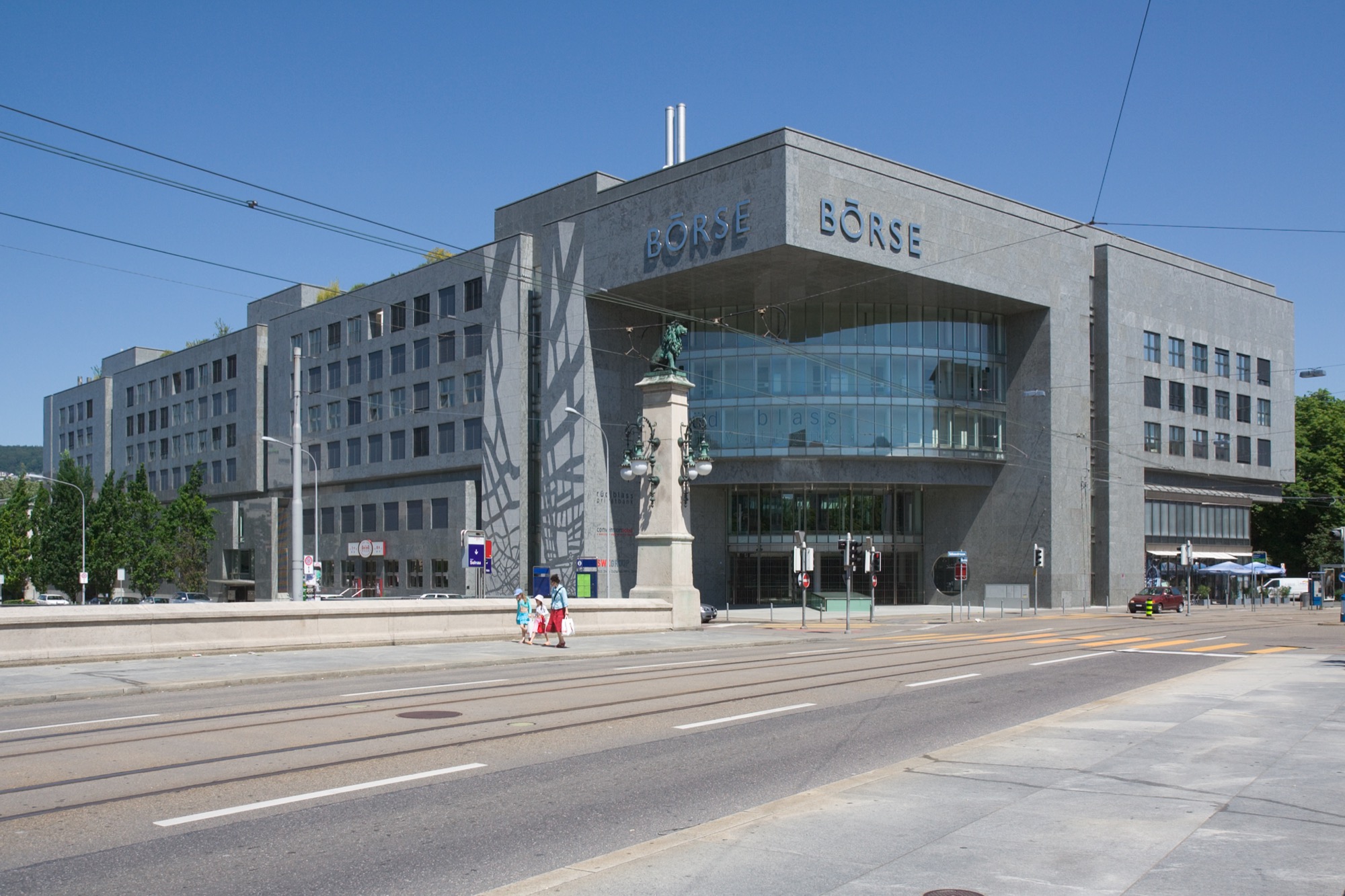
The Zurich Stock Exchange occupied two purpose-built structures over its history, both reflecting the institution’s evolving ambitions. The first dedicated exchange building, known today as the Alte Börse, was designed by the Zurich architectural firm Henauer und Witschi and constructed between 1928 and 1930 at Bleicherweg 5, just steps from Paradeplatz. Walter Henauer (1880–1936) had trained at the Winterthur Technical School and worked in Dresden, Leipzig, and Berlin before establishing his Zürich practice in 1911; his partner Ernst Witschi (1881–1959) had apprenticed as a building draftsman in Zürich and worked in several Berlin offices before joining Henauer in 1913. Their design for the Börse exemplified the Neue Sachlichkeit aesthetic then reshaping Swiss commercial architecture: a rationalist composition distinguished by long horizontal window bands across the street-facing facades, behind which offices enclosed the central trading hall and, above it, the securities exchange. The most striking feature was the large, tower-like cylindrical corner risalit housing a staircase, its vertical articulation making a confident statement toward Paradeplatz and the bank headquarters clustered around it. The ground floor was kept publicly accessible, with cafés and shops, while the upper levels served the exchange’s operations. As Stephanie Hering documented in her dissertation Geldadressen: Zürcher Börsenbauten, the building was Switzerland’s largest trading venue for securities until 1992. When the exchange outgrew the Alte Börse, an architectural competition attracted seventy-four submissions. The winning design by the Basel-based firm Suter + Suter produced the Neue Börse at Selnaustrasse 30, constructed from 1987 to 1991 on the banks of the Sihl River near Stauffacherbrücke. The building’s monolithic, strictly structured form -- with a footprint of 130 by 52 meters -- was clad in dark blue-grey Kösseine granite from the Fichtelgebirge in Bavaria, chosen to convey what architectural critics described as elegance, coolness, and massive seriousness. Large-scale circular and semicircular design elements, including cutouts in the roof and the building’s plan, deliberately echoed the geometry of ring trading inside. A central 64-ton steel spiral staircase connected the floors, and the interior provided space for six separate trading rings. However, the building’s physical infrastructure was rendered partly obsolete almost immediately: fully electronic trading began on 16 August 1996, making the rings redundant. SIX Group relocated its headquarters to Hard Turm Park in Zurich West in 2017, and the Neue Börse was subsequently acquired by EF Education First, which commissioned Stücheli Architekten to adapt it as a corporate headquarters. The Alte Börse at Bleicherweg, meanwhile, has been repurposed for hospitality and entertainment uses, its former trading floor converted into a nightclub -- a transformation that would have astonished the sober functionalists Henauer and Witschi.
The decorative programs of the Zurich exchange buildings reflected the broader trajectory of twentieth-century Swiss commercial architecture, moving from modernist restraint to late-twentieth-century public art integration. Henauer and Witschi’s Alte Börse of 1930 was conceived in the Neue Sachlichkeit idiom, which by principle eschewed the elaborate sculptural programs and painted allegories typical of nineteenth-century exchanges such as the Palais Brongniart in Paris or Theophil Hansen’s Vienna Börse. The Alte Börse’s ornamental vocabulary was limited to the elegant massing of its cylindrical corner tower and the rhythmic discipline of its horizontal fenestration -- the building’s form was its decoration. The interior trading hall, while spacious and functionally articulated, relied on spatial proportion and natural light rather than murals or allegorical sculpture to project gravitas. This austerity was consistent with the broader Swiss commercial aesthetic of the interwar period, in which institutions like the Schweizerische Kreditanstalt and the Schweizerischer Bankverein were building headquarters at Paradeplatz that similarly favored restrained neoclassical and modernist idioms over elaborate decorative programs. The Neue Börse of 1991, by contrast, incorporated deliberate artistic interventions into its architecture. The facade on the Sihlhölzlistrasse side featured a site-specific installation by the Swiss artist Ernst Häusermann (born 1947, Lenzburg) and painter Max Matter, consisting of three vertical facade elements measuring approximately 4 by 25 meters each, displaying abstracted city maps of New York, London, and Tokyo -- the world’s other principal financial centers. Häusermann, known primarily as a ceramicist, sculptor, and object artist, collaborated with Matter on this large-scale architectural commission that placed Zurich symbolically at the center of a global financial network. The same artist duo also designed a stone circle for the entrance area incorporating stones from distant countries representing the cardinal directions. Inside the Neue Börse, the central trading space was defined by the monumental spiral staircase and the open geometries of the trading rings rather than by applied decoration, though the building’s granite materiality and precise detailing gave its interiors a lapidary quality befitting the seriousness of financial exchange.
The Zurich Stock Exchange’s two buildings charted a geographic shift that mirrors the broader evolution of the city’s financial district. The Alte Börse at Bleicherweg 5 stood at the very heart of Zurich’s banking quarter, immediately adjacent to Paradeplatz -- the square that has functioned since the late nineteenth century as the symbolic and operational center of Swiss finance. Paradeplatz originated as a livestock market lying outside the medieval city walls and was incorporated within the Baroque fortifications completed around 1642; its transformation into a financial hub began with the construction of Bahnhofstrasse, laid out in 1867 over the filled-in Fröschengraben moat after the city’s medieval fortifications were demolished in 1864. Alfred Escher’s Schweizerische Kreditanstalt (later Credit Suisse), founded in 1856 primarily to finance Swiss railway construction, erected its headquarters at Paradeplatz between 1873 and 1876; the Schweizerischer Bankverein (Swiss Bank Corporation, later UBS) followed with its own Paradeplatz headquarters in 1899, designed by architect Charles Mewès. By the time Henauer and Witschi built the Alte Börse just steps away in 1930, Bleicherweg -- named for the medieval linen-bleaching grounds that once occupied the area along the Schanzengraben moat -- had become fully integrated into this financial precinct. The Bahnhofstrasse corridor, running 1.4 kilometers from the Hauptbahnhof through Paradeplatz to Bürkliplatz on Lake Zurich, concentrated the headquarters of Switzerland’s largest banks, insurance companies, and private wealth managers within a few hundred meters of the exchange. The Neue Börse’s 1992 relocation to Selnaustrasse on the Sihl riverbank, near the Stauffacherbrücke, represented a deliberate move to a larger site on the city’s western edge, in an area historically associated with the industrial working-class district of Aussersihl -- incorporated into Zurich in the great municipal expansion of 1893. SIX Group’s subsequent 2017 move to Hard Turm Park in Zurich West continued this westward trajectory, placing the exchange’s infrastructure in the former industrial quarter (Kreis 5) that has undergone large-scale rezoning into commercial and cultural uses. The Swiss Finance Museum, inaugurated in June 2017 in SIX’s new headquarters, now houses one of the world’s most significant collections of historical securities, with some 10,000 items from more than 150 countries.
Organized securities trading in Zurich traces its origins to the mid-nineteenth century. As documented in the research of the Swiss Finance Museum, 1855 marks the founding year of the Zurich Stock Exchange Association (Zürcher Effektenbörsenverein), though the exchange in its recognizable modern form dates to 1873, when formal trading commenced. In 1877, the exchange appeared for the first time on an official price sheet. Switzerland’s comparatively late development of stock exchanges -- Geneva opened the first Swiss bourse in 1850, followed by Basel in 1866 and Zurich and Lausanne in 1873, as documented in Contratto and Hofmann’s study of Swiss equity markets (2009) -- reflected the country’s slow industrialization and the predominance of privately held companies. However, the enormous financing needs of railway construction in the second half of the nineteenth century, epitomized by Alfred Escher’s founding of the Schweizerische Kreditanstalt in 1856 to fund the Swiss Northeastern Railway and later the Gotthard railway (completed 1882), created urgent demand for equity and bond markets. From 1884, the Zurich exchange operated under cantonal supervision, a decentralized regulatory arrangement that persisted for over a century. Trading was conducted à la criée -- by open outcry in trading rings (Ringhandel) -- with hand signals supplementing voice: palms facing the body to buy, palms outward to sell. In 1961, the firms Autophon and Telekurs introduced the first stock exchange television systems in the Basel and Zurich exchanges, transmitting real-time images of handwritten price sheets to offices and bank branches. Switzerland’s political neutrality proved decisive for the exchange’s international standing. As Sébastien Guex demonstrated in his study of the genesis of Swiss banking secrecy (Financial History Review, 2000), the maintenance and reinforcement of banking secrecy represented a major objective of Swiss authorities throughout the twentieth century. The 1934 Federal Act on Banks and Savings Banks codified client confidentiality as a federal crime, a measure Guex showed stemmed not from humanitarian motives but from a political compromise during the Depression in which banks accepted prudential supervision in exchange for ironclad secrecy guarantees. Bruno Frey and Marcel Kucher’s analysis of World War II as reflected on capital markets (Economics Letters, 2000) used government bond prices traded on the Swiss bourse to track the war’s progress, finding that the Swiss exchange closed from 10 May through 8 July 1940 during the fall of France and Belgium. Youssef Cassis, in Capitals of Capital (Cambridge University Press, 2006), situated Zurich among the smaller international financial centers that found distinctive market niches -- in Zurich’s case, as an entrepôt for capital and wealth management rather than a market driven by domestic economic scale. The consolidation of Swiss exchanges began in 1993, when the remaining bourses at Basel, Geneva, and Zurich merged into the Verein Schweizerische Effektenbörse (Swiss Securities Exchanges Association). The new entity, publicly known as the Swiss Exchange, took over trading in 1995 and became the first stock exchange in the world to incorporate a fully automated trading, clearing, and settlement system, rendering the physical trading rings obsolete. The Federal Act on Stock Exchanges and Securities Trading (SESTA) of 1995 replaced cantonal jurisdiction with national regulation. In 2008, the Swiss Exchange merged with SIS Group and Telekurs Group to form SIX Group AG, and the exchange was renamed SIX Swiss Exchange.
The Zurich exchange’s traded instruments evolved from local railway securities to a diversified international marketplace. In its earliest decades after 1873, trading centered on the bonds and equities needed to finance Switzerland’s rapid railway expansion -- the primary catalyst for organized securities markets across the Swiss cantons, as Contratto and Hofmann documented. The Schweizerische Kreditanstalt, which had channeled 25 percent of its first-year revenues into the Swiss Northeastern Railway (Nordostbahn), was among the most actively traded bank stocks. As Switzerland industrialized in the late nineteenth and early twentieth centuries, the exchange listed shares of the country’s growing textile, engineering, and chemical firms, alongside government bonds of the Confederation and individual cantons. Insurance company shares, particularly those of the Zürich Versicherungs-Gesellschaft (founded 1872) and Schweizerische Rückversicherungs-Gesellschaft (Swiss Re, founded 1863), became staples of the Zurich board. Switzerland’s neutrality and banking secrecy transformed the exchange into a significant venue for international securities. Frey and Kucher’s research demonstrated that during the interwar period and World War II, government bonds of France, Germany, Belgium, Austria, and other European nations were actively traded on the Swiss bourse, their price movements precisely tracking the fortunes of war -- French and Belgian bonds falling by 31 and 35 percent respectively during the Blitzkrieg of May 1940. The countries that borrowed most heavily on the Swiss capital market between the wars were France and Germany, followed by Belgium and Austria. In the postwar decades, the exchange became the primary venue for shares of Switzerland’s multinational corporations -- Nestlé, the world’s largest food company; the pharmaceutical giants Roche (Basel) and Novartis (formed from the 1996 merger of Ciba-Geigy and Sandoz, at the time the largest corporate merger in history); and the major banks UBS and Credit Suisse. The Swiss Market Index (SMI) was introduced on 30 June 1988 as the blue-chip benchmark, tracking the twenty largest and most liquid stocks; three companies alone -- Nestlé, Roche, and Novartis -- have consistently accounted for roughly half the index’s total weight. Ring trading at the Zurich exchange involved up to six simultaneous rings for different security classes, with real-time price information disseminated after 1961 via the Telekurs stock exchange television system to subscribers throughout the city. The transition to fully electronic trading in 1995–1996 ended over a century of physical ring trading, and SIX Swiss Exchange today lists approximately 250 companies alongside a substantial bond market that includes Swiss Confederation government bonds, corporate bonds, and international debt instruments.
Images will be added as the project develops. Photographs by Larry Ng and from research sources.