Zurich Stock Exchange (original) (Börsenstrasse)
Zurich, Switzerland · Established 1877
This site requires authorization to access.
To request access, contact
william.goetzmann@yale.edu
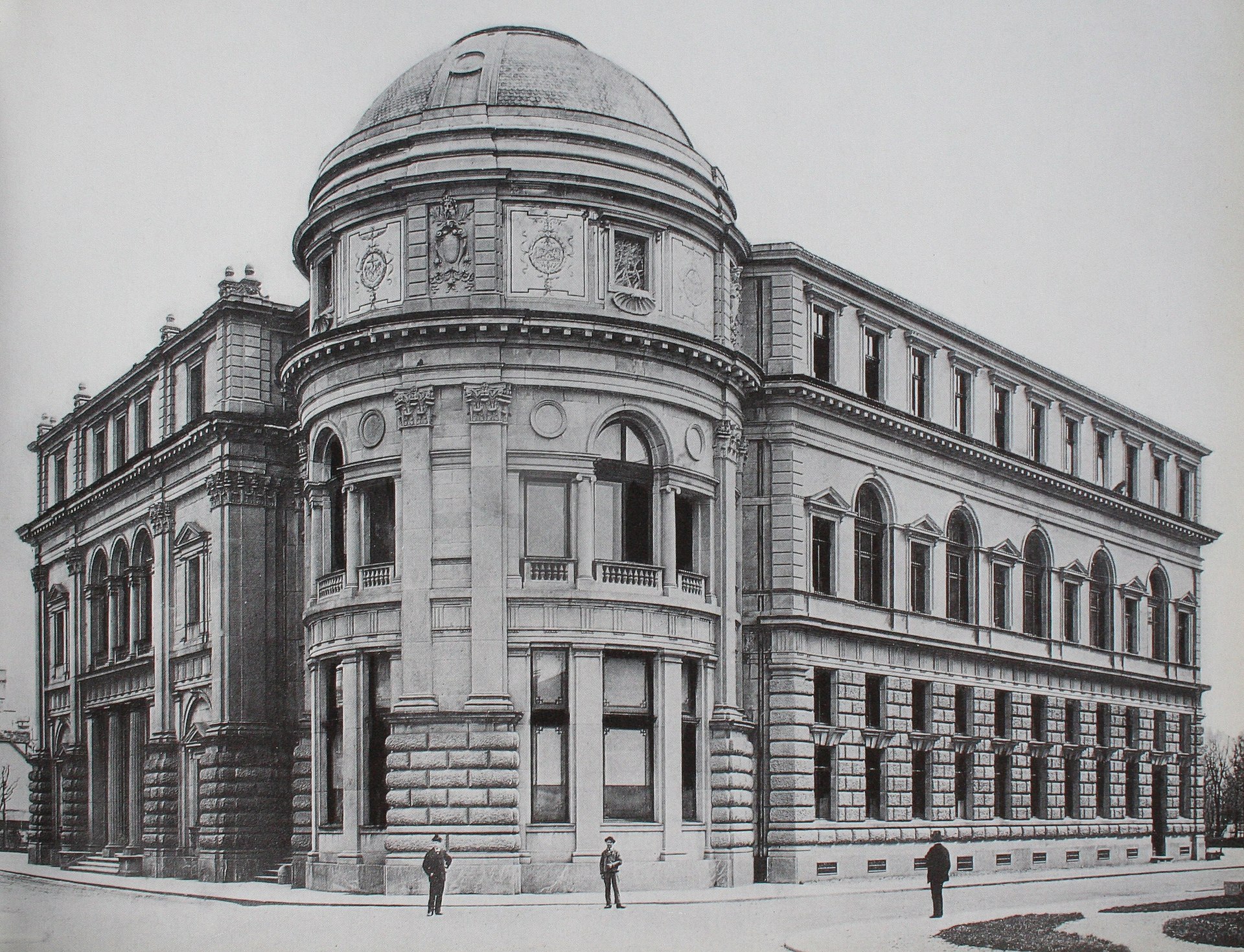
The first Zürcher Börse, Switzerland’s original purpose-built stock exchange, was erected between 1877 and 1880 at the corner of Bahnhofstrasse and Börsenstrasse—the latter street taking its name from the institution it anchored. The building was designed by August Albert Müller (1846–1912), a student of Gottfried Semper at the Eidgenössisches Polytechnikum, in collaboration with Caspar Conrad Ulrich. Müller had won first prize in an 1876 architectural competition for the commission, with Semper himself serving on the jury (gta Archiv, ETH Zürich, “August Albert Müller”). Drawing on his training under Semper’s rigorous Neo-Renaissance methodology—articulated in Semper’s treatise Der Stil in den technischen und tektonischen Künsten (1860–63)—Müller conceived the Börse in an Italian Renaissance revival idiom. The façade featured a prominent round tower, articulated columnwork, and a rhythmic arrangement of arched windows that recalled Florentine palazzo design. Inside, the principal trading hall rose fifteen meters to a barrel-vaulted ceiling with mirror vaults and crystal chandeliers; marbled interior walls were interrupted by load-bearing columns that framed the central trading ring (Neue Zürcher Zeitung, “Glamour war gestern,” 2019). The building was considered one of the most significant commercial structures of the later nineteenth century in Zurich. In 1929, the historicist façade was “purified” when ornamental detail fell from fashion. When the exchange relocated to Bleicherweg in 1930, the original trading hall was destroyed during conversion to banking use, and the building was substantially renovated again in 1930–32, with its natural stone façade completely redesigned. The structure at Bahnhofstrasse 3 survives today under heritage protection.
The decorative program of Müller’s original Börse was conceived in the spirit of Semper’s Gesamtkunstwerk ideal, in which architectural ornament, material finish, and spatial composition formed an integrated artistic statement. The fifteen-meter-high trading hall was the building’s showpiece: barrel vaults and mirror vaults overhead caught light from crystal chandeliers, while the walls below were clad in polished marble interrupted by classical columns—an arrangement that projected the gravitas and permanence appropriate to a financial institution (Stephanie Hering, Geldadressen: Architektur und Öffentlichkeit von Bankbauten und Börsen, ETH Zürich dissertation). The round tower element and columned rows on the exterior carried Renaissance vocabulary drawn directly from Semper’s pedagogy at the Polytechnikum, where the Italian Cinquecento served as a primary stylistic model (Harry Francis Mallgrave, Gottfried Semper: Architect of the Nineteenth Century, Yale University Press, 1996). When the exchange moved to Bleicherweg, the building corporation Tiefengrund—founded by the Zurich Chamber of Commerce and the Canton of Zurich—commissioned Augusto Giacometti (1877–1947) to paint his monumental world-map mural (1931) on the first floor of the new Börse. Measuring 18 meters wide and covering 154 square meters, the egg-tempera painting—executed using a formula attributed to Arnold Böcklin—depicted global trade routes and continents as a visual manifesto of Switzerland’s aspirations in an increasingly interconnected economy (SWI swissinfo.ch, “Augusto Giacometti’s hidden treasure,” 2018). Giacometti expert Beat Stutzer documented the mural’s significance in his monograph Augusto Giacometti (Verlag Scheidegger & Spiess, revised edition). The work, completed in three and a half months, has since been obscured behind projection screens, though the building received heritage monument status in 1992.
The siting of the Zürcher Börse at the intersection of Bahnhofstrasse and Börsenstrasse placed it at the epicenter of Zurich’s emerging financial quarter. Bahnhofstrasse itself was a product of mid-nineteenth-century urban modernization: built over the filled-in Fröschengraben (medieval moat) beginning in 1854, the full boulevard was completed in 1877—the same year the stock exchange received its first official price sheet (Vereinigung Bahnhofstrasse Zürich, “History”). Alfred Escher’s founding of the Schweizerische Kreditanstalt in 1856 had already established Paradeplatz, just steps away, as a banking nucleus; the Kreditanstalt’s headquarters at Paradeplatz 8, designed by Jakob Friedrich Wanner and inaugurated in 1876, anchored the financial gravity of the district. The Börse’s placement confirmed Börsenstrasse as the institutional spine linking Paradeplatz to the broader commercial quarter, a geography that would attract the Zürcher Kantonalbank (founded 1870), Bank Julius Bär (1890), and eventually UBS (arriving on Bahnhofstrasse in 1907). Paradeplatz itself had evolved from a seventeenth-century livestock market known as Säumärt (“pig market”) into the symbolic heart of Swiss banking (Wikipedia, “Paradeplatz”). When the exchange outgrew Müller’s building, the second Börse at Bleicherweg 5 (1928–30, Henauer and Witschi) was sited barely 300 meters southwest, maintaining proximity to Paradeplatz and its concentration of banking headquarters—a clustering that persists in Zurich’s financial geography today.
The institutional history of the Zürcher Börse begins with the founding of the Zurich Stock Exchange Association (Zürcher Börsenverein) in 1855, though formal trading commenced only when the first official price sheet appeared in 1877 (Swiss Finance Museum, “History of Trading”). The association’s origins were bound up with the railway boom that transformed Swiss finance: Alfred Escher’s creation of the Schweizerische Kreditanstalt in 1856 to fund the Swiss Northeastern Railway and later the Gotthard Railway generated an unprecedented volume of securities requiring organized markets (Youssef Cassis, “Railway Boom, the Big Banks, and the Ascent of Zurich as Financial Centre, 1848–1914,” in Switzerland and Its Banks, Springer, 2023). From 1884, the exchange came under cantonal supervision. The purpose-built Börse opened in 1880, providing a fifteen-meter-high ring-trading hall where securities were exchanged à la criée—by vocal acclamation at the ring. By the 1920s the first building proved inadequate, and the exchange relocated in 1930 to the Neue Börse at Bleicherweg 5, designed by Henauer and Witschi in the Neues Bauen style. Ring trading persisted there for over six decades, employing some 350 brokers (the first woman trader joined in 1988). In 1993, the Zurich, Geneva, and Basel exchanges merged to form the Swiss Stock Exchange. On 15 August 1996, after 140 years, ring trading ended; the following day, fully electronic trading commenced, making the Swiss Exchange the first in the world to automate trading, clearing, and settlement on a single platform (SIX Swiss Exchange, corporate history). The exchange was renamed SWX Swiss Exchange and, following a 2008 merger with SIS Group and Telekurs, became part of SIX Group Ltd.
From its earliest operations in the 1870s, the Zürcher Börse principally traded shares in railway companies and the banks that financed them. The Schweizerische Kreditanstalt, whose founding capital of three million francs was oversubscribed within three days in 1856, was itself among the first securities to trade actively (Ernst & Young, “Credit Suisse History”). Railway obligations—particularly bonds for the Swiss Northeastern Railway and the Gotthard Railway—dominated early listings, reflecting the infrastructure financing needs that had called the exchange into being. As Swiss industrialization accelerated, the exchange absorbed equities in insurance (Winterthur Group, founded 1875), machinery, textiles, and chemical firms. Throughout much of the twentieth century, the number of bonds listed exceeded the number of equities, with federal, cantonal, and municipal bonds constituting a significant share of turnover (Henri B. Meier, John E. Marthinsen, Pascal A. Gantenbein, and Samuel S. Weber, “Swiss Equity Markets,” in Swiss Finance, Springer, 2023). Trading was conducted à la criée at the ring, with brokers negotiating prices by voice and hand signal during sessions that ran from 9:30 a.m. to noon. The exchange’s global stature grew with the listing of multinational corporations headquartered in Switzerland—Nestlé, Novartis, Roche, UBS, and Zurich Insurance among them—transforming it from a regional securities market into one of Europe’s most capitalized exchanges. The 1996 transition to electronic trading via the SWX platform brought a massive increase in turnover and liquidity by enabling worldwide remote participation, consolidating Zurich’s position as a preeminent global financial center.
Images will be added as the project develops. Photographs by Larry Ng and from research sources.