Zurich Stock Exchange (current) / SIX Swiss Exchange
Zurich, Switzerland · Established 1995
This site requires authorization to access.
To request access, contact
william.goetzmann@yale.edu
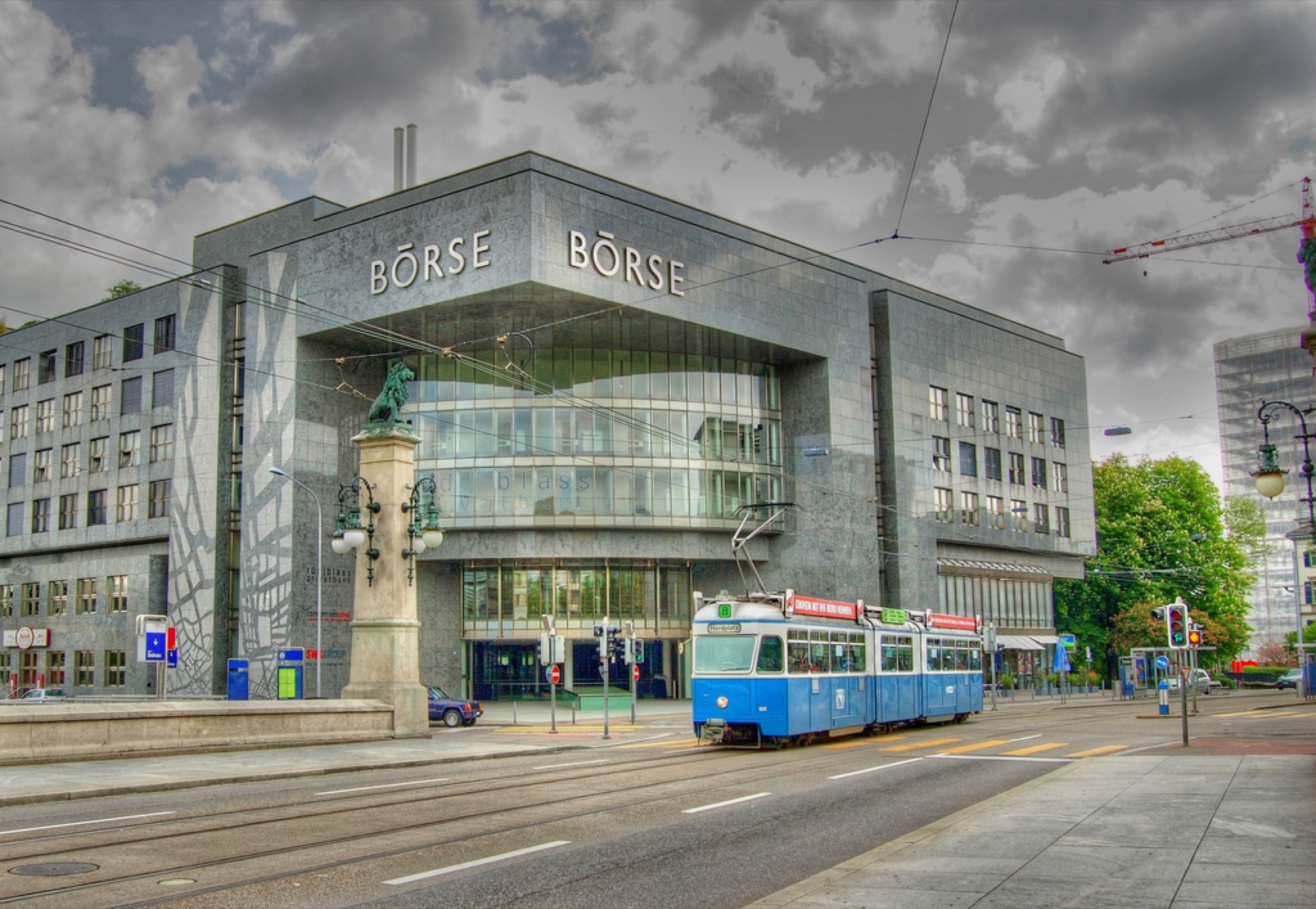
The SIX Swiss Exchange has occupied two purpose-built structures that bookend the transition from physical to electronic trading. The Neue Börse at Selnaustrasse 30, designed by the Basel-based firm Suter + Suter and constructed from 1987 to 1991, served as the exchange’s flagship until 2017. Selected from seventy-four competition entries, the design produced a monolithic, strictly structured building with a footprint of 130 by 52 meters, clad in dark blue-grey Kösseine granite from Bavaria’s Fichtelgebirge—a material chosen to project what Stephanie Hering, in her dissertation Geldadressen: Zürcher Börsenbauten, described as elegance and massive seriousness befitting a financial institution. The mass of the building extends solidly toward the Sihl River and Selnaustrasse, while the rear facade facing the Schanzengraben canal and Old Botanical Garden opens through a stepped, semicircular glass-metal curtain wall. Three large circular cutouts in the roof and plan deliberately echoed the geometry of the ring-trading floor within, where six simultaneous trading rings once operated. A central 64-ton steel spiral staircase connected the interior levels, and an innovative geothermal system drew water from the adjacent Schanzengraben to heat and cool the building. The trading rings became obsolete almost immediately: fully electronic trading commenced on 16 August 1996, rendering the physical infrastructure of open outcry superfluous. Following SIX Group’s 2017 relocation, the Neue Börse was acquired by EF Education First, which commissioned Stücheli Architekten to adapt its interiors. SIX Group’s current headquarters at Hardturmstrasse 201, in the Hard Turm Park development of Zurich West, occupies a seven-storey commercial building designed with activity-based working principles by Mint Architecture AG (completed 2019). The open-plan offices, Lindner Cube room-in-room modules, and collaboration zones reflect the exchange’s transformation from a physical marketplace into a digital financial infrastructure provider. The Swiss Finance Museum, inaugurated within the new headquarters in June 2017, anchors the public-facing dimension of the building, housing one of the world’s most significant collections of historical securities.
The decorative programs of the SIX Swiss Exchange’s buildings chart the shift from modernist restraint to site-specific public art commissioned for a global financial institution. The Neue Börse of 1991 incorporated deliberate artistic interventions into its granite architecture. On the Sihlhölzlistrasse facade, the Swiss sculptor and ceramicist Ernst Häusermann (born 1947, Lenzburg) and painter Max Matter created three monumental vertical facade elements, each measuring approximately four by twenty-five meters, displaying abstracted city maps of New York, London, and Tokyo—the world’s other principal financial centers—thereby placing Zurich symbolically at the nexus of a global trading network. The same artist duo designed a stone circle for the entrance area incorporating stones from distant countries representing the cardinal directions, an installation that resonated with the exchange’s aspiration to international connectivity. Within the building, the Canton of Zurich commissioned a collection of works by contemporary Swiss artists during the 1990s; these pieces, which remained with the building after SIX’s departure, reflected the Zurich tradition of Kunst am Bau (art in architecture) mandated for significant public commissions. The interior spaces derived their aesthetic character less from applied decoration than from the lapidary quality of the granite surfaces, the monumental spiral staircase, and the open geometries of the trading rings—spaces whose circular forms recalled the amphitheater-like architecture of earlier European bourses. At the current SIX headquarters in Hard Turm Park, the Swiss Finance Museum functions as both cultural institution and decorative anchor, displaying what the Foundation Collection of Historical Securities describes as one of the most significant collections of historical securities worldwide, with some 10,000 items from more than 150 countries. These include original share certificates from the Dutch East India Company era, early Swiss railway bonds, and a certificate from Charlie Chaplin’s film production company. Interactive multimedia installations allow visitors to experience simulated stock exchange trading, connecting the museum’s historical artifacts to the digital infrastructure operating in the floors above.
The SIX Swiss Exchange’s successive relocations trace the westward expansion of Zurich’s financial geography. The exchange’s predecessor institutions operated near Paradeplatz, the square that has served since the late nineteenth century as the symbolic center of Swiss finance. Paradeplatz originated as a livestock market outside the medieval walls, incorporated within the Baroque fortifications completed around 1642 along the Schanzengraben moat; its transformation began when Bahnhofstrasse was laid out in 1867 over the filled-in Fröschengraben after the city’s medieval defenses were demolished in 1864. Alfred Escher’s Schweizerische Kreditanstalt (later Credit Suisse, now UBS) built its headquarters at Paradeplatz between 1873 and 1876; the Schweizerischer Bankverein (Swiss Bank Corporation) followed in 1899, designed by Charles Mewès. By 1930 the first Zurich exchange building, the Alte Börse at Bleicherweg 5, stood just steps from these banking headquarters. The 1992 relocation to the Neue Börse at Selnaustrasse on the Sihl riverbank moved the exchange to a larger site at the edge of the Aussersihl district, the working-class quarter incorporated into Zurich during the great municipal expansion of 1893. SIX Group’s 2017 move to Hard Turm Park at Hardturmstrasse 201 continued this westward trajectory into Zurich West (Kreis 5), the former Escher Wyss industrial quarter. As Klaus Späth and Rahel Nydegger documented in their research on Zurich’s post-industrial transformation (Cities, 2017), the creative industry policy narratives driving the regeneration of Zürich-West converted a 100-hectare wasteland of abandoned steel plants and shipbuilding factories into a mixed-use innovation district. Landmarks of this transformation include the Toni-Areal (a former dairy now housing the Zurich University of the Arts), the Prime Tower (Switzerland’s tallest building at completion in 2011), and the Freitag Tower built from recycled shipping containers. SIX’s presence in Hard Turm Park—alongside the 25hours Hotel, residential towers, and creative studios—embeds financial market infrastructure within a district consciously designed to blur the boundaries between technology, culture, and commerce.
The SIX Swiss Exchange emerged from the 1993 consolidation of Switzerland’s three remaining regional bourses, but its roots extend to 1873, when formal securities trading commenced in Zurich. Geneva had opened the first Swiss bourse in 1850, followed by Basel in 1866 and Zurich in 1873; as Henri B. Meier, John E. Marthinsen, Pascal A. Gantenbein, and Samuel S. Weber documented in Swiss Finance: Banking, Finance, and Digitalization (Springer, 2023), Switzerland’s comparatively late development of stock exchanges reflected the country’s slow industrialization and the predominance of privately held companies, until the enormous financing needs of railway construction—epitomized by Alfred Escher’s founding of the Schweizerische Kreditanstalt in 1856—created urgent demand for equity and bond markets. From 1884, the Zurich exchange operated under cantonal supervision, a decentralized arrangement that persisted for over a century. Trading was conducted by open outcry in trading rings (Ringhandel) with hand signals: palms inward to buy, palms outward to sell. In 1988, the Swiss Options and Financial Futures Exchange (SOFFEX) was launched by the Zurich, Basel, and Geneva exchanges as the world’s first fully electronic derivatives exchange—a technological breakthrough that, as the MarketsWiki entry on SOFFEX documents, fueled the subsequent growth of electronic derivatives markets worldwide. SOFFEX licensed its proprietary system to Germany’s Deutsche Terminbörse, and the two merged in 1998 to form Eurex. The three Swiss exchanges formally merged to found the Verein Schweizerische Effektenbörse (Swiss Securities Exchanges Association) in 1993; the unified exchange began trading on 17 May 1995, and on 16 August 1996, the closing bells rang for the last time on the trading floors, ending over a century of ring trading. The new entity became the first stock exchange in the world to implement fully automated trading, clearing, and settlement. The Federal Act on Stock Exchanges and Securities Trading (SESTA, 1995) replaced cantonal jurisdiction with national regulation under the newly empowered Swiss Financial Market Supervisory Authority. In 2001, the Swiss Exchange launched virt-x in partnership with London-based Tradepoint, a pan-European platform for blue-chip equities; the venture was fully absorbed in 2009. In 2008, the Swiss Exchange merged with SIS Group (securities settlement) and Telekurs (financial information) to form SIX Group AG. Most recently, SIX Digital Exchange (SDX), granted FINMA licenses in September 2021, became the world’s first fully regulated blockchain-based exchange and central securities depository, launching with a 150-million-franc digital bond—an innovation positioning Switzerland at the frontier of tokenized finance.
SIX Swiss Exchange today lists approximately 60,000 securities across equities, bonds, exchange-traded funds, exchange-traded products, sponsored funds, and structured products, making it one of Europe’s most diversified trading venues. The Swiss Market Index (SMI), introduced on 30 June 1988 at a baseline of 1,500 points to coincide with the launch of SOFFEX derivatives, tracks the twenty largest and most liquid Swiss equities, representing approximately 70 percent of free-float market capitalization and 85 to 90 percent of total trading turnover. Three companies alone—Nestlé, Roche, and Novartis—have consistently accounted for roughly half the SMI’s weight, reflecting what Meier et al. (2023) characterized as the Swiss market’s unusual concentration in globally dominant pharmaceutical and consumer goods multinationals. The broader Swiss Performance Index (SPI) captures the full universe of SIX-listed equities and is registered under the EU Benchmarks Regulation with the European Securities and Markets Authority. Switzerland’s structured products market is among the world’s most developed: according to the Swiss Structured Products Association (SSPA), outstanding volume reached approximately 260 billion Swiss francs by mid-2025, with nearly 60,000 instruments available on SIX from issuers including UBS, Zürcher Kantonalbank, Vontobel, Julius Bär, and Leonteq. This ecosystem encompasses participation products, yield enhancement certificates, capital protection instruments, and leverage products—a taxonomy codified by the SSPA that has become a European standard. SIX’s clearing infrastructure, centered on the x-clear central counterparty, has pioneered interoperability arrangements under MiFID and MiFIR regulations, enabling cross-border clearing across multiple European trading venues and reducing margin requirements through multilateral netting. The exchange also operates the SIX Repo platform for secured money-market lending and the Swiss National Bank’s SIC (Swiss Interbank Clearing) real-time gross settlement system. Through SDX, SIX has extended its traded instruments into the realm of tokenized securities, including the landmark 150-million-franc blockchain bond issued at launch in November 2021—connecting the institution’s 150-year tradition of financial innovation, from open-outcry railway bonds to distributed-ledger digital assets.
Images will be added as the project develops. Photographs by Larry Ng and from research sources.