Zürich Grain Exchange (Kornhaus)
Zürich, Switzerland · Established 1616
This site requires authorization to access.
To request access, contact
william.goetzmann@yale.edu
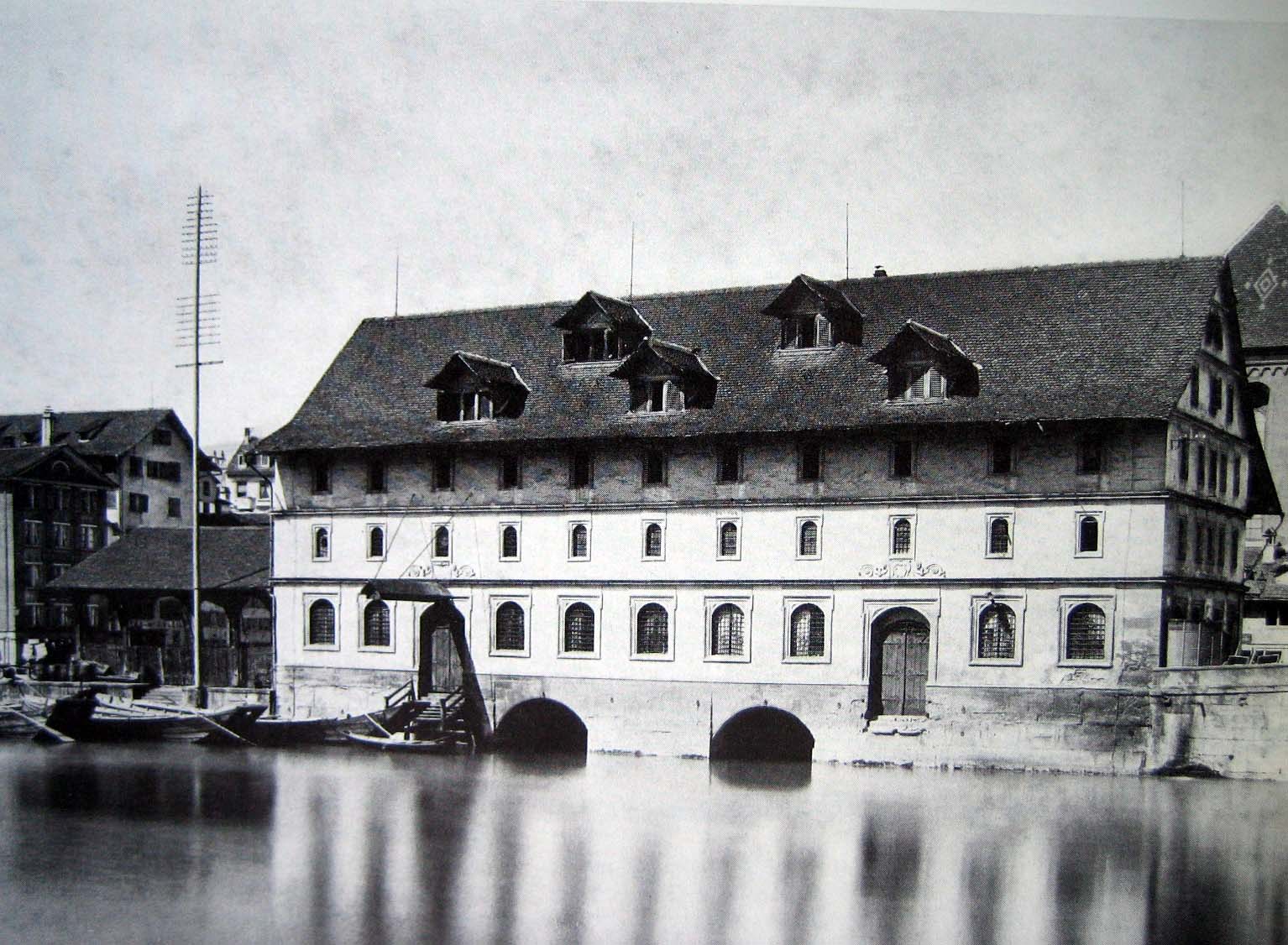
Zürich’s Kornhaus was a monumental Renaissance warehouse erected between 1616 and 1619 on the left bank of the Limmat, directly opposite the Rathaus and adjacent to the Fraumünster. Construction commenced in January 1616 with the laying of water-retaining foundations, and the topping-out ceremony took place on 12 December 1618. As described in the German-language entry of the Kornhaus (Zürich) article in Wikipedia (drawing on the Baugeschichtliches Archiv der Stadt Zürich), the building presented an imposing three-story façade in the Renaissance style, rising above vaulted ground-floor arcades constructed from dressed ashlar masonry (Quadermauerwerk). The steeply pitched gable roof was originally flanked by stepped gables (Treppengiebel), a characteristic motif of Swiss civic architecture. Stories were articulated by profiled string-courses, and every window received carved stone frames. Two river-facing portals allowed merchant vessels to load and unload grain directly from the Limmat, and from the 1690s purpose-built loading docks with mechanical hoisting devices expedited the transfer of cargo into the building’s upper floors. On the landward western side, three entrances served wagon traffic, and a large timber canopy was added in 1668 to shelter goods during loading. In the first decades of the seventeenth century the Kornhaus was the only major public building project undertaken by the Zürich authorities, signaling the civic government’s determination to centralize grain provisioning. The building was demolished in 1897–98 to widen the Stadthausquai; only two of the original Limmat-side arched portals survive, still used as sheltered moorings for traditional Weidling boats. The equestrian monument of Bürgermeister Hans Waldmann, sculpted by Hermann Haller and unveiled in 1937, now marks the former site.
The Kornhaus bore an elaborate painted decorative program that distinguished it from utilitarian warehouses. As the building’s German Wikipedia entry notes, all windows were “surrounded by painted ornaments” (gemalte Ornamente) until the early eighteenth century, and the considerable expense of this paintwork is documented in surviving painters’ account-books (Malerrechnung). While the specific iconographic subjects have not been fully catalogued in published scholarship, the painted façade tradition in Zürich civic buildings typically featured heraldic shields, allegorical figures, and foliate scrollwork—conventions paralleled in guild houses along the Limmatquai. The profiled stone window-frames and string-courses provided a sculptural framework that complemented the surface painting. Zürich’s broader heraldic culture is well documented: a 1593 stained-glass roundel from the workshop of Hans Rütter, now in the Cleveland Museum of Art (accession 1955.71), displays the arms of the Canton of Zürich surrounded by thirty ward-shields and the Imperial double eagle, exemplifying the civic heraldic vocabulary that would have informed the Kornhaus’s decorative program. The Zürcher Wappenrolle, one of the oldest armorial rolls of the Holy Roman Empire with 559 coats of arms, further attests to the region’s deep investment in heraldic display. Inside the Kornhaus, the functional spaces—measuring rooms, storage lofts, and the trading hall—were more austere, though the grain-measurers’ instruments and standard measures themselves represented a form of institutional material culture, as Hermann Heidinger documented in his dissertation Die Lebensmittel-Politik der Stadt Zürich im Mittelalter (1910).
The Kornhaus occupied a commanding position in Zürich’s Altstadt on the Stadthausquai, directly across the Limmat from the Rathaus and the guild houses lining the Limmatquai. Its placement beside the Fraumünster—whose abbesses had held market rights, toll-collection privileges, and minting authority since King Henry III’s charter of 1045—embedded the grain warehouse within the city’s oldest commercial axis. The adjacent Münsterhof, first documented in 1221 and the largest square within the medieval walls, served variously as pig market, wine market (relocated from the Weinplatz in 1647), and general marketplace, as detailed in the Münsterhof Wikipedia entry. Upstream, the Schipfe quarter at the foot of the Lindenhof hill functioned as Zürich’s primary transshipment point for goods arriving by river, and from the sixteenth century housed the silk industry and boatbuilding workshops. The Kornhaus’s river-facing loading portals connected it directly to the Limmat’s commercial traffic—flat-bottomed Weidling boats carried grain downstream from Lake Zürich and the surrounding agricultural hinterland. Across the water, the Limmatquai was lined with the guild houses (Zunfthäuser) of the thirteen Zünfte established by Rudolf Brun’s constitution of 1336, including the Zunfthaus zur Haue (seat of the merchant guild Zunft zum Kämbel) and the Zunfthaus zur Saffran (documented from 1383). The Kornhausbrücke, inaugurated in 1930, still bears the building’s name, testifying to its lasting imprint on Zürich’s urban geography.
The Kornhaus was the institutional center of Zürich’s grain provisioning system, a function rooted in the city’s guild-based political economy. Following Rudolf Brun’s guild revolution of 1336, which established thirteen Zünfte and the Gesellschaft zur Constaffel as the governing bodies of the city (as described by the Zentralbibliothek Zürich’s exhibit on the Zürcher Zünfte), guilds regulated competition and quality within their respective trades. The Zunft zum Kämbel, representing small merchants, salt-sellers, wine importers, and food traders, oversaw provisions sold at the Limmatquai arcades, the Weinplatz, and the Gmüesbrücke, as Steven A. Epstein’s Wage Labor and Guilds in Medieval Europe (University of North Carolina Press, 1991) contextualized within broader European guild structures. Hermann Heidinger’s dissertation Die Lebensmittel-Politik der Stadt Zürich im Mittelalter (1910) documented that by the fourteenth century the city operated grain houses on both banks of the Limmat, that all grain entering the city was required to be sold at a central market under official supervision, and that the council maintained municipal grain reserves—purchasing “1,000 marks worth of grain” annually at harvest-season prices from as early as 1427. Strict anti-speculation rules prohibited pre-purchasing grain outside designated market times. The 1616–1619 Kornhaus replaced earlier, smaller structures and centralized these regulatory functions in a single monumental building, staffed by specialized officials: grain measurers (Imminers), market inspectors, and grain porters. As Sheilagh Ogilvie analyzed in The European Guilds: An Economic Analysis (Princeton University Press, 2019), such regulatory frameworks served both consumer protection and rent-seeking purposes. In 1783 the council relocated the grain market and converted the Kornhaus into a general Kaufhaus; after further administrative shifts, a new Kornhaus designed by engineer Alois Negrelli opened in 1840 near Sechseläutenplatz, later converted into the “Old Tonhalle” concert hall in 1867.
The commodities traded in Zürich’s Kornhaus centered on the bread grains essential to the city’s food supply. As the Historisches Lexikon der Schweiz entry on Kornhäuser documents, these public granaries stored bread grains along with salt, wine, and butter, which authorities collected from natural revenues or purchased on the open market for redistribution at reduced prices during scarcity. Spelt (Dinkel) was the dominant cereal of the Swiss Plateau, as noted by Agrarforschung Schweiz, and along with wheat (Weizen), rye (Roggen), and oats (Hafer) constituted the principal grain varieties handled in the Kornhaus. The grain distinction between “glatte Frucht” (hulled or processed grain) and “rauhe Frucht” (unhulled grain, including spelt in its husks) was fundamental to measurement and pricing, as the University of Zürich’s Ad Fontes resource on Getreidemasse documents. Grain was measured using the Zürich system: one Malter equaled four Mütt (each Mütt approximately 54 kilograms), one Mütt equaled four Viertel, and each Viertel subdivided into four Vierling or ten Immi—yielding roughly 331 liters per Malter for processed grain. These measurements were enforced by sworn grain measurers (Imminers) who operated within the Kornhaus. Price volatility could be extreme: during the crisis of 1570–71, a Mütt of grain quadrupled from approximately 60 to over 240 Schillings. In addition to bulk cereals, flour (Mehl) and salt (Salz) were traded, the latter arriving via the South German trade routes connecting Zürich to the salt deposits of Bavaria and Austria. The Emperor Frederick III’s grant of free navigation rights on the Limmat and Rhine to Zürich in 1447 facilitated the downstream transport of these commodities.
Images will be added as the project develops. Photographs by Larry Ng and from research sources.