Merchant Adventurers' Hall
York, England · Established 1357
This site requires authorization to access.
To request access, contact
william.goetzmann@yale.edu
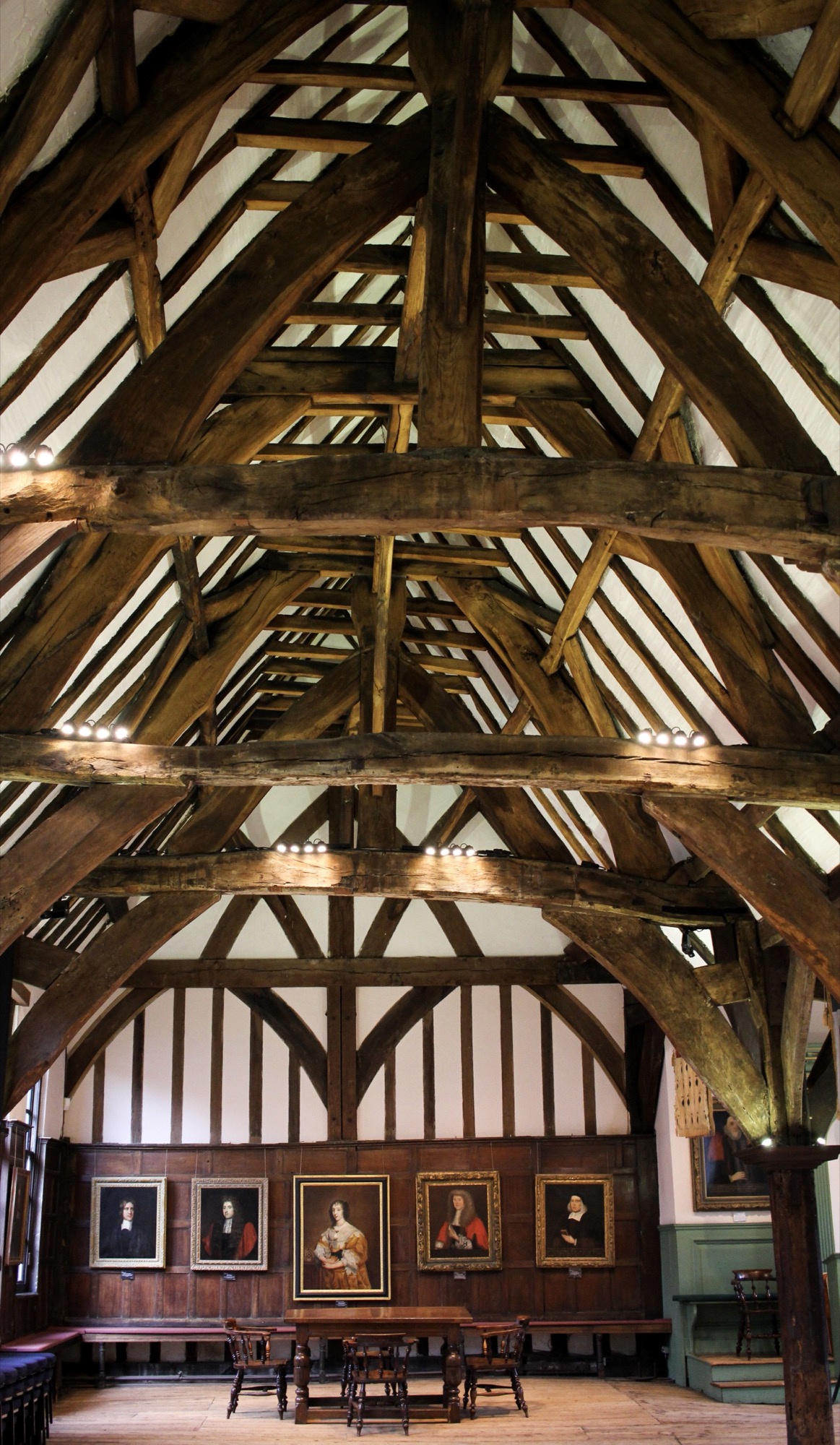
The Merchant Adventurers’ Hall in York is the largest timber-framed building in the United Kingdom still standing and used for its original purpose. Erected between 1357 and 1361, the Hall was documented in detail by the Royal Commission on the Historical Monuments of England in An Inventory of the Historical Monuments in City of York, Volume 5, Central (London, 1981), which records the building’s three-level structure: a Great Hall on the upper floor for meetings and feasts, a brick-built Undercroft at ground level that served as a hospital and almshouse, and a Chapel added in the early fifteenth century. The Great Hall’s roof is a masterwork of medieval carpentry: its crown-post construction features slightly cambered tie-beams with crown-posts having enlarged heads that rise to collars, with cross-bracing to each side. The RCHME survey noted that the hall employs kerb-principals in its roof trusses, a structural feature not otherwise found in York until a considerably later period, suggesting that the Merchant Adventurers’ builders were drawing on carpentry traditions from outside the city. The entire structure is held together by wooden pegs rather than nails, and the oak framing timber was sourced from the Forest of Galtres, north of York. The ground-level Undercroft is built primarily of brick—the first bricks made in York since the departure of the Romans, produced at a Carmelite Friary near Fossgate. This early brickwork makes the Hall significant not only as a commercial building but as evidence of the reintroduction of brick construction to northern England. The upper timber-framed section sits atop these brick walls, and the contrast between the heavy masonry below and the light timber frame above gives the building its distinctive silhouette. Beautifully decorated barge boards dating to 1601 ornament the gables. An Elizabethan-era two-story annexe was added later, the Undercroft floor was raised to address periodic flooding from the nearby River Foss, and Georgian-period windows were inserted, but the essential medieval structure survives intact. A survey of the hall was made as early as February 1814 by the York architects Atkinson and Phillips, indicating the building’s recognized architectural importance even before the age of systematic preservation. The building is designated Grade I by Historic England (List Entry 1257828).
The decorative program of the Merchant Adventurers’ Hall reflects the intertwined commercial, religious, and charitable functions of the medieval guild. The Great Hall’s most striking artistic element is the exposed timber roof itself—the crown-post construction with its rhythmic pattern of structural members creates a visual effect that is simultaneously functional and ornamental, comparable to the open timber roofs of other great English medieval halls such as Westminster Hall. The 1601 barge boards on the gables display carved decoration in the Jacobean style, marking the transition from medieval to early modern taste. The Chapel, added around 1411, retains late seventeenth-century fittings including paneling and furnishings that reflect the Company’s continued investment in its devotional space. The Company’s coat of arms and merchant marks appear throughout the building—these heraldic devices, which combined religious imagery (the fraternity was originally dedicated to Our Lord Jesus and the Blessed Virgin Mary) with symbols of mercantile identity, represent the visual culture of medieval commerce in which trade and piety were inseparable. The Company’s extensive archive, with documents dating from the thirteenth century and continuous account rolls from 1432, constitutes another form of visual and material culture. As Maud Sellers documented in The York Mercers and Merchant Adventurers 1356–1917 (Surtees Society, vol. cxxix, 1918), these manuscript records include charters, account rolls, and minute books that preserve the handwriting and administrative practices of medieval commerce. Sellers meticulously collated these materials after first visiting the Hall in 1895; she became the first female member of the Company in nearly four hundred years when she was made Honorary Member in 1913, and served as Honorary Curator from 1918. Her edition of these records, which made important selections from the Company’s manuscripts available to scholars for the first time, remains a foundational primary source for the study of English medieval guild culture.
The Merchant Adventurers’ Hall stands on Fossgate, one of medieval York’s principal commercial streets, running along the east bank of the River Foss between the city walls and the confluence of the Foss with the River Ouse. This location placed the Hall at the heart of York’s mercantile quarter, close to the wharves where goods were loaded and unloaded. The River Foss was navigable in the medieval period and provided direct water access to the agricultural hinterland of the Vale of York, while the Ouse connected York to the Humber Estuary and the North Sea, making the city a natural hub for both domestic and international trade. York’s urban form in the fourteenth century was shaped by its Roman and Viking inheritance. The city walls, largely rebuilt in the thirteenth and fourteenth centuries on Roman and Norman foundations, enclosed a dense medieval city crossed by narrow streets—a spatial typology comparable to the covered souks and narrow commercial lanes found in other pre-modern trading centers. The Shambles, a narrow street of overhanging timber-framed buildings just northwest of the Hall, preserves the character of this dense medieval commercial urbanism. Markets occupied several fixed locations within the walls: the Thursday Market (now St. Sampson’s Square), the Saturday Market (now Parliament Street), and the Pavement, where goods were displayed on paved surfaces near the entry to Fossgate itself. The Hall’s position along Fossgate connected it to this network of markets and to the city’s religious infrastructure. York Minster, the seat of the Archbishop, dominated the northern part of the walled city, while parish churches and religious houses were densely distributed throughout. The Carmelite Friary near Fossgate that produced the Hall’s bricks was one of several mendicant houses whose presence reflected the wealth that commerce brought to the medieval city. As the seat of England’s northern ecclesiastical province and a major center of both secular and religious authority, York offered merchants access to powerful institutional patrons and a large consuming population.
The Merchant Adventurers’ Hall was built for a religious fraternity that evolved into one of England’s most powerful trading companies. In 1357, a group of influential men and women in York came together to form a religious guild dedicated to Our Lord Jesus and the Blessed Virgin Mary, combining mutual aid, charitable work, and religious devotion. This fraternity, also known as the Guild of the Holy Trinity, built the Hall between 1357 and 1361 as its communal meeting place, hospital, and chapel. By 1430, the fraternity had merged with the Fellowship of Mercers—dealers in textiles—to form the Company of Merchant Adventurers of the City of York, which received its royal charter from Queen Elizabeth I in 1581. The Company’s rise coincided with York’s position at the center of England’s most important medieval export commodity: wool. As Eileen Power documented in The Wool Trade in English Medieval History (Ford Lectures, Oxford University Press, 1941), raw wool accounted for approximately ninety percent of England’s export revenues in the thirteenth and fourteenth centuries. Yorkshire wool, though not the finest in England (that distinction belonged to the Welsh Marches and Lincolnshire), was produced in enormous quantities and exported through York to the Low Countries, Germany, France, and the Baltic. The decisive transformation of England’s trade from raw wool to finished cloth exports took place in the later fourteenth century—precisely the period when the Merchant Adventurers were consolidating their power. As John Oldland documented in the Economic History Review (2014), cloth exports rose from 10,000 cloths per year in 1349–50 to 60,000 by 1446–47, and the York Mercers were positioned to profit from this transition. The Company controlled York’s overseas trade for centuries, governing access to foreign markets through a system of apprenticeship, membership fees, and regulatory oversight. Under one roof, the Hall embodied the three functions of a medieval guild: business and social events in the Great Hall, charitable work in the Undercroft hospital, and religious life in the Chapel. The Company’s extensive archive, with accounts dating from 1432, preserves the administrative record of this integrated guild life. Though the Company is no longer engaged in mercantile activities, it survives as a charitable membership organization and maintains the Hall as a historical monument and public attraction—one of the few medieval guild halls in Europe still owned and operated by its founding institution.
The Merchant Adventurers of York dealt primarily in textiles—both raw wool and, increasingly from the late fourteenth century onward, finished woolen cloth. York served as a collection point for wool from the great monastic estates of Yorkshire, particularly the Cistercian abbeys of Fountains, Rievaulx, Jervaulx, and Kirkstall, whose flocks produced vast quantities of fleece. This wool was exported through the city’s river port on the Ouse, which connected via the Humber to the North Sea ports of Hull and beyond to the Continental markets of the Low Countries, where Flemish and Brabantine weavers produced the finest textiles in medieval Europe. The Company of the Merchants of the Staple, granted the monopoly on English wool exports, channeled shipments through designated staple towns—most importantly Calais after 1363. The York Merchant Adventurers operated alongside and sometimes in competition with the Staplers, but their particular distinction was the export of finished cloth rather than raw wool. As the English cloth industry expanded in the fourteenth and fifteenth centuries, the Adventurers’ trade shifted toward broadcloth, kerseys, and other textiles shipped to markets in the Low Countries, the Hanseatic cities of the Baltic, and France. Beyond textiles, York’s merchants traded in lead from the Yorkshire Dales and the Pennines, a valuable commodity used throughout medieval Europe for roofing, plumbing, and window leading. Grain was both exported from the fertile Vale of York and imported in years of poor harvest. The city’s merchants also dealt in wine imported from Gascony, salt, iron, timber from the Baltic, and luxury goods including spices and dyed fabrics arriving through the Hanseatic and Italian trading networks. The river system gave York merchants access to a broad commercial hinterland: the Ouse and its tributaries drained much of northern England, and goods moved by barge between York and the agricultural and industrial districts of the surrounding region. The wool trade that built the Merchant Adventurers’ Hall was thus embedded in a diverse network of commodity exchange that sustained York as one of England’s wealthiest and most commercially active cities throughout the later Middle Ages.
Images will be added as the project develops. Photographs by Larry Ng and from research sources.