Yangon Stock Exchange (former Reserve Bank of India building)
Yangon (Rangoon), Myanmar · Established 1930s (Rangoon Stock Exchange); building 1939; present exchange 2015
This site requires authorization to access.
To request access, contact
william.goetzmann@yale.edu
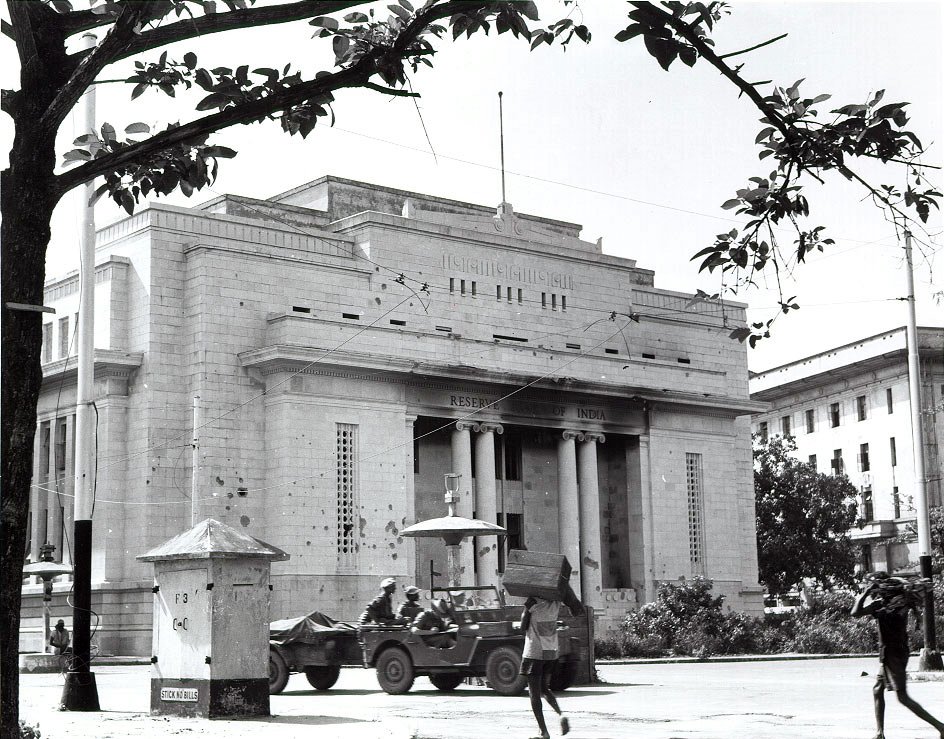
The building that now houses the Yangon Stock Exchange was designed by the architect G. Douglas Smart and completed in 1939 as the Rangoon branch of the Reserve Bank of India; several architectural surveys, including the Yangon Architectural Guide (yangongui.de), associate the commission with the Hong Kong and Shanghai firm Palmer & Turner, which also raised the nearby Chartered Bank on Pansodan Street. Built of heavy cut stone, the structure presents a deliberately fortress-like, vault-secure aspect appropriate to a note-issuing central bank: a largely sealed principal facade pierced by only a few tall grilled windows, and a recessed entrance portico framed by two pairs of Ionic columns supporting a plain carved entablature inscribed RESERVE BANK OF INDIA. The interwar idiom is a stripped, austere neoclassicism in which monumental order and solidity are prized over ornament, the bronze-grilled doors historically marked Issue Department and Banking Department recording the building's original monetary function. The Irrawaddy's Places in History feature on the building ('Now YSX, the Building Once Managed Myanmar's Monetary System') and the Yangon Architectural Guide both stress this impregnable, security-driven design, which survived the Japanese occupation and successive renovations with its exterior substantially intact.
As a working bank vault converted to an exchange, the building is reticent in decorative art; its visual interest lies less in painting or sculpture than in the disciplined classicism of the stonework itself. The principal artistic statements are architectural: the cut-stone Ionic order of the entrance, the incised lettering of the cornice frieze naming the Reserve Bank of India, and the ornamental metal grilles over the windows and doors, which combine protective and decorative purposes in the manner of interwar bank design. The Yangon Heritage Trust, which advised on the 2014-2015 conversion and installed one of its blue heritage plaques on the building, advocated specifically for conservation of the interior; under that guidance the Japanese-led refit (Daiwa and the Japan Exchange Group) was confined so as not to alter the historic exterior, preserving the original architectural character rather than introducing new decorative programmes.
The building stands at 24-26 Sule Pagoda Road, on the corner of Sule Pagoda Road and Merchant Street in Kyauktada Township, the heart of the colonial commercial grid that the British laid out after annexing Lower Burma in 1852. This downtown core, organised on a rigid orthogonal plan running back from the Strand and the Rangoon River, became one of the densest concentrations of monumental colonial architecture in Southeast Asia, anchored by the gilded Sule Pagoda a short walk to the north and lined with the banks, trading houses and government offices of British Burma's mercantile spine. The Reserve Bank of India building sits among this ensemble of financial landmarks-the Chartered Bank, the former Bank of Bengal on the Strand, the High Court and the Secretariat-an architectural fabric now championed by the Yangon Heritage Trust and surveyed in the Commonwealth Heritage Forum's Yangon programme as one of the most complete colonial townscapes to survive in the region.
Securities trading in Rangoon long predates the present building. As the Wikipedia entry on the Rangoon Stock Exchange records, an informal, secondary over-the-counter market run by seven European firms operated from the 1930s until 1941, dealing chiefly in British and American shares whose prices were largely relayed from the Calcutta and Bombay exchanges rather than set locally; it closed with the Japanese invasion, briefly revived in the late 1950s to trade nine public-private joint ventures, and was extinguished when General Ne Win's 1962 coup nationalised the firms. The building's own institutional history runs in parallel. Opened in 1939, it served as the Rangoon office of the Reserve Bank of India, which-as the RBI's own museum account ('pm_burma') notes-acted as banker to the Government of Burma and issued distinctive Burma notes under the Burma Monetary Arrangements Order of 1937, continuing until 1 April 1947 apart from the 1942-1945 occupation. After independence it became the Union Bank of Burma, where the first Burmese kyats were issued in July 1952; it later housed the Central Bank of Myanmar and then the military-owned Myawaddy Bank. In December 2015 the restored building opened as the Yangon Stock Exchange, a joint venture established in 2014 between Myanma Economic Bank, the Daiwa Institute of Research and the Japan Exchange Group, marking the return of organised securities trading to a structure built to manage the nation's money.
Rangoon's commercial significance rested on commodities rather than securities: it was the greatest rice-exporting entrepot of British Asia, shipping the milled output of the Irrawaddy delta across the Indian Ocean, alongside teak, oil and other primary exports of a colonial extractive economy. The interwar Rangoon Stock Exchange that grew up in that boomtown was, by contrast, a thin and derivative market-an over-the-counter venue managed by a handful of European houses trading British and American equities, with quotations imported from Calcutta and Bombay, as the Rangoon Stock Exchange Wikipedia entry describes. The building itself, meanwhile, traded in money in the most literal sense, issuing and managing first the Reserve Bank of India's Burma rupee notes and, after 1952, the new kyat. The modern Yangon Stock Exchange that reopened the building to trading in 2015 has remained small, listing only a handful of domestic companies-on the order of four to eight issuers in its first years-as Myanmar's capital market slowly rebuilds after decades of nationalisation and isolation.
Images will be added as the project develops. Photographs by Larry Ng and from research sources.