Winnipeg Grain Exchange
Winnipeg, Canada · Established 1887
This site requires authorization to access.
To request access, contact
william.goetzmann@yale.edu
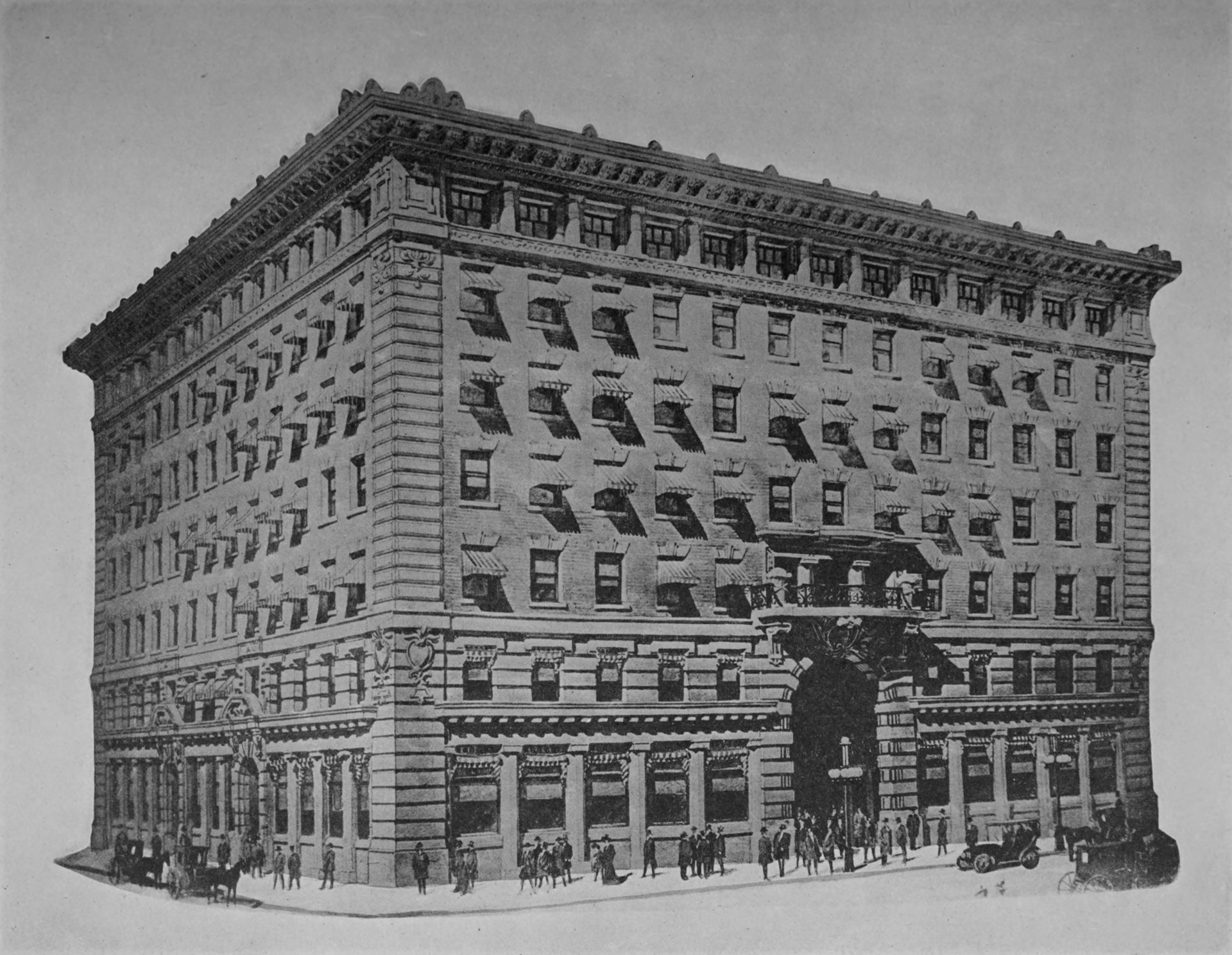
The Grain Exchange Building at 167 Lombard Avenue in Winnipeg stands as the monumental architectural expression of Western Canada’s wheat economy. Designed by the distinguished Toronto firm of Darling and Pearson—Canada’s foremost commercial architects, who also designed the Bank of Commerce headquarters in Toronto and numerous institutional buildings across the Dominion—the structure was erected between 1906 and 1908 by the contracting firm Kelly Brothers and Mitchell. As documented in the City of Winnipeg Historical Buildings Committee report (1992), the building exemplified the Sullivanesque style, a variant of the Chicago School of architecture for tall, steel-framed commercial buildings, combined with Italian Renaissance palazzo detailing. The steel and reinforced concrete frame represented the technological advance that enabled the skeleton-frame construction commonly used in multi-storey commercial architecture, permitting far greater window expanses since the building’s structural load was no longer borne entirely by its exterior walls. The original structure rose five storeys; a seven-storey addition was completed in 1913 by the Winnipeg associate firm of Jordan and Over, who had previously worked in Darling and Pearson’s local office. As the Winnipeg Architecture Foundation’s inventory records, Lewis H. Jordan and W. Percy Over maintained their partnership from 1910 until 1925, overseeing the exchange’s expansion during the wheat boom years. A Bedford stone base encompasses the ground and mezzanine floors, the office mid-section consists of solid buff-coloured brick walls, and the capital features an attic storey crowned by a heavy, projecting cornice. A colossal round-arched stone entry on the Lombard Avenue façade extends upward to a third-floor balcony supported by console brackets, and a large limestone lintel above the entry door bears raised block lettering identifying the exchange. A row of tall arched windows on the sixth floor marks the location of the double-height trading room—the very heart of the building’s commercial purpose. The structure eventually reached ten storeys and today encompasses over 250,000 square feet of office space on unusually large 25,000-square-foot floor plates spanning an entire city block, as detailed by current property managers. Designated a Grade II Heritage Building by the City of Winnipeg, the building sits within the Exchange District National Historic Site, declared in 1997. Since 2007 the building has undergone extensive floor-by-floor renovations and continues to house government and private offices, including, fittingly, the Canola Council of Canada.
The decorative program of the Grain Exchange Building reflects the restrained opulence characteristic of early twentieth-century commercial architecture in western Canada. As the Archiseek architectural survey notes, the Lombard Avenue façade’s colossal round-arched stone entry, extending to the third-floor balcony with its console bracket supports, constitutes the building’s principal sculptural element—a monumental portal befitting the gateway to the continent’s wheat trade. The raised block lettering on the limestone lintel above the main entrance, spelling out the exchange’s name, exemplifies the period’s preference for architectural epigraphy as both identification and civic assertion. Interior spaces featured fine woodwork and classical detailing throughout the halls and corridors, with the grand entrance hall adorned with paneled wainscoting. The double-height trading room on the sixth and seventh floors—visible from the street through its distinctive row of arched windows—was itself a work of functional theatre: as Allan Levine described in The Exchange: 100 Years of Trading Grain in Winnipeg (Peguis Publishers, 1987), the trading floor was designed to channel both visual sightlines and acoustic energy, allowing traders to read the price boards and hear competing bids across the open-outcry pit. The interior light well, or atrium, that extends through the building’s core provided natural illumination to interior offices while creating a sense of vertical grandeur. The building’s exterior ornamental vocabulary—the heavy projecting cornice, the articulated belt courses dividing the palazzo’s base, shaft, and capital, and the carefully proportioned fenestration—drew on the Sullivanesque tradition of treating commercial architecture as civic art. Within the broader Exchange District, as the Parks Canada heritage designation statement records, the prevailing materials palette of Tyndall limestone, buff brick, terracotta, and granite created a unified streetscape of monumental commercial architecture. The earlier Grain Exchange Building at 156–160 Princess Street, designed by Samuel Hooper and completed in 1898 for exchange founder Nicholas Bawlf, preserved original golden oak wainscoting and vault doors featuring pastoral scenes—decorative elements connecting the world of high finance to the agrarian landscape that sustained it.
The Grain Exchange Building’s position at 167 Lombard Avenue places it at the commercial heart of Winnipeg’s Exchange District, a twenty-block precinct of approximately 150 heritage buildings that the Parks Canada designation statement (1997) describes as “one of the most historically intact turn-of-the-century commercial districts on the continent.” Winnipeg’s emergence as the grain capital of the British Empire was a direct consequence of geography and rail infrastructure. The city sits at the confluence of the Red and Assiniboine Rivers—a site known as The Forks that had served as a trading crossroads for thousands of years before European settlement. The arrival of the Canadian Pacific Railway in 1881 transformed this ancient meeting place into the critical junction linking the vast agricultural prairies of western Canada to the shipping terminals of the Great Lakes and, through them, to global markets. As the Manitoba Historical Society documents, by 1911 Winnipeg had twenty-four rail lines converging on it and over 200 wholesale businesses, earning it the sobriquet “Chicago of the North.” The city was the fastest-growing metropolis of its size in North America, ranking as Canada’s third largest by 1911. The exchange building anchored a district that included grain company headquarters, banks, insurance offices, and the warehouses of the wholesale trade—all oriented toward the railway yards that fanned out to the north and east. The grain elevator system formed the physical infrastructure connecting prairie producers to the exchange floor: as the Manitoba government’s economic history study A History of Grain Elevators in Manitoba documents, country elevators at railway sidings across the prairies funneled wheat into terminal elevators at Winnipeg and the lakehead at Thunder Bay, whence it moved by ship through the Great Lakes to eastern ports and overseas. The first grain shipment destined for overseas was collected in Winnipeg and shipped by rail to Port Arthur in 1883. The Exchange District’s development slowed dramatically after the First World War and the 1913 opening of the Panama Canal, which redirected shipping routes and diminished Winnipeg’s strategic advantage. Paradoxically, this economic stagnation preserved the district’s architectural character, as few of its Chicago School buildings were demolished for redevelopment. The Exchange District was designated a National Historic Site of Canada on September 27, 1997, by federal Heritage Minister Sheila Copps, recognized for illustrating “the city’s key role as a centre of grain and wholesale trade, finance and manufacturing, in the historically important period in western development between 1880 and 1913.”
On November 24, 1887, a group of prominent Winnipeg businessmen—including Daniel H. McMillan, George F. Galt, James A. Mitchell, Rodmond P. Roblin, Nicholas Bawlf, Samuel Spink, and Charles N. Bell—met at the offices of the Winnipeg Board of Trade to organize the Winnipeg Grain and Produce Exchange, as the Manitoba Historical Society’s institutional record documents. McMillan served as the first president, and Bell as Secretary-Treasurer from 1887 to 1915, providing essential institutional continuity during the exchange’s formative decades. For its first eighteen years the exchange operated strictly as a cash market for grain already harvested; in 1904 it established futures contracts for wheat, followed by oats and flaxseed the same year, barley in 1913, and rye in 1917. The institution was reorganized as a voluntary non-profit organization in 1908, adopting the streamlined name Winnipeg Grain Exchange. By the 1920s, as Vernon Fowke documented in The National Policy and the Wheat Economy (University of Toronto Press, 1957), more than half the world’s wheat sales were completed on the Winnipeg trading floor, making the exchange one of the most significant commodity markets on earth. The exchange’s history was inseparable from the political struggles over grain marketing in western Canada. The Winnipeg General Strike of 1919—when over 30,000 workers shut down the city for six weeks—reflected broader tensions between labor, capital, and the agrarian west. As Allan Levine recounted in The Exchange: 100 Years of Trading Grain in Winnipeg (1987), prairie farmers harbored deep suspicion of the private grain trade concentrated on the exchange floor, believing that speculators and elevator companies exploited their market power at producers’ expense. The federal government established a temporary Canadian Wheat Board to market the 1919 crop, but disbanded it in 1920. Farmers then organized the provincial wheat pools—the Alberta, Saskatchewan, and Manitoba Co-operative Wheat Producers—which operated cooperative marketing systems throughout the 1920s. When the pools collapsed financially during the Depression, the government permanently re-established the Canadian Wheat Board in 1935, initially on a voluntary basis. As William Morriss detailed in Chosen Instrument: A History of the Canadian Wheat Board (1987, 2000), from 1943 the Board operated as the compulsory single-desk seller of western Canadian wheat and barley, fundamentally constraining the exchange’s role. André Magnan’s When Wheat Was King: The Rise and Fall of the Canada–UK Grain Trade (UBC Press, 2016) traces how this regulatory framework shaped Canadian grain marketing until the Board’s dismantling in 2012. The exchange itself was renamed the Winnipeg Commodity Exchange in 1972 to reflect its broadened product range. It demutualized in 2001 and was acquired by the Intercontinental Exchange (ICE) on August 28, 2007, for C$50 million, becoming ICE Futures Canada on January 1, 2008. The Winnipeg office finally closed in May 2018, ending 131 years of continuous grain trading in the city.
The Winnipeg Grain Exchange was founded as a cash market in wheat, oats, and barley, the staple grains of the expanding Canadian prairies. As D.A. MacGibbon documented in The Canadian Grain Trade (Macmillan, 1932), the exchange introduced wheat futures contracts in 1904, followed by oats and flaxseed futures the same year, barley futures in 1913, and rye futures in 1917—creating a comprehensive derivatives market for the prairie grain complex. The exchange’s most consequential innovation came in 1963, when it launched rapeseed futures contracts. As the crop was scientifically transformed from an industrial lubricant feedstock into canola—one of the world’s premium cooking oils—the modest contract grew to dominate the exchange’s volume. By the time of the ICE acquisition, canola futures accounted for ninety-five percent of trading activity, and the contract remains the global benchmark for canola pricing. Trading was conducted by open outcry in the double-height trading pit on the sixth and seventh floors of the Lombard Avenue building. As Charles Anderson described in Grain: The Entrepreneurs (Watson & Dwyer, 1991), traders in colored jackets—blue for RBC, red for Fimat—shouted bids and offers while clerks on catwalks above marked prices on giant chalkboards, later replaced by electronic display boards. The trading floor functioned as the price-discovery mechanism for the entire western Canadian grain trade: prices established in the Winnipeg pit determined what farmers received at country elevators across the prairies, what terminal operators paid at the lakehead, and what exporters quoted to overseas buyers. The physical infrastructure of the grain trade—the network of country elevators at railway sidings, terminal elevators at Winnipeg and Thunder Bay, and the railway system itself, dominated by the Canadian Pacific Railway—formed an integrated supply chain that channeled grain from individual farms to the exchange floor and onward to world markets. In May 2004, members voted to end open-outcry trading and migrate to the Chicago Board of Trade’s e-CBOT electronic platform. The final floor session occurred on December 17, 2004, making the Winnipeg exchange the first commodities market in North America to abandon the trading pit entirely. Under ICE ownership after 2007, the exchange continued to trade canola, milling wheat, durum wheat, and western barley futures electronically until the Winnipeg office’s closure in 2018.
Images will be added as the project develops. Photographs by Larry Ng and from research sources.