Wheeling Stock Exchange
Wheeling, USA · Established c. 1880s
This site requires authorization to access.
To request access, contact
william.goetzmann@yale.edu
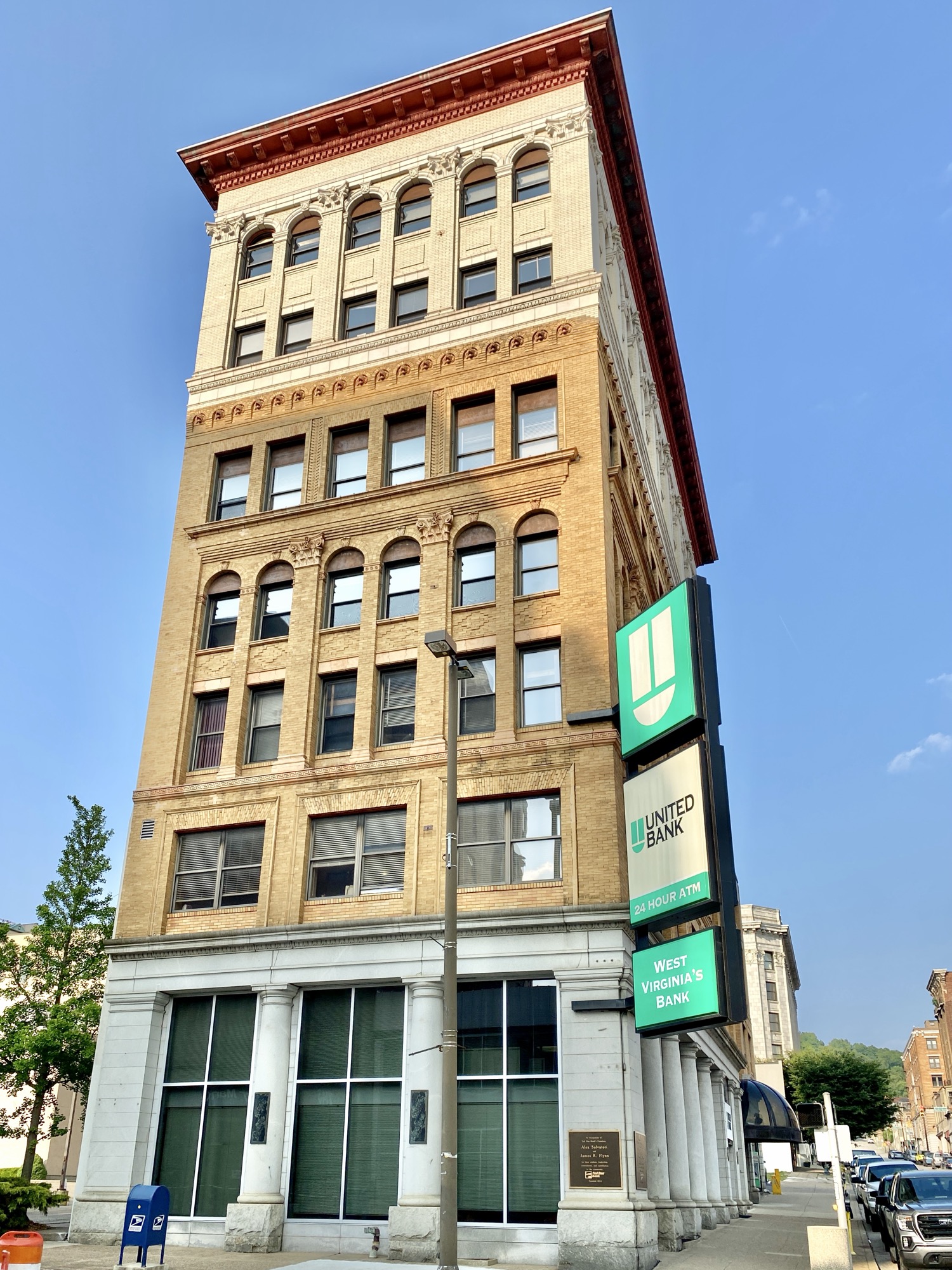
The Wheeling Stock Exchange operated within the financial corridor along Main Street in downtown Wheeling, closely associated with the National Exchange Bank Building at the corner of Main and 12th Streets. The bank’s origins trace to the Bank of Northwestern Virginia, established in 1817 as, in the words of the Ohio County Public Library’s archival records, “the first bank, strictly speaking, west of the mountains” in Virginia. The original single-story structure was replaced in 1898 with a five-story edifice, which architects Millard F. Giesey and Frederick F. Faris expanded by two additional stories in 1911, creating the imposing seven-story building that still stands. As documented in the Ohio County Public Library’s National Exchange Bank history, the façade featured “a classic Doric facade with graceful columns and massive pilasters rising to a height of nearly 40 feet,” executed in white granite by contractor Edward C. Kreutzer. Giesey and Faris, described by the Weelunk historical journal as “a dynamic duo who made their mark on Wheeling through architecture,” were self-taught practitioners whose portfolio included West Virginia’s first skyscraper, the twelve-story Schmulbach Building (1907). Their Neoclassical vocabulary for the bank building—monumental Doric columns, rusticated granite base, and symmetrical massing—reflected the conventions of American banking architecture in the Progressive Era. The nearby Board of Trade Building at 80 12th Street, designed by Edward B. Franzheim in 1902 and reconstructed by Charles W. Bates after an 1909 fire, housed the Ohio Valley Board of Trade with Classical Revival detailing and an 1,800-seat theater on its ground floor, further concentrating commercial exchange functions in this two-block financial precinct.
The decorative programs of Wheeling’s financial buildings reflected the city’s distinctive industrial arts traditions. The National Exchange Bank’s 1911 expansion by Giesey and Faris incorporated the monumental Doric order—white granite columns and pilasters—as both structural expression and civic symbolism, projecting the stability expected of a banking institution in an industrial boomtown. Wheeling’s own manufacturing base contributed directly to commercial interior decoration: the Wheeling Corrugating Company, as documented in their catalogs held by the Metropolitan Museum of Art and HathiTrust Digital Library, became America’s leading manufacturer of stamped-metal decorative ceilings in the late nineteenth century. These “Wheeling Ceilings,” pressed from steel sheets using rope drop hammers and cast iron molds, featured elaborate Victorian patterns that adorned banks, mercantile stores, and offices throughout the Ohio Valley and beyond. The company’s patented “encaustic metal” finish, documented in their 1906 catalog on the Internet Archive, simulated the richness of plaster molding at a fraction of the cost. Meanwhile, Wheeling’s renowned glass industry contributed decorative elements to commercial interiors. Hobbs, Brockunier & Company, as noted by the Library of Congress and the Metropolitan Museum of Art in their holdings, produced pressed, cut, and engraved glassware of international reputation. The Schmulbach Building (1907), designed by the same Giesey and Faris firm, featured what its promotional booklet described as “artistic decorations, grilles, hardwood finish and plate glass throughout”—a standard of commercial ornamentation that characterized Wheeling’s financial district during the stock exchange’s operating years.
Wheeling’s emergence as a financial center was inseparable from its geographic position at the western terminus of the National Road, America’s first federally funded highway, which reached the Ohio River at Wheeling in 1818. As the e-WV Encyclopedia of West Virginia documents, this convergence of road and river transformed Wheeling into “the Gateway to the West,” a transshipment point where overland commerce met Ohio River steamboat traffic. The Baltimore and Ohio Railroad’s arrival in 1853 added a third transportation axis, cementing Wheeling’s role as the commercial hub of the upper Ohio Valley. The city’s downtown developed along a narrow valley on the east bank of the Ohio, with Main Street and Market Street running parallel to the river and cross-streets connecting the commercial core to riverfront wharves. The Wheeling Historic District, listed on the National Register of Historic Places in 1979, encompasses twenty-one gridded blocks bounded roughly by 10th Street, Chapline Street, Wheeling Creek, and the Ohio River—a dense concentration of nineteenth-century commercial architecture that the National Register nomination describes as “the state’s most significant concentration of 19th century commercial and residential architecture.” The financial district clustered around Main and 12th Streets, where the National Exchange Bank, the Bank of Wheeling (1892, designed by Edward B. Franzheim in Richardsonian Romanesque style), and the National Bank of West Virginia (1915) created a banking canyon comparable to those in much larger cities. Factories producing nails, steel, glass, and tobacco lined the riverfront both north and south of downtown, their proximity to the financial district ensuring that industrial capital and securities trading remained tightly linked.
The Wheeling Stock Exchange emerged in the 1880s amid a period of extraordinary industrial growth in the upper Ohio Valley. By 1886, as documented in the Wheeling Daily Intelligencer’s special edition preserved by the Ohio County Public Library, the city’s eight banks held aggregate capital of $950,000 and deposits of $3,500,000, and Wheeling served as “the financial center not only of the great industrial community which lies about her on both sides of the Ohio river, but as well for contiguous Ohio, Southwestern Pennsylvania, and a considerable part of the State of West Virginia.” The exchange formalized securities trading that had grown alongside Wheeling’s dominance in nail manufacturing—the city produced forty percent of nails manufactured west of the Alleghenies—as well as iron, steel, glass, and tobacco production. Wheeler H. Bachman, later president of the investment firm Speidel & Bachman, Incorporated (founded 1914), served as secretary and treasurer of the Wheeling Stock Exchange for three years, according to his biographical entry in the Ohio County Public Library archives. The exchange was part of a national network: as the SEC Historical Society documents, more than fifty regional exchanges flourished in the 1920s. When the Securities Exchange Act of 1934 established federal oversight, twenty-four exchanges registered with the SEC while nineteen received temporary exemptions. The Cambridge University Press’s Financial History Review published research analyzing 327 US exchanges from 1855 to 2012, finding that exchanges were “more likely to exit per year after the passage of the Securities Exchange Act.” The Wheeling Stock Exchange survived longer than many peers but ultimately ceased operations in 1965, a casualty of regulatory consolidation and the centralization of securities trading in New York.
The Wheeling Stock Exchange served as a marketplace for securities of the Ohio Valley’s concentrated industrial base. Wheeling’s economy, as the e-WV Encyclopedia of West Virginia details, rested on iron and steel (including the Wheeling Steel Corporation, which occupied the Schmulbach Building from 1921), nail manufacturing at facilities like the La Belle Iron Works and Riverside Iron and Steel Works—described by the Ohio County Public Library’s 1886 records as “the largest nail factory in the world”—glass production by firms such as Hobbs, Brockunier & Company and Hazel Atlas Glass Company, and tobacco enterprises including Bloch Brothers and Marsh Wheeling Stogies. A 1922 “Wheeling Stocks and Bonds Market Report” documents active securities trading in shares of these local enterprises. The exchange also likely facilitated trading in shares of coal, oil, and natural gas companies operating throughout West Virginia’s extractive economy, as well as banking shares from institutions like the National Exchange Bank ($200,000 capital), the National Bank of West Virginia ($200,000 capital), and the Bank of the Ohio Valley ($175,000 capital). Investment firms such as Speidel & Bachman, Incorporated, which the Ohio County Public Library archives describe as “underwriters and investment brokers,” operated from offices in the Wheeling Bank & Trust Company Building, providing the brokerage infrastructure that connected Wheeling’s exchange to broader capital markets. The exchange’s listings reflected the regional pattern identified by the SEC Historical Society: small exchanges traded shares of “relatively low-profit companies” on local markets, a business model that the Securities Exchange Act’s higher listing standards gradually undermined by driving smaller firms to the unregulated over-the-counter market.
Images will be added as the project develops. Photographs by Larry Ng and from research sources.