Washington Stock Exchange
Washington, USA · Established 1880s
This site requires authorization to access.
To request access, contact
william.goetzmann@yale.edu
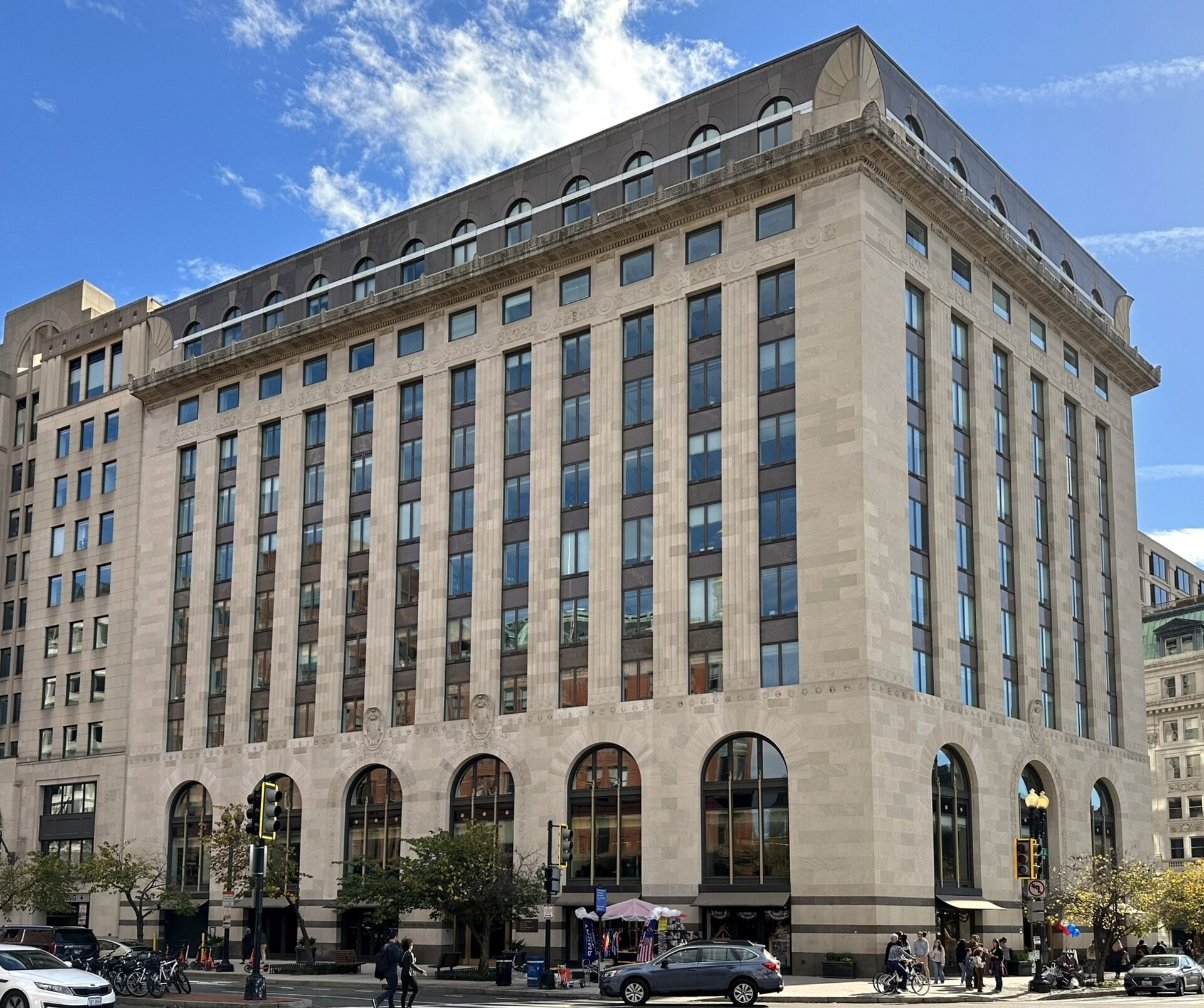
The Washington Stock Exchange was housed in the Washington Building, an imposing steel-framed office block clad in Indiana limestone at 1440 New York Avenue NW, designed by the distinguished Boston firm Coolidge, Shepley, Bulfinch & Abbott and constructed in 1926–1927 by the James Stewart & Company contracting firm. The architectural partnership traced its lineage to Henry Hobson Richardson’s practice, founded in 1874, and by the 1920s had become one of the nation’s preeminent designers of institutional and commercial buildings, responsible for major commissions at Harvard, Stanford, and the Chicago Public Library (as documented in the Society of Architectural Historians’ Archipedia). The Washington Building stood at one of the capital’s most prominent intersections—one block from the White House and directly across 15th Street from the United States Treasury—occupying a site photographed during construction by government survey teams, whose gelatin silver prints survive in the National Archives (Google Arts & Culture, “Construction of the Washington Building, 1926–1927”). Its exterior employed the restrained neoclassical vocabulary favored along the 15th Street Financial Historic District, where Beaux-Arts and Neo-Classical Revival styles, inspired by the City Beautiful movement of the late 1890s, predominated among banking houses and commercial structures (National Register of Historic Places, Fifteenth Street Financial Historic District nomination). The building’s “highly stylized flattened classical details,” as described in the SAH Archipedia entry for the 15th Street Historic District, projected the sober permanence that financial tenants—including the stock exchange—required.
While no comprehensive photographic survey of the Washington Stock Exchange’s interior decorative program is known to survive, the exchange operated within the broader visual culture of early-twentieth-century American brokerage rooms. Regional exchanges of this era typically featured board rooms equipped with large quotation blackboards, mechanical ticker-tape machines, and annunciator systems that conveyed price information from correspondents on the New York Stock Exchange floor, as described in the NYSE’s official institutional history and in Robert Sobel’s “The Big Board: A History of the New York Stock Market” (Free Press, 1965). The Washington Building’s commercial tenants occupied spaces designed in the restrained classical idiom characteristic of the 15th Street financial corridor, where, as the DC Preservation League’s “Downtown Washington” walking tour notes, banking halls and brokerage offices employed marble wainscoting, bronze hardware, and coffered plaster ceilings to project institutional gravitas. The exchange’s most significant material artifacts are the engraved stock certificates of the local companies it listed—notably the Washington Gas Light Company certificates printed by the American Bank Note Company, examples of which survive as collectibles—and the printed daily quotation sheets that circulated among Washington brokers. The stock certificates of Potomac Electric Power Company and Riggs National Bank, traded on the exchange, featured elaborate vignette engravings typical of Gilded Age securities design, connecting the decorative arts of finance to the broader tradition of American banknote engraving documented by Mark Tomasko in “The Feel of Steel: The Art and History of Bank-Note Engraving in the United States” (2012).
The Washington Stock Exchange’s location within the Fifteenth Street Financial Historic District placed it at the symbolic and functional heart of American government finance. The district’s development began in 1799 when the first U.S. Treasury building was erected on 15th Street NW, east of the White House, and by the 1840s William W. Corcoran and George Washington Riggs had established their banking partnership nearby, negotiating a landmark government loan to finance the Mexican-American War of 1846–48 (DC Historic Sites, “Historic Banks and Financial Institutions of DC” tour). Major banks and financial institutions clustered along 15th Street precisely because of their proximity to the Treasury, as documented in the National Register nomination for the Financial Historic District (DC State Historic Preservation Office). The exchange’s home in the Washington Building stood directly across from the Treasury’s east façade, surrounded by the National Savings and Trust Company (James Windrim, 1888), Riggs National Bank (York & Sawyer, 1902), and the American Security and Trust Company (York & Sawyer, 1904)—all monumental Beaux-Arts structures designed to embody the “strength and power” of the institutions within them. Unlike Wall Street, where securities trading drove urban form, Washington’s financial district developed as an appendage to federal governance. The exchange thus occupied a unique niche: close enough to the Treasury to attract dealers in government obligations, yet operating in a city whose economy was dominated by the federal payroll rather than by private enterprise, which limited the exchange’s growth potential throughout its seven-decade existence.
The Washington Stock Exchange was active as early as October 24, 1884, during the wave of regional exchange formation that also produced bourses in Pittsburgh (1864), New Orleans (1880), Chicago (1882), and San Francisco (1882), as catalogued in Finaeon’s “Regional Stock Markets in the United States.” The exchange served Gilded Age investors in the nation’s capital who needed a local venue to buy and sell shares of District-chartered companies. George M. Ferris, who in 1932 would found the investment bank Ferris & Co. at 1700 Pennsylvania Avenue NW, served as president and chairman of the exchange and became its most prominent figure, as documented in his obituary (“Investment Firm Founder George M. Ferris Dies at 99,” Washington Post, October 30, 1992). The exchange registered with the newly created Securities and Exchange Commission in 1935, adopting standardized compliance rules under the Securities Exchange Act of 1934, as noted in the SEC’s annual reports. Operating at less than one-five-hundredth the volume of the New York Stock Exchange, the Washington exchange never expanded beyond the capital city, and its antiquated clearing-house infrastructure became a growing liability in the postwar era. After twenty-two months of negotiations led by president Fenton Cramer, the exchange’s board voted unanimously on July 21, 1953, to merge with the Philadelphia-Baltimore Stock Exchange, effective in 1954. The consolidated Philadelphia-Baltimore-Washington (PBW) Stock Exchange maintained a Washington branch, but the local exchange as an independent institution had ceased to exist. The PBW itself later absorbed the Pittsburgh Stock Exchange in 1969 and was renamed the Philadelphia Stock Exchange in 1976 (Encyclopedia of Greater Philadelphia).
The Washington Stock Exchange specialized in the securities of locally chartered companies whose operations were tied to the infrastructure and governance of the District of Columbia. Its principal listings included shares of Riggs National Bank, the venerable institution founded in 1840 by Corcoran and Riggs that served as the “Bank of Presidents”; the Potomac Electric Power Company (PEPCO), the District’s electric utility whose predecessor was incorporated in the 1890s; Washington Gas Light Company, chartered by Congress on July 8, 1848, as the capital’s first gas utility; and Washington Railway and Electric Company, which operated the District’s streetcar network. These listings reflected the exchange’s function as a market for local infrastructure and banking securities rather than the industrial and railroad stocks that dominated the New York Stock Exchange. The exchange also facilitated trading in District of Columbia municipal bonds and, given its proximity to the Treasury, attracted brokers who dealt in federal government obligations. The NBER Working Paper “Competition among the Exchanges before the SEC” (Eugene N. White, 2013) documents how regional exchanges like Washington’s served as price-discovery venues for securities with primarily local investor bases. Fenton Cramer’s assertion, at the time of the 1953 merger vote, that the principal benefit of consolidation would be “the establishment of a modern clearing house for security” underscored the exchange’s limited technological capacity—it still relied on manual settlement procedures while larger exchanges had adopted mechanized systems, as described in the SEC’s Nineteenth and Twentieth Annual Reports (1953–1954).
Images will be added as the project develops. Photographs by Larry Ng and from research sources.