Warsaw Stock Exchange (Giełda Papierów Wartościowych)
Warsaw, Poland · Established 1817
This site requires authorization to access.
To request access, contact
william.goetzmann@yale.edu
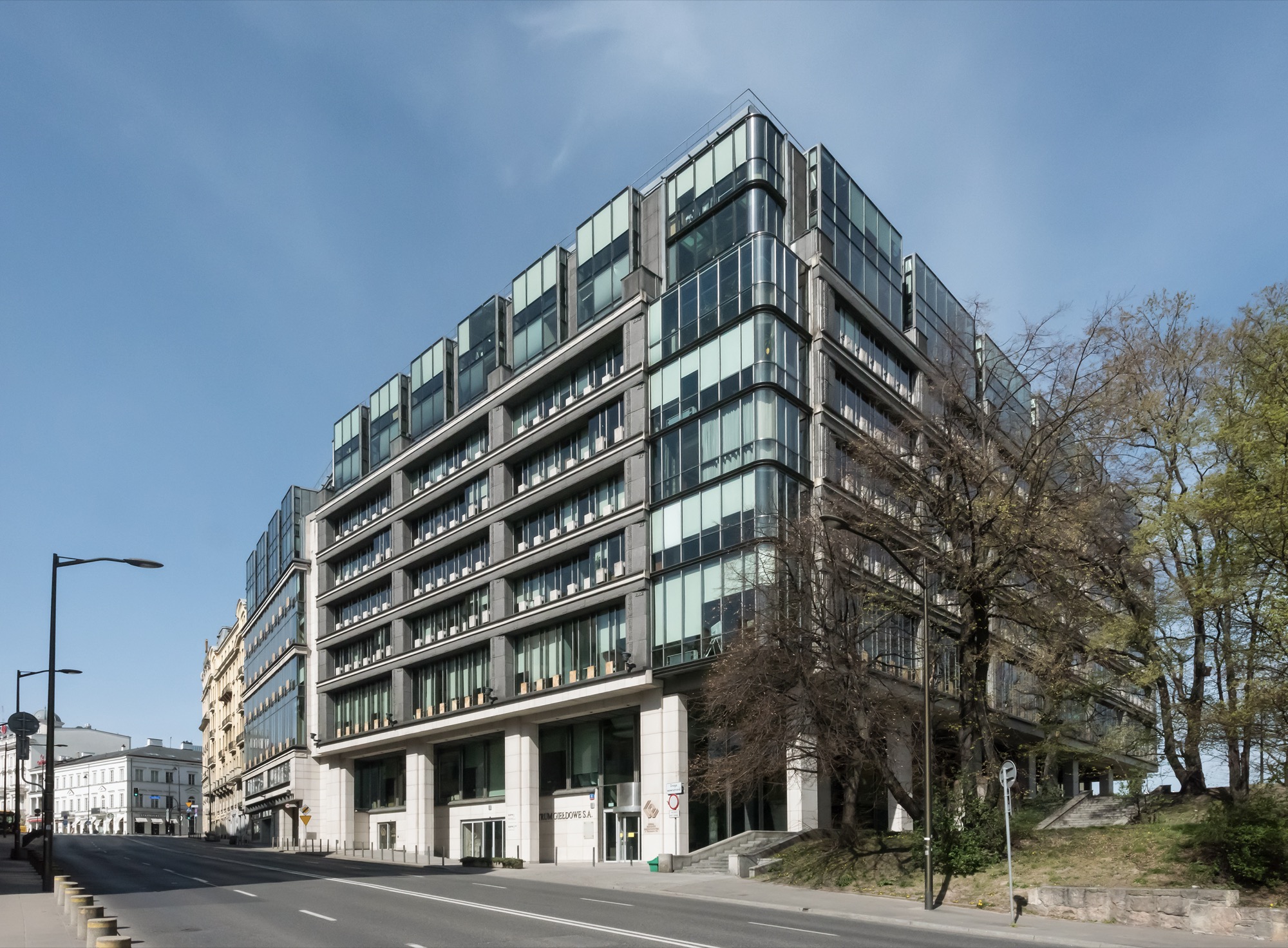
The Warsaw Stock Exchange has occupied several buildings across its two-century history, each reflecting the political and economic circumstances of its era. When the Giełda Kupiecka (Mercantile Exchange) was founded in 1817, trading first took place in the Old Town Hall before moving that same year to the Saxon Palace on what is now Plac Piłsudskiego. The exchange’s most architecturally significant home was the neoclassical Bank of Poland and Stock Exchange building on Plac Bankowy (Bank Square), designed by the Italian architect Antonio Corazzi in collaboration with Jan Jakub Gay and constructed between 1825 and 1828. Corazzi, a Tuscan-born architect who arrived in Warsaw in 1819 at the invitation of Stanisław Staszic, became the leading figure of late neoclassicism in Poland, designing approximately fifty buildings including the Grand Theatre on Theatre Square. The Bank and Exchange building’s dominant feature is a monumental corner rotunda topped with a dome, whose drum is adorned with bas-relief sculptures of winged figures by the Austrian sculptor Ludwig Kauffmann, holding a cornucopia and caduceus — classical symbols of prosperity and trade. The building housed the exchange until 1877, when trading moved to a separate Exchange Building near the Saxon Garden. In 1919–1921, the architect Marian Lalewicz, a leading proponent of academic classicism in interwar Poland, undertook a major restoration. The building suffered severe fire damage during the 1939 German bombardment of Warsaw and was reconstructed between 1950 and 1954 by Piotr Biegański, who simplified the interior ornamentation and altered the dome’s proportions; it now houses the Museum of the John Paul II Collection. When the exchange reopened in April 1991, it was housed — with deliberate symbolic irony — in the former headquarters of the Polish United Workers’ Party (PZPR) Central Committee on Nowy Świat, a building erected between 1948 and 1952 that Poles had called the ‘White House.’ The exchange remained there until 2000, when it moved to the purpose-built Stock Exchange Center (Centrum Giełdowe) at ulica Książęca 4 in the Śródmieście Południowe district. Designed by the Polish-French architect Stanisław Fiszer and Andrzej M. Chołdzyński and constructed by PORR Polska between 1998 and 2000, this nine-story Class A office building features a glazed trading hall, three underground levels with 222 parking spaces, a 30-by-10-meter internal patio, and what was then the longest unsupported escalator in Europe at 60 meters. The building was nominated for the European Union Prize for Contemporary Architecture (the Mies van der Rohe Award).
The decorative program of the original Bank of Poland and Stock Exchange building on Plac Bankowy expressed the civic ambitions of Congress Kingdom Warsaw through classical allegory. Antonio Corazzi’s design centered on the grand corner rotunda of the exchange hall, whose tholobate (the cylindrical wall supporting the dome) bears a frieze of bas-relief sculptures by Ludwig Kauffmann depicting winged figures of Fame or Victory clutching a cornucopia and the caduceus of Mercury — the traditional attributes of commerce, abundance, and peaceful trade. These reliefs exemplified the neoclassical convention of adorning financial buildings with allegorical programs linking commercial enterprise to civic virtue, a tradition visible in contemporary exchange buildings across Europe. The exterior façade featured large arcaded openings at ground level and four sculptural figures crowning the upper register. The interior of the rotunda exchange hall was originally lavishly decorated, though the specific scheme was simplified during Piotr Biegański’s 1950–1954 postwar reconstruction, when the vault was extended upward and much of the original ornamental detail was lost. In 1876, part of the arcade had already been bricked in to create additional office space, altering the building’s original rhythm of open arches. The building’s current incarnation as the Museum of the John Paul II Collection, displaying Western European paintings donated by Zbigniew Karol Porczyński and Janina Porczyńska in 1987, offers an ironic afterlife for a space once dedicated to commerce. The modern Stock Exchange Center on Książęca Street, by contrast, employs the transparent aesthetic of late-twentieth-century financial architecture: the glazed trading hall allows views into the exchange floor, while Chołdzyński’s panoramic elevator serves as a vertical focal point within the atrium. The building’s architectural language — glass, steel, and open sightlines — reflects the post-1989 ideal of market transparency, a deliberate contrast with the opacity of the communist-era command economy.
The Warsaw Stock Exchange’s successive locations trace the shifting geography of financial power in the Polish capital. The exchange’s founding in 1817 placed it initially in the Saxon Palace on the Saxon Axis, the grand east-west boulevard that connected the Royal Castle to the Saxon Garden, reflecting the administrative centrality of Congress Kingdom governance. When Corazzi’s Bank of Poland and Exchange building was completed in 1828, it anchored Plac Bankowy (Bank Square), which became Warsaw’s financial nucleus. The square was framed by three monumental neoclassical buildings designed by Corazzi — the Bank and Exchange, the Palace of the Government Commission of Revenues and Treasury (now Warsaw City Hall), and the Palace of the Minister of Treasury — forming what contemporaries called the ‘temples of finance.’ Plac Bankowy sat at the junction of Senatorska Street, connecting Castle Square and the Old Town to the northwest, and the commercial thoroughfares leading south toward Nowy Świat and Krakowskie Przedmieście, the heart of the Royal Route. This positioning made the exchange accessible to both the administrative elite of the Russian-governed Kingdom of Poland and the merchant community concentrated along Warsaw’s central arteries. The wartime destruction of 1939 and the subsequent communist nationalization of the economy scattered this financial geography. When trading resumed in 1991, the exchange’s placement in the former PZPR headquarters on Nowy Świat — one of Warsaw’s most prominent historic boulevards and part of the Royal Route — carried unmistakable political symbolism. The move in 2000 to Książęca Street in Śródmieście Południowe (South Downtown) placed the exchange within the emerging post-communist central business district, near the Warsaw Financial Center and the cluster of modern office towers that rose along the Vistula’s western bank in the 1990s and 2000s. This new financial quarter, bounded roughly by Jana Pawła II Avenue, Solidarności Avenue, and the Nowy Świat corridor, represents Warsaw’s transformation from a socialist administrative capital into Central Europe’s largest financial center.
The Warsaw Mercantile Exchange (Giełda Kupiecka w Warszawie) was established on 12 May 1817 by decree of Viceregent Grand Duke Constantine Romanov, following an order by General Józef Zajączek, Governor of the Congress Kingdom of Poland. The first trading session took place on 16 May 1817, with sessions held daily from noon to 1:00 p.m. Initially only currencies, bills of exchange, and commodities were traded; the number of brokers doubled between 1817 and 1822. In October 1826, the first public securities appeared — mortgage bonds of the Towarzystwo Kredytowe Ziemskie (Land Credit Society), a pioneering institution of Polish agricultural finance. The first equities admitted to trading were railroad shares in the 1840s, as the Congress Kingdom’s railway network expanded. A major regulatory reform came in 1873 with a new, more liberal stock exchange act that separated securities trading from commodity trading, leading to the founding of a separate Warsaw Commodities Exchange in 1874. Despite Poland’s lack of sovereign statehood under Russian partition, the Warsaw exchange grew to become the largest securities market in the Russian Empire, handling an estimated five to six percent of global securities trading by the late nineteenth century, as Marek Dietl and Dariusz Zarzecki document in *Understanding the Polish Capital Market* (Routledge, 2022). The exchange closed during World War I but reopened in 1919 following Polish independence, and the interwar Warsaw Money Exchange became by far the largest of Poland’s several bourses (others operated in Kraków, Lwów, Łódź, Katowice, Poznań, and Wilno), accounting for ninety-five percent of trading volume and sixty-five to eighty-five percent of all transactions on the Polish capital market. New stock exchange laws were enacted in 1921, 1926, and 1935. At its interwar peak, the exchange had more than 150 participants, 25 brokers, and over 130 issuers, with annual turnover of approximately one billion Polish zlotys. The 1929 world crisis hit Polish markets hard; trading volumes crashed in the early 1930s and remained depressed through the decade. On 1 September 1939, the German invasion closed all Polish stock exchanges. The physical infrastructure suffered devastating damage during the siege of Warsaw and the 1944 Warsaw Uprising. Under the communist People’s Republic, the exchange remained closed for fifty-two years, incompatible with a centrally planned economy. The modern Warsaw Stock Exchange (Giełda Papierów Wartościowych w Warszawie, GPW) was re-established as a joint-stock company owned by the State Treasury under the Act on Public Trading in Securities and Trust Funds of 22 March 1991. The first trading session took place on 16 April 1991 — exactly 174 years after the original founding — with shares of five privatized state-owned enterprises (Tonsil, Próchnik, Krosno, Exbud, and Kable) and a daily turnover of approximately two thousand dollars. As Wiesław Rozłucki, the exchange’s co-founder and first chairman (1991–2006), recalled, the reopening was organized under the Balcerowicz Plan as a critical mechanism for transferring state-owned enterprises to private ownership. Jean-François Nivet’s study ‘Stock Markets in Transition: The Warsaw Experiment’ (*Economics of Transition*, 1997) documented the exchange’s rapid early development. By 1993–1994, a speculative bull market produced historic records, including 830,000 subscriptions for the Bank Śląski IPO. The WIG20 blue-chip index was launched on 16 April 1994. Derivatives trading began in 1998 with WIG20 index futures. By 2000, 265 companies were listed and the WSE had surpassed the Vienna Stock Exchange in several categories. In 2018, Poland became the first and only post-communist country to achieve FTSE Russell developed-market status.
Throughout its history, the Warsaw exchange reflected the evolving financial needs of the Polish economy. In its earliest decades under the Congress Kingdom, the Giełda Kupiecka dealt primarily in currencies and bills of exchange — the essential instruments of international trade for a territory at the crossroads of Russian, Prussian, and Austrian commercial networks. Foreign exchange trading was crucial because the Congress Kingdom used the Polish zloty alongside the Russian ruble, and merchants required reliable conversion mechanisms. The first securities to appear were the mortgage bonds (listy zastawne) of the Towarzystwo Kredytowe Ziemskie in 1826, instruments backed by landed estates that channeled capital into Polish agriculture. Government bonds of the Congress Kingdom and later Russian imperial bonds also traded actively. The introduction of railroad shares in the 1840s marked the exchange’s transition toward equity trading, as the Warsaw-Vienna Railway and other lines required substantial capital. The 1873 reform that separated securities from commodities reflected the growing sophistication of both markets; the new Warsaw Commodities Exchange handled grain, sugar beet, timber, and other agricultural products that formed the backbone of the Polish economy under partition. By the late nineteenth century, the securities exchange listed shares of industrial enterprises in textiles, metallurgy, and sugar refining, alongside municipal and railway bonds. During the interwar period (1919–1939), the Warsaw Money Exchange traded a wide range of government bonds, municipal debentures, bank shares, and industrial equities, with over 130 issuers and annual turnover of approximately one billion zlotys, as documented by Wolfgang Aussenegg in his study of Polish privatization IPOs (*Multinational Finance Journal*, 2000). The post-1991 exchange was built around the privatization of state-owned enterprises. The initial five listings — Tonsil (electronics), Próchnik (clothing), Krosno (glassware), Exbud (construction), and Kable (cables) — represented Poland’s strategy of case-by-case privatization through public offerings rather than the mass voucher schemes adopted by Czechoslovakia and Russia. Trading initially used a single-price auction system conducted once weekly, designed to accommodate Poland’s limited telecommunications infrastructure. By the late 1990s, the exchange had evolved into a modern electronic marketplace with continuous trading. The introduction of WIG20 index futures in 1998 marked the beginning of derivatives trading. The exchange also developed bond markets, including the Catalyst platform for corporate and municipal debt. As Dietl and Zarzecki emphasize in *Understanding the Polish Capital Market* (2022), the WSE’s trajectory from five privatization stocks to FTSE Russell developed-market status in 2018 represents one of the most successful capital market developments in the post-communist world.
Images will be added as the project develops. Photographs by Larry Ng and from research sources.