Warsaw Commodity Exchange
Warsaw, Poland · Established 1817
This site requires authorization to access.
To request access, contact
william.goetzmann@yale.edu
The Warsaw Commodity Exchange’s first purpose-built home was the Gmach Giełdy i Banku Polskiego (Stock Exchange and Bank of Poland Building), designed by the Tuscan-born architect Antonio Corazzi in collaboration with Jan Jakub Gay and erected between 1825 and 1828 on Plac Bankowy. As Mirosława Sielatycka describes in her study of Corazzi’s Warsaw commissions, the two-storey Late Classicist structure is dominated by a monumental corner rotunda capped with a coffered dome rising on a tall drum, whose 21-metre interior diameter made it one of the largest commercial halls in the Congress Kingdom. The ground floor presents rusticated brick walls pierced by tall, open arcades, while the piano nobile above is finished in smooth stucco and punctuated by arched windows. Internally, Corazzi deployed four Doric columns at ground level and an Ionic colonnade on the gallery floor, creating a double-height exchange hall ringed by a circumscribing balcony. Before 1817 the exchange had convened temporarily in the Old Town Hall and then the Saxon Palace; the Corazzi building gave it a permanent architectural identity. The structure suffered fire damage during the 1939 siege of Warsaw, and Piotr Biegański directed its reconstruction between 1950 and 1954, simplifying much of the original ornamental interior but preserving the exterior’s neoclassical silhouette. It now houses the Museum of the John Paul II Collection.
The decorative program of the Corazzi exchange building was conceived to proclaim the dignity of commerce through classical allegory. As noted in the Zabytek.pl heritage register, the drum of the rotunda’s dome carries bas-relief panels sculpted by Ludwik Kauffmann (1801–1855), an Austrian-born artist who maintained a Warsaw atelier from 1823. Kauffmann’s winged genii of Fame hold a cornucopia and a caduceus of Mercury—traditional emblems of prosperity and peaceful trade—flanking the semicircular clerestory window that floods the exchange hall with daylight. The interior once featured figural wall panels on the gallery balustrade and a richly coffered cupola vault whose compartments echoed Roman precedents, though Biegański’s postwar restoration stripped these elements in favor of a simplified aesthetic consistent with the 1950s reconstruction ethos documented by the Society of Architectural Historians. The ground-floor arcade originally doubled as a commercial cloister, its vaulted bays sheltering traders and brokers between sessions. In 1876, portions of the arcade were bricked up for offices, and a subsequent 1919–1921 restoration directed by Marian Lalewicz partially reopened them. Across Warsaw’s exchange history, visual symbols of commerce—Mercury’s staff, the horn of plenty, and classical orders connoting stability—served as a shared iconographic language linking Poland’s financial ambitions to broader European neoclassical traditions.
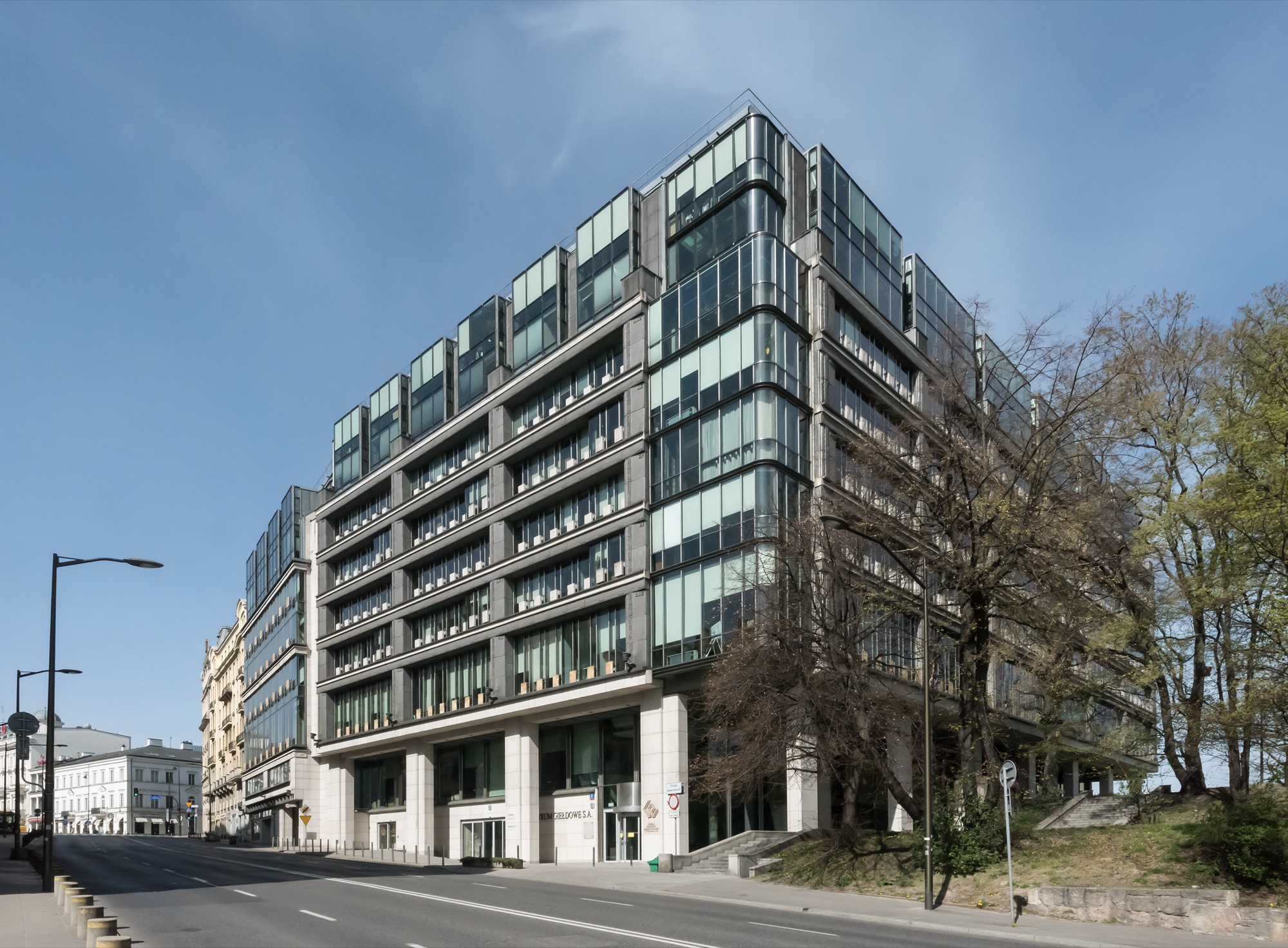
Plac Bankowy (Bank Square), the site of the Corazzi exchange building, was conceived in 1825 under the Congress Kingdom as Warsaw’s representative financial quarter. Antonio Corazzi designed three interconnected neoclassical edifices along the square’s western edge: the Palace of the Ministry of Revenues and Treasury, the Bank of Poland headquarters, and the exchange rotunda, forming what the Zabytek.pl heritage catalogue calls “a harmonious architectural whole.” The ensemble gave the square its name and established it as the administrative and fiscal heart of the city, a role it retained under Russian, German, and Polish governance. The nearby Saxon Garden—one of Europe’s oldest public parks—provided a green buffer zone between the exchange quarter and the residential neighborhoods to the west. During the communist period the square was renamed Plac Dzierżyńskiego, and a statue of the Bolshevik secret-police founder displaced its mercantile symbolism; that monument was toppled in 1989, marking Poland’s symbolic break with central planning. The modern Warsaw Stock Exchange (GPW) relocated in 2000 to a purpose-built Stock Exchange Center on ul. Książęca, designed by Stanisław Fiszer and Andrzej M. Chołdzyński, whose steel-and-glass facade was nominated for the European Union Prize for Contemporary Architecture. Yet Plac Bankowy retains its historic identity, now serving as Warsaw’s city hall complex while the Corazzi rotunda houses a museum.
The Warsaw Mercantile Exchange (Giełda Kupiecka w Warszawie) was established on 12 May 1817 by decree of Viceregent Grand Duke Constantine Romanov, making it the first state-organized securities exchange on Polish territory, as Marek Dietl and Dariusz Zarzecki document in Understanding the Polish Capital Market (Routledge, 2023). The first session convened on 16 May 1817 in the Old Town Hall; after that building’s destruction the exchange moved to the Saxon Palace, and from 1828 to the new Corazzi building on Bank Square. Trading sessions ran daily from noon to one o’clock, and the number of brokers doubled between 1817 and 1822. Jean-François Nivet, in “Stock Markets in Transition: The Warsaw Experiment” (Economics of Transition, 1997), notes that by the late nineteenth century the Warsaw bourse had grown into a significant regional market within the Russian Empire, though St. Petersburg remained the empire’s leading bourse. In independent interwar Poland (1919–1939), the exchange accounted for 95 percent of national trading volume, with over 130 listed securities by 1938. The September 1939 German invasion closed all Polish exchanges. Under communism the exchange remained dormant, but on 16 April 1991 trading resumed—symbolically—in the former headquarters of the Polish United Workers’ Party, with five newly privatized firms and a turnover of just $2,000. The GPW subsequently became Central Europe’s largest bourse and was promoted to FTSE Developed Market status in 2018.
In its early decades the Warsaw exchange dealt overwhelmingly in bills of exchange, government debentures, and state-backed bonds, reflecting the fiscal needs of the Congress Kingdom. As the Semantic Scholar-hosted study “Regulation of the Warsaw Stock Exchange” details, share trading broadened only after mid-century industrialization brought railroad, mining, and banking equities to the listing rolls. By 1938, 130 securities were officially quoted: government bonds, municipal obligations, mortgage instruments, and corporate shares. Commodity trading paralleled securities activity; grain, sugar, and textile raw materials circulated through Warsaw’s mercantile networks, though formal commodity futures did not emerge until the post-communist era. In the modern period, the Warszawska Giełda Towarowa (WGT), founded in 1995, operates the largest and oldest spot commodity market in Poland, trading soft commodities including milling wheat, feed wheat, and live hogs, with peak wheat volumes reaching 33 percent of annual domestic production. The WGT also launched futures contracts and its own clearing house (IR WGT S.A.) in 1999. Meanwhile, the Towarowa Giełda Energii (TGE), part of the GPW Capital Group since 2012, provides regulated markets for electricity, natural gas, property rights, and—since 2020—agricultural commodities. Together these platforms continue Warsaw’s two-century tradition of intermediating financial and physical trade on the Vistula.
Images will be added as the project develops. Photographs by Larry Ng and from research sources.