Vienna Stock Exchange (Wiener Börse)
Vienna, Austria · Established 1877

This site requires authorization to access.
To request access, contact
william.goetzmann@yale.edu
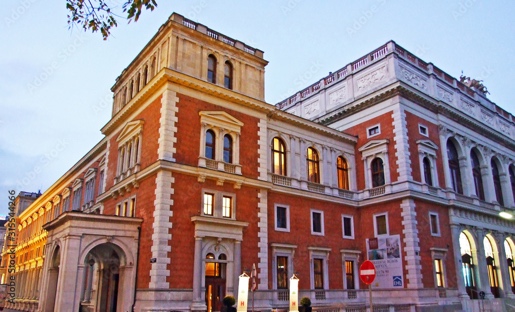
The Borsegebaude on the Schottenring, designed by the Danish-born architect Theophil von Hansen and his collaborator Carl Tietz, was constructed between 1874 and 1877 and inaugurated by Emperor Franz Joseph I on 14 March 1877. Hansen conceived the building in the Neo-Renaissance style, employing a striking red-brick facade punctuated by pale stone columns, arched windows, and ornate cornices that evoked Italian palazzo architecture while asserting Vienna's ambitions as a modern financial capital. The richly articulated structure features a superelevated central projection forming a two-storey loggia with Tuscan and Composite columns, flanked by lower side wings and elevated corner risalits crowned by a relieved attic. The attic bears sculptural reliefs of Greek gods, including Vincenz Pilz's commanding figure of Neptune on a quadriga drawn by hippocamps, symbolizing maritime commerce. The heart of the building was the grand Wertpapierborsesaal, a magnificent securities trading hall measuring approximately 58.8 by 26.5 meters with ceilings soaring to 22.8 meters — some 1,440 square meters of trading floor that ranked among the finest exchange interiors in Europe. Hansen, who simultaneously designed the nearby Austrian Parliament and the celebrated Musikverein concert hall, insisted on lavish decorative detail throughout the Borse, personally covering cost overruns when the bank committee demanded economies.
Hansen, who regarded a building as incomplete without the full integration of architecture and the applied arts, designed the Borse's interior decoration as a Gesamtkunstwerk encompassing sculpture, painting, ornamental stonework, and polychrome surfaces. The three principal halls — the Festsaal, the Effektenborsesaal, and the Warenborsesaal — boasted ceilings rising to thirteen meters, richly articulated with coffered panels, stucco ornament, Corinthian and Composite capitals, and swags of red velvet. The sculptural program, executed by Vincenz Pilz and Alois Dull, extended from the exterior attic reliefs of Zeus and Neptune into the interior, where allegorical figures embodying commerce, industry, and abundance adorned the grand staircase and hall entrances. Hansen's signature polychrome approach — developed during his formative years studying architecture in Athens from 1837 to 1846 — pervaded the building: rather than the conventional white plaster of Viennese classicism, he applied bold terracotta reds, gilding, and contrasting stone tones to columns, friezes, and wall surfaces, arguing that such coloration was more authentically classical. The monumental staircase, with its carved balustrades and ornamental lanterns, served as the ceremonial axis connecting the public entrance to the trading floors above. All decorative facade elements and sculptures were later cast in plaster and stored in the Leopoldine Wing of the Hofburg for safekeeping after the devastating 1956 fire, which gutted the irreplaceable Wertpapierborsesaal and destroyed many of Hansen's original interior finishes.
The Borsegebaude occupies a commanding position on the Schottenring, one of the principal sections of Vienna's celebrated Ringstrasse boulevard. This grand circular avenue, measuring 57 meters in width and five kilometers in length, was decreed by Emperor Franz Joseph I on 20 December 1857 with the famous words 'Es ist Mein Wille' ('It is My Will'), ordering the demolition of the medieval city fortifications and their replacement with a monumental boulevard lined with public buildings, palaces, parks, and apartment blocks. The Stock Exchange stands within an extraordinary ensemble of Ringstrasse monuments: to the west rises Heinrich von Ferstel's neo-Gothic Votivkirche, while the University of Vienna and Friedrich von Schmidt's neo-Gothic Rathaus are nearby. Hansen's own Austrian Parliament building, designed in Greek Revival style as a conscious allusion to Athenian democracy, anchors the adjacent section. The Borse's placement on this stretch situated the Habsburg capital's financial marketplace within a carefully orchestrated architectural panorama expressing imperial ambition, cultural prestige, and economic modernity — the exchange building standing as a monument to commerce alongside monuments to faith, learning, government, and the arts.
The Vienna Stock Exchange was founded on 1 August 1771 by decree of Empress Maria Theresa, who established a state-controlled bourse to strengthen confidence in Habsburg state finances and provide an orderly market for government bonds. Trading commenced on 2 September 1771 at premises on the Kohlmarkt. Over the following decades, the exchange migrated through several locations before moving to a temporary wooden structure at Schottenring 19 in May 1872 while Hansen's permanent building was under construction. The mid-nineteenth century brought explosive growth: in 1818, the Austrian central bank became the first joint-stock company listed, and by the 1840s railway shares dominated trading. The Grunderzeit boom of the 1860s and early 1870s saw hundreds of new banking, railway, and industrial companies floated, many existing only on paper. The bubble burst catastrophically on Black Friday, 9 May 1873 — the Grunderkrach — when panic selling wiped out nearly half of all listed joint-stock companies, overshadowing the Vienna World Exhibition that had opened just days earlier. The crash prompted the Stock Exchange Act of 1 April 1875, one of Europe's first modern securities regulations. Hansen's Borsegebaude opened in 1877 as the exchange recovered. Following the Anschluss of March 1938, the exchange lost its independence and was subjected to German stock exchange law. After World War II, the exchange reopened ceremonially on 15 November 1948. On 13 April 1956, a fire caused by a careless smoker destroyed the irreplaceable Wertpapierborsesaal and much of the interior. Architect Erich Boltenstern won the reconstruction commission; rather than restoring the oversized trading hall, he converted it into an open courtyard with a parking garage below and new office wings, reopening the building on 7 December 1959. The Wiener Borse operated from the Schottenring building until relocating to the Palais Caprara-Geymüller in 2001.
Maria Theresa founded the exchange specifically to create a regulated market for Habsburg government bonds, and sovereign debt remained the primary instrument for decades. Initially only bonds and currencies were traded, but in 1818 the shares of the Austrian central bank became the first equity listing. The railway age transformed the exchange: shares in Emperor Ferdinand's Northern Railway were listed on 3 May 1842, and by mid-century railway securities dominated trading volumes. The great Viennese banking houses were central to this expansion. Salomon Mayer von Rothschild established the Vienna branch of the Rothschild banking dynasty in 1820, and his son Anselm von Rothschild founded the Credit-Anstalt fur Handel und Gewerbe in 1855 as the empire's premier investment bank, initially focused on financing the rapidly expanding railway network. During the Grunderzeit boom, hundreds of new banking, industrial, and transport companies were floated, fueling speculation that culminated in the 1873 crash. In the aftermath, the exchange's role in government bond issuance remained central to Habsburg state finance, while industrial securities — steel, mining, textiles, and later electrical companies — grew in importance. The 1931 collapse of the Creditanstalt, by then Austria's largest bank, triggered a banking crisis that deepened the Great Depression across Central Europe and demonstrated the continued systemic importance of institutions first nurtured on the Vienna exchange floor.