Venice Rialto Square
Venice, Italy · Established c. 1097
This site requires authorization to access.
To request access, contact
william.goetzmann@yale.edu
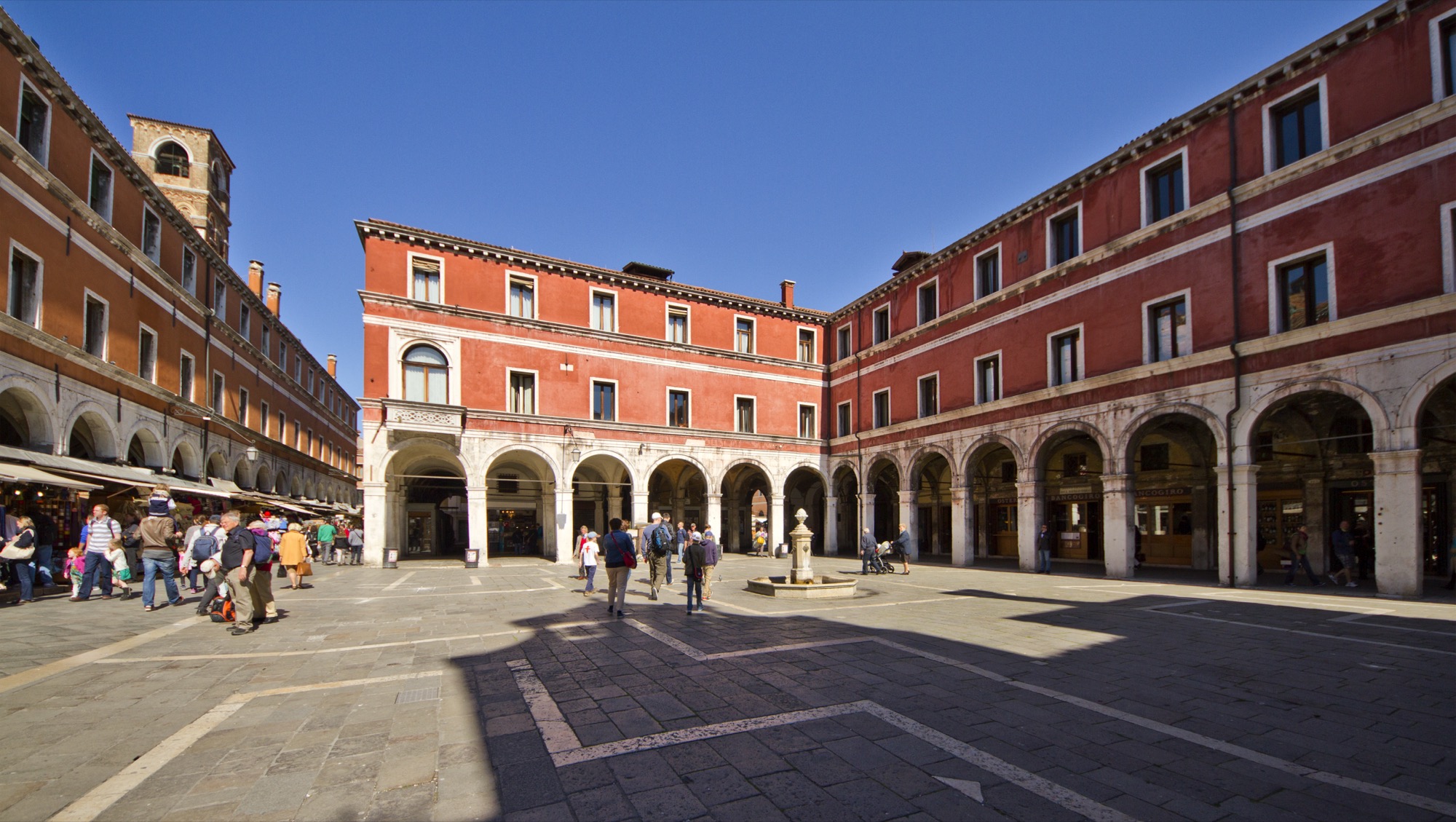
The Rialto commercial district comprises a dense cluster of purpose-built market structures, financial offices, and ecclesiastical buildings that together formed the physical infrastructure of medieval and Renaissance Europe's most important financial center. The district's anchor is the Ponte di Rialto, the celebrated stone bridge spanning the Grand Canal. Designed by Antonio da Ponte and built between 1588 and 1591, the single-arch bridge measures approximately 28.8 meters in span and 22.9 meters in width, with the crown of its arch rising some 7.5 meters above the water. It rests on approximately 12,000 wooden pilings driven into the soft alluvial mud on each side, an engineering achievement that many contemporaries doubted would succeed -- the architect Vincenzo Scamozzi reportedly predicted its eventual collapse (Calabi and Morachiello, *Rialto: le fabbriche e il ponte*, 1987). The bridge carries two arcades of shops flanking three parallel walkways, making it simultaneously a crossing, a marketplace, and an architectural monument. It replaced a succession of earlier wooden bridges: the first fixed crossing, the Ponte della Moneta, was designed by Niccolo Barattieri around 1178; it was rebuilt after collapses in 1255 and 1264, and a famous drawbridge version -- visible in Carpaccio's paintings -- stood until a design competition was launched in 1551, attracting proposals from Andrea Palladio, Jacopo Sansovino, Vincenzo Scamozzi, and possibly Michelangelo, before Antonio da Ponte's bold single-arch design was selected on 9 June 1588. On the western bank, the market buildings define the commercial quarter. The Fabbriche Vecchie, designed by Antonio Abbondi, known as Scarpagnino, and erected between 1520 and 1522, replaced structures destroyed in the catastrophic fire of 10 January 1514 that leveled most of the wooden Rialto district. Scarpagnino's design enclosed three sides of the Campo San Giacomo di Rialto with long porticoed buildings of two stories -- ground-floor arcades for shops and banking tables, with offices and storage above. Across the Grand Canal, the Fabbriche Nuove, designed by Jacopo Sansovino and built between 1554 and 1556, form an 88-meter-long, slightly curving three-story building along the northern bank, its ground-floor portico facilitating the unloading of goods directly from boats (Calabi, *The Market and the City*, 2004). The Palazzo dei Camerlenghi, built between 1525 and 1528 to a design by Guglielmo dei Grigi of Bergamo in a Renaissance style influenced by Mauro Codussi and Pietro Lombardo, housed the financial magistrates of the Republic; its ground floor served notoriously as a debtors' prison, its placement beside the Rialto Bridge serving as a pointed reminder to merchants of the consequences of insolvency. Nearby stood the church of San Giacomo di Rialto, called San Giacometto, traditionally held to be the oldest church in Venice, supposedly consecrated on 25 March 421, though the first reliable documentary evidence dates only to 1152 (Lane, *Venice: A Maritime Republic*, 1973). Its Gothic portico is one of the few surviving examples in Venice, its interior preserves Veneto-Byzantine capitals on columns of ancient Greek marble dating from the eleventh century, and its large fifteenth-century clock above the entrance served the business district as an essential timepiece. Across the Grand Canal near the bridge stood the Fondaco dei Tedeschi, a combined warehouse, marketplace, and residential compound for German merchants, first established in 1228 and rebuilt after a 1505 fire in a Renaissance style, with its four facades famously frescoed by Giorgione and Titian in 1508.
The artistic legacy of the Rialto is inseparable from its commercial function: the district's buildings, sculptures, and painterly depictions all document the life of a working marketplace. The most celebrated sculptural monument is Il Gobbo di Rialto, the Hunchback of the Rialto, a marble figure carved by Pietro da Salo and unveiled on 16 November 1541. The statue depicts a crouching, naked hunchback supporting a small flight of granite steps that served as a podium for the public proclamation of laws and sentences -- decrees were read simultaneously from the Pietra del Bando near San Marco and from Il Gobbo at the Rialto, the two poles of Venetian civic life. The block above the hunchback's head bears a Latin inscription from an 1836 restoration: 'The rock for declaring the republic's laws, restored by public money.' Condemned criminals were sometimes stripped and forced to run the gauntlet from San Marco to the Rialto, ending their punishment by kissing the statue. The Palazzo dei Camerlenghi accumulated a remarkable pictorial cycle through the Venetian tradition that departing magistrates would commission a devotional painting for their former offices. As Philip Cottrell and others have documented, the palazzo housed major works by Bonifacio de' Pitati (his *Judgment of Solomon*, 1533, painted for the financial magistrates' chamber), Jacopo Tintoretto, and other leading Venetian painters, many of which were removed during the Napoleonic occupation and eventually transferred to the Gallerie dell'Accademia. The Rialto appears as a central subject in some of the most important paintings of the Venetian school. Vittore Carpaccio's *Miracle of the Relic of the Cross at the Rialto Bridge* (c. 1496, tempera on canvas, Gallerie dell'Accademia) depicts the old wooden drawbridge crowded with merchants, gondoliers, and spectators, providing an extraordinary visual record of the commercial quarter before the 1514 fire. In the eighteenth century, Giovanni Antonio Canal, known as Canaletto, painted the Rialto Bridge and its surroundings repeatedly as central subjects in his vedute tradition; his *The Grand Canal, Venice, Looking South toward the Rialto Bridge* (Metropolitan Museum of Art) and numerous other canvases documented the stone bridge as the commercial hub of the city for an international clientele of Grand Tour collectors. Francesco Guardi similarly depicted the bridge and the Palazzo dei Camerlenghi in atmospheric compositions now in major museum collections. Perhaps the most remarkable visual document of the Rialto is Jacopo de' Barbari's monumental woodcut *View of Venice* (1500), printed from six blocks at the commission of the Nuremberg publisher Anton Kolb, creating a composite image measuring approximately 135 by 280 centimeters -- the first geometrically accurate bird's-eye view of any city. The Rialto area appears at the compositional heart of the image, positioned between the two presiding deities of Mercury (god of commerce) and Neptune (god of the sea), a placement that scholars such as Juergen Schulz have interpreted as an explicit statement of the Rialto's centrality to Venetian identity (*Art Bulletin*, 1978).
The Rialto occupies a uniquely strategic position within Venice's island geography. The name derives from Rivo Altus ('high bank'), referring to the slightly elevated terrain -- reaching approximately two meters above the lagoon -- that made this site among the first to be settled in the archipelago of 118 islands that would become Venice. As Frederic Lane documented in *Venice: A Maritime Republic* (1973), the Rialto settlement was the nucleus around which the city coalesced, and the area served as the commercial heart of Venice from at least the tenth century, while political and religious authority concentrated around San Marco at the opposite end of the Grand Canal. This bipolar structure -- mercantile Rialto and political San Marco -- defined the urban geography of the Republic for a millennium. The Grand Canal, Venice's principal waterway, sweeps in a reverse-S curve for approximately 3.8 kilometers through the city, and the Rialto Bridge crosses it at its narrowest and most central point, connecting the sestieri of San Marco and San Polo. Until the construction of the Ponte dell'Accademia in 1854, it was the only fixed crossing of the Grand Canal, making it the indispensable link in Venice's pedestrian circulation. The canal itself functioned as a commercial artery, lined with warehouses, fondachi (foreign merchants' combined residences and trading posts), and the palazzi of the merchant aristocracy. Boats laden with spices, textiles, and raw materials could moor directly at the Fabbriche Nuove's waterside portico, transferring goods from maritime vessels to the retail and wholesale markets clustered in the surrounding streets. The district's urban fabric reflects its commercial purpose: narrow calli (alleys) named for the specific trades practiced within them -- the Ruga degli Orefici (goldsmiths), the Erbaria (vegetable market), the Pescheria (fish market), the Naranzeria (citrus market) -- radiate outward from the Campo San Giacomo di Rialto, the small square that served as the financial district's central gathering place. Donatella Calabi, in *The Rialto: Venice's Island Market* (2022), has described this spatial organization as a microcosm of global trade compressed into a few hectares of island, where the physical proximity of commodity markets, banking tables, insurance brokers, government financial offices, and foreign merchants' compounds created an information-rich environment that no other European city could match before the seventeenth century. The lagoon setting itself was essential: Venice's position at the head of the Adriatic, sheltered by barrier islands from open-sea storms yet connected by navigable channels to the Mediterranean trade routes, made it a natural entrepot between the commerce of the East and the markets of northern Europe, as Lane and others have emphasized.
The Rialto's history as a financial center stretches from the early medieval period through the fall of the Republic in 1797, encompassing some of the most consequential innovations in the history of European finance. The area was established as Venice's commercial quarter by the late eleventh century; the first permanent bridge across the Grand Canal at the Rialto site was built around 1178, confirming the district's centrality to Venetian economic life. By the twelfth and thirteenth centuries, as Frederic Lane established in *Venice: A Maritime Republic* (1973), the Rialto had become the principal marketplace for international trade in the Mediterranean world, its open loggias and porticoes serving as the venue where Venetian and foreign merchants negotiated deals in spices, precious metals, silk, and other commodities. The development of Venetian public finance was centered at the Rialto. In 1262, the Republic consolidated its various forced loans (prestiti) into a single fund that became known as the Monte Vecchio, paying 5 percent annual interest in semiannual installments. As William Goetzmann documented in *Money Changes Everything* (Princeton, 2016), and as Reinhold C. Mueller analyzed in exhaustive detail in *The Venetian Money Market: Banks, Panics, and the Public Debt, 1200-1500* (Johns Hopkins, 1997), these prestiti became freely tradable on a secondary market centered at the Rialto, making Venice arguably the first city in Europe to develop a functioning government bond market. The bonds were recorded and transferred through the Ufficiali degli Prestiti, and their prices fluctuated with the Republic's military fortunes -- falling when new forced loans expanded the supply, rising when the state made large repayments. Private banking emerged at the Rialto from the thirteenth century onward. As Mueller documented, deposit and transfer banks (banchi de scripta) operated from tables set up under the porticoes of the Campo San Giacomo di Rialto, conducting giro (transfer) banking in which payments were made by book entry rather than physical exchange of coin. These private banks were periodically shaken by panics and failures -- Mueller traces major crises in 1499-1500 and throughout the fourteenth and fifteenth centuries. Following the bankruptcy of the last private banking firm of Pisani and Tiepolo in 1584, Senator Tommaso Contarini proposed a public alternative: the Banco della Piazza di Rialto, established by Senate decree on 11 April 1587, which became the first public bank of the Republic, conducting giro transfers with a state solvency guarantee. In 1619, the Banco del Giro was established alongside it; together these institutions provided a model that directly influenced the creation of the Bank of Amsterdam (Wisselbank) in 1609, as Charles Dunbar documented in his classic study 'The Bank of Venice' (*Quarterly Journal of Economics*, 1892). Marine insurance also developed at the Rialto. Venice established specialized courts, the Consoli dei Mercanti, to adjudicate insurance disputes as early as 1436. The catastrophic fire of 10 January 1514 destroyed most of the wooden Rialto district but spurred a comprehensive rebuilding program under Scarpagnino and later Sansovino that gave the market its Renaissance character. The Rialto remained the financial heart of Venice until Napoleon dissolved the Republic in 1797, but its market functions -- fish, fruit, and vegetables sold under the ancient arcades -- continue to the present day.
The Rialto was the site where commodity trading, government debt, marine insurance, foreign exchange, and banking converged in a single urban space, creating what may fairly be called the first integrated financial marketplace in European history. At its most fundamental level, the Rialto was a commodity market. Spices above all drove its commerce: pepper, cinnamon, cloves, nutmeg, and ginger arrived via the great Venetian galley fleets that sailed to Alexandria, Beirut, and Constantinople, and were distributed from the Rialto across Europe. As the Smithsonian Magazine has noted in a detailed account of the spice trade, pepper was far and away the most important commodity -- in the thirteenth century, a pound of pepper in London sold for a sum equivalent to a week's wages for an unskilled laborer. The 'Messeri del Pepe' (Masters of the Pepper) supervised quality at the Rialto market, and the annual spice fair drew buyers from across the continent. Lane documented in *Venice: A Maritime Republic* (1973) how the regularized convoy system of merchant galleys, called the muda, connected Venice's Rialto marketplace to the luxury goods of Asia via established routes through the eastern Mediterranean. Beyond commodities, the Rialto housed Europe's earliest experiments in financial instruments. Government bonds (prestiti) consolidated under the Monte Vecchio from 1262 were traded on a secondary market at the Rialto, with prices recorded and transfers managed by the Ufficiali degli Prestiti; Mueller's research has shown that these were true negotiable securities with fluctuating market prices, not merely fixed obligations. Bills of exchange (lettere di cambio) facilitated international payments between the Rialto and commercial centers from Bruges to Constantinople, allowing merchants to settle debts across vast distances without physical transfer of specie. Marine insurance contracts, underwritten by wealthy merchants and arranged through brokers called sensali, covered the risks of seaborne trade; Goetzmann (*Money Changes Everything*, 2016) emphasizes that this pooling and pricing of maritime risk was a foundational innovation of modern finance. Trading was conducted in the open air, under the porticoes and in the loggias of the Campo San Giacomo di Rialto. Bankers sat at their tables (banchi), keeping ledgers in which credits were transferred from one account to another by book entry -- the giro system that gave its name to the Banco del Giro. As contemporary accounts describe, business was conducted decorously in low voices, without disputes or noise, befitting the honor of the Republic. The sensali (brokers) played an essential intermediary role, matching buyers and sellers and drafting formal contracts for insurance, exchange, and commodity sales. Richard Mackenney, in *Tradesmen and Traders: The World of the Guilds in Venice and Europe, c. 1250-c. 1650* (1987), documented how the guild system regulated the various trades clustered around the Rialto, from the goldsmiths of the Ruga degli Orefici to the silk merchants whose industry Luca Mola analyzed in *The Silk Industry of Renaissance Venice* (Johns Hopkins, 2000). The surrounding streets and campi hosted specialized retail markets -- the Erbaria for vegetables, the Pescheria for fish, the Naranzeria for citrus fruits, the Beccarie for meat -- creating a comprehensive marketplace that served both the daily provisioning needs of the city and the vast international trade networks that made Venice the commercial capital of the medieval Mediterranean.
Images will be added as the project develops. Photographs by Larry Ng and from research sources.