Fondaco dei Tedeschi
Venice, Italy · Established 1228
This site requires authorization to access.
To request access, contact
william.goetzmann@yale.edu
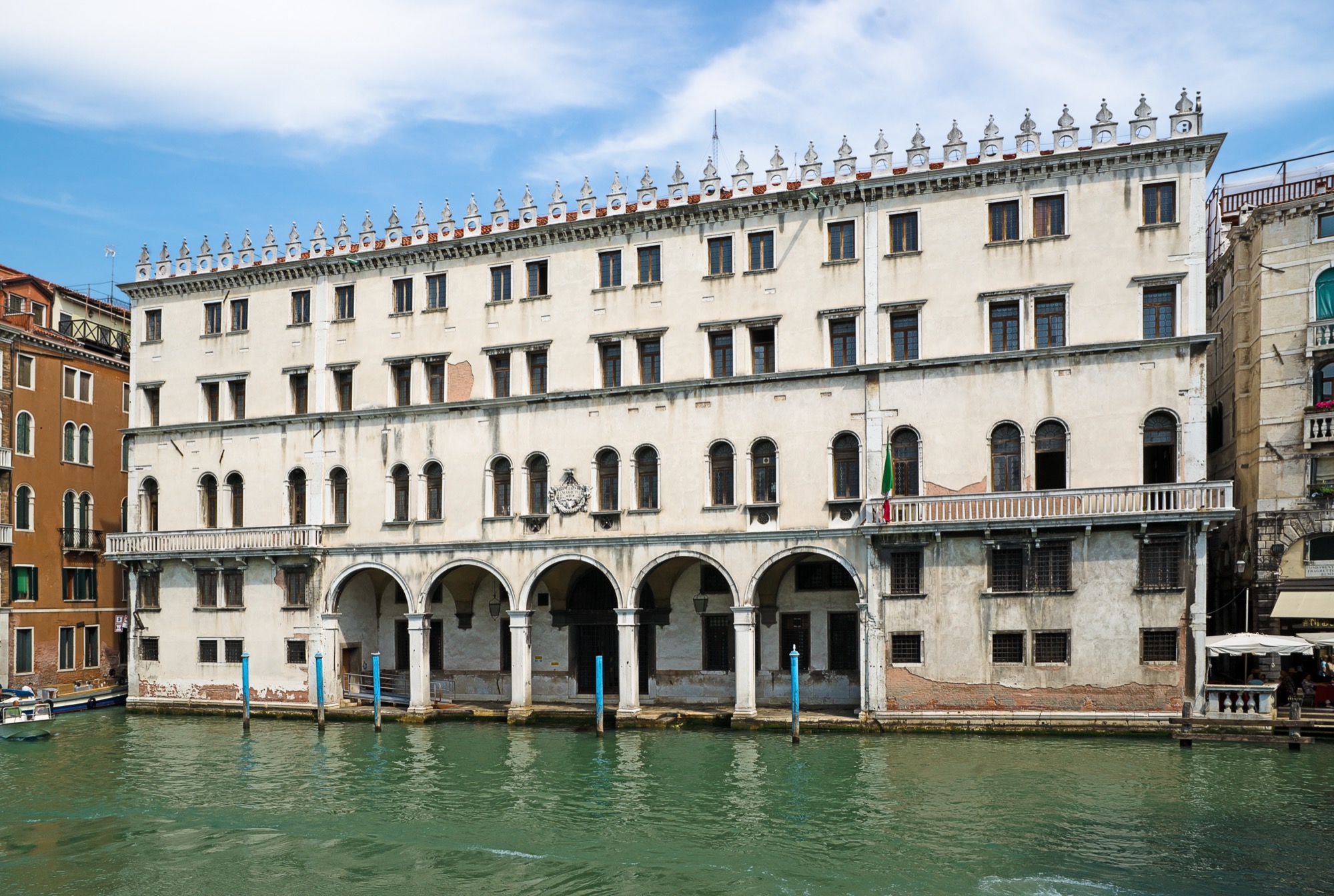
The Fondaco dei Tedeschi (“Warehouse of the Germans”) was the Venetian Republic's mandatory trading house, warehouse, and residence for merchants from the territories of the Holy Roman Empire. Any German-speaking merchant arriving in Venice with goods to trade was required to stay there and conduct business under the watchful eyes of Venetian customs officials.
When the Fondaco was rebuilt after the 1505 fire, the Venetian state commissioned Giorgione to fresco the principal facade facing the Grand Canal, while the young Titian — then only twenty — painted the side facing the Merceria. Giorgio Vasari, in his Lives of the Artists (1550; 1568), described the central image above the main doorway as a seated woman holding a sword and a severed giant's head, possibly Judith with Holofernes, though he confessed he never understood the overall iconographic program. The frescoes encompassed the entire facade, wrapping around windows with painted trompe-l'oeil architectural elements. Venice's salt-laden humidity caused rapid deterioration; by the mid-eighteenth century the images were already badly faded, prompting Antonio Maria Zanetti the Younger to record them in his Varie pitture a fresco de' principali maestri veneziani (Venice, 1760), a suite of etchings now held by the Metropolitan Museum of Art that remains the principal visual record of the lost cycle. In 1966, the surviving fragments were detached and transferred to the Galleria Giorgio Franchetti alla Ca' d'Oro, where Giorgione's so-called Nuda — a standing female figure variously interpreted as an allegory of peace or as the Hesperid nymph Aegle, as discussed by Jaynie Anderson in her monograph Giorgione: The Painter of Poetic Brevity (1997) — and Titian's Judith or Justice can still be seen. Alessandro Nova, in his essay in Giorgione Entmythisiert (Brepols, 2008), argued that the iconographic structure was rooted in a northern Italian visual culture foreign to Vasari's Central Italian forma mentis, helping to explain the enduring scholarly puzzlement over the frescoes' meaning.
The Fondaco dei Tedeschi stands on the Grand Canal immediately beside the Rialto Bridge, at the heart of what Frederic C. Lane, in Venice: A Maritime Republic (Johns Hopkins, 1973), called the commercial and financial nerve center of the Venetian state. The Rialto district concentrated banks, insurers, commodity brokers, and the state weighing-house within a few hundred meters, and the Fondaco's waterfront location allowed goods to be unloaded directly from barges into its ground-floor storerooms. Venice's lagoon geography — a chain of low islands threaded by canals and shielded from the open Adriatic by barrier sandbars — made the city a natural entrepot between maritime trade routes to the Levant and overland routes across the Alpine passes, as Reinhold C. Mueller documented in The Venetian Money Market: Banks, Panics, and the Public Debt, 1200-1500 (Johns Hopkins, 1997). The fondaco building type itself reflected this cross-cultural position: as Deborah Howard argued in Venice and the East: The Impact of the Islamic World on Venetian Architecture, 1100-1500 (Yale, 2000), the Venetian fondaco descended from the Arabic funduq or caravanserai, combining warehouse, marketplace, and lodging under one roof. The Fondaco dei Tedeschi was one of several such institutions; the thirteenth-century Fondaco dei Turchi on the upper Grand Canal served Ottoman merchants in an analogous arrangement. Together these regulated trading houses enabled the Republic to channel, tax, and surveil virtually all foreign commerce passing through the city.
The original building near the Rialto Bridge dates to 1228. After a catastrophic fire on the night of January 27–28, 1505, Doge Leonardo Loredan ordered immediate reconstruction. The new building, designed by Giorgio Spavento and completed by Antonio Scarpagnino by 1508, adopted a grand square plan with an open central courtyard encircled by three tiers of arcaded galleries. Giorgione and Titian frescoed the exterior facades with allegorical scenes — surviving fragments are now in the Ca’ d’Oro. The Fondaco was a critical node in European commerce. From the north came metals, furs, leather, and fine textiles; merchants purchased spices, silks, perfumes, and luxury goods from the East for export over the Alpine passes. The building served simultaneously as warehouse, exchange, hostel, and customs house — concentrating foreign trade in one place for surveillance and duty collection.
After the fall of the Venetian Republic in 1797, the building became a customs house, then Venice’s central post office from 1925 to 2008. It was renovated by Rem Koolhaas/OMA and reopened in 2016 as a luxury department store, which closed in 2025.
Images will be added as the project develops. Photographs by Larry Ng and from research sources.