Vancouver Stock Exchange
Vancouver, Canada · Established incorporated 1906; trading from 1907; purpose-built 1929 building
This site requires authorization to access.
To request access, contact
william.goetzmann@yale.edu
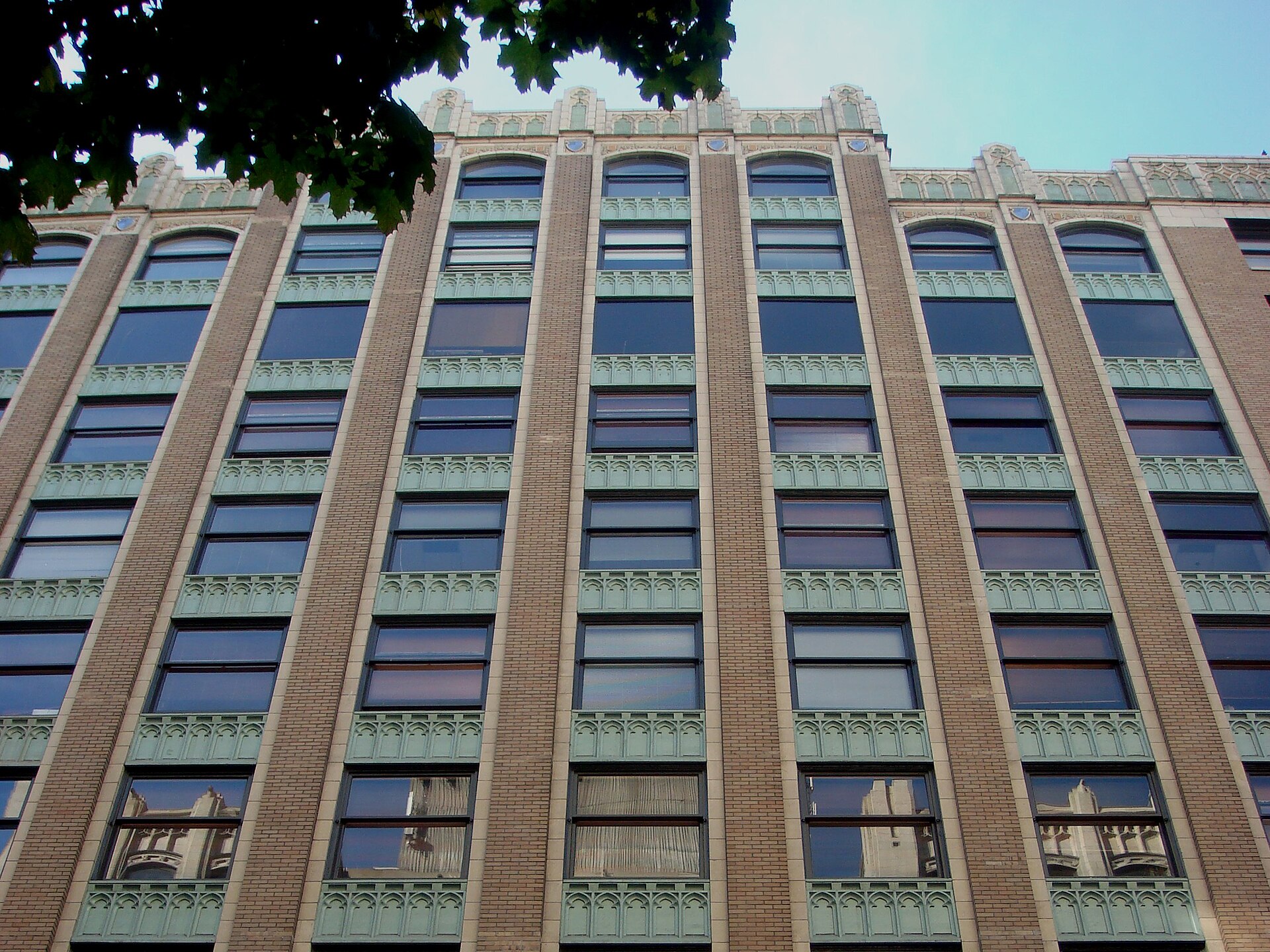
The exchange's defining home is the eleven-storey Stock Exchange Building at 475 Howe Street, on the southwest corner of Howe and West Pender, designed by the prominent Vancouver firm Townley & Matheson and erected in 1928-29, opening only months before the Wall Street crash of October 1929. Fred L. Townley and Robert M. Matheson, both University of Pennsylvania graduates who would go on to design Vancouver's monumental Art Deco City Hall (1936), produced a steel-framed tower clad in polychrome terra cotta that the City of Vancouver's heritage authorities describe as a rare local example of "Commercial Gothic" married to Art Deco massing and detailing. The Biographical Dictionary of Architects in Canada records the commission in Townley's catalogue as the "Vancouver Stock Exchange, Howe Street at Pender Street West, a ten-storey office block with Trading Floor, 1928-29," documented in the Vancouver Province (1 July 1928) and the trade journal Construction (March 1930). The lower floors housed a double-height trading hall, with rental offices stacked above. The building is listed in the "A" category of the Vancouver Heritage Register and carries municipal protection; in a $240-million redevelopment completed in the 2010s the heritage block was retained and integrated into the 31-storey Exchange Tower, whose new design involved Swiss architect Harry Gugger, making it one of Vancouver's most ambitious heritage-conversion projects.
The building's artistic interest lies chiefly in its architecture rather than in any program of fine art. As the heritage-site documentation notes, its principal decorative feature is the polychrome terra cotta cladding, whose coloured glazed surfaces and Gothic-derived vertical piers, setbacks and ornamented spandrels carry the Art Deco vocabulary across the facade. Unlike older European exchanges such as the Oslo Bors with its bronze Mercury, the Vancouver building was a speculative commercial office tower and did not accumulate a notable collection of statuary or commissioned murals; its symbolic weight came instead from the bustle of the trading floor and the terra-cotta dignity of its street presence. The interior, much altered over a century of use and the recent tower conversion, has not preserved a significant body of original artworks.
The Stock Exchange Building stands in the heart of downtown Vancouver's financial district, the cluster of bank towers and brokerage houses around Howe, Hastings and Pender Streets that formed the city's commercial core in the early twentieth century. Its 1929 location was the culmination of a restless itinerancy: as Geoffrey Poitras documents in "Fleecing the Lambs? The Founding and Early Years of the Vancouver Stock Exchange" (BC Studies, no. 201, Spring 2019), the exchange shifted repeatedly through rented quarters -- 849 West Pender (1907-10), the Province Building at 142 West Hastings (1910-15), the Pacific Building on West Hastings (1915-18), 326 Homer Street (1918-24) and 532 Granville (1924-29) -- before commissioning its own purpose-built tower at Howe and Pender. That move placed the exchange firmly among the head offices of the banks and resource companies whose shares it traded. Today the preserved heritage block, wrapped into the Exchange Tower, remains a landmark within Vancouver's "City of Glass" highrise core.
The Vancouver Stock Exchange was incorporated on 17 February 1906 and began trading on 1 August 1907 with twelve founding members, making it Canada's third major exchange after Toronto and Montreal. From the outset it was the financing engine for British Columbia's resource frontier, specialising in small-capitalisation mining, oil and gas-exploration issues. Its colourful, often disreputable, reputation became notorious: a 1973 RCMP study estimated that 20-30 percent of listed companies were involved in some form of fraud, and in 1989 Forbes magazine famously dubbed the VSE the "scam capital of the world." After more than nine decades of operation, the exchange ceased to exist as an independent institution on 29 November 1999, when it merged with the Alberta Stock Exchange to form the Canadian Venture Exchange (CDNX); that body was acquired by the Toronto Stock Exchange's parent in 2001 and renamed the TSX Venture Exchange, which continues to serve as Canada's principal junior and venture-capital market. The 1929 building had long since been vacated by the exchange, which moved to larger premises around 1960.
From its 1907 opening the Vancouver Stock Exchange was overwhelmingly a market in resource and venture securities -- the shares of mining, oil and gas, and exploration companies working the mountains and coast of British Columbia and beyond. As Poitras (BC Studies, 2019) shows in his account of the exchange's founding, the VSE was conceived precisely to provide a public marketplace for the penny mining stocks that fuelled the province's prospecting booms, with trading conducted on the floor among member brokers. This specialisation in low-priced, high-risk speculative issues defined the exchange throughout its history and underlay both its role as a genuine source of venture financing for the Canadian resource economy and its long-standing reputation for stock promotion, manipulation and fraud. When the VSE merged into the Canadian Venture Exchange in 1999, that venture-capital and junior-mining franchise passed directly to the successor TSX Venture Exchange, which remains the dominant listing venue for early-stage resource companies in Canada.
Images will be added as the project develops. Photographs by Larry Ng and from research sources.