Valparaíso Stock Exchange (Bolsa de Comercio de Valparaíso)
Valparaíso, Chile · Established 1892
This site requires authorization to access.
To request access, contact
william.goetzmann@yale.edu
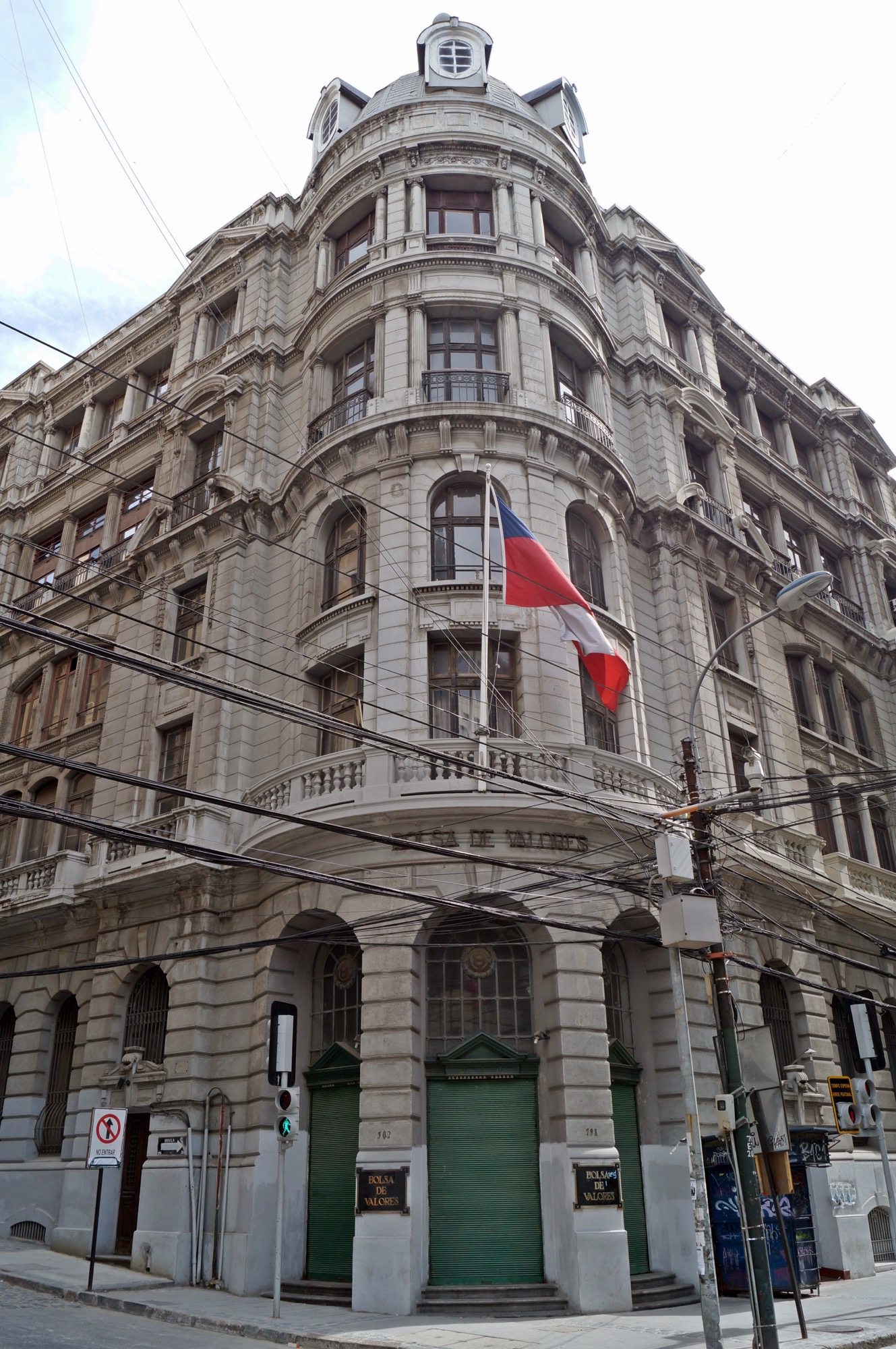
The Edificio de la Bolsa de Valores de Valparaíso stands at the corner of Calle Prat and Urriola in the heart of the port city’s historic financial district. Originally designed by the architectural firm of Huber and Laclolet, the plans were subsequently revised by Carlos Federico Claussen Galeas (1859–1943), a German-Chilean architect known for eclectic residential and commercial commissions across Valparaíso, including the Rosenqvist house on Avenida Gran Bretaña. Construction began in 1911 and the building was inaugurated in 1915, making it the first purpose-built stock exchange in Chile—predating the Santiago exchange’s own Beaux-Arts headquarters by two years. The structure displays a neoclassical vocabulary inflected with eclectic French Second Empire elements: rusticated stone base courses, Corinthian pilasters on the upper stories, an elegant rounded corner pavilion, and, most prominently, a copper-clad dome that became an immediate landmark on the Prat streetscape. Inside, the principal space was the gran salón housing the rueda de corredores (broker’s trading wheel), a circular railed enclosure that survives intact as a physical artifact of open-outcry practice. As Sandro Maino documented in “Iron Cages: Technical Discussions after the 1906 Valparaíso Earthquake and Reconstruction with New Techniques and Materials” (2021), the devastating 8.2-magnitude earthquake of August 16, 1906, had leveled much of the Almendral commercial quarter and spurred a wholesale shift toward reinforced concrete and steel-frame construction; the Bolsa building, begun five years after the catastrophe, incorporated these post-seismic structural innovations beneath its classical stone and plaster skin. Samuel Martland’s study “Reconstructing the City, Constructing the State: Government in Valparaíso after the Earthquake of 1906” (Hispanic American Historical Review, 2007) details how a presidentially appointed reconstruction commission reshaped the city’s building codes and streetscapes, creating the regulated environment in which the Bolsa was erected. In 2001, Calle Prat was declared a Zona Típica (National Monument) by Chile’s Consejo de Monumentos Nacionales under Exempt Decree No. 605, and in 2003, UNESCO inscribed the Historic Quarter of the Seaport City of Valparaíso as a World Heritage Site, encompassing the exchange building. After the Bolsa de Corredores ceased operations in October 2018, the Universidad Técnica Federico Santa María acquired the 4,800-square-meter structure in 2019 and undertook an exhaustive heritage restoration, supervised by the Consejo de Monumentos Nacionales, to preserve Claussen’s original architectural character. Since March 2022 the building has housed the university’s Instituto Internacional para la Innovación Empresarial (3iE), converting this monument of commercial capitalism into a hub for technological entrepreneurship.
The decorative program of the Bolsa de Valores reflected the aspirations of Valparaíso’s commercial elite to rival the great European bourses. The principal interior space—the double-height trading hall beneath the dome—featured coffered ceiling panels, Corinthian-capitalled pilasters, and elaborate plaster cornices in the French academic manner that Claussen favored. The rueda de corredores, the circular broker’s rail at the center of the hall, was executed in turned hardwood and wrought iron, combining functional design with decorative craftsmanship; it remains preserved in situ as a rare surviving example of Latin American open-outcry trading furniture. Contemporaneous financial buildings on Calle Prat established a shared decorative language: the nearby Banco Anglo Sudamericano (1923, now Banco Santander), with its glass skylights, marble wall cladding, and intricate mosaic floors, indicates the ornamental standards expected in the district. As the UNESCO nomination dossier for the Historic Quarter of Valparaíso (2003) noted, the Prat Street and Turri Square precinct contains “examples of monumental architecture” that collectively form a unified ensemble of late-nineteenth and early-twentieth-century commercial design. Broader artistic documentation of the port’s commercial life is held by the Biblioteca Nacional Digital de Chile, which preserves an 1864 photographic record of the original Bolsa de Comercio de Valparaíso—one of the earliest visual documents of a South American securities exchange. The aesthetic evolution from this modest mid-century sala to Claussen’s domed neoclassical palace traces the growing ambition and wealth that the nitrate and copper trades brought to the city’s merchant class. Nearby, the Palacio Baburizza on Cerro Alegre (built 1916 for Croatian shipping magnate Pascual Baburizza) displays the Art Nouveau and Art Deco decorative sensibilities—stained glass, carved woodwork, ornamental ceilings—that circulated among the port’s cosmopolitan commercial community during the same years the Bolsa was completed.
Valparaíso’s unique geography—a narrow crescent of flat reclaimed land pressed between a deep Pacific bay and forty-two steep cerros (hills)—profoundly shaped its emergence as Chile’s premier financial center. The Bolsa de Valores occupied a strategic position on Calle Prat, the longitudinal spine of the banking district that developed at the foot of the hills in the El Puerto sector, steps from the customs house, the naval headquarters on Plaza Sotomayor, and the Muelle Prat (Prat Pier) where cargo lighters connected ocean vessels to the shore. As the UNESCO World Heritage nomination (2003) documented, five interlaced neighborhoods compose the historic quarter: La Matriz and Santo Domingo, Echaurren and Serrano, Prat Pier and Sotomayor Square, Prat Street and Turri Square—where the Bolsa stood—and the residential hills of Cerro Alegre and Cerro Concepción. British and German immigrants settled these hillsides from the 1820s onward, establishing Protestant churches, social clubs, and schools that gave the neighborhood the character of what contemporaries called “a virtual British colony.” As Eduardo Cavieres Figueroa documented in Comercio chileno y comerciantes ingleses, 1820–1880 (Universidad Católica de Valparaíso, 1988), English merchant houses transformed the port’s commercial landscape, and by mid-century Valparaíso had become Chile’s commercial, industrial, and financial capital. Manuel Llorca-Jaña’s The British Textile Trade in South America in the Nineteenth Century (Cambridge University Press, 2012) documents more than 260 British merchant houses operating in Valparaíso and Santiago, with major firms—Antony Gibbs & Sons (1826), Duncan Fox & Co. (1834), Graham Rowe & Co. (1842), and Williamson Balfour (1851)—concentrated along the waterfront streets. By 1840, 166 of the 287 ships anchored in the bay were British. The Turri Clock Tower (Reloj Turri, 1924, architect Augusto Geiger), rising six stories at the junction of Prat and Cochrane, provided a visual terminus to the financial corridor and reinforced the district’s identity as a self-contained commercial city-within-a-city. Juan Ricardo Couyoumdjian’s article “El alto comercio de Valparaíso y las grandes casas extranjeras, 1880–1930” (Historia 33, 2000) describes how these foreign trading houses created a financial ecosystem of insurance companies, shipping agencies, and brokerage offices that naturally coalesced along Calle Prat and gave rise to the formal exchange. The opening of the Panama Canal in 1914, however, eliminated Valparaíso’s strategic monopoly as a coaling station on the Cape Horn route, and banking and corporate headquarters gradually shifted to Santiago during the twentieth century, leaving the Prat district’s architectural patrimony intact but economically diminished.
Securities trading in Valparaíso dates to 1858, when the Bolsa de Comercio de Valparaíso was inaugurated on March 6 under President Manuel Montt—the first formal commercial exchange in Chile, predating all rival institutions. That initial sala, located near the Plaza de la Intendencia (today’s Plaza Sotomayor), operated for roughly twelve years before closing. Informal stock, bond, and bill-of-exchange transactions revived around 1880, driven by the financing demands of insurance companies, banks, shipping lines, and mining ventures concentrated at the port. These transactions were conducted in the private office of broker Alfredo Lyon Santa María, who became the pivotal organizer of the local capital market. In 1892 Lyon and fellow corredores formalized their activities by creating the Salón de Corredores (Brokers’ Hall), and in 1898 the institution was reconstituted as the Bolsa de Valores de Valparaíso with a capital of 60,000 pesos. For several years the Valparaíso exchange’s transaction volumes exceeded those of its Santiago counterpart, the Bolsa de Comercio de Santiago founded on November 27, 1893, as Juan Ricardo Couyoumdjian, René Millar Carvacho, and Josefina Tocornal detail in Historia de la Bolsa de Comercio de Santiago, 1893–1993: Un siglo del mercado de valores en Chile (1993). The War of the Pacific (1879–1883) had dramatically expanded Chile’s territory and revenue base: Thomas O’Brien’s “The Antofagasta Company: A Case Study of Peripheral Capitalism” (Hispanic American Historical Review, 1980) and Carmen Cariola and Osvaldo Sunkel’s Un siglo de historia económica de Chile, 1830–1930 (1982) document how annexation of the Tarapacá and Antofagasta nitrate fields swelled the national treasury by 900 percent between 1879 and 1902, generating a flood of new corporate securities. The devastating 8.2-magnitude earthquake of August 16, 1906, destroyed much of El Almendral and the commercial quarter; Samuel Martland’s “Reconstructing the City, Constructing the State” (Hispanic American Historical Review, 2007) shows how national government intervention in relief and reconstruction diminished local political autonomy even as the physical city was rebuilt. The new Bolsa building, inaugurated in 1915, symbolized the port’s resilience, but structural forces were already working against it: the opening of the Panama Canal in 1914 diverted trans-oceanic shipping away from the Strait of Magellan route, eroding Valparaíso’s role as an indispensable waystation. Banking headquarters migrated to Santiago through the twentieth century, and the Bolsa de Corredores de Valparaíso progressively lost market share. A financial crisis in the early 1980s further weakened the institution. By the 2010s trading volume was negligible, and on October 5, 2018, the Comisión para el Mercado Financiero (CMF) revoked the exchange’s authorization to operate, citing its failure to maintain the legal minimum of ten broker members—only six remained, with just one actively transacting. After 126 years, the Bolsa de Valparaíso ceased to exist as a regulated securities exchange, closing a chapter in Latin American financial history that stretched from the age of nitrate and silver to the era of electronic trading.
The Valparaíso exchange served as the primary marketplace for the securities generated by Chile’s mining-export economy. During the nitrate era (1880s–1920s), the dominant listings were shares of salitreras (nitrate mining companies) operating in the Tarapacá and Antofagasta deserts. As Thomas O’Brien documented in his study of the Compañía de Salitres y Ferrocarriles de Antofagasta (Hispanic American Historical Review, 1980), that Valparaíso-based firm—in which Antony Gibbs & Sons of London held a 29 percent stake—listed shares that attracted both Chilean and British investors. Robert Greenhill’s analysis in “Nitrate Crises, Combinations, and the Chilean Government in the Nitrate Age” (Hispanic American Historical Review, 1963) traces how cyclical booms and busts in the global fertilizer market reverberated through the Valparaíso trading floor. Silver and copper mining stocks featured prominently as well: the Chañarcillo silver discovery of 1832 and subsequent mines in the Norte Chico generated the first wave of publicly traded mining shares in Chile, while copper production, which made Chile the world’s leading exporter by mid-century, sustained corporate listings through the 1870s and beyond. As Leland Pederson discussed in “Mine Owners, Moneylenders, and the State in Mid-Nineteenth-Century Chile” (Hispanic American Historical Review, 1993), Valparaíso merchant-bankers like Agustín Edwards Ossandón advanced credit to northern miners and channeled their output through the port’s financial institutions. Bank stocks constituted another major category: Chile’s earliest commercial banks were founded in Valparaíso, including the Banco de Valparaíso (1855) and the Banco Nacional de Chile (1857, formed from the merger of the Valparaíso and Agricultural banks), and their equity traded actively on the local exchange. Government bonds, both national and municipal, circulated alongside private securities, as did letras de cambio (bills of exchange) and short-term commercial paper drawn on the British merchant houses—Gibbs, Duncan Fox, Williamson Balfour, and Huth & Co.—that dominated the port’s financial ecosystem, as Manuel Llorca-Jaña demonstrated in “The Economic Activities of a Global Merchant-Banker in Chile: Huth & Co. of London, 1820s–1850s” (Historia 45, 2012). Shipping company shares also appeared on the board, reflecting Valparaíso’s status as the busiest port on South America’s Pacific coast. Trading was conducted through the rueda (wheel), the circular enclosure in the main hall where brokers gathered for the daily call; prices were recorded on chalkboards and published in the commercial press. The Bolsa also facilitated currency exchange transactions, a critical function given the port’s international trade flows. By the late twentieth century, as Baldomero Estrada Turra’s research on Valparaíso’s alto comercio (Historia, 2000) contextualizes, the shift of corporate headquarters and financial activity to Santiago reduced the Valparaíso exchange to a marginal venue, and by 2018 it lacked sufficient broker members to continue operating.
Images will be added as the project develops. Photographs by Larry Ng and from research sources.