Lonja de Valencia
Valencia, Spain · Established 1483
This site requires authorization to access.
To request access, contact
william.goetzmann@yale.edu
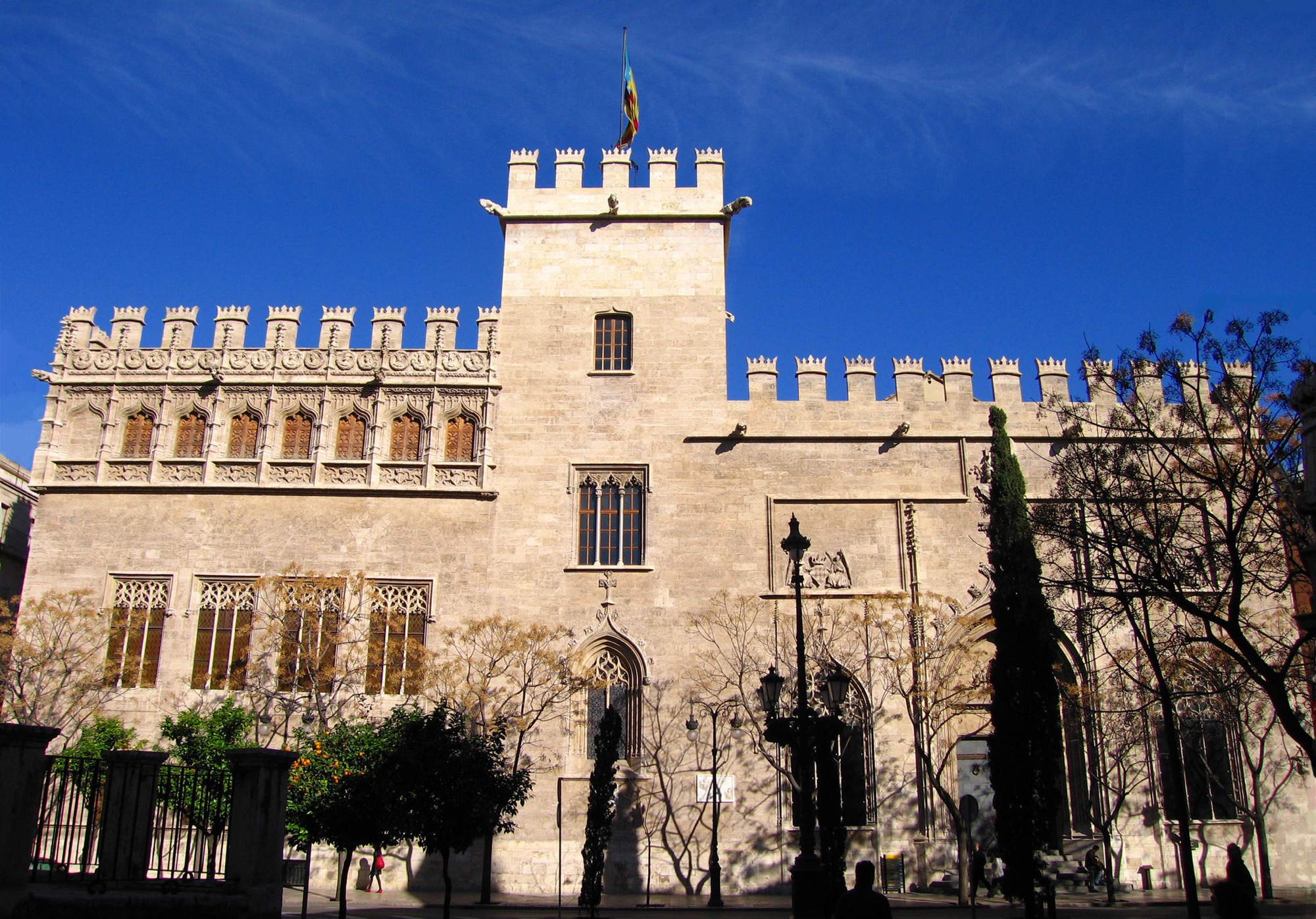
The Lonja de la Seda, or Silk Exchange, stands in the historic center of Valencia as one of Europe's finest surviving examples of late Gothic civil architecture. Commissioned at the height of Valencia's commercial prosperity in the fifteenth century, the building was designed by the master stonemason Pere Compte and modeled on the earlier Lonja of Palma de Mallorca by Guillem Sagrera. Construction of the main Trading Hall, the Sala de Contratación, was completed in just fifteen years, from 1483 to 1498. The full complex, including the Consulado del Mar and decorative additions, was not finished until 1533.
The building's most celebrated feature is the Sala de Contratación, a soaring hall supported by eight slender spiral columns that rise like twisted palm trunks to meet a ribbed star-vaulted ceiling at a height of over seventeen meters. A Latin inscription rendered in golden letters on a blue band encircling the hall's interior walls exhorts honest dealing, declaring that the merchant who avoids deceit and usury shall enjoy both earthly riches and eternal life.
Adjoining the hall, the Consulado del Mar housed the first maritime commercial tribunal established in Spain, resolving disputes among Mediterranean traders. A central tower served, when necessary, as a prison for merchants who defaulted on their debts. An enclosed courtyard planted with orange trees completes the complex.
Designated a UNESCO World Heritage Site in 1996, the Lonja de la Seda was recognized as “a wholly exceptional example of a secular building in late Gothic style, which dramatically illustrates the power and wealth of one of the great Mediterranean mercantile cities.” It remains one of the oldest and most architecturally distinguished exchange buildings in the world, a monument to the commercial ambitions of medieval Valencia.
The Lonja de Valencia served as the commercial nucleus of one of the western Mediterranean's most dynamic trading economies. Although the building's popular name, the Silk Exchange, reflects the commodity most closely associated with the city, the site on which it rose had long hosted a predecessor known as the Lonja del Aceite, where olive oil, grain, and other agricultural goods changed hands. As Paulino Iradiel and German Navarro Espinach documented in their study "Silk in Valencia in the Middle Ages" (in Spain and Portugal in the Silk Routes, 1998), the settlement of Genoese merchants and craftsmen in the fifteenth century brought Italian silk-weaving technology to the city, and the founding of the Velluters guild in 1479 rapidly made Valencia the foremost center of silk production on the Iberian Peninsula. Enrique Cruselles Gomez, in Los mercaderes de Valencia en la Edad Media (2001), showed how the merchant class operating within the Sala de Contratacion dealt not only in raw and woven silk but also in wool, saffron, dried fruit, ceramics, spices, and hides, connecting Valencia to trading circuits stretching from Flanders to North Africa. Financial transactions were facilitated by the Taula de Canvis, a municipal public bank established by royal privilege of Martin I in 1407 and physically installed in the exchange hall, as described in the studies collected in Jacqueline Guiral-Hadziiossif's Valence, port mediterraneen au XVe siecle (1989). Bills of exchange and letters of credit linked Valencian correspondents to banking houses in Barcelona, Genoa, and Florence. Maritime commercial disputes fell under the jurisdiction of the Consulado del Mar, whose tribunal, established in Valencia in 1283 under Peter III, applied the customs codified in the Llibre del Consolat de Mar. James Casey's The Kingdom of Valencia in the Seventeenth Century (Cambridge, 1979) charted the crisis that followed the expulsion of the Moriscos in 1609, which devastated the labor force essential to sericulture and precipitated the bankruptcy of the Taula de Canvis in 1613, marking the long decline of silk as Valencia's signature trade.
Images will be added as the project develops. Photographs by Larry Ng and from research sources.