Mongolian Stock Exchange (MSE)
Ulaanbaatar, Mongolia · Established 1991
This site requires authorization to access.
To request access, contact
william.goetzmann@yale.edu
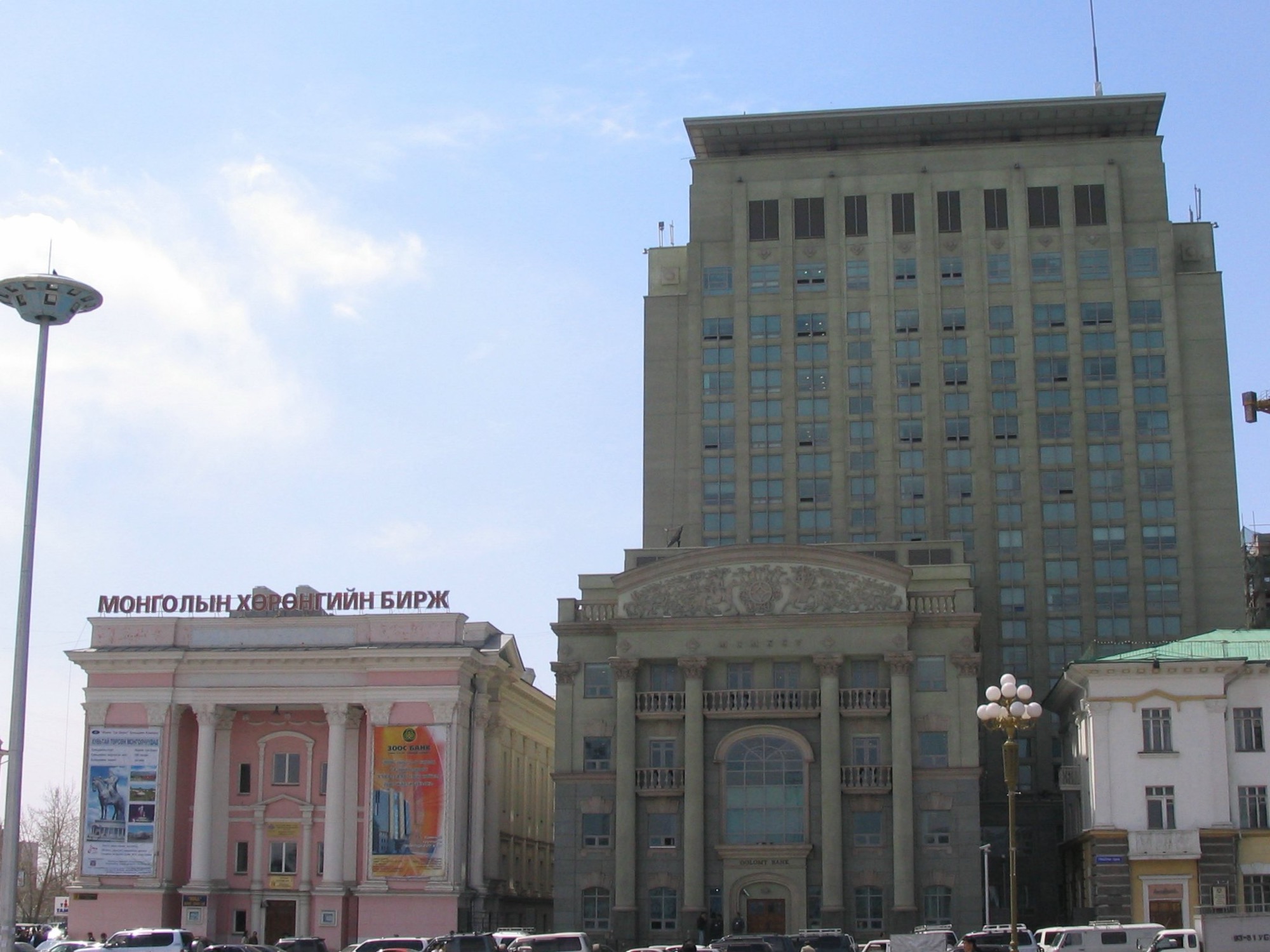
The Mongolian Stock Exchange occupies one of Ulaanbaatar’s most distinctive Soviet-era buildings: the former Eldev-Ochir Children’s Cinema, designed by Soviet engineer N. Klimov in 1945–46 and completed on 8 July 1948. The three-story structure, covering approximately 9,700 square meters, exemplifies the Stalinist neoclassical style that Soviet architects imposed across Mongolian civic architecture in the postwar decades. A colonnaded facade with classical pilasters and a symmetrical plan gave the building the monumental gravity typical of what scholars of Mongolian urbanism describe as “Classicism under the conditions of Socialism” (Ts. Dashnyam, The Art and Architecture of Mongolia, UNESCO, 1981). The original interior housed an auditorium seating over four hundred. In 1991, the Mongolian government repurposed the cinema for the newly decreed stock exchange, commissioning a US$4.5 million renovation that stripped out seats and projection equipment, replacing them with a trading floor outfitted with computers and electronic displays. The facade, initially a striking pink-and-white palette—leading Financial Times correspondent Leslie Hook to dub it the “pink house of equities”—has since been repainted gray. Despite these alterations, the building retains its neoclassical columns, cornices, and pediment, making it one of the best-preserved examples of Soviet institutional architecture on Sükhbaatar Square and a tangible link between Mongolia’s socialist past and its capitalist present.
The decorative program of the Mongolian Stock Exchange reflects its dual identity as a 1940s Soviet cinema and a post-socialist financial institution. The original Eldev-Ochir Cinema incorporated Stalinist neoclassical ornament characteristic of Soviet public buildings across Central and East Asia: classical pilaster capitals, molded cornices, and geometric relief panels framing the entrance. Mongolian architects of this period, as documented in The Art and Architecture of Mongolia (UNESCO, 1981), sought to “creatively combine neo-Classicism with the traditional features of Mongolian architecture,” sometimes integrating meander patterns (alkhan khee) and stylized cloud motifs drawn from Buddhist decorative traditions. The 1991–1992 renovation for the stock exchange introduced modern financial iconography. Electronic ticker boards and trading terminals replaced the cinema screen, and the interior was reconfigured around a central trading pit visible from a visitors’ gallery. The Soyombo symbol—Mongolia’s national emblem, created by the scholar Zanabazar in 1686 and incorporating representations of fire, sun, moon, and the yin-yang—appears prominently in the exchange’s official branding and institutional signage. Photographs of the trading floor from the 1990s, reproduced in Morris Rossabi’s Modern Mongolia: From Khans to Commissars to Capitalists (University of California Press, 2005), show a spare, functional interior where Soviet-era architectural flourishes frame banks of early computing equipment—a visual juxtaposition that encapsulates Mongolia’s abrupt transition from command economy to capital markets.
The Mongolian Stock Exchange stands on the western flank of Sükhbaatar Square (briefly renamed Chinggis Square from 2013 to 2016), the ceremonial heart of Ulaanbaatar and the symbolic center of Mongolian political life. The square, laid out by Soviet planners in the 1940s and 1950s, is bounded on the north by the Government Palace housing the State Great Khural (parliament), on the east by the Central Cultural Palace and State Opera House, and on the south and west by an evolving cluster of financial and telecommunications buildings. The exchange’s immediate neighbors include the Mongolia Telecom headquarters and the Central Post Office. Since the 2000s, the square’s perimeter has been transformed by glass-and-steel high-rises—the Central Tower (completed 2008) and the 25-story Blue Sky Tower (2009)—that house banks, luxury retail, and international hotel chains, signaling Ulaanbaatar’s emergence as a commodity-driven boomtown. As Kevin Cheng documents in Growth and Recovery in Mongolia During Transition (IMF Working Paper 03/217, 2003), the capital’s rapid urbanization intensified after the democratic revolution, drawing nearly half of Mongolia’s population into the Ulaanbaatar metropolitan area. The exchange’s placement at the nexus of government, telecommunications, and finance made it the spatial anchor of an emergent financial district, even as the ger (yurt) settlements ringing the city provided a stark contrast to the square’s increasingly cosmopolitan facade.
The Mongolian Stock Exchange was established by Government Decree No. 22 on 18 January 1991, making it one of the earliest institutional products of Mongolia’s “shock therapy” transition from a Soviet-style command economy. As Cevdet Denizer and Alan Gelb analyze in their World Bank Policy Research Working Paper, Mongolia: Privatization and System Transformation in an Isolated Economy (No. 1063, 1992), the exchange was conceived primarily as a mechanism for mass voucher privatization. The government distributed blue vouchers worth MNT 7,000 to every citizen born before 31 May 1991—ultimately reaching 1.97 million of the country’s 2.2 million people—enabling them to bid for shares in 475 state-owned enterprises. Trading commenced on 7 February 1992, with shares in three companies auctioned on the first day for a turnover of approximately US$15,000. A network of 29 brokerage houses was established across the country. By the close of the voucher phase in 1995, Mongolia could claim the world’s highest rate of share ownership, with roughly one million shareholders—43 percent of the population. James Anderson, Young Lee, and Peter Murrell examined the institutional weaknesses of this rapid privatization in “Competition and Privatization Amidst Weak Institutions: Evidence from Mongolia” (Economic Inquiry, 2000). The exchange transitioned to electronic trading in 1998, and in 2012 signed a Master Service Agreement with the London Stock Exchange Group to install its Millennium IT integrated trading platform, modernizing clearing, surveillance, and depository systems to international standards.
During its initial voucher-privatization phase (1992–1995), the Mongolian Stock Exchange functioned as an auction house for state enterprise shares purchased with government-issued blue coupons worth MNT 7,000 each. As Bayarsaikhan Davaadorj and Bujinlkham Boldbaatar document in The Emerging Asia Pacific Capital Markets: Mongolia (CFA Institute Research Foundation Brief, 2021), the market has since evolved to encompass equities, government bonds, corporate bonds, and—more recently—mining products. Government bonds became the exchange’s largest business from November 2000, and in 2001 Barilga Corporation issued the first corporate bond, valued at US$4.4 million. The MSE lists over 200 companies, organized into tiered indices: the MSE Top 20 tracks the most liquid blue-chip stocks, while the MSE A and MSE B indices reflect progressively relaxed corporate governance standards. Mining dominates the listed landscape, reflecting Mongolia’s vast mineral wealth; the long-anticipated IPO of Erdenes Tavan Tolgoi, the state coal giant, has been repeatedly deferred but remains a transformative prospect. Under the Mining Product Exchange Law, the MSE also facilitates physical commodity trading—in recent years handling millions of tons of coal and hundreds of thousands of tons of iron ore concentrate. The first conventional IPO occurred in 2005 when Mongol Shiltgeen LLC went public. Market capitalization, once negligible at roughly 5 percent of GDP (MNT 52 billion in 2003), grew to MNT 13.85 trillion by 2025, as the exchange has gradually shed its reputation as the world’s smallest stock market by capitalization.
Images will be added as the project develops. Photographs by Larry Ng and from research sources.