Turin Stock Exchange (Borsa di Torino)
Turin, Italy · Established 1850
This site requires authorization to access.
To request access, contact
william.goetzmann@yale.edu
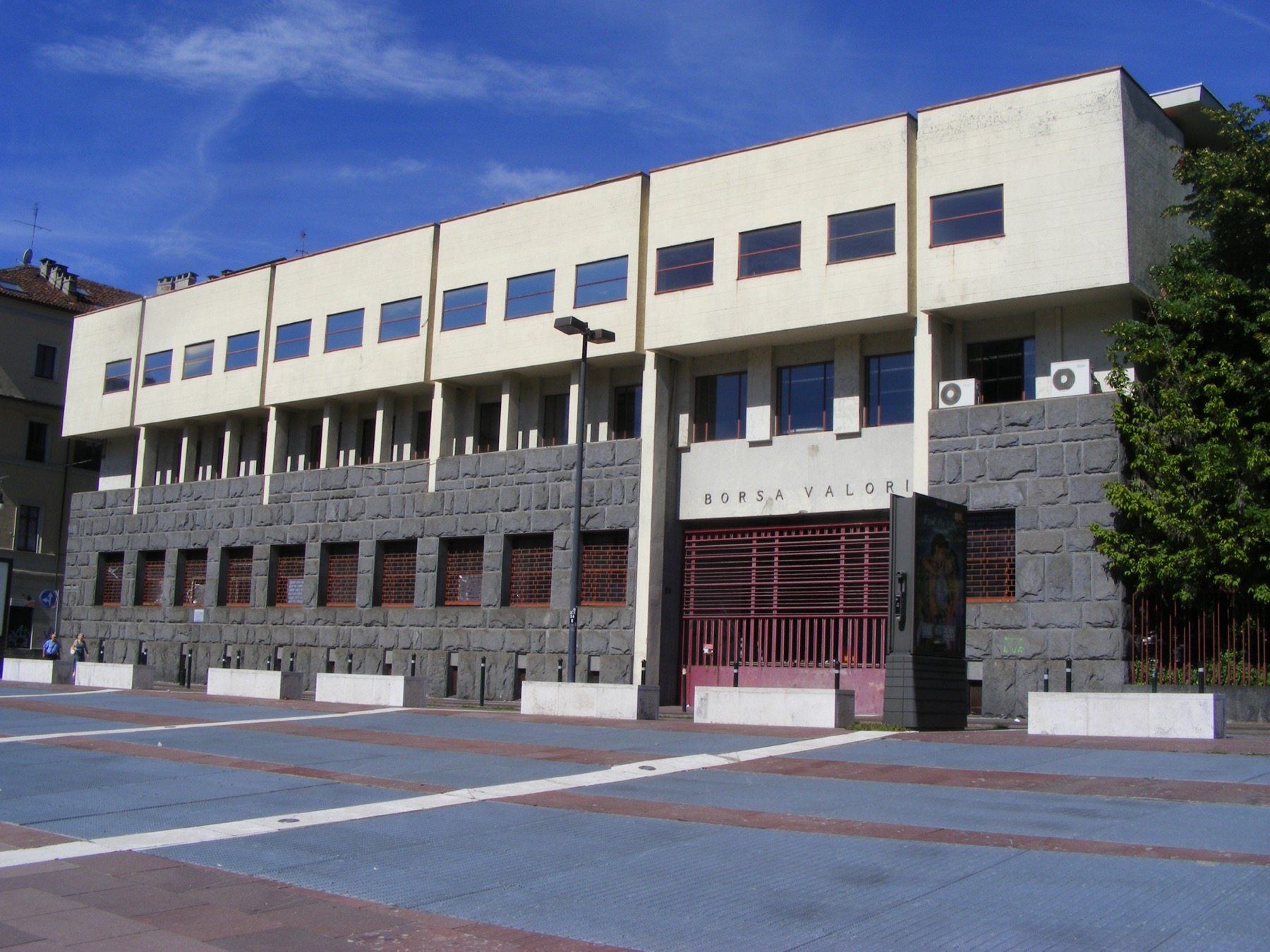
The Turin Stock Exchange has occupied four distinct premises since its founding by royal decree on 26 November 1850. Count Camillo Benso di Cavour, then Minister of Commerce, established the exchange within the Camera di Commercio on Via Alfieri 9, a modest institutional setting befitting the nascent market of the Kingdom of Sardinia. In 1873, operations transferred to the Palazzo d’Agliano (also known as Palazzo Morozzo della Rocca) on Via Ospedale 28, a patrician baroque residence studied by Paolo Cornaglia in “Architetti di corte per il palazzo Morozzo della Rocca a Torino” (Bollettino della Società per gli studi storici, archeologici ed artistici della provincia di Cuneo, 2009). The palazzo served the exchange until Allied bombing in December 1942 forced evacuation to the Circolo degli Artisti on Via Bogino 9. The definitive building, inaugurated on 9 July 1956 at Via San Francesco da Paola 28, was the product of a 1951 competition won by architects Roberto Gabetti (1925–2000), Aimaro Oreglia d’Isola (b. 1928), and engineers Giorgio and Giuseppe Raineri, whose entry bore the prescient title “Stellage”—a term for an options contract. As analyzed in the 2022 Politecnico di Torino thesis by Mattia Pescarolo and Jacopo Rosa (supervised by Cesare Tocci and Gentucca Canella), the central trading hall exceeded 20,000 cubic meters, crowned by an aluminum-clad dome spanning forty meters. The Ministry of Cultural Heritage has designated the building “one of the most significant works of artistic character of the second half of the twentieth century.” The exchange closed in 1992 when Italian markets consolidated under Borsa Italiana in Milan.
The decorative program of the 1956 Borsa Valori reflects the integrated design philosophy of Gabetti and Isola, who conceived both the architecture and the interior furnishings as a unified artistic statement. As the Encyclopedia.com entry on Roberto Gabetti notes, the partnership “declared their rejection of the ideals and doctrines of the Modern Movement,” preferring instead to develop local building traditions—an approach that would soon be labeled Neo-Liberty after their contemporaneous Bottega d’Erasmo (1953–1956). For the Borsa Valori, Gabetti and Isola designed custom chairs, stools, desks, and conference tables realized by the Colli furniture workshop and other small Turin ateliers. These pieces featured turned woods in organic forms, veneered and polished surfaces, and exposed metal structural elements that echoed the tension between tradition and modernity in the building itself. The chair designed for the trading floor (1952–1956), executed in wood, metal, and artificial leather, now resides in the permanent collection of the Museum of Modern Art (MoMA) in New York. Ceccotti Collezioni continues to produce the “Stellage 52” chair based on the original design. The exterior employs naturally split basalt blocks as a high base, with dark-red iron window frames and basalt-hammered panels lining the entrance atrium, window sills, and lintels—a material palette that connects the modernist building to Piedmont’s geological landscape. Reyner Banham famously criticized such Neo-Liberty tendencies as a “retreat from modern architecture” in The Architectural Review (April 1959), yet the Borsa Valori’s synthesis of artisanal craft and structural expression has endured as a landmark of post-war Italian design.
The Borsa Valori stands on Via San Francesco da Paola in Turin’s historic center, within the Borgo Nuovo quarter developed under Savoy patronage. Turin’s distinctive orthogonal grid plan, among the most rigorous in Europe, originated in the Roman castrum and was systematically extended by ducal architects from the sixteenth century onward after Emmanuel Philibert transferred the Savoy capital from Chambéry to Turin in 1563. The city’s grand porticoed avenues—including Via Roma, Via Po, and the arcaded perimeter of Piazza Castello—were designed by court architects including Ascanio Vitozzi, Carlo di Castellamonte, and Filippo Juvarra, whose Palazzo Birago di Borgaro (now the Camera di Commercio’s institutional headquarters on Via Carlo Alberto) represents, according to the Chamber of Commerce, “one of the most elegant and renowned examples of late Baroque architecture in Piedmont.” The adjacent Palazzo degli Affari on Via San Francesco da Paola 24, designed by Carlo Mollino, houses the Chamber’s public offices, creating a cluster of commercial-institutional buildings. Turin served as the first capital of unified Italy from 1861 to 1865, and its urban fabric reflects the ambitions of a royal capital that transformed into an industrial metropolis. The grid that once channeled courtly processions came to serve the logistics of FIAT’s factory system, earning Turin the epithet “Italy’s Little Detroit.” The Borsa Valori’s position along the Via Cavour axis—named for the statesman who founded the exchange—embeds the building within the commemorative geography of the Risorgimento.
Count Cavour established the Borsa di Torino by royal decree on 26 November 1850 as part of his sweeping modernization of the Kingdom of Sardinia’s economy. As Gianni Toniolo documents in An Economic History of Liberal Italy, 1850–1918 (Routledge, 1990), Cavour’s reforms promoted free trade, railway expansion, and bank credit, terminating Piedmont’s dependence on costly Rothschild loans. The regulatory framework derived from the Albertine Code of Commercial Law of 1842, supplemented by the brokerage law of 1854 and successive Commercial Codes of 1865 and 1882—legislation that governed all Italian exchanges until the unified stock exchange law of 1913 (Law 272). Despite Turin’s status as political capital, Borsa Italiana’s institutional history notes that “it was never the financial capital”: an 1847 draft law allocated twelve brokers to Genoa, six to Turin, and four to Nice, reflecting Genoa’s commercial preeminence. Turin’s significance grew with industrialization. Italgas, founded as the Compagnia di Illuminazione a Gas, became the first company listed on the Kingdom of Sardinia exchange on 14 July 1851. The founding of FIAT (Fabbrica Italiana Automobili Torino) on 11 July 1899 by Giovanni Agnelli and partners, followed by Lancia & C. in 1906 and Olivetti in 1908, anchored a concentration of industrial securities that sustained the exchange’s importance well into the twentieth century. As Donatella Strangio observes in The Roman Stock Exchange between the 19th and 20th Centuries (Palgrave Macmillan, 2022), the Kingdom of Sardinia was “the only surviving constitutional, parliamentary and liberal kingdom” among Italian states—a political distinction that shaped its financial institutions.
The Borsa di Torino’s trading evolved from Sardinian government bonds and bills of exchange to a diversified portfolio reflecting Piedmont’s industrial transformation. In its earliest decades, sovereign debt of the Kingdom of Sardinia dominated, alongside railway securities that multiplied as Cavour’s infrastructure program gave Piedmont 800 kilometers of track by 1860—one-third of all railways in the Italian peninsula. Italgas shares, first listed on 14 July 1851, represent one of the oldest continuously traded industrial securities in Italy. Piedmont’s historic silk trade, which since the fifteenth century had produced high-grade organzine thread for markets in Lyon, Holland, and London, generated ancillary commercial paper and commodity transactions. By the early twentieth century, Turin’s exchange became a venue for the securities of the automobile and manufacturing firms that defined Italy’s industrial triangle: FIAT (incorporated as a joint-stock company in 1906), Lancia, and eventually Olivetti, whose typewriter works in nearby Ivrea made it a pillar of Piedmontese industry. Banking shares—including those of institutions that financed industrialization—circulated alongside insurance paper. Trading followed the open-outcry method, the “recinto delle grida” (ring of shouts), as documented in the Bocconi University exhibition “The Ring of Shouts: Stock Exchanges in Italy Before Borsa Italiana.” By 1942, Borsa Italiana’s institutional history attributes the exchange’s wartime resilience to “the strong investment capacity of the local financial community” and the concentration of major listed companies in the city. The 1956 building’s 400 telephones and 140 external lines, with luminous price display panels, reflected the scale of mid-century trading before electronic systems rendered the floor obsolete in 1992.
Images will be added as the project develops. Photographs by Larry Ng and from research sources.