Trieste Commodity Exchange
Trieste, Italy · Established 1755 (commodity exchange by Maria Theresa); building 1802—1806
This site requires authorization to access.
To request access, contact
william.goetzmann@yale.edu
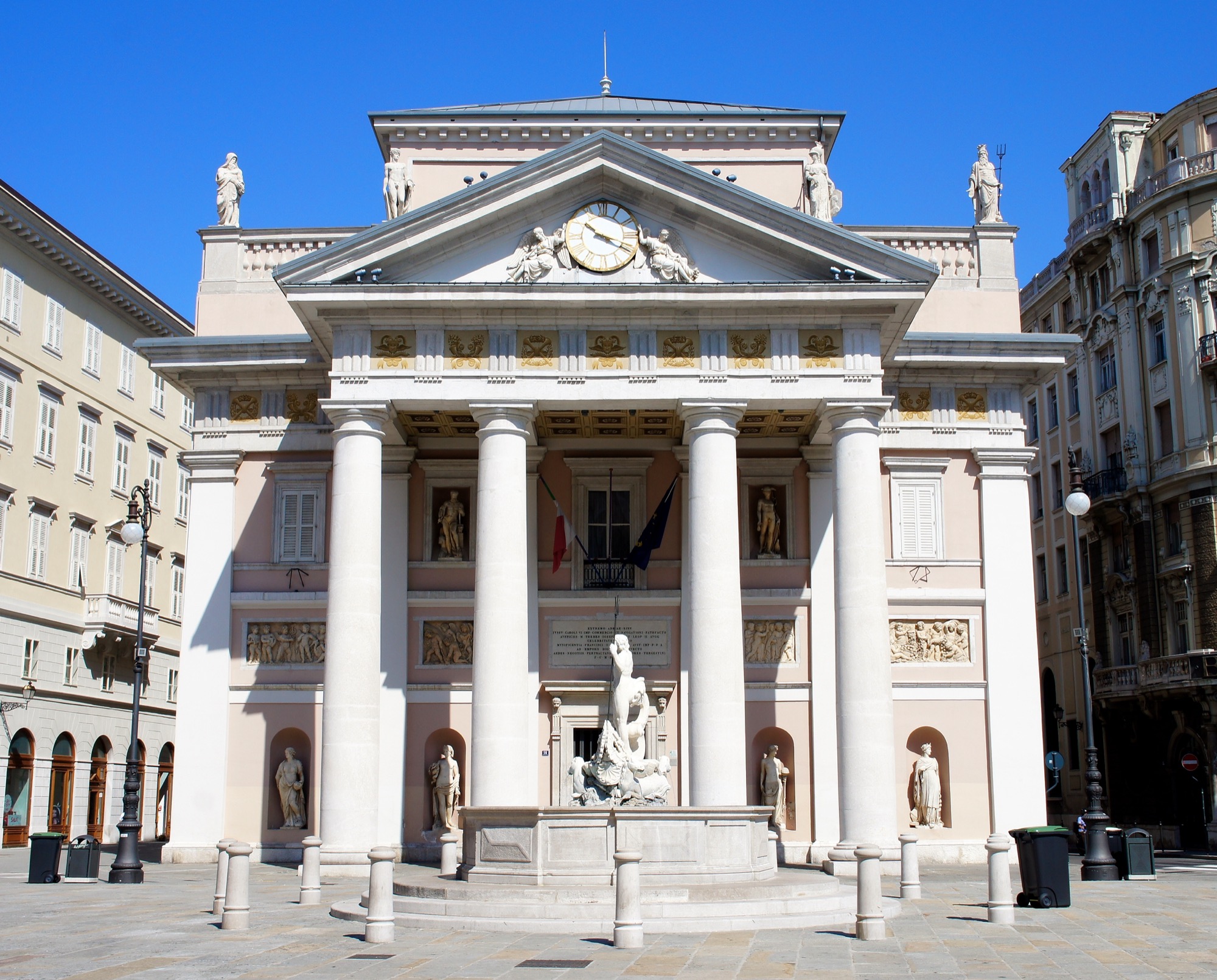
The Palazzo della Borsa Vecchia in Trieste, designed by the architect Antonio Mollari of Corridonia and erected between 1802 and 1806, stands as one of the Adriatic’s finest neoclassical commercial buildings. Mollari, trained at the Academy of Parma, conceived a temple-front composition dominated by a hexastyle Doric portico of imposing proportions, recalling the Greek revival vocabulary then spreading through Habsburg civic architecture (see Francesca Gattera, “Indagini su Antonio Mollari architetto prima e dopo l’exploit triestino,” Il capitale culturale, 2015). The building was commissioned to house the commodity exchange founded by Empress Maria Theresa in 1755, when Trieste was Austria’s principal maritime outlet. The great trading hall, or Sala Maggiore, on the piano nobile is crowned by a coffered dome that floods the room with natural light—a design intended to facilitate the visual inspection of commodity samples. On the ground floor, a loggia with paired Doric columns shelters a monumental sundial twelve meters in length, installed in 1820 by the Friulian horologist Antonio Sebastianutti. After the stock exchange relocated to the Palazzo del Tergesteo in 1844, the Borsa Vecchia became the permanent seat of the Trieste Chamber of Commerce, a function it retains today. The building’s siting on the Piazza della Borsa—at the hinge between the medieval Città Vecchia and the eighteenth-century Borgo Teresiano—physically embodied the city’s transformation from a modest fishing town into the Habsburg Empire’s busiest commercial port.
The sculptural program of the Borsa Vecchia was entrusted in 1805 to three Venetian artists working in the Canovian neoclassical tradition: Antonio Bosa, Bartolomeo Ferrari, and Domenico Banti. Bosa, a direct pupil of Antonio Canova who maintained an active workshop in Trieste, carved the allegorical figures of Neptune and Minerva for the rooftop balustrade alongside personifications of the Danube and the Genius of Trieste—a quartet symbolizing the maritime and riverine trade routes that converged on the port (see the Treccani entry on Antonio Bosa in the Dizionario Biografico degli Italiani). At ground level, Ferrari and Banti contributed colossal seated figures representing the four continents—Europe, Asia, Africa, and America—signaling the global reach of Trieste’s commodity trade. Bosa also modeled the genii supporting the clock on the facade tympanum and four decorative relief panels featuring putti amid commercial attributes. Inside, the painter Giuseppe Bernardino Bison—who had relocated to Trieste from Venice around 1802—executed the ceiling frescoes of the Sala Maggiore between 1805 and 1806, centering on an allegorical scene of Emperor Charles VI proclaiming the Free Port of Trieste in 1719. Bison’s broader decorative work in Trieste, documented in the scholarship of Giuseppe Pavanello (Giuseppe Bernardino Bison, 2012), included mythological and commercial allegories that linked the city’s prosperity to divine favor. Together, the sculptural and painted program constituted a coherent iconographic statement: Trieste as a divinely sanctioned emporium where the wealth of four continents flowed under Habsburg protection.
The Borsa Vecchia occupies a pivotal position on the Piazza della Borsa, the commercial heart of Trieste and the threshold between the old hilltop city and the Borgo Teresiano, the planned commercial quarter laid out on reclaimed salt-pan land beginning in the 1730s under Emperor Charles VI and expanded under Empress Maria Theresa. The urban historian Fabio Zubini has documented how the Borgo Teresiano’s rational orthogonal grid—one of the earliest examples of Enlightenment town planning in the Habsburg lands—was organized around the Canal Grande, a navigable waterway designed by Matteo Pirona between 1754 and 1766 to allow merchant vessels to unload cargo directly in the city center. The exchange building thus anchored a network of commercial infrastructure: to the southeast stood the Canal Grande warehouses and the Greek Orthodox church of San Nicolò dei Greci, hub of the powerful Hellenic merchant community; to the north, the Palazzo del Tergesteo (1842, architect Francesco Bruyn), a glass-roofed commercial gallery inspired by Milan’s Galleria de Cristoforis, which housed the stock exchange from 1844 to 1928. Along the waterfront, the Porto Vecchio warehouse complex—designed by Paul Talabot and constructed between 1868 and 1883 on the model of Hamburg’s Speicherstadt—extended the commercial geography seaward. The Magazzino dei Vini (1902) stored Istrian and Dalmatian wines for re-export. This layered urban fabric reflected Trieste’s unique status as a free port (porto franco) since 1719, where exemptions from customs duties attracted a cosmopolitan population of Italian, Greek, Serbian, Armenian, and Jewish merchants who each established their own churches, synagogues, and trading houses within walking distance of the exchange.
Trieste’s emergence as a financial center began with Emperor Charles VI’s declaration of free-port status in 1719, transforming a modest Adriatic fishing settlement into the Habsburg monarchy’s principal window on the sea. The commodity exchange was formally established by Empress Maria Theresa in 1755, and as the economic historian Marina Cattaruzza has shown (Trieste nell’Ottocento, 1995), the port’s volume of trade grew dramatically through the eighteenth and nineteenth centuries. Trieste’s merchant elite was remarkably cosmopolitan: Lois C. Dubin’s landmark study The Port Jews of Habsburg Trieste (Stanford University Press, 1999) documents how Jewish, Greek, Serbian, and Armenian trading families were granted civic inclusion in exchange for the revenues their commerce generated. Maritime insurance became a defining industry: by 1825 some twenty insurance firms operated in the city, and in 1831 Giuseppe Lazzaro Morpurgo assembled a consortium of Trieste financiers to found the Assicurazioni Generali, which grew into one of Europe’s largest insurers. The Riunione Adriatica di Sicurtà (RAS) followed in 1838, specializing in fire and cargo-transport coverage. The Österreichischer Lloyd (Austrian Lloyd), established in 1833, became one of the world’s largest shipping companies, managing most of Austria-Hungary’s overseas trade. As Erica Bouchard and Karin Kreuzer have documented, the railway link to Vienna completed in 1857 further amplified trade volumes. The exchange listed shares of these insurance and shipping firms alongside government bonds, making Trieste not merely a commodity port but a sophisticated financial marketplace linking Central European capital to Mediterranean and Levantine commerce.
The Trieste Commodity Exchange dealt in a broad spectrum of goods reflecting the port’s role as gateway between Central Europe and the Mediterranean world. Coffee dominated: as the Habsburg Empire’s only significant seaport, Trieste became one of Europe’s principal coffee entrepots, with green beans arriving from the Levant, Brazil, and the East Indies for redistribution throughout the Empire. By the late nineteenth century, the city hosted over sixty coffee import firms and ten industrial roasters, and in the early twentieth century a dedicated Coffee Exchange was established under the Chamber of Commerce. Grain—wheat, maize, and barley from the Hungarian plains and the Po Valley—formed another major category, shipped through Trieste to Mediterranean markets. Istrian and Dalmatian wines and olive oil were stored in the waterfront Magazzino dei Vini before re-export. Timber from Carniolan and Styrian forests arrived via river and rail for maritime shipment. Sugar, cotton, tobacco, and colonial spices passed through the free-port warehouses. On the financial side, the exchange facilitated trading in maritime insurance policies, the shares of the Assicurazioni Generali, RAS, and the Österreichischer Lloyd, as well as Austrian and later Austro-Hungarian government bonds. Bills of exchange denominated in multiple currencies—florins, lire, francs, and Ottoman piastres—circulated freely in a marketplace whose multilingual brokers operated at the crossroads of Germanic, Latin, Slavic, and Levantine commercial networks.
Images will be added as the project develops. Photographs by Larry Ng and from research sources.