Toulouse Bourse des Marchands
Toulouse, France · Established 1549
This site requires authorization to access.
To request access, contact
william.goetzmann@yale.edu
In July 1549, King Henri II issued letters patent creating the Bourse des Marchands in Toulouse — the first permanent commercial jurisdiction in France. The institution served simultaneously as a bourse (exchange), a tribunal (commercial court), and a bank. Merchants elected a prior and two consuls to judge commercial disputes.
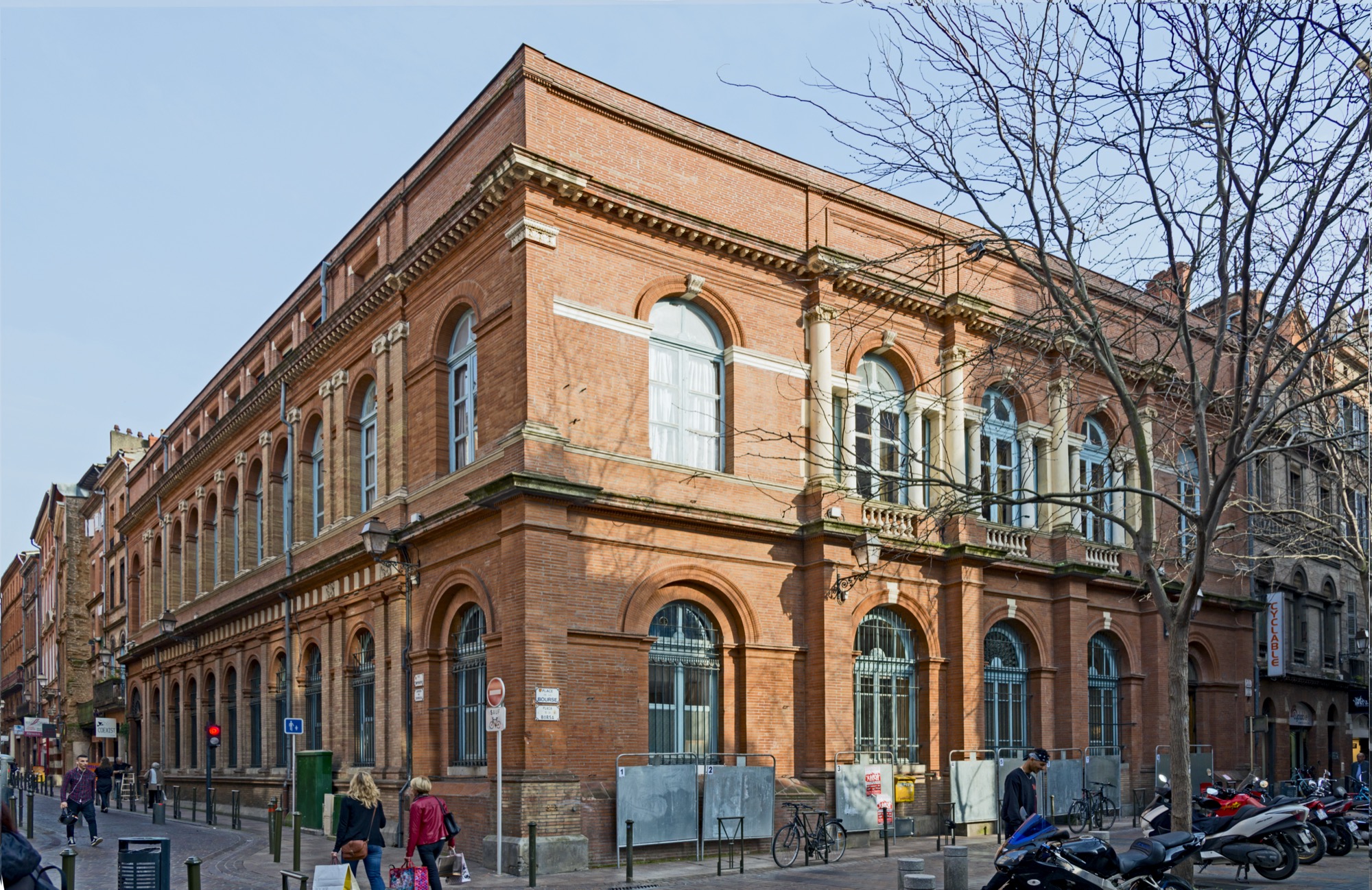
The 1836 Hotel de la Bourse, designed by Jean Bonnal and Jean-Antoine Raynaud, presents a restrained but carefully articulated neoclassical decorative program. The facade employs Ionic marble columns on the upper register, separating tall French windows crowned with round arches, while the ground floor is articulated by pilasters serving as buttresses between wide arched openings — a rare example of Palladian-style architecture in Toulouse, as noted in the city's architectural survey published by the Presses universitaires du Midi (Toulouse, une metropole meridionale). Mercury, the god of commerce, was the dominant figure in the sculptural iconography of Toulouse's commercial buildings during the nineteenth century, frequently accompanied by cornucopias and allegories of agriculture, industry, and navigation referencing the Canal du Midi's importance. The institution's visual legacy also survives in numismatic art: a silver jeton struck for the Chambre de Commerce de Toulouse in 1703 depicts on its obverse a ship resembling the vessels of the Estates of Languedoc, inscribed CONSILIUM TOLOSANI COMMERCII, while the reverse shows Minerva reclining before the city of Toulouse, holding a pike bearing the Languedoc flag and leaning on two shields, with the legend COMMERCIA MENTE REGUNTUR — "Commerce is governed by intellect." The Musee Paul Dupuy in Toulouse holds approximately one hundred thousand graphic works, including prints documenting the city's architectural landmarks, which preserve views of the Place de la Bourse and its commercial quarter from the eighteenth and nineteenth centuries.
The Place de la Bourse lies at the heart of Toulouse's historic cloth merchants' quarter — the quartier des marchands drapiers — where wealthy textile dealers controlled the entire production chain, purchasing coarse fabrics from weavers and having them finished by fullers and dyers before sale. The square sits within the old city on the right bank of the Garonne, a river that since Roman times served as the essential artery for trade between the Pyrenees, the Mediterranean, and the Atlantic coast. Nearby landmarks chart the city's commercial and civic evolution: the Capitole, whose monumental 135-meter facade was designed by Guillaume Cammas in 1750-1760, housed the capitouls who governed trade and taxation from the twelfth century; the Hotel d'Assezat (1555-1562), designed by Nicolas Bachelier for the pastel merchant Pierre d'Assezat, testifies to the fortunes made in the woad trade; and the Bazacle mills on the Garonne, site of what Germain Sicard demonstrated in Les origines des societes anonymes (1952) to be Europe's earliest incorporated shareholding companies. In the eighteenth century, the Canal du Midi — completed by Pierre-Paul Riquet in 1681 — transformed Toulouse into a transit hub: grain from the Lauragais was shipped via horse-drawn barge from Port Saint-Etienne to Agde on the Mediterranean, while an estimated 1,800 small boats annually carried cereals, wine, wood, and colonial goods along the Garonne northward toward Bordeaux. The Place de la Bourse was enlarged westward in the early nineteenth century, and the present Hotel de la Bourse replaced the Hotel de Bastard that the exchange had occupied since 1778.
The original building was on Rue Clémence Isaure. It relocated to Place de la Bourse in the late 18th century. The current neoclassical building, designed by architects Bonnal and Raynaud, dates from 1836 and now houses the Tribunal de Commerce. It is inscribed as a Monument Historique.
The Bourse des Marchands, created by Henri II's letters patent of July 1549, served as both exchange and commercial court, with an elected prior and two consuls exercising first-instance jurisdiction over merchant disputes — a principle of rapid, autonomous commercial justice reaffirmed by royal edict in December 1551. The institution's founding charter authorized merchants to gather for "trafficking, trading, and providing for the costs required and necessary for the maintenance of the said common Bourse, exchange and insurance," establishing it simultaneously as a marketplace, tribunal, and bank. In its earliest decades, the Bourse served the great pastel trade: as Francis Brumont documents in "La commercialisation du pastel toulousain, 1350-1600" (Annales du Midi, 1994), Toulouse merchants coordinated the export of nearly 40,000 tons of woad dye annually to London, Antwerp, Hamburg, and Spain, with payment cycles stretching one to two years and settled through letters of exchange drawn on correspondents in Antwerp and London. The families enriched by this trade — the Bernuy, Assezat, Lancefoc, and Cheverry — dominated the Bourse's governance. Toulouse was also distinguished by Europe's earliest tradable equity shares: the uchaux of the Societe des Moulins du Bazacle, which entitled holders to dividends (partisons) from grain-milling fees. William Goetzmann, David Le Bris, and Sebastien Pouget have shown in "The Present Value Relation Over Six Centuries" (Journal of Financial Economics, 2019) that these shares yielded approximately five percent annually. In 1703, Louis XIV formalized the Chambre de Commerce under the Bourse's prior, adding four merchant deputies. By the eighteenth century, trade through the Canal du Midi in grain, wine, and textiles sustained the institution until the Revolution transformed it into the Tribunal de Commerce in 1790.
Images will be added as the project develops. Photographs by Larry Ng and from research sources.