Toronto Stock Exchange (TSX)
Toronto, Canada · Established 1852

This site requires authorization to access.
To request access, contact
william.goetzmann@yale.edu
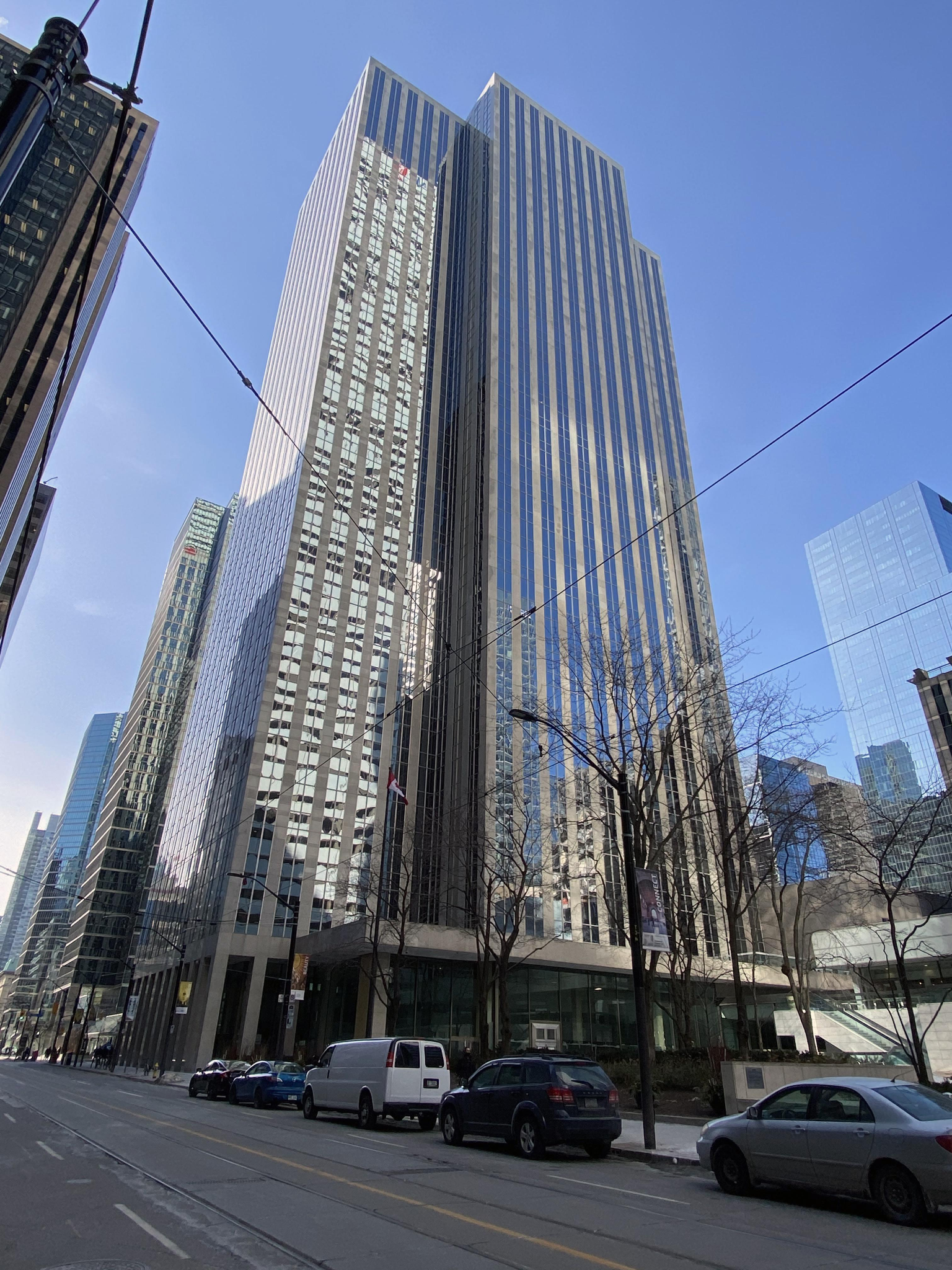
The Toronto Stock Exchange building at 234 Bay Street, completed in 1937, stands as one of Canada’s finest examples of Art Deco commercial architecture. Designed by the firm of George and Moorehouse with associate S.H. Maw, the structure replaced an earlier 1912 exchange on the same site, erected after the 1934 merger with the Standard Stock and Mining Exchange demanded larger quarters. The architects blended streamlined Moderne, Art Deco, and stripped classicism into a facade of hazy pink granite and beige Indiana limestone, organized around attenuated pilasters that lend the building a restrained monumentality. At a cost of $750,000 — enormous for the Depression era — the exchange was hailed upon its April 1937 opening as “the most up-to-date trading floor in the world,” as the Globe and Mail reported. The column-free trading hall, floored in natural maple with black trim and treated for acoustic performance, accommodated 200 telephones and electrical display boards linked by a pneumatic tube system to ticker operations in the basement. The building was also the first in Toronto to feature air conditioning, and Canada’s first fluorescent lamp hung above the grand staircase, predating the commercial introduction of fluorescent lighting across North America. The Architectural Conservancy of Ontario has documented the heritage significance of the building, which was designated under Part IV of the Ontario Heritage Act on August 14, 1978. When the TSE relocated to Exchange Tower at King and York Streets in 1983, the original building was incorporated into Mies van der Rohe’s Toronto-Dominion Centre complex. In 1991, the Ernst & Young Tower was constructed overhead, and the firm of KPMB Architects — Bruce Kuwabara, Thomas Payne, Marianne McKenna, and Shirley Blumberg — undertook a sensitive restoration completed in 1994, converting the 40,000-square-foot interior into the Design Exchange, a museum of Canadian design. The project received the Governor General’s Award for Architecture (Award of Merit) in 1997, recognizing the successful integration of heritage preservation with contemporary adaptive reuse.
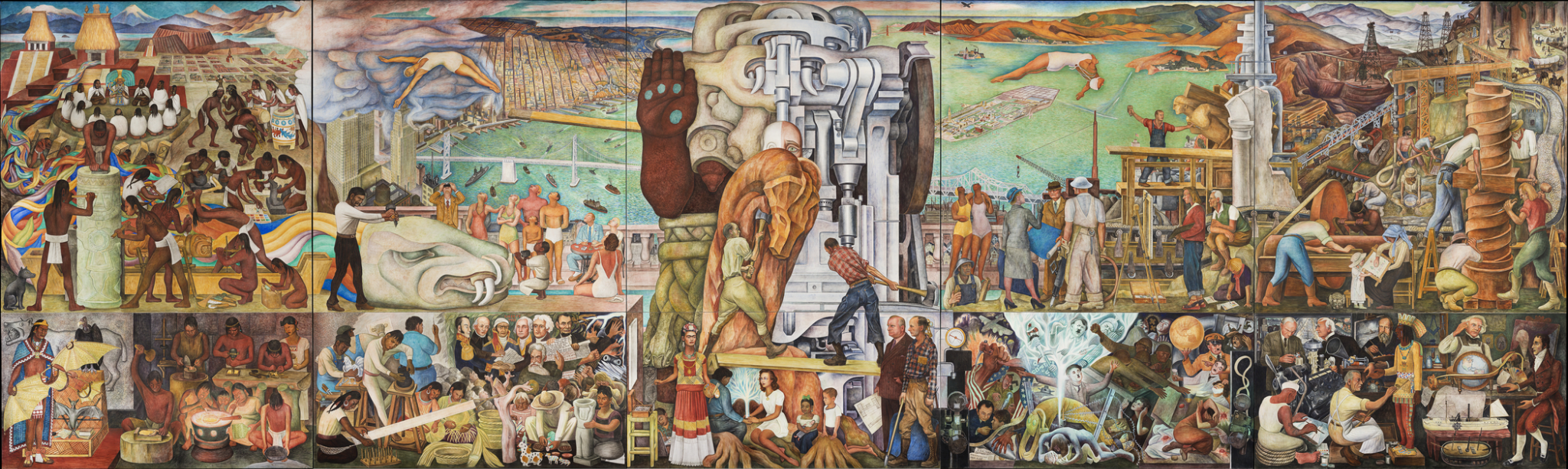
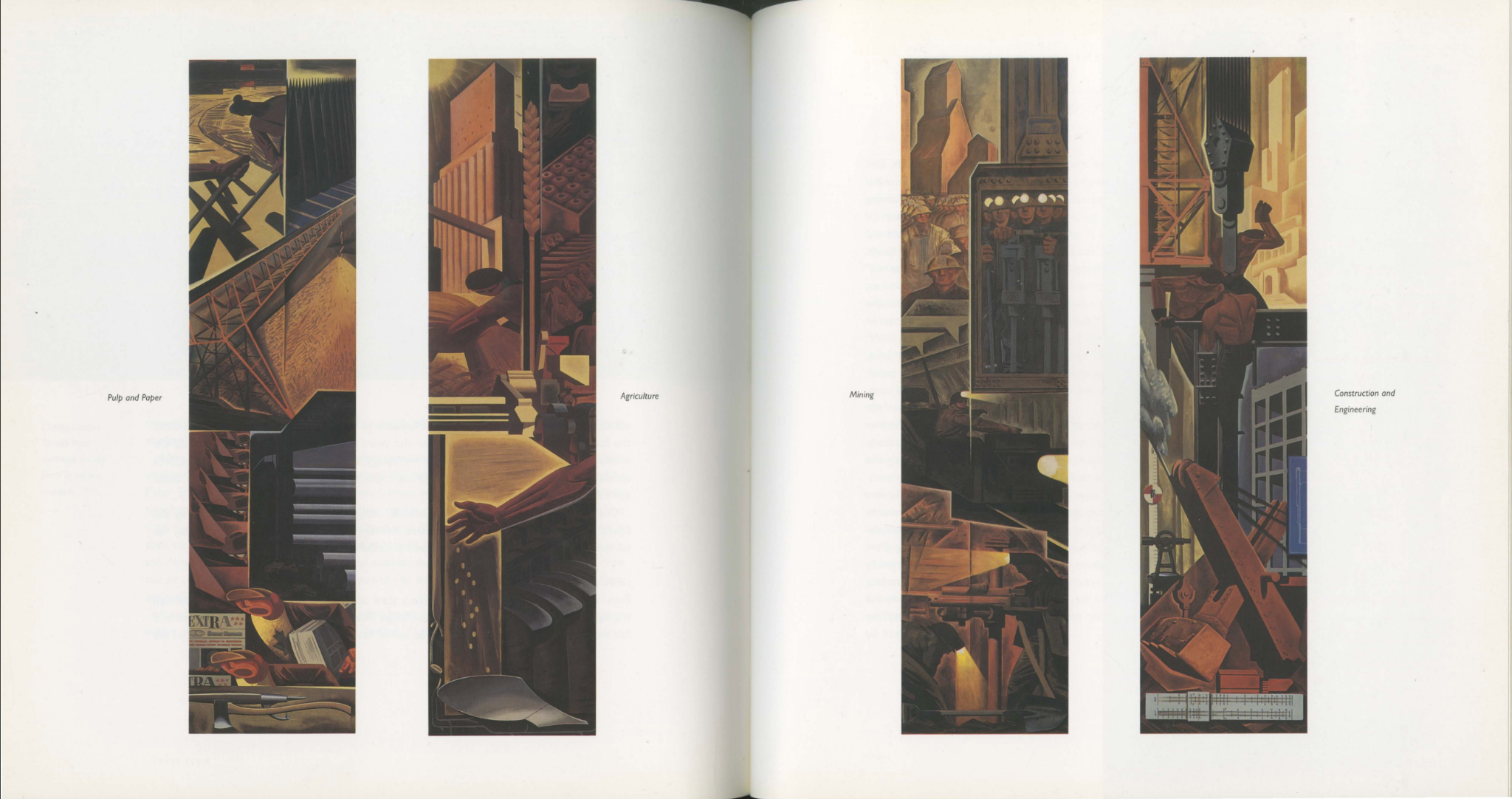
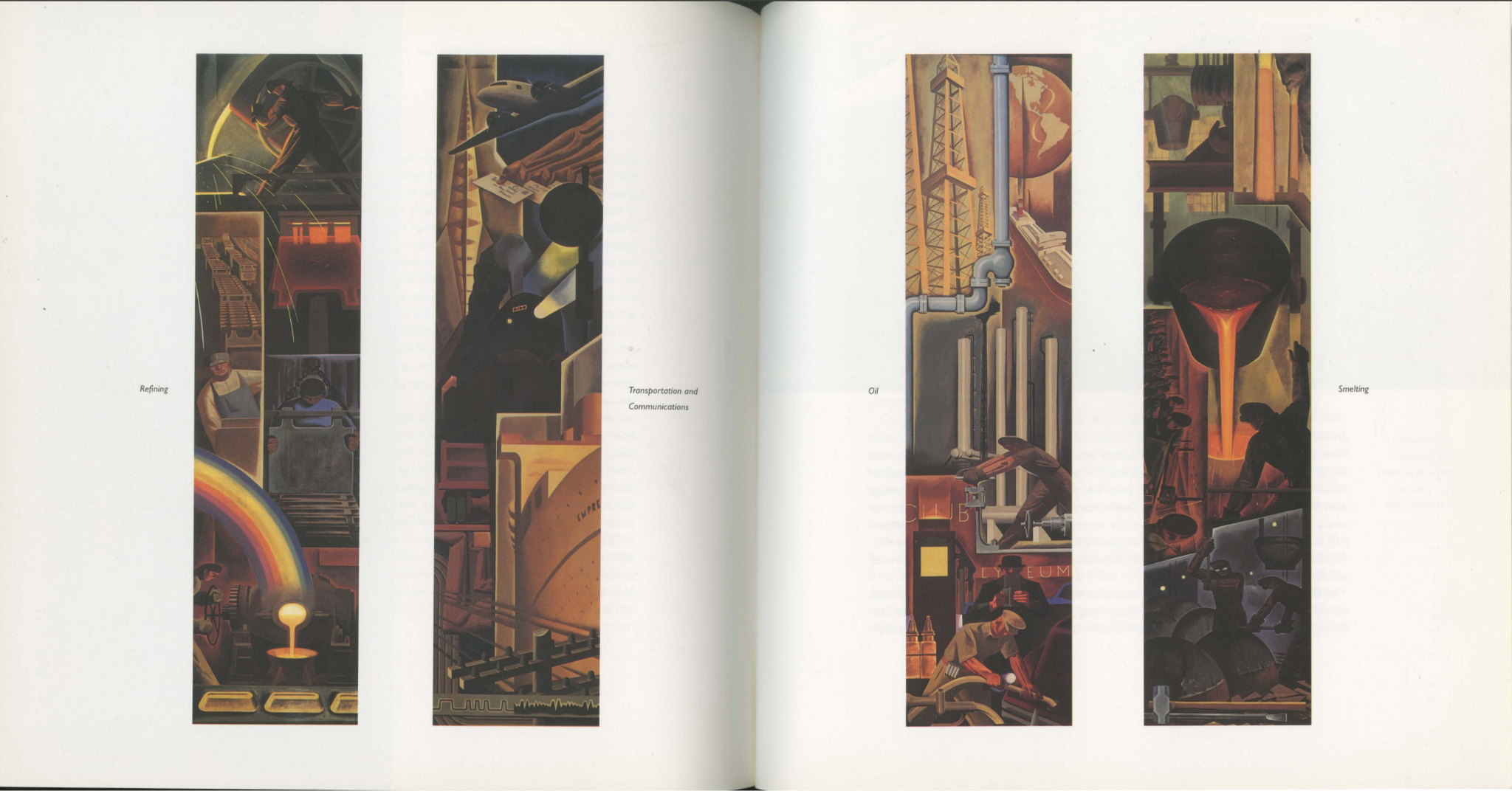
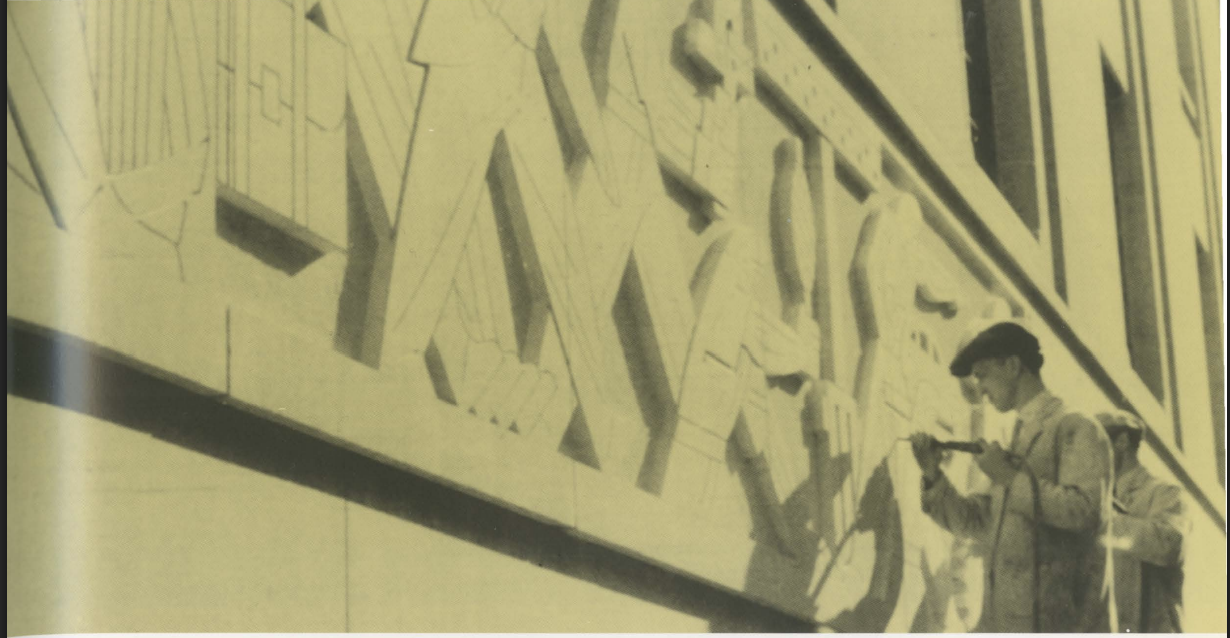
The decorative program of the Toronto Stock Exchange represents one of the most ambitious integrations of fine art and commercial architecture in interwar Canada. The artist Charles Fraser Comfort, then an emerging figure in Canadian modernism later appointed Director of the National Gallery of Canada (1960–1965), received the commission in 1936 to design a unified artistic program spanning three media. On the exterior, a monumental bas-relief frieze in pneumatically chiseled limestone stretches above the entrance doors, depicting a processional of Canadian industry — muscular figures engaged in mining, logging, smelting, transportation, and communication. The frieze’s vigorous, stylized forms draw on both the heroic figuration of Diego Rivera’s North American murals and the geometric discipline of European Art Deco, yielding what scholars have called the first modern interpretation of mural work in Canada, as discussed in Lynda Musson Nykor’s study “Mural Roots: Charles Comfort and the Toronto Stock Exchange” published in the Journal of Canadian Art History. Comfort embedded subversive social commentary within the seemingly celebratory imagery: one panel shows a businessman’s hand reaching into the pocket of a laborer, while in another a worker grips a jackhammer positioned so that it resembles a rifle aimed at a suited figure — pointed critiques of capital-labor tensions during the Great Depression. Inside the forty-foot-high trading hall, eight large-scale oil-on-canvas murals overlooked the exchange floor, each panel paying homage to a major sector whose shares were traded below: mining, pulp and paper, oil, agriculture, transportation, electrical power, construction, and communications. The heroic scale and earth-toned palette suited the sober mood of the 1930s, when traders sought reassurance of industrial strength amid economic distress. On the entrance doors, stainless steel roundels carried additional industrial motifs, while the Vale Inco Staircase — a sweeping curve of stainless steel with a lacquered birch handrail — exemplified the streamlined craftsmanship of the building’s interior. A large glass medallion depicting an Egyptian farmer sowing wheat adorned the staircase landing, linking the ancient origins of commodity exchange to Canada’s modern grain trade. During the 1994 KPMB renovation, the Comfort murals were restored and a new bridge-stair element was introduced to create a dramatic viewing platform, allowing visitors to experience the paintings from the elevated vantage originally available only to exchange officials.
The Toronto Stock Exchange occupies a pivotal position at 234 Bay Street, the thoroughfare that serves as the symbolic and functional spine of Canadian finance. Originally named Bear Street for the wildlife encountered by early settlers, the road was renamed Bay Street in 1797 because it connected Lot Street (now Queen Street West) to a bay of Toronto Harbour. Until the 1920s, Bay Street extended directly to the waterfront, and this proximity to the port shaped the street’s commercial identity: banks, insurance offices, and brokerage houses clustered along its length to serve the shipping and commodity trade flowing through Toronto’s harbour. The intersection of Bay and King Streets became known as the “MINT Corner” — an acronym for the Montreal, Imperial, Nova Scotia, and Toronto-Dominion banks whose headquarters converged there. By the time the new exchange building opened in 1937, Bay Street had already eclipsed Montreal’s St. James Street as the center of Canadian securities trading, a shift accelerated by the 1934 merger that consolidated mining-stock activity in Toronto. The postwar era transformed the surrounding streetscape dramatically. In 1967, Ludwig Mies van der Rohe’s Toronto-Dominion Centre, designed in association with John B. Parkin Associates and Bregman and Hamann Architects, introduced International Style towers of bronze-tinted glass and black steel set back from Bay Street around expansive public plazas — a rare gesture of spatial openness in North American commercial urbanism, as documented in the Ontario Heritage Trust’s plaque program. I.M. Pei’s Commerce Court followed in 1972, and Santiago Calatrava’s Allan Lambert Galleria at Brookfield Place further defined the corridor. The 1976 election of the Parti Québécois in Quebec precipitated a mass exodus of financial institutions from Montreal to Toronto, confirming Bay Street’s supremacy as the Canadian equivalent of Wall Street. Today, the original exchange building sits quietly within the TD Centre complex, its Art Deco facade preserved as a heritage artifact amid the glass-and-steel towers that its own success helped generate. The financial district extends along the King Street corridor from University Avenue to Yonge Street, housing the headquarters of four of Canada’s five major chartered banks and the offices of the TMX Group, which continues to operate the exchange that began in that column-free trading hall.
The Toronto Stock Exchange traces its origins to July 26, 1852, when a group of Toronto businessmen formed an Association of Brokers to facilitate securities trading. On October 25, 1861, twenty-four brokers gathered at the Masonic Hall to formally constitute the Toronto Stock Exchange, which was incorporated by act of the Ontario legislature in 1878. The early exchange listed only thirteen securities — predominantly bank shares and government bonds — but Toronto’s fortunes were transformed by a succession of mining discoveries in Northern Ontario. The 1903 Cobalt silver rush, triggered when railroad subcontractors J.H. McKinley and E.F. Darragh found native silver assaying at 4,000 ounces per ton near Cobalt Lake, created explosive demand for junior mining shares. In 1908, the Standard Stock and Mining Exchange was organized specifically to handle this speculative market, as Douglas Baldwin has documented in his study of the Cobalt boom’s impact on Toronto’s emergence as a financial center. The 1909 Porcupine gold rush, ignited when prospector Harry Preston discovered quartz veins laced with gold ninety miles north of Cobalt, further cemented Toronto’s role as the world’s preeminent mining-finance center. By 2001, the Porcupine camp had yielded sixty-seven million troy ounces of gold, making it the most productive gold rush in history by volume. The Standard Stock and Mining Exchange merged with the Toronto Stock Exchange in 1934, and from that year forward the TSE’s total trading volume surpassed that of the Montreal Stock Exchange, as Joe Martin of the Rotman School of Management’s Finance and Business History Initiative has chronicled. The merged exchange moved into its landmark Art Deco building at 234 Bay Street in 1937. In 1977, the TSE became the first stock exchange in the world to introduce computer-assisted trading with its CATS (Computer Assisted Trading System), initially handling ninety less-liquid equities. On April 23, 1997, the physical trading floor closed entirely, making the TSE the second-largest exchange in North America to adopt a fully electronic environment, as recorded in a Rotman School case study by Darren Karn, “How Toronto Became the Financial Capital of Canada” (2019). On May 1, 2008, the TSE’s parent company TSX Group completed its $1.31-billion acquisition of the Montréal Exchange, forming TMX Group Inc., which now operates the Toronto Stock Exchange (senior equities), TSX Venture Exchange (public venture market), the Montréal Exchange (derivatives), TSX Alpha Exchange, and the Canadian Depository for Securities.
The Toronto Stock Exchange’s identity has been inseparable from Canada’s resource economy. In its earliest decades, the exchange listed bank stocks — shares in the Bank of Toronto, the Imperial Bank of Canada, the Bank of Commerce — alongside government bonds and railway securities such as those of the Grand Trunk Railway and the Canadian Pacific Railway, the transcontinental line whose completion in 1885 opened the western frontier to capital markets. The Cobalt silver rush of 1903 and the Porcupine gold rush of 1909 flooded the exchange with junior mining issues, and the Standard Stock and Mining Exchange was created in 1908 to absorb the speculative volume, as Stan Sudol has chronicled in his surveys of Northern Ontario mining history. Following the 1934 merger, the TSE became the undisputed global center for mining finance: International Nickel Company of Canada (later Inco, now Vale) was among the most actively traded stocks on the exchange for decades, and the Eldorado Mining and Refining Company brought uranium shares to the trading floor during the postwar nuclear era. Today, approximately forty percent of the world’s publicly listed mining companies trade on the TSX and its junior counterpart the TSX Venture Exchange, encompassing gold producers such as Barrick Gold and Agnico Eagle, base-metal miners, and uranium companies including Cameco. The energy sector has been equally significant: the development of Alberta’s oil sands drew listings from Suncor Energy, Canadian Natural Resources, Imperial Oil, Cenovus Energy, and pipeline operators Enbridge and TC Energy, making the TSE one of the world’s most important exchanges for petroleum securities. The financial sector anchors the exchange’s blue-chip listings, with the Royal Bank of Canada, Toronto-Dominion Bank, Bank of Nova Scotia, Bank of Montreal, and Canadian Imperial Bank of Commerce among the most heavily capitalized stocks. The TSE’s evolution from a thin market of thirteen bank shares and government bonds to a diversified exchange listing over 1,500 companies reflects the broader transformation of Canada from a colonial resource frontier into a modern industrial economy, a trajectory that Charles Comfort’s trading-floor murals were designed to celebrate.