Toledo Produce Exchange
Toledo, USA · Established 1876
This site requires authorization to access.
To request access, contact
william.goetzmann@yale.edu
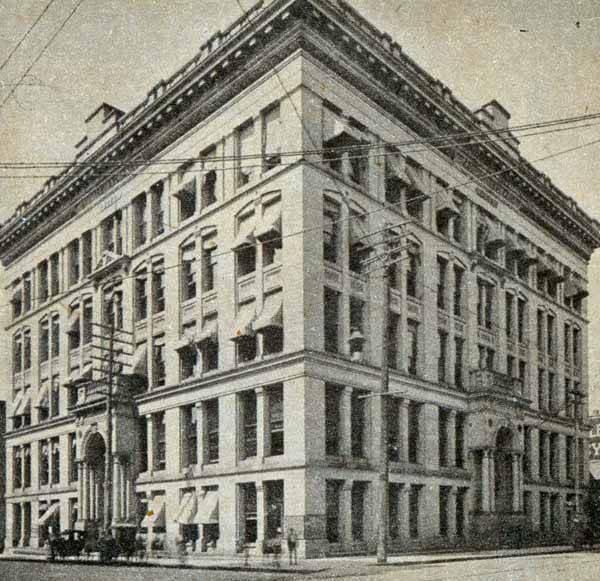
The Toledo Produce Exchange Building rose in 1878 at the corner of Madison Avenue and St. Clair Street, in the commercial heart of downtown Toledo. Its architect, C. C. Miller, came to the commission fresh from assisting in the rebuilding of Chicago's Board of Trade, and he carried the new Chicago manner east to Lake Erie (Toledo Lucas County Public Library, "Produce Exchange (1878–1984)"). By the standards of 1878 the building was strikingly austere: decoration was confined largely to the cornices and to a pair of "triumphal-arch"-inspired entrances, while paired, recessed windows generated a powerful vertical emphasis tempered by horizontal banding between the floors. Contemporaries and later surveys read in this restrained, frame-like articulation the influence of William Le Baron Jenney and the emergent "Chicago School" of commercial architecture, making the Toledo exchange an early provincial expression of a style that would soon define the American downtown (Toledo Lucas County Public Library). The building was later renamed the Lamb Building; in the 1960s it was unsympathetically refaced with colored panels, and it was demolished in 1984.
As a working merchants' exchange rather than a monumental palais de la bourse, the Toledo Produce Exchange carried comparatively little fine-art ornament; its visual character rested on architectural form rather than sculpture or mural. The two arched entrances, framed in a stripped classical idiom, and the molded cornice band supplied the principal decorative incident on an otherwise sober commercial elevation (Toledo Lucas County Public Library, "Produce Exchange"). The building's most enduring visual legacy survives in the photographic record—Detroit Publishing Company views of about 1895–1910 held by the Library of Congress and circulated through the Digital Public Library of America—which capture the recessed window bays and arched portals that gave the structure its disciplined, vertical rhythm (Library of Congress, item 2016794467; DPLA).
The exchange stood at Madison Avenue and St. Clair Street, on the spine of Toledo's late-nineteenth-century business district a short distance from the Maumee River wharves, rail yards, and grain elevators that made the city a Great Lakes commercial hub. Toledo sat at the western end of Lake Erie, where the Wabash and Erie Canal, the Miami and Erie Canal, and a dense fan of trunk-line railroads converged, funneling the wheat, corn, and clover seed of northwestern Ohio and the eastern corn belt toward lake shipping and eastern markets. The Produce Exchange thus occupied the institutional center of a transshipment economy, ringed by elevators, freight houses, commission merchants, and—visible in period photographs beside it—the Ohio Building, marking the district as the city's financial and mercantile core (Library of Congress, "Produce Exchange and Ohio Building, Toledo").
Toledo's organized grain trade dated to 1849, when the Toledo Board of Trade was founded; the body was reorganized under the name Toledo Produce Exchange in 1876, and the new Produce Exchange Building followed in 1878 (Bowling Green State University, Center for Archival Collections, MS 247, Toledo Board of Trade). For more than half a century the exchange functioned as the organized marketplace where buyers and sellers of grain met to trade, and—crucially—as the body that inspected, weighed, and graded the hundreds of millions of bushels of grain that flowed each year into Toledo's rail yards and freight elevators; it also ran a transportation department to negotiate freight rates with the railroads (BGSU, MS 247). The institution reverted to the name Toledo Board of Trade in 1930. Its self-regulatory functions were curtailed after the grain-export scandals of the mid-1970s: under the United States Grain Standards Act of 1976 the Board surrendered grain weighing and inspection to the new Federal Grain Inspection Service in 1977. A successor for-profit corporation operated from 1979 until it permanently shut down on December 31, 1999 (BGSU, MS 247).
The Toledo exchange was, above all, a grain market. Wheat and corn dominated the trade that moved through the city's elevators, and the exchange's grading and inspection apparatus existed precisely to certify the quality of the enormous tonnages arriving by rail and departing by lake vessel (BGSU, MS 247, Toledo Board of Trade). Toledo was also one of the country's leading markets for clover and grass seed, ranking with Chicago, Cincinnati, and St. Louis as the Midwest emerged as the center of seed production—a high-value, low-bulk cash crop well suited to the city's mercantile commission houses (chestofbooks.com, "The Produce Exchange"). As one of the principal produce-exchange points on the Great Lakes alongside Chicago, Milwaukee, Duluth, Detroit, and Buffalo, Toledo's quotations formed part of the regional price structure that linked the western grain belt to eastern and export demand.
Images will be added as the project develops. Photographs by Larry Ng and from research sources.