Tokyo Stock Exchange (Historical)
Tokyo, Japan · Established 1878
This site requires authorization to access.
To request access, contact
william.goetzmann@yale.edu
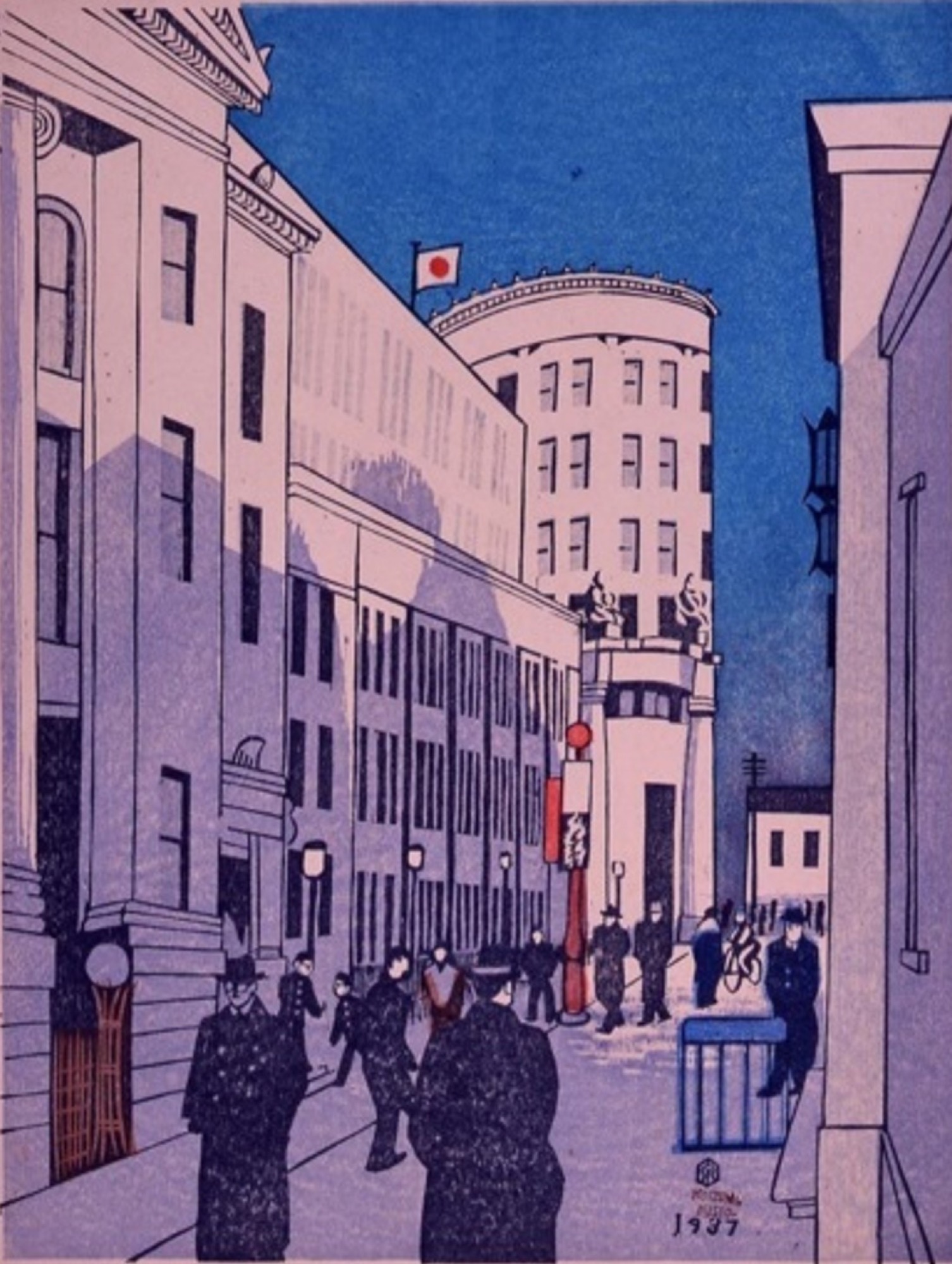
The physical architecture of the Tokyo Stock Exchange traces a remarkable progression from Meiji-era improvisation to modernist permanence. When the exchange commenced operations on June 1, 1878, it occupied a Western-style building in Kabutocho originally constructed for the Shimada-gumi company and designed by the pioneering builder Kisuke Shimizu II, as documented in the Japan Exchange Group’s official history of the Kabutocho district. This pseudo-Western structure, with its hybrid Meiji-era stylistic vocabulary, signaled the new government’s commitment to transplanting European financial institutions onto Japanese soil. The Great Kanto Earthquake of September 1923 devastated the entire Kabutocho quarter, destroying the exchange buildings and necessitating a comprehensive reconstruction. Fireproof and earthquake-resistant structures rose from approximately 1926 onward, with the market wing completed in 1927 and the main building finished in 1931—a reinforced-concrete structure clad in stone that reflected early Showa-era engagement with Western neoclassical forms. As Mitsubishi Jisho Design Inc. has documented, the building’s facade employed high-grade Inada granite with a cracked stone finish, deliberately evoking “deep shadows seen in classical architecture” to express tradition and institutional dignity. This Showa-era masterpiece survived the wartime bombing of 1945 and served the exchange until the current structure, also designed by Mitsubishi Jisho, was completed on May 23, 1988. The fifteen-story replacement, with its 49,157 square meters of floor area, utilized a phased construction method that allowed trading to continue uninterrupted. A recent seismic retrofit installed tuned mass dampers on the roof while preserving the facade’s classical-inspired design.
The decorative program of the Tokyo Stock Exchange’s commercial spaces evolved from Meiji-era Western pastiche to a distinctive modern architectural language. The 1931 building’s facade, with its Inada granite stonework and classical proportioning, adopted the columned and pedimented vocabulary that characterized European financial architecture—an aesthetic choice explored in Hiroshi Watanabe’s The Architecture of Tokyo (2001) as part of the broader Showa-era engagement with monumental Western forms. The granite’s intentional “cracked stone finish,” as described by Mitsubishi Jisho Design, was itself a decorative decision, creating textured shadow patterns that evoked the gravitas of European bourse buildings without slavish imitation. When the 1988 replacement structure was erected, the design team consciously referenced this classical heritage in the new facade’s proportions and material palette. The most striking artistic intervention came with the creation of TSE Arrows in May 2000, following the closure of the physical trading floor in April 1999. At the heart of this facility stands the Market Center—a glass cylinder seventeen meters in diameter that encloses the exchange’s market supervision operations. Surrounding the cylinder, a large LED ticker displays transactions in real-time, creating what the Japan Exchange Group describes as a visual expression of “fair and transparent” securities trading. The Architectural Institute of Japan recognized the 1988 building with its Selected Architectural Designs award in 1990. The cylindrical Market Center, broadcast continuously across Japan and internationally, has become the exchange’s most recognizable visual symbol—a luminous architectural emblem that replaced the kinetic spectacle of the old open-outcry trading floor.
The Tokyo Stock Exchange’s situation in Nihonbashi Kabutocho places it at the geographic and symbolic center of Japanese capitalism. As Edward Seidensticker recounts in Low City, High City (1983), the Nihonbashi district served as Edo’s commercial heart from the early seventeenth century, when Tokugawa Ieyasu ordered the reclamation of surrounding swampland to extend the castle town. The Nihonbashi bridge, completed in 1603, became the terminus of the five great highways radiating outward from the capital—the point from which all distances in Japan were officially measured. The district became a thriving distribution center where goods shipped from across Japan arrived by water to riverside warehouses. Kabutocho itself, named for the Kabuto-zuka (helmet mound) in the former Makino family villa, was bestowed upon loyalist families after the Meiji Restoration of 1868. Shibusawa Eiichi, the “father of Japanese capitalism,” established the First National Bank nearby in 1873 and moved his own residence to Kabutocho in 1888—a Venetian Gothic mansion designed by Kingo Tatsuno that overlooked the Nihonbashi River. Tatsuno also designed the Bank of Japan headquarters (completed 1896) just blocks away, a Neo-Baroque structure modeled on the Bank of England and the National Bank of Belgium, establishing Nihonbashi as a unified financial precinct. The concentration of the Bank of Japan, the First National Bank, Mitsui Bank, Sumitomo, Yasuda, and the exchange itself within walking distance created an institutional density comparable to the City of London—earning Kabutocho its enduring designation as Japan’s Wall Street.
The Tokyo Stock Exchange’s origins lie in a deep tradition of organized financial trading unique to Japan. As Ulrike Schaede demonstrated in “Forwards and Futures in Tokugawa-Period Japan” (Journal of Banking and Finance, 1989), the Dojima Rice Exchange in Osaka—licensed in 1697 and formally authorized for futures trading by Shogun Yoshimune in 1730—constituted the world’s first organized futures market, complete with standardized contracts, margin deposits, daily settlement, and clearinghouse functions. Mark D. West’s “Private Ordering at the World’s First Futures Exchange” (Michigan Law Review, 2000) further established Dojima’s sophisticated self-regulatory framework. Following the Meiji Restoration, Finance Minister Okuma Shigenobu and the industrialist Shibusawa Eiichi secured passage of the Stock Exchange Ordinance on May 4, 1878, establishing the Tokyo Stock Exchange eleven days later. As Hamao, Hoshi, and Okazaki document in “The Genesis and the Development of the Pre-War Japanese Stock Market” (2007), early trading centered on government bonds issued to former samurai, but by the 1920s equity trading predominated. Wartime consolidation merged all Japanese exchanges into a single entity in 1943; trading ceased on August 1, 1945. The exchange reopened on May 16, 1949, under occupation-era reforms that dissolved the zaibatsu and democratized share ownership—individuals held approximately 70 percent of outstanding stock. Japan’s postwar economic miracle propelled the Nikkei 225 index to its historic peak of 38,957.44 on December 29, 1989, fueled by what William Goetzmann and other financial historians have analyzed as one of history’s most dramatic asset-price bubbles, followed by decades of stagnation before the index finally surpassed that level in February 2024.
From its inception, the Tokyo Stock Exchange reflected the distinctive financial instruments of a rapidly modernizing economy built upon centuries of mercantile innovation. As Ishida and Yokoyama argue in “Origins of the Tokyo Stock Exchange: Path Dependence of Trading Systems” (JPX Working Paper No. 41, 2023), the primary brokers initially dealt in yogin trading—foreign exchange transactions involving Mexican and Japanese silver currencies—before transitioning to securities. The exchange’s earliest listings comprised government bonds, particularly the kinroku kosai bonds issued to compensate former samurai for abolished feudal stipends, alongside gold and silver currencies. Shares in the First National Bank (Dai-Ichi Kokuritsu Ginko), founded by Shibusawa in 1873, provided among the first equity listings. As Japan industrialized through the late Meiji and Taisho eras, railroad stocks, textile manufacturers, and shipping companies joined the boards. The zaibatsu conglomerates—Mitsui, Mitsubishi, Sumitomo, and Yasuda—dominated prewar listings through their interlocking holding structures, as documented by Franks, Mayer, and Miyajima in “The Ownership of Japanese Corporations in the 20th Century” (2014). The postwar dissolution of zaibatsu holding companies and the redistribution of shares created a newly democratic equity market. Japanese government bonds (JGBs) have remained a cornerstone instrument throughout. The postwar era saw the listing of firms that would become global icons—Toyota, Sony, Honda, and Panasonic—transforming the exchange into the world’s third-largest by market capitalization. Modern trading encompasses over 3,900 listed companies across the Prime, Standard, and Growth market segments.
Images will be added as the project develops. Photographs by Larry Ng and from research sources.