Tokyo Commodity Exchange (TOCOM)
Tokyo, Japan · Established 1984
This site requires authorization to access.
To request access, contact
william.goetzmann@yale.edu
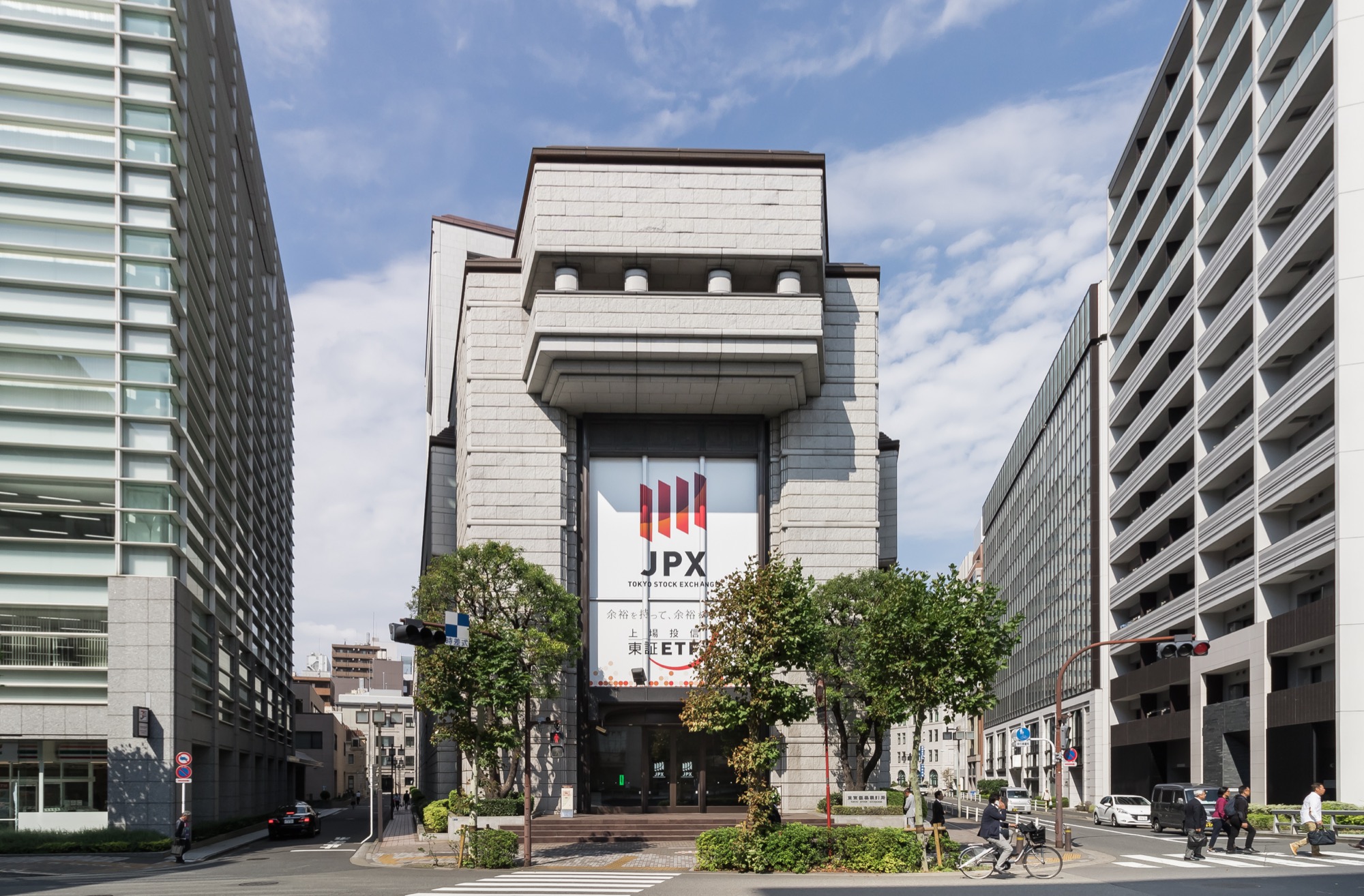
The Tokyo Commodity Exchange (TOCOM) occupied two distinct architectural settings during its history. From its founding in 1984, TOCOM was headquartered in the Tosen Building at 10-8 Nihonbashi Horidomechiō 1-chome, Chūō-ku—a functional mid-century commercial structure in a district long associated with textile wholesaling. The building housed open-outcry trading pits where commodity brokers negotiated futures contracts in person, a practice that continued alongside electronic systems introduced in 1991. On 5 August 2020, following TOCOM’s acquisition by the Japan Exchange Group (JPX) in October 2019, the exchange relocated its headquarters to the Tokyo Stock Exchange Building in Nihonbashi Kabutochō, completed in April 1988 to designs by Mitsubishi Jisho (Mitsubishi Estate). As documented by Mitsubishi Jisho Design Inc., this fifteen-story steel-frame tower rises 78.8 meters and is clad in Inada granite with a cracked-stone finish that, in the architect’s words, “actively express[es] the deep shadows seen in classical architecture.” The complex includes a market building whose ground-floor trading hall was originally designed around a central stock-trading booth, with back-office functions stacked in the high-rise behind it. Its phased construction—new market hall completed October 1984, main tower finished April 1988—ensured exchange operations never ceased during rebuilding of the original 1927 structure.
The decorative program of TOCOM’s current home, the Tokyo Stock Exchange Building, centers on the TSE Arrows facility, opened 9 May 2000 in the former trading-floor space. Its signature feature is the Market Center, a cylindrical glass enclosure seventeen meters in diameter that houses real-time market-surveillance operations. Stock-price tickers and market-data visualizations scroll continuously across LED bands crowning the glass drum, creating what the Japan Exchange Group describes as an expression of “fair and transparent” securities trading. The surrounding Visitors’ Gallery overlooks the cylinder from above, while a ceremonial bell—rung at each new company listing—occupies a prominent position on the Open Platform event stage. A TSE Historical Museum within the Arrows complex displays artifacts from the exchange’s 140-year history, including Meiji-era share certificates and early teletypewriter equipment. The building’s exterior ornament is restrained: cracked-finish Inada granite panels produce a rhythmic pattern of shadow and light that Mitsubishi Jisho’s designers intended to evoke the gravitas of classical financial architecture without period pastiche. TOCOM’s earlier Horidomechiō premises were notably utilitarian—a mid-rise office block whose most visually distinctive interior feature was the commodity trading pit itself, with tiered platforms and electronic price boards typical of late-twentieth-century Japanese commodity exchanges.
TOCOM’s history is inseparable from the geography of Nihonbashi, Tokyo’s oldest financial quarter. The exchange’s original home in Horidomechiō sat within a neighborhood whose commercial identity dates to the early Edo period, when the Nishibori canal enabled river-borne goods to reach wholesale warehouses lining its banks. As the JPX corporate history notes, the nearby Kabutochō district was designated as a financial quarter in September 1871, when land surrounding the future Tokyo Stock Exchange was granted to Mitsui and other zaibatsu as rewards for supporting the Meiji Restoration. After the Great Kantiō Earthquake of 1923 destroyed much of Kabutochō, the neighborhood was rebuilt with fire-resistant concrete structures and emerged, in historian Mikio Sumiya’s phrase, as a “completely modern town” (Sumiya, “A History of Japanese Trade and Industry Policy,” 2000). TOCOM’s 2020 relocation to Kabutochō placed commodity derivatives under the same roof as Japan’s equity markets, reinforcing the district’s role as the nation’s equivalent of Wall Street. However, as securities trading has become electronic, many financial firms have migrated to newer business districts in Marunouchi and Otemachi, prompting the Kabutochō Revitalization Project led by Heiwa Real Estate, which aims to reimagine the neighborhood with hotels, co-working spaces, and cultural venues alongside its legacy exchange buildings.
TOCOM was established on 1 November 1984 through the amalgamation of three single-commodity exchanges: the Tokyo Textile Exchange (founded 1951), the Tokyo Rubber Exchange (1952), and the Tokyo Gold Exchange (1982). As Mark West argues in “Private Ordering at the World’s First Futures Exchange” (Michigan Law Review, 2000), Japan’s commodity-futures tradition reaches back to the Dōjima Rice Exchange in Osaka, where organized forward trading began in the late seventeenth century—a market Ulrike Schaede demonstrated in “Forwards and Futures in Tokugawa-Period Japan” (Journal of Banking & Finance, 1989) fulfilled all the technical criteria of a modern futures exchange. TOCOM carried forward this legacy into the late twentieth century, launching electronic trading in 1991 and adding an energy-futures complex in 1999. The exchange merged with the Tokyo Grain Exchange on 12 February 2013, absorbing agricultural and sugar contracts, and became a for-profit corporation in 2008. On 1 October 2019, the Japan Exchange Group (JPX) acquired TOCOM as a wholly owned subsidiary, and on 27 July 2020 transferred precious-metals, rubber, and agricultural-product futures and options to the Osaka Exchange (OSE), leaving TOCOM as Japan’s dedicated energy-derivatives marketplace. This consolidation, as S&P Global Commodity Insights reported, aimed to boost Japan’s competitiveness in the Asian derivatives landscape by unifying clearing through the Japan Securities Clearing Corporation (JSCC).
Throughout its history, TOCOM has offered futures and options spanning four major commodity groups. At its founding, the exchange listed contracts inherited from its predecessor institutions: raw silk, woolen yarn, and cotton yarn from the Tokyo Textile Exchange; natural rubber (RSS3 and TSR20 grades) from the Tokyo Rubber Exchange; and gold, silver, platinum, and palladium from the Tokyo Gold Exchange. The energy complex, introduced in 1999, became TOCOM’s most liquid segment, encompassing Dubai crude oil, gasoline, kerosene, and gas oil futures. Following JPX’s July 2020 reorganization, precious-metals and agricultural contracts migrated to the Osaka Exchange, and TOCOM retained energy derivatives exclusively. Today it is the only Japanese exchange listing gasoline, kerosene, gas oil, Dubai crude oil, LNG (Platts JKM, listed on a trial basis in April 2022), baseload and peakload electricity futures, and regional Chukyo gasoline and kerosene contracts. TOCOM’s electricity futures, initially trial-listed in May 2019, were promoted to permanent listing status, reflecting Japan’s post-Fukushima energy-market liberalization. Trading is fully electronic on the J-GATE platform powered by Nasdaq’s Genium INET technology, replacing the earlier open-outcry system. As documented by the Japan Exchange Group, TOCOM’s integration into JPX created cross-margining efficiencies between commodity and financial derivatives, positioning the exchange within Asia’s broadening energy-risk-management ecosystem.
Images will be added as the project develops. Photographs by Larry Ng and from research sources.