Bedesten of Thessaloniki (Bezesteni)
Thessaloniki, Greece · Established c. 1455–1459
This site requires authorization to access.
To request access, contact
william.goetzmann@yale.edu
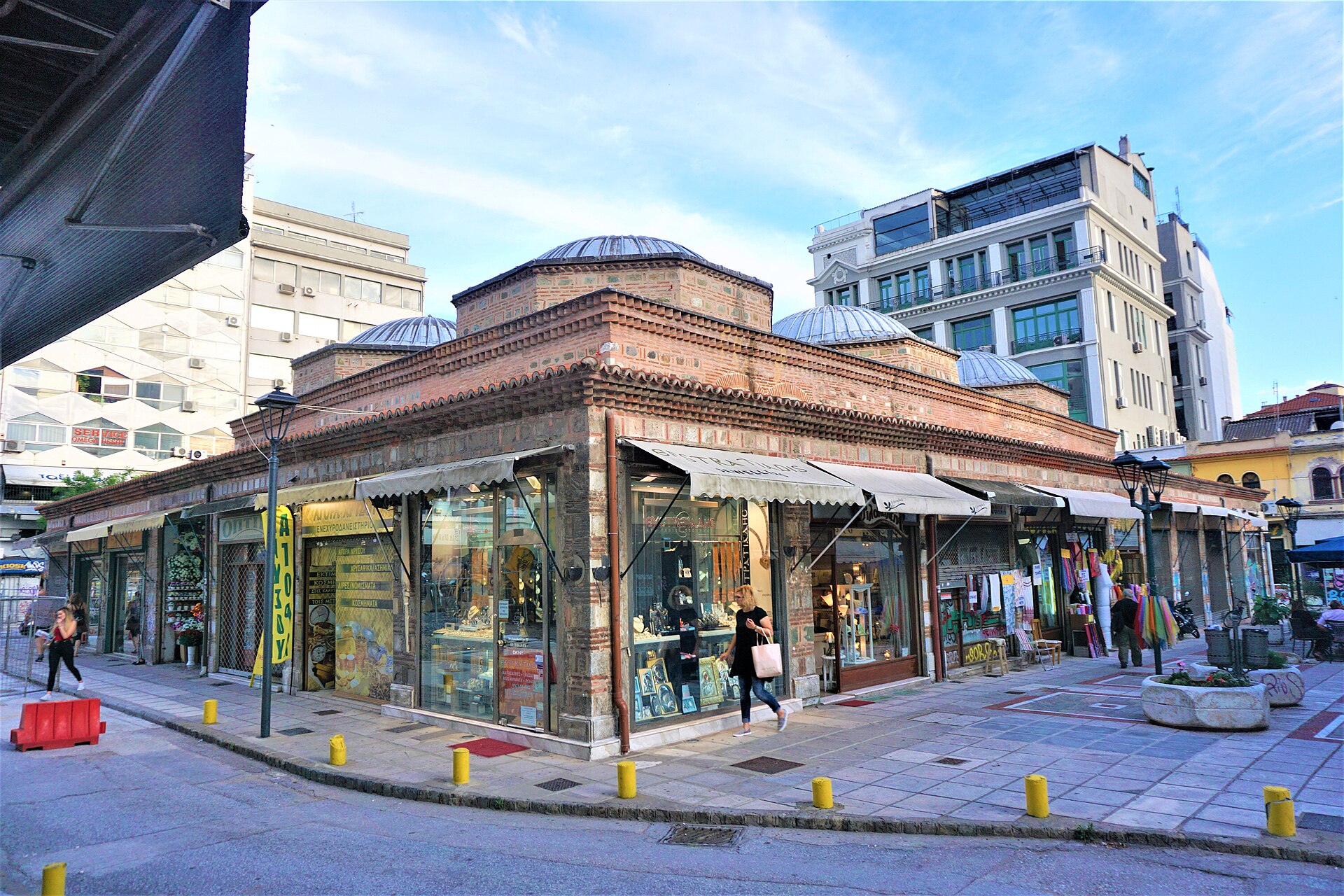
The Bedesten of Thessaloniki — known locally as the Bezesteni — was erected in the first generation after the Ottoman conquest of the city in 1430, most authorities placing its construction during the reign of Sultan Mehmed II between roughly 1455 and 1459, though some scholars assign it to the late fifteenth or early sixteenth century under Bayezid II (Wikipedia, 'Bedesten of Thessaloniki'; A. Ameen, 'The Ottoman Bedestens in Greece', Shedet 7, 2020, pp. 115–144). It belongs to the distinctive Ottoman type of the bedesten, a fortified covered cloth-and-treasure market that was, as Ameen notes drawing on the seventeenth-century traveller Evliya Çelebi, virtually unknown in the Balkans before the Ottomans introduced it. The building is a compact rectangular hall pierced by an entrance on each of its four sides, its interior divided into six quadrilateral bays carried on seven double arches that spring from two central piers; the whole is roofed by six lead-covered domes (Ephorate of Antiquities of Thessaloniki City; thessaloniki.travel, 'Bezesteni Textile Market'). The fabric is heavy load-bearing masonry — stone walls roughly a metre thick with brick-built domes — a robust, almost windowless construction designed to make the structure fireproof and secure enough to serve as a strongroom as well as a market. As a survival it is exceptional: it is one of only three Ottoman bedestens still standing within the borders of modern Greece, the others being at Serres and Larissa, and the only one of Thessaloniki's Ottoman monuments that has never ceased to perform its original commercial function.
As a working market hall conceived for security and trade rather than display, the Bedesten is architecturally austere and possesses little in the way of figural or applied ornament; its aesthetic effect derives almost entirely from the rhythm of its structure — the cluster of six lead-sheathed domes rising above the masonry block, the brick coursing of the walls, and the play of arches and piers across the dim interior (thessaloniki.travel, 'Bezesteni Textile Market'). This restraint is itself characteristic of the bedesten type, whose monumental value lay in mass and permanence rather than decoration. Whatever colour and richness the building possessed came not from carved or painted surfaces but from the merchandise it sheltered: the bolts of silk and fine cloth, the worked gold and precious stones, and the textiles that gave the structure its name, from the Arabic 'bez' meaning fabric (Wikipedia, 'Bedesten of Thessaloniki'). The lead domes, a deliberately costly roofing material reserved for important Ottoman foundations, signalled the building's prestige to the surrounding city.
The Bedesten stands at the junction of Venizelou and Solomou streets, near the Hamza Bey Mosque and the old town hall, at what was for centuries the commercial nucleus of Ottoman Salonica (Wikipedia, 'Bedesten of Thessaloniki'). It anchored a dense bazaar quarter of khans, hamams and shops that radiated outward from it, the bedesten functioning as the secure heart around which the wider open-air market grew — a pattern common to Ottoman cities, where the bedesten served as the most trusted and valuable point in the commercial fabric (Mapping Eastern Europe, Princeton University, 'Ottoman Commerce and Piety in Thessaloniki'). The great fire of 1917, which destroyed much of central Salonica, swept away the warren of timber stalls around it, and the post-fire replanning left the masonry shell exposed; a ring of exterior shops was subsequently built around its perimeter. Today the building sits within the modern grid of the rebuilt city centre, hemmed by twentieth-century commercial blocks yet still operating as a bustling covered market — one of the very few markets anywhere to have kept its original use for more than five hundred years.
Built within a generation of Mehmed II's incorporation of Thessaloniki into the empire, the Bedesten formed part of the deliberate Ottoman investment that transformed Salonica into a major imperial trading entrepôt. Its rise coincided with the arrival, after the Spanish expulsion of 1492, of tens of thousands of Sephardic Jews, who made the city the foremost centre of Jewish commerce, manufacture and learning in the Mediterranean; by the sixteenth century Salonica held the largest Jewish population of any city in the world, and Jewish, Greek, Armenian, Turkish and other Balkan merchants traded side by side through institutions such as the bedesten (M. Mazower, 'Salonica, City of Ghosts: Christians, Muslims and Jews, 1430–1950', 2004; D. E. Naar, 'Jewish Salonica', Stanford University Press, 2016). On the eve of the 1917 fire the hall contained one hundred and thirteen lockable shops (Wikipedia, 'Bedesten of Thessaloniki'). The city passed from Ottoman to Greek rule in 1912, and the building survived the upheavals of fire, population exchange and the twentieth century; structural restoration addressing subsidence and tilting was carried out in the 1980s and 1990s under the Greek Ministry of Culture, and it is today a protected monument managed by the Ephorate of Antiquities of Thessaloniki City.
Within the Bedesten the most valuable goods of the Salonican economy changed hands: luxury textiles and silks above all — the trade from which the building takes its name — together with precious stones, worked gold and other high-value objects (thessaloniki.travel, 'Bezesteni Textile Market'; Wikipedia, 'Bedesten of Thessaloniki'). But the bedesten was more than a cloth hall. It performed the quasi-institutional functions of a money market and clearing house: it was the place where the quality of merchandise was officially inspected and certified, where valuables, documents and assets could be safeguarded in its strongroom-like vaults, and — most significantly for a financial history — where currency exchange rates were determined, so that Greek commentators describe it as effectively the 'stock exchange' of its day (A. Ameen, 'The Ottoman Bedestens in Greece', Shedet 7, 2020). In this it embodied the dual character of the Ottoman bedesten as both marketplace and trusted depository of wealth, a node where commodity prices, currency rates and credit informally converged. Salonica's hinterland fed the trade with wool — Salonican wool clothed the Janissaries — alongside silk, spices and the goods of a port that linked the Balkans, the Aegean and the wider Levant.
Images will be added as the project develops. Photographs by Larry Ng and from research sources.