Brihadeeswara Temple (Guild-Temple Bank)
Thanjavur, India · Established c. 1010 CE
This site requires authorization to access.
To request access, contact
william.goetzmann@yale.edu
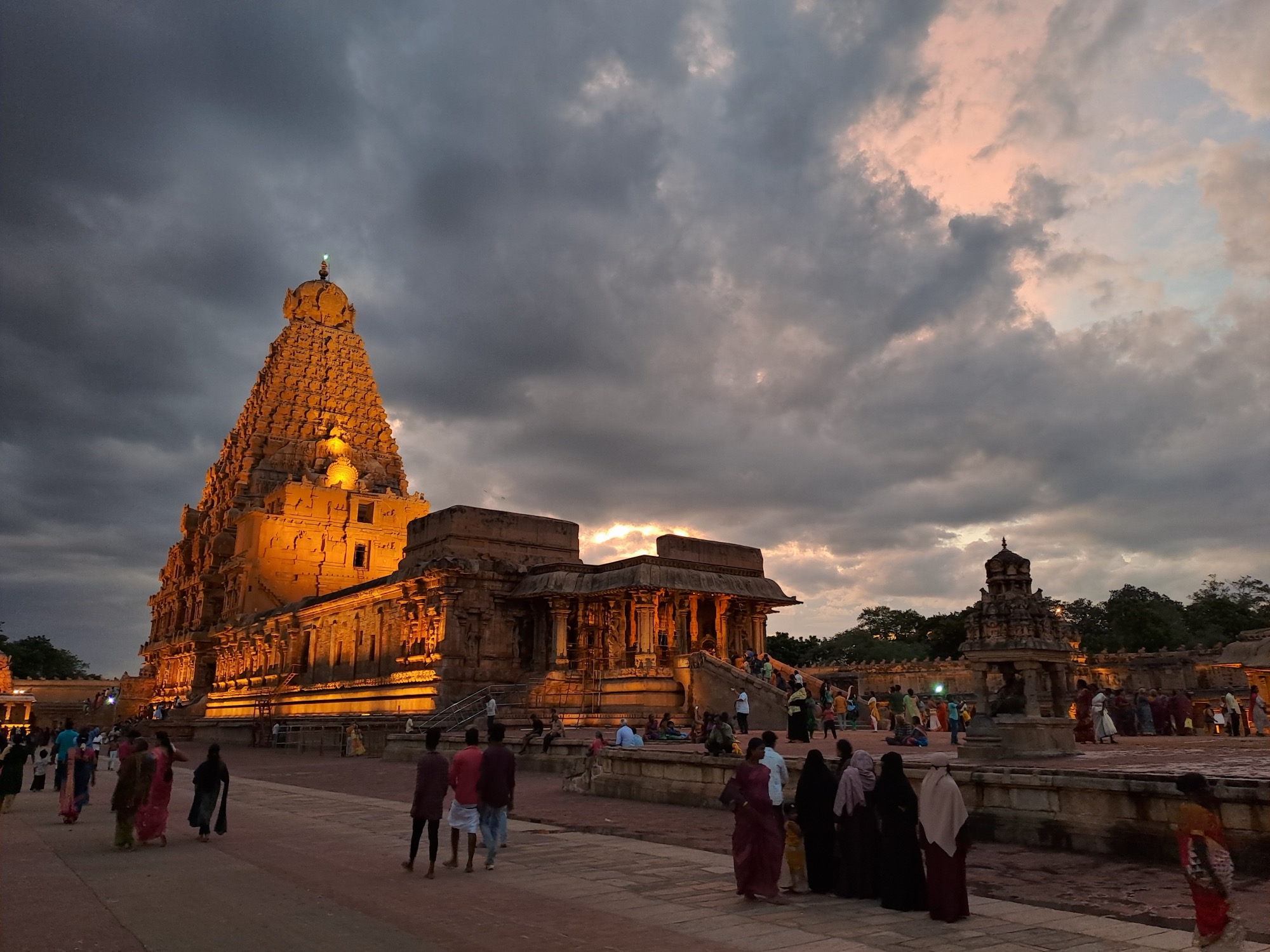
The Brihadeeswara Temple at Thanjavur, also known as the Rajarajesvaram, rises to a height of approximately sixty-six meters at its vimana (tower above the sanctum), making it the tallest temple structure of its period anywhere in the Indian subcontinent. Completed around 1010 CE under the patronage of the Chola emperor Rājarāja I, the temple was constructed almost entirely from granite blocks quarried and transported from sites as far as sixty kilometers away — a logistical feat analyzed by K.A. Nilakanta Sastri in The Cōḷas (University of Madras, 1935; 2nd ed. 1955). The massive capstone atop the vimana, an octagonal monolith estimated at eighty tons, was raised by means of an earthen ramp, according to traditional accounts recorded by Sastri. The temple compound is organized along a strict east-west axis: an outer enclosure wall, a Nandi pavilion housing one of the largest monolithic Nandi sculptures in India, a mahāmaṇḍapa (great hall), and the garbhagṛha (sanctum) beneath the soaring vimana, which comprises thirteen diminishing tiers (talas). Burton Stein, in Peasant State and Society in Medieval South India (Oxford University Press, 1980), situated this colossal building program within the broader political economy of the Chola imperium. What distinguishes the Brihadeeswara from other monumental temples is the density of inscriptions carved into its walls — over one hundred recorded by the Archaeological Survey of India — which served as permanent public financial records, documenting land grants, tax assignments, donations of gold and livestock, and institutional lending operations. UNESCO designated the temple as part of the Great Living Chola Temples World Heritage Site in 1987, recognizing it as “an outstanding example of Chola architecture.”
The Chola dynasty produced what many scholars regard as the greatest tradition of bronze sculpture in world history. The Nataraja — Shiva as Lord of the Dance, depicted within a ring of cosmic fire — achieved its iconic form under Chola patronage in the tenth and eleventh centuries. Vidya Dehejia, in Art of the Imperial Cholas (Columbia University Press, 1990), traced the evolution of Chola bronze casting through the lost-wax (cire perdue) technique, documenting how temple workshops at Thanjavur and surrounding towns produced Nataraja figures, processional images of Shiva, Vishnu, Pārvatī, and other deities with an anatomical naturalism and spiritual intensity unmatched in South Asian metalwork. Inside the Brihadeeswara, the ambulatory passage around the sanctum preserves a cycle of Chola-era wall paintings depicting scenes from Shaiva mythology, rediscovered beneath later Nayak-period overpainting and partially restored by the Archaeological Survey of India. R. Nagaswamy, in Masterpieces of Early South Indian Bronzes (National Museum, New Delhi, 1983), catalogued the bronzes associated with the Thanjavur temple precinct. Beyond figural art, the inscriptions themselves constitute a distinct art form: stone-carved Tamil calligraphy in the elegant Chola Grantha script, incised with remarkable precision across hundreds of square meters of granite wall surface. These epigraphic panels served simultaneously as legal documents, financial ledgers, and public declarations of royal piety, their careful execution reflecting the importance the Chola state placed on the permanent, visible recording of economic transactions. Relief sculptures on the vimana and subsidiary shrines depict narrative scenes from Hindu epics alongside decorative programs of pilasters, niches, makaras, and yalis that characterize the mature Chola Dravidian aesthetic.
Thanjavur sits at the heart of the Kaveri River delta, the alluvial plain that Tamil literary tradition calls the “granary of the south.” The city’s agricultural hinterland — irrigated by an elaborate system of channels, tanks, and anicuts (diversion dams) engineered over centuries — generated the surplus rice production that underwrote the Chola imperial economy. Burton Stein, in Peasant State and Society in Medieval South India (Oxford University Press, 1980), described the Kaveri delta as a “nuclear zone” of intensive wet-rice cultivation whose revenue sustained the Chola state and its monumental temple-building program. The Brihadeeswara Temple functioned as an economic engine for the entire region: its inscriptions record that the temple employed over six hundred people — dancers, musicians, priests, accountants, watchmen, garland-makers, and numerous other functionaries — whose salaries were paid from the interest generated by the temple’s lending operations. George W. Spencer, in “Temple Money-Lending and Livestock Redistribution in Early Tanjore” (Indian Economic and Social History Review, 1968), demonstrated that the temple stood at the center of a financial circuit linking agricultural production, merchant guild capital, and ritual expenditure. The surrounding landscape of paddy fields, irrigation works, and village settlements was not merely backdrop but the revenue base upon which the temple’s financial operations depended. Kenneth R. Hall, in Trade and Statecraft in the Age of the Cōḷas (Abhinav Publications, 1980), emphasized that the temple complex anchored a network of market towns and trade routes connecting the Kaveri delta to the broader Indian Ocean commercial world, with Thanjavur serving as the administrative and ritual capital of an empire whose commercial reach extended to Southeast Asia, Sri Lanka, and the South China Sea.
Rājarāja Chola I (r. 985–1014 CE), the most powerful ruler of the Chola dynasty, commissioned the Brihadeeswara Temple as both a statement of imperial sovereignty and a functioning financial institution. K.A. Nilakanta Sastri, in The Cōḷas (University of Madras, 1935; 2nd ed. 1955), documented Rājarāja’s military campaigns across southern India, Sri Lanka, and the Maldives, conquests that funneled war plunder and tribute into the temple’s endowments. The temple’s inscriptions reveal an institutional lending operation of remarkable sophistication. The most celebrated of these — often called the “Banana inscription” because of the garden land involved — records that 360 kasu (gold coins) were lent at an annual interest rate of 12.5 percent (one kasu per eight kasu), with the principal diversified across four separate merchant guilds: Mummudi Chola Peruntheru received 120 kasu, Veerasigamani Peruntheru received 120 kasu, Nitthavinotha Peruntheru received 60 kasu, and Tirubhuvana Maadevi Perangadi received 60 kasu. George W. Spencer, in his seminal article “Temple Money-Lending and Livestock Redistribution in Early Tanjore” (Indian Economic and Social History Review, vol. 5, no. 3, 1968), analyzed this and other inscriptions to reconstruct the guild-temple financial loop: merchant guilds donated capital to the temple as pious endowments; the temple then lent this capital back to the guilds at specified interest rates; the interest income funded the temple’s vast operational expenses, including salaries for over six hundred employees listed by name in a single inscription. This circular flow of capital — guilds funding the temple, temple lending to guilds, interest funding temple operations — constituted one of the most sophisticated institutional financial arrangements of the medieval world. Noboru Karashima, in South Indian History and Society: Studies from Inscriptions, A.D. 850–1800 (Oxford University Press, 1984), drew on a vast corpus of Chola-era inscriptions to document how temple-based finance extended across the entire Tamil country. The Chola system anticipated by centuries the financial intermediation functions that European banking institutions would later develop independently.
The Brihadeeswara Temple’s inscriptions document a diversified portfolio of financial instruments and commodity flows. The core financial product was the deposit lent at a specified interest rate: the standard rate across Chola temple inscriptions was 12.5 percent per annum (one unit of interest per eight units of principal), though George W. Spencer (“Temple Money-Lending and Livestock Redistribution in Early Tanjore,” Indian Economic and Social History Review, 1968) identified variations depending on the type of collateral and the borrower’s status. Spencer also documented a distinctive feature of Chola temple finance: livestock redistribution, in which the temple received cattle donations and then lent animals to cultivators, receiving returns in ghee (clarified butter) and other dairy products used for temple rituals. The agricultural produce of the Kaveri delta — primarily rice, but also oil, ghee, betel, and cloth — formed the commodity base against which many financial transactions were denominated. The merchant guilds that served as the temple’s financial counterparties — the Manigramam, the Ayyavole (also known as the Ainnūrruvar, or “Five Hundred Lords of Ayyavole”), and the Nanadesi — were supra-regional trading corporations that Kenneth R. Hall, in Trade and Statecraft in the Age of the Cōḷas (Abhinav Publications, 1980), described as operating across the entire Indian Ocean littoral. These guilds functioned as financial intermediaries, accepting deposits from individuals and institutions, extending trade credit, guaranteeing contracts, and facilitating long-distance commerce. Meera Abraham, in Two Medieval Merchant Guilds of South India (Manohar Publications, 1988), documented the internal governance structures and financial practices of these guild organizations. The hundi system — a form of bill of exchange or negotiable instrument transferable across long distances — facilitated remittances between guild branches in different cities and ports. The Chola inscriptional evidence thus reveals a temple-centered financial ecosystem encompassing deposit-taking, interest-bearing lending, commodity-denominated obligations, livestock leasing, and long-distance trade finance mediated by corporate merchant guilds.


