Tallinn Exchange (Great Guild Hall)
Tallinn, Estonia · Established 1410
This site requires authorization to access.
To request access, contact
william.goetzmann@yale.edu
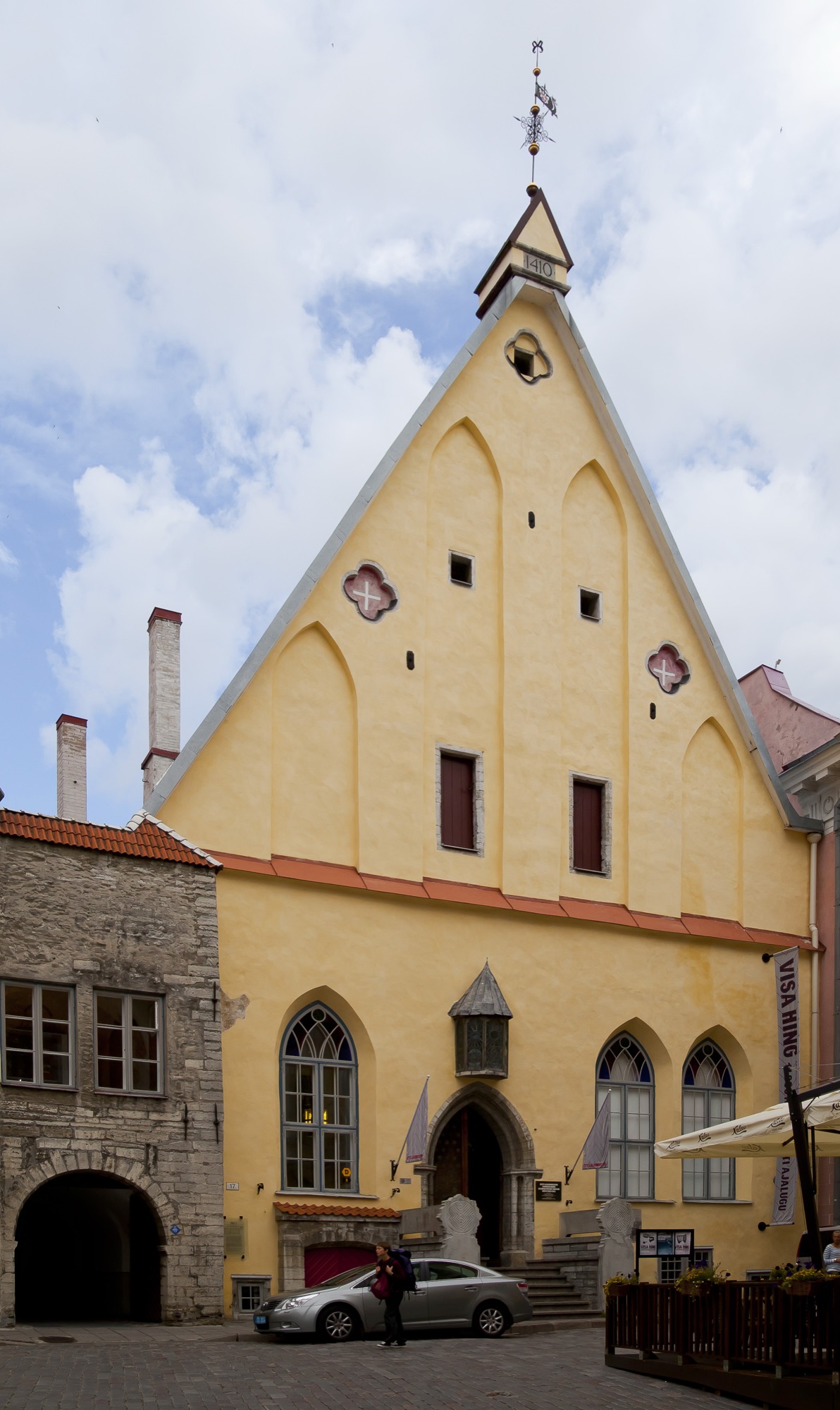
The Great Guild Hall (Suurgildi hoone) stands at Pikk 17 in the heart of Tallinn's medieval old town, one of the finest surviving examples of Hanseatic commercial architecture in the Baltic region. The guild acquired the land in the spring of 1406, building upon the foundations of a former burgomaster's house, and construction proceeded from 1407 to 1410, with the date inscribed on the roof ridge. The interiors were completed by 1417. Built of local Tallinn limestone in the late Gothic style characteristic of northern Hanseatic cities, the facade measures 16.8 meters wide and 20.5 meters high, dominated by a stepped gable set slightly back from the street line. The facade is articulated with four lancet niches containing commodity hatches for loading goods to upper storage levels, and four-bladed niches displaying the coat of arms of Tallinn, which also served as the guild's own emblem. A complex two-stage portal with a modest impost, positioned asymmetrically on the facade, follows the design vocabulary of the nearby Tallinn Town Hall. The bronze door knockers, cast in the form of lion heads by master Merten Seifert in 1430, bear Latin and Low German inscriptions; the right knocker reads "anno domini millesimo ccccxxx o rex glorie xpe veni in pace" (in the year of the Lord 1430, O glorious King Christ come in peace). Inside, the great hall encompasses 365 square meters, supported by a row of pillars with decoratively carved capitals beneath star and cross ribbed vaults that are both structural and ornamental masterpieces. The cellar level, spanning the full length of the building from Pikk Street through to Lai Street, provided cool vaulted storage essential for the merchants' commodities, including wine, furs, and textiles. During the nineteenth century this cellar housed a popular wine establishment known as Das Susse Loch ("The Sweet Hole"). As Ivar Leimus and Anu Mand documented in their chapter "Reval (Tallinn): A City Emerging from Maritime Trade" (in The Routledge Handbook of Maritime Trade around Europe 1300-1600, 2017), the building exemplifies how Hanseatic merchant communities invested in monumental commercial architecture that combined governance, trade, and storage functions under one roof. The building compares closely with other Hanseatic guild halls of the period, particularly the House of the Blackheads in Riga (originally 1330s, rebuilt) and the merchant guild halls of Lubeck, though the Tallinn Great Guild Hall is distinguished by its exceptional state of preservation. The structure underwent major renovation in 2010-2011, funded by the European Regional Development Fund and the Estonian Ministry of Culture, and since 1952 has housed the Estonian History Museum. In 2013, it was awarded the European Heritage Label in recognition of its significance as a monument to Hanseatic commercial culture.
The artistic program of the Great Guild Hall is inseparable from its commercial function, with decorative elements serving to project the wealth, authority, and corporate identity of the merchant elite. The facade's four-bladed niches display carved representations of the Tallinn coat of arms, which doubled as the guild's heraldic emblem, an exceptional case where municipal and mercantile identity were literally one and the same. The bronze lion-head door knockers, cast by master Merten Seifert in 1430, represent some of the finest surviving examples of medieval metalwork in the Baltic, their Latin inscriptions invoking divine blessing upon the commercial house. Inside the great hall, the carved stone capitals atop the supporting pillars display foliate and geometric motifs typical of late Gothic decorative vocabulary, while the brass rosettes adorning the hall doors add further ornamental refinement. The star and cross ribbed vaults of the main hall, completed by 1417, are themselves works of architectural art, their stone ribs creating patterns of light and shadow that lent solemnity to the guild's deliberations. Anu Mand, in her monograph Urban Carnival: Festive Culture in the Hanseatic Cities of the Eastern Baltic, 1350-1550 (Brepols, 2005), documented how the Great Guild Hall served as the venue for elaborate annual festivals, including Christmas celebrations, Carnival, and the May Count festivities, at which the guild displayed its ceremonial silver, textiles, and regalia. The guild's accumulated silver plate, weighing equipment, and ceremonial objects formed a treasury that signified mercantile authority in the manner common to Hanseatic guilds across northern Europe. In Tallinn, the guild's relationship with artistic production extended to its fraternal organization, the Brotherhood of the Blackheads, whose nearby house on Pikk Street (acquired 1531, facade redesigned in Renaissance style in 1597) featured elaborate sculptural ornament and whose patron Saint Maurice appeared on the brotherhood's heraldic arms. Mand's research on "Membership and Social Career in Tallinn Merchants' Guilds" (Acta Historica Tallinnensia, 2007) reveals how the display of guild art and regalia reinforced the social hierarchy through which young merchants progressed from the Brotherhood of the Blackheads into the Great Guild itself.
The Great Guild Hall occupies a commanding position on Pikk Street (Long Street), the principal commercial artery of medieval Tallinn's lower town, connecting the harbor gate to the Town Hall Square (Raekoja plats). This siting was deliberate: the building stands near the Town Hall, close to the intersection of the city's major trade routes, and within easy reach of the harbor where Hanseatic cogs unloaded their cargoes. Tallinn's medieval urban structure, inscribed as a UNESCO World Heritage Site in 1997, preserves a remarkably complete division between the upper town (Toompea), seat of the Danish and later Livonian Order administration and the cathedral chapter, and the lower town, where the German-speaking merchant community governed itself under Lubeck law, granted in 1248. As the UNESCO inscription notes, the lower town preserves its thirteenth-century layout of building plots, streets, and squares, along with an extraordinary concentration of medieval public and merchant architecture: the Town Hall (1402-1404), the churches of St. Olaf and St. Nicholas, the Dominican monastery, and the guild halls. The Great Guild Hall, together with the nearby House of the Blackheads, the St. Canute Guild Hall, and the Town Hall, formed an institutional cluster that concentrated commercial, judicial, and civic power in a compact urban precinct. Tallinn's geography was fundamental to its commercial role. Situated on the southern shore of the Gulf of Finland, the city controlled the maritime approach to the lucrative Russian trade, particularly the overland and river routes to Novgorod. As Leimus and Mand explain in their Routledge Handbook chapter (2017), Reval developed into a medium-sized maritime trade city due to its geopolitical position, its well-located port, and its proximity to Russian resources and markets. The city received coining rights in 1265 and, crucially, the warehousing right (stapelrecht) in 1346, which required all merchandise transiting through the town to pass through local merchant intermediaries. This staple privilege directly enriched the members of the Great Guild, who monopolized the intermediary trade. The town's population grew from fewer than 1,000 in the mid-fourteenth century to 6,000-7,000 by the late medieval period, as Philippe Dollinger documented in The German Hansa (1970), a growth trajectory driven almost entirely by the expansion of Baltic commerce.
The Great Guild (Grosse Gilde, Suurgild) was founded around 1325 as an association of the wealthiest merchants and shipowners in Reval (Tallinn), and it rapidly became the most powerful institution in the city's civic life. Only members of the Great Guild could serve on the Town Council (Rat) or be elected mayor, creating a fusion of commercial and political authority characteristic of Hanseatic self-governance. In 1285, Reval had become the northernmost member of the Hanseatic League, a mercantile and defensive alliance of predominantly German-speaking trading cities whose network stretched from London and Bruges in the west to Novgorod in the east. Philippe Dollinger's foundational study The German Hansa (1970) documented how two hundred German merchants accompanied by Danes and Swedes had settled in Reval by 1230, establishing it as a base for German merchants traveling by sea to the Hanseatic Kontor at Novgorod (the Peterhof). The guild's institutional function has been analyzed through the lens of institutional economics by Avner Greif, Paul Milgrom, and Barry Weingast in their influential article "Coordination, Commitment, and Enforcement: The Case of the Merchant Guild" (Journal of Political Economy, 1994), which argued that merchant guilds solved the commitment problem between rulers and alien merchants by enabling collective punishment of rights violations. This framework was applied specifically to the Tallinn Great Guild by Maive Rute in "Credible Commitment and Cartel: The Case of the Hansa Merchant in the Guild of Late Medieval Tallinn" (Baltic Journal of Economics, 2010), demonstrating how the guild enforced inter-city trade agreements and maintained commercial order during the Hanseatic period, but devolved into protectionist rent-seeking after the League's decline. Anu Mand's research on membership and social career in Tallinn's merchants' guilds has revealed the formalized progression through which merchants advanced: entering the Brotherhood of the Blackheads as unmarried men around age eighteen, spending an average of five years in that confraternity, and then upon marriage and establishment of an independent business, being admitted to the Great Guild. The guild's political dominance was challenged only during the Reformation, when religious upheaval temporarily disrupted Tallinn's social order. The closure of the Novgorod Kontor by Grand Duke Ivan III in 1494, when Russian authorities arrested 49 German merchants and confiscated their goods, dealt a severe blow to Tallinn's transit trade, though the city managed to revive its commerce in the sixteenth century through alternative routes. As Justyna Wubs-Mrozewicz and Stuart Jenks documented in their edited volume The Hanse in Late Medieval Europe (Brill, 2013), small Hanseatic firms survived by employing commercial techniques well adapted to their northern environment, including extensive networks of trust and reputation. The Great Guild continued to operate until 1920, when Estonia's independence and modernization rendered the medieval institution obsolete.
The Great Guild Hall served as the nexus for Tallinn's role as a major entrepot in the East-West trade that defined Hanseatic commerce. The city's warehousing right (stapelrecht), obtained in 1346, meant that all goods passing through Tallinn had to be offered for sale through local merchant intermediaries, giving Great Guild members a lucrative monopoly on the transit trade. The principal commodities flowing eastward from Western Europe included Luneburg salt essential for food preservation, Atlantic and Baltic herring, Flemish broadcloth and English wool textiles, Rhenish wine, and metals including silver ingots. In return, Russian and eastern goods flowing westward through Tallinn comprised furs (sable, ermine, marten, beaver, and squirrel), beeswax for candles and sealing, honey, timber, flax, hemp, and hides. As Philippe Dollinger detailed in The German Hansa (1970), Novgorod supplied the Hanseatic network with vast quantities of furs and wax, receiving silver, cloth, and manufactured goods in return. The cellar of the Great Guild Hall itself functioned as commodity storage, its vaulted chambers maintaining the cool, stable temperatures required for storing furs, textiles, and wine. The weighing of goods was a critical function in medieval trade, and Tallinn maintained a weighing house (Waage) visible from the Town Hall, where commodities were officially measured according to Hanseatic standards. Ulf Christian Ewert and Stephan Selzer, in Institutions of Hanseatic Trade: Studies on the Political Economy of a Medieval Network Organisation (Peter Lang, 2015), demonstrated that a typical Hanseatic merchant maintained as many as forty different trading partners over the course of his career, with relationships built on trust, reputation, and reciprocity rather than formal legal contracts. Stuart Jenks challenged earlier assumptions about Hanseatic financial conservatism, showing that credit instruments including bills of exchange were more sophisticated than previously understood, and that the Hanseatic emphasis on gelouwe (trustworthiness) served as an informal enforcement mechanism for commercial obligations. The guild regulated prices, maintained quality standards, and settled commercial disputes among its members, functioning as what Albrecht Cordes has described in his research on medieval merchant law as a localized legal order distinct from any universal lex mercatoria. After the closure of the Novgorod Kontor in 1494, Tallinn's merchants adapted by developing alternative trade routes through Narva, Pskov, and other intermediary points, though the city never fully recovered its earlier dominance as the gateway to Russian trade. The Great Guild Hall thus represents a complete commercial ecosystem: a building where goods were stored, weighed, priced, and traded, where commercial disputes were adjudicated, and where the institutional framework of Hanseatic commerce was physically and symbolically embodied.
Images will be added as the project develops. Photographs by Larry Ng and from research sources.