Taiwan Stock Exchange (TWSE)
Taipei, Taiwan · Established 1961
This site requires authorization to access.
To request access, contact
william.goetzmann@yale.edu
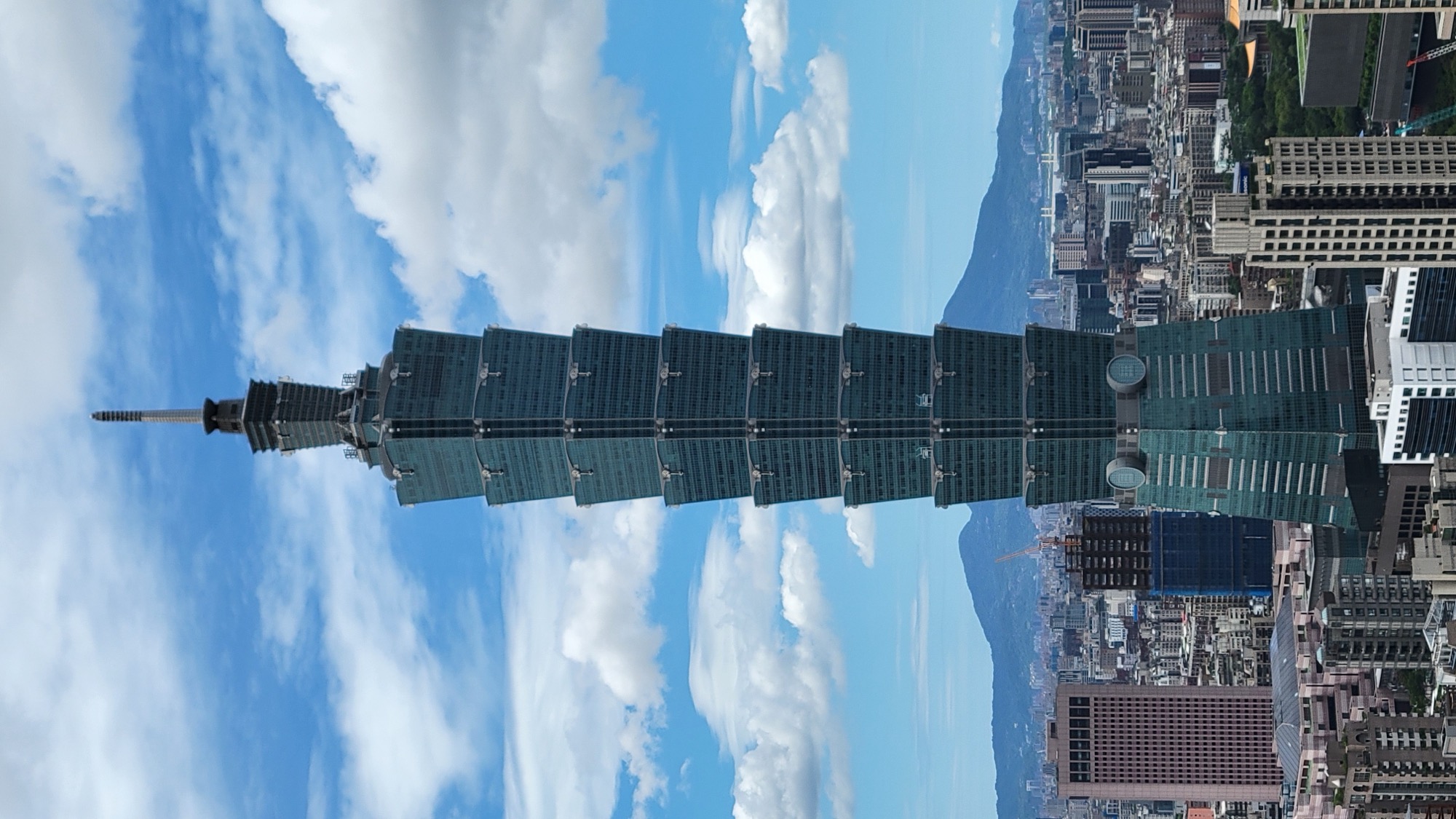
The Taiwan Stock Exchange began its institutional life in 1962 in the Industrial and Mineral Building on Huaining Street in central Taipei, a modest utilitarian structure suited to the exchange’s initial scale of just eighteen listed companies. As trading volumes expanded through the 1970s, the exchange relocated to the Chengzhong Building, where open outcry auction trading gave way to increasingly mechanized processes. The decisive architectural transformation came in 2005, when the TWSE moved into Taipei 101, the 508-meter supertall skyscraper designed by C.Y. Lee & Partners and completed in 2004. As structural engineer Shaw-song Shieh and colleagues documented in “Structural Design of Taipei 101, the World’s Tallest Building” (Council on Tall Buildings and Urban Habitat, 2004), the tower’s form draws upon traditional Chinese architectural symbolism: eight stacked segments of eight floors each evoke both the tiers of a pagoda and the joints of a bamboo stalk, while the number eight carries associations of prosperity and abundance in Chinese-speaking cultures. C.Y. Lee incorporated ruyi motifs—talismanic figures connoting healing, protection, and fulfillment—throughout the facade, each standing at least eight meters tall, rendered in industrial metal as a deliberate fusion of ancient symbolism and modern materials. The TWSE occupies approximately seven floors of Taipei 101, making it the building’s largest tenant. The tower’s celebrated 660-metric-ton tuned mass damper, a steel pendulum suspended from the 92nd to the 88th floor, exemplifies the engineering sophistication of a structure that served as the world’s tallest building from 2004 to 2007, providing the exchange with premises that project Taiwan’s technological and financial ambitions onto the global skyline.
The decorative program of the Taiwan Stock Exchange’s commercial spaces reflects the broader aesthetic language of Taipei 101 rather than a bespoke artistic commission for the exchange itself. C.Y. Lee’s postmodern design integrates traditional Chinese ornamental vocabulary into the building’s curtain wall and lobbies: the green-tinted glass facade suggests indigenous bamboo, while gilded ruyi cloud motifs and coin-shaped medallions between facade sections invoke classical symbols of wealth and heavenly blessing. The Taiwan Stock Museum, established by the Taiwan Depository and Clearing Corporation and opened in December 2012 in Songshan District, preserves a more directly financial visual culture. Its five exhibition halls display historically significant stock certificates—including the earliest paper shares issued in Taiwan and a Chunghwa Telecom certificate with a face value of NT$281 billion—alongside interactive multimedia installations tracing the evolution of securities trading. The museum’s collection connects Taiwan’s material culture of commerce to the broader history of financial instruments. Within Taipei 101 itself, the lobby spaces feature contemporary art installations and design elements that blend feng shui principles with corporate modernism, though the exchange’s office floors prioritize functional technology infrastructure over decorative display—a characteristic common to exchanges that completed their transition from physical trading floors to fully electronic systems, as the TWSE did with its adoption of the Fully Automated Securities Trading (FAST) system in 1993.
The Taiwan Stock Exchange’s location in Taipei’s Xinyi District places it at the heart of a deliberately planned financial and commercial center whose development reflects Taiwan’s postwar economic trajectory. As the Taipei Municipal Government documented in its Xinyi Planning District proposals beginning in 1976, the district was conceived as a secondary commercial center to relieve congestion in the old city core around Taipei Station and Ximending. The area east of the Sun Yat-sen Memorial Hall was systematically redeveloped through the 1980s and 1990s into the island’s premier business district, distinguished as the only commercial development zone in Taipei with a wholly planned street grid and urban design. The concentration of the Taipei World Trade Center, the International Convention Center, Taipei City Hall, and ultimately Taipei 101 created a financial agglomeration that anchored Taiwan’s position as one of East Asia’s major capital markets. Taiwan’s island geography has fundamentally shaped its financial center’s character: as Cheng Tun-jen argued in “Transforming Taiwan’s Economic Structure in the 20th Century” (The China Quarterly, 2001), the economy’s evolution from an agrarian colonial base under Japanese rule to the world’s third-largest producer of information technology products by century’s end was driven by export-oriented industrialization that demanded sophisticated capital markets. Taipei’s position on the western coastal plain, facing the Taiwan Strait and connected by trade to Japan, Southeast Asia, and the Pacific Rim, made it the natural hub for financial intermediation. The Xinyi District’s emergence as a cluster of glass-curtain-wall towers housing securities firms, banks, and technology companies mirrors the broader pattern of Asian financial centers—from Singapore’s Raffles Place to Shanghai’s Pudong—where purpose-built districts replaced organic commercial cores to signal modernization and attract international capital.
Securities trading in Taiwan has colonial-era antecedents rooted in the Japanese imperial financial system established after 1895. As Kelly Olds documented in “Colonial Taiwan’s Financial Revolution” (Australian Economic History Review, 2018), the Bank of Taiwan, established in 1897 under the Taiwan Bank Act, functioned as the central financial hub for colonial economic development, underwriting public investment bonds and introducing Western-style banking to a frontier society. While formal securities exchange trading did not exist during the colonial period, these institutional foundations—including a unified system of weights and measures, centralized banking, and bond issuance—created the infrastructure upon which postwar capital markets would be built. The arrival of Chiang Kai-shek’s Kuomintang government in 1949, bringing mainland China’s technocratic traditions and approximately two million refugees, transformed Taiwan’s economic landscape. As Thomas Gold chronicled in State and Society in the Taiwan Miracle (M.E. Sharpe, 1986), the KMT pursued import-substitution industrialization through the 1950s before pivoting to export orientation in the 1960s under the guidance of economic planners such as K.T. Li, who served as economic minister (1965–1969) and finance minister (1969–1976). J. Megan Greene’s The Origins of the Developmental State in Taiwan (Harvard University Press, 2008) further demonstrates how the developmental state emerged gradually through the combined efforts of technocrats, academicians, and foreign advisors. The Taiwan Stock Exchange Corporation was formally established on October 23, 1961, and commenced operations on February 9, 1962, opening with eighteen listed companies and a modest average daily trading value of NT$1,647,760. The Securities and Exchange Act of 1968 provided the foundational regulatory framework. The TAIEX index, first published in 1967 with a 1966 base year value of 100, grew steadily through the 1970s as Taiwan’s export-driven economy expanded. The exchange introduced computer-assisted trading (CATS) in 1985, migrating all stock trading to the semi-automated system by 1988 and eliminating open outcry entirely. The late 1980s witnessed one of history’s most spectacular market bubbles. As Steven R. Champion detailed in The Great Taiwan Bubble: The Rise and Fall of an Emerging Stock Market (Pacific View Press, 1998), the TAIEX surged from 1,000 points in late 1986 to 12,495 by February 1990, driven by 4.6 million active brokerage accounts in a nation of 20 million people. Stocks traded at an average of 100 times earnings, and daily volume sometimes exceeded the combined figures of Tokyo and New York. The KMT’s 1989 election slogan “Big Profits and Great Prosperity” was widely interpreted as an implied government guarantee against market losses. The crash that followed was devastating: by October 1990, the index had plunged to approximately 2,560, an 80 percent decline that wiped out vast amounts of household wealth. The lifting of martial law in 1987, after 38 years, coincided with both the bubble’s inflation and broader financial liberalization. In 1991, Taiwan introduced the Qualified Foreign Institutional Investor (QFII) program, permitting direct foreign investment in the stock market for the first time. As Karen Lu documented in her BIS Papers analysis (No. 15, 2003), qualification criteria were gradually relaxed until foreign investment restrictions were largely abolished on October 2, 2003, aligning with Taiwan’s accession to the World Trade Organization. The exchange completed its technological transformation with the adoption of the Fully Automated Securities Trading (FAST) system in November 1993, became the first exchange globally to earn ISO 27001 information security certification in 2004, and launched a next-generation trading system in 2014 with 5-millisecond latency. The TWSE’s relocation to Taipei 101 in 2005 marked its physical transformation from a modest postwar institution into a major Asian financial center.
The Taiwan Stock Exchange has evolved from a small market of eighteen listed companies trading primarily in government-linked industrial shares to one of Asia’s largest exchanges by market capitalization, dominated by the semiconductor and electronics sectors that define Taiwan’s modern economy. Taiwan Semiconductor Manufacturing Company (TSMC), listed as ticker 2330, constitutes approximately 30 percent of the TAIEX index and stands as the world’s largest dedicated contract chipmaker, reflecting the extraordinary concentration of global advanced chip fabrication on the island. Other major listed companies span electronics manufacturing (Hon Hai/Foxconn, MediaTek), petrochemicals (Formosa Plastics Group), financial services, and telecommunications. The exchange’s product offerings have expanded significantly since the 1990s: call warrants were introduced in 1997, Taiwan’s first exchange-traded fund (ETF) in 2003, index warrants in 2009, exchange-traded notes in 2019, and Asia’s first active ETF in 2025. Government bonds and corporate debt instruments trade alongside equities. A distinctive feature of the Taiwan market, extensively studied by Brad Barber, Yi-Tsung Lee, Yu-Jane Liu, and Terrance Odean in “Just How Much Do Individual Investors Lose by Trading?” (Review of Financial Studies, 2009), is the extraordinarily high proportion of retail investor participation: individual investors account for approximately 74 percent of trading volume and roughly 90 percent of all trader accounts, with average annual turnover rates approaching 300 percent. Barber and colleagues calculated that aggregate individual investor losses amounted to 2.2 percent of Taiwan’s GDP—nearly as much as total private expenditure on clothing and footwear. This retail-dominated market structure distinguishes the TWSE from institutional-dominated exchanges in Europe and North America and has made it a natural laboratory for behavioral finance research. The transition from open outcry to the Computer-Assisted Trading System in 1985–1988 and then to the Fully Automated Securities Trading system in 1993 fundamentally changed how orders were matched, enabling the high-frequency, high-volume trading that characterizes the contemporary market. In 2020, the exchange introduced intraday continuous trading and odd-lot trading mechanisms, further broadening retail access to a market whose daily volumes regularly rank among the highest in Asia.
Images will be added as the project develops. Photographs by Larry Ng and from research sources.